
What is Returns Management?
Returns management is the end-to-end operational process of governing customer-returned merchandise from the point of return request initiation through final asset disposition. This orchestration layer synchronizes real-time data across front-end customer portals, decentralized inventory databases, and downstream fulfillment networks to minimize margin erosion.
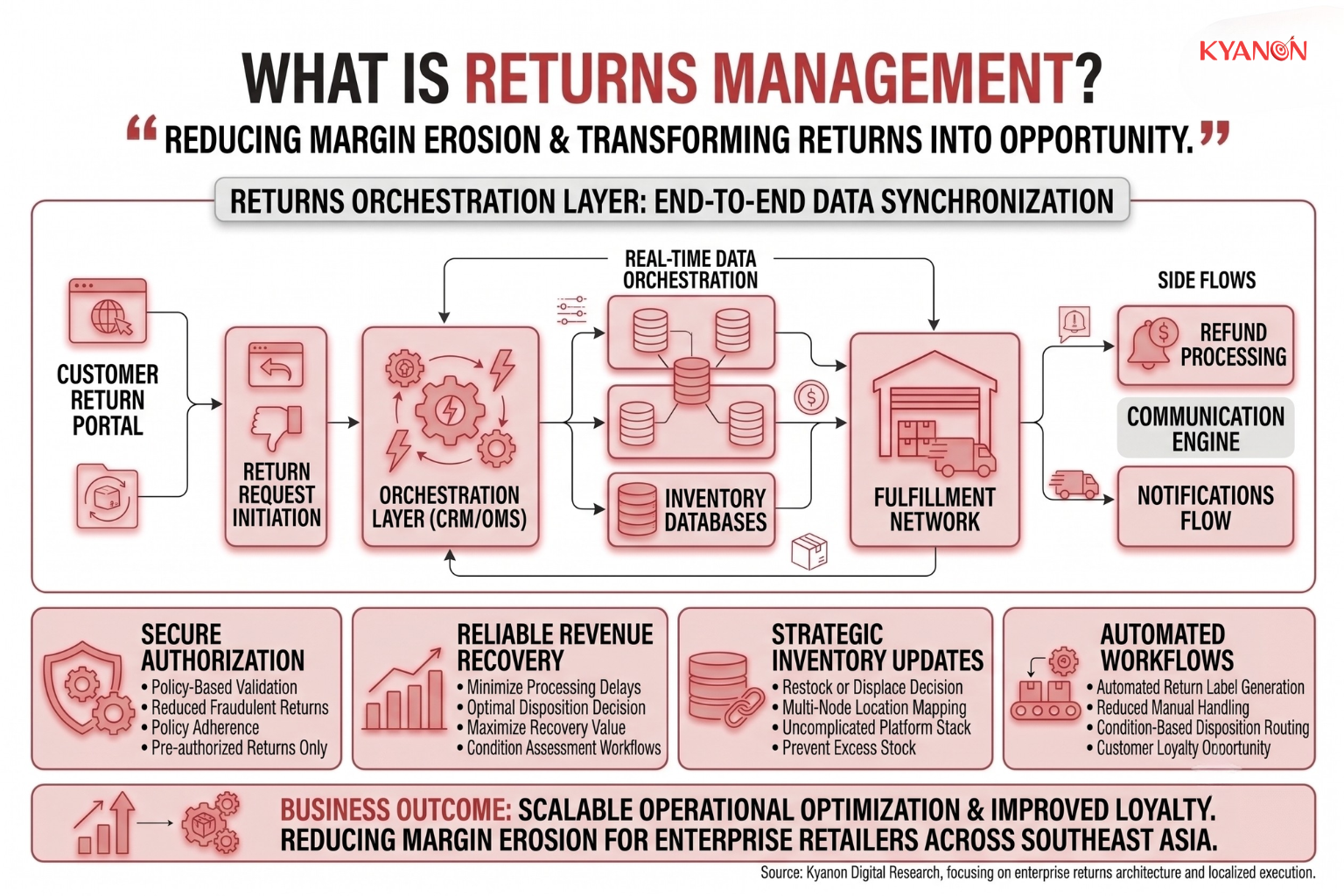
Unlike a simple reverse logistics process, modern returns management involves orchestrating multiple systems and decision points, including return authorization, product condition assessment, inventory updates, refund processing, and recovery strategies. It synchronizes real-time data across customer-facing portals, order management systems, warehouse management platforms, and decentralized inventory databases to determine the most efficient next action for each returned item.
For enterprise retailers and eCommerce businesses, effective returns management helps minimize margin erosion by reducing processing delays, preventing unnecessary inventory write-offs, and maximizing the recovery value of returned merchandise. By combining automation, analytics, and integrated workflows, modern returns management platforms enable businesses to transform returns from a cost center into an opportunity for operational optimization and improved customer loyalty.
How Returns Management Works
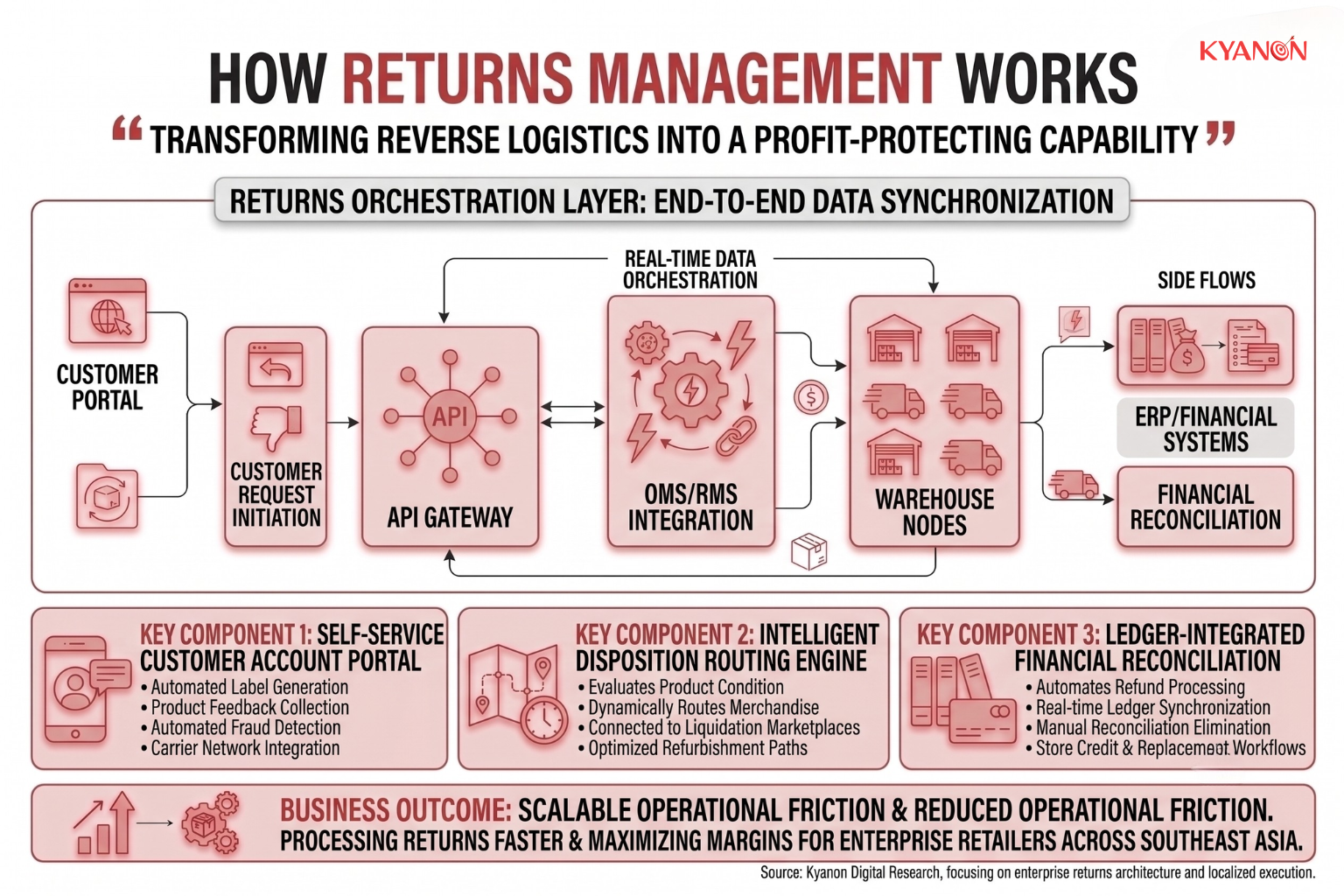
Modern returns management transforms reverse logistics from a cost-intensive operational process into a profit-protecting capability by combining microservices-based architecture, automated decision-making, and real-time data orchestration. Instead of relying on disconnected systems between customer service, warehouses, finance, and fulfillment teams, modern returns platforms create a unified workflow that manages the entire return lifecycle, from authorization and carrier tracking to inspection, disposition, and financial reconciliation.
The architecture connects customer-facing portals with core commerce infrastructure through API gateways, allowing real-time communication between the Order Management System (OMS), Returns Management System (RMS), warehouse platforms, and enterprise resource planning (ERP) systems. When a return is initiated, event-driven workflows automatically update relevant systems, notify fulfillment nodes, and trigger the next operational steps without requiring manual coordination.
Self-Service Customer Account Portal
The customer portal acts as the primary data collection layer for the returns process. Instead of relying on manual customer service interactions, users can select specific items from their order history, provide structured return reasons, generate return labels, and choose available drop-off or pickup options.
Behind the interface, the portal captures valuable operational signals that improve downstream decision-making. Mandatory return reason codes standardize customer feedback for product quality analysis, while automated fraud detection mechanisms use indicators such as return frequency, account behavior, and transaction patterns to identify abnormal return activity.
Dynamic QR code-based return labels can also simplify the customer experience by eliminating home printing requirements and connecting returns directly with local carrier or drop-off networks. This early data capture allows retailers to forecast return volumes, optimize warehouse capacity, and identify potential product or quality issues before returned items arrive.
Intelligent Disposition Routing Engine
After a return request is approved, an automated business rules engine determines the most valuable next step for each item. Rather than sending all returned products through a single centralized process, the system evaluates multiple factors, including product condition, acquisition cost, shipping expenses, geographic location, inventory demand, and recovery potential.
Based on these inputs, returned merchandise can be dynamically routed to the most appropriate destination, such as regional refurbishment centers, nearby retail locations, restocking facilities, or third-party liquidation marketplaces. For items that cannot be resold through traditional channels, integrated marketplace APIs can automatically connect excess inventory with B2B liquidation platforms to recover additional value.
This intelligent routing approach reduces unnecessary transportation costs, accelerates inventory recovery, and helps retailers maximize margins from returned products.
Ledger-Integrated Financial Reconciliation
Returns management also requires seamless financial coordination across commerce and enterprise systems. Modern platforms integrate directly with ERP and financial ledger systems to automate refund processing, inventory adjustments, and accounting reconciliation.
Once predefined validation conditions are met, such as the first carrier scan or successful warehouse receipt, the system can automatically trigger customer compensation through the original payment method, issue store credit, or initiate replacement workflows. Automated ledger synchronization eliminates manual reconciliation between finance, operations, and customer service teams while improving transaction accuracy.
By connecting customer portals, operational workflows, intelligent routing, and financial systems into a single architecture, modern returns management enables retailers to process returns faster, reduce operational friction, and convert reverse logistics into a strategic advantage.
Returns Management vs Forward Logistics
While both frameworks direct the physical movement of retail inventory across complex international supply chains, they operate on inverted processing logic, data structures, and inventory predictability.
|
Dimension |
Forward Logistics | Returns Management (Reverse) |
| Inventory Predictability | High; uniform pallets, predictable SKU volumes, and scheduled bulk inbound shipments. |
Low; highly fragmented single-item packets arriving via erratic consumer timelines. |
|
Packaging Consistency |
High; standardized, factory-sealed manufacturer cartons and optimized crating parameters. | Low; unsealed, heavily compromised, or completely missing primary consumer packaging. |
| System Flow Direction | One-to-many distribution moving from centralized manufacturing hubs down to regional nodes. |
Many-to-one or many-to-many collection structures gathering disparate units back into core systems. |
|
Core Software Alignment |
Legacy Warehouse Management System (WMS) tuned for pick-pack-ship optimization. | Dedicated Returns Management System (RMS) built for multi-tiered disposition paths. |
| Primary Valuation State | Known wholesale or retail book asset values anchored to static product catalogs. |
Variable, highly fluid asset value determined post-facto via complex physical quality grading. |
When to Consider Returns Management Architecture
Consider deploying an enterprise-grade returns management architecture if:
- Multiple fulfillment nodes face processing bottlenecks due to manual item verification, paper-based tracking sheets, and uncoordinated physical return routing.
- Your current customer lifetime value drops because processing refunds, issuing manual gift cards, or handling exchanges takes your service teams longer than 5 business days.
- Total cost of ownership rises sharply due to cross-border shipping friction, non-optimized reverse line-haul fees, and high volume depreciation of uninspected warehouse inventory.
It may not be the right priority if:
- Your digital commerce storefront is operating as an early-stage MVP with low multi-channel order frequencies and less than 50 customer returns per month.
Why Returns Management Matters for Enterprise Commerce
Optimizing reverse logistics workflows transforms returns from an operational liability into a strategic capability for revenue retention, margin protection, and asset recovery. For enterprise retailers operating across multiple channels, markets, and fulfillment networks, inefficient returns processes can create significant costs through delayed processing, excess inventory accumulation, and rapid product depreciation.
According to McKinsey, reverse logistics represents an estimated $200 billion annual cost burden for retailers, highlighting the financial impact of poorly managed return flows. By implementing AI-driven automation and intelligent returns workflows, enterprises can improve recovery outcomes, with automated processes helping increase asset recovery rates to 75% while reducing the value loss associated with returned merchandise.
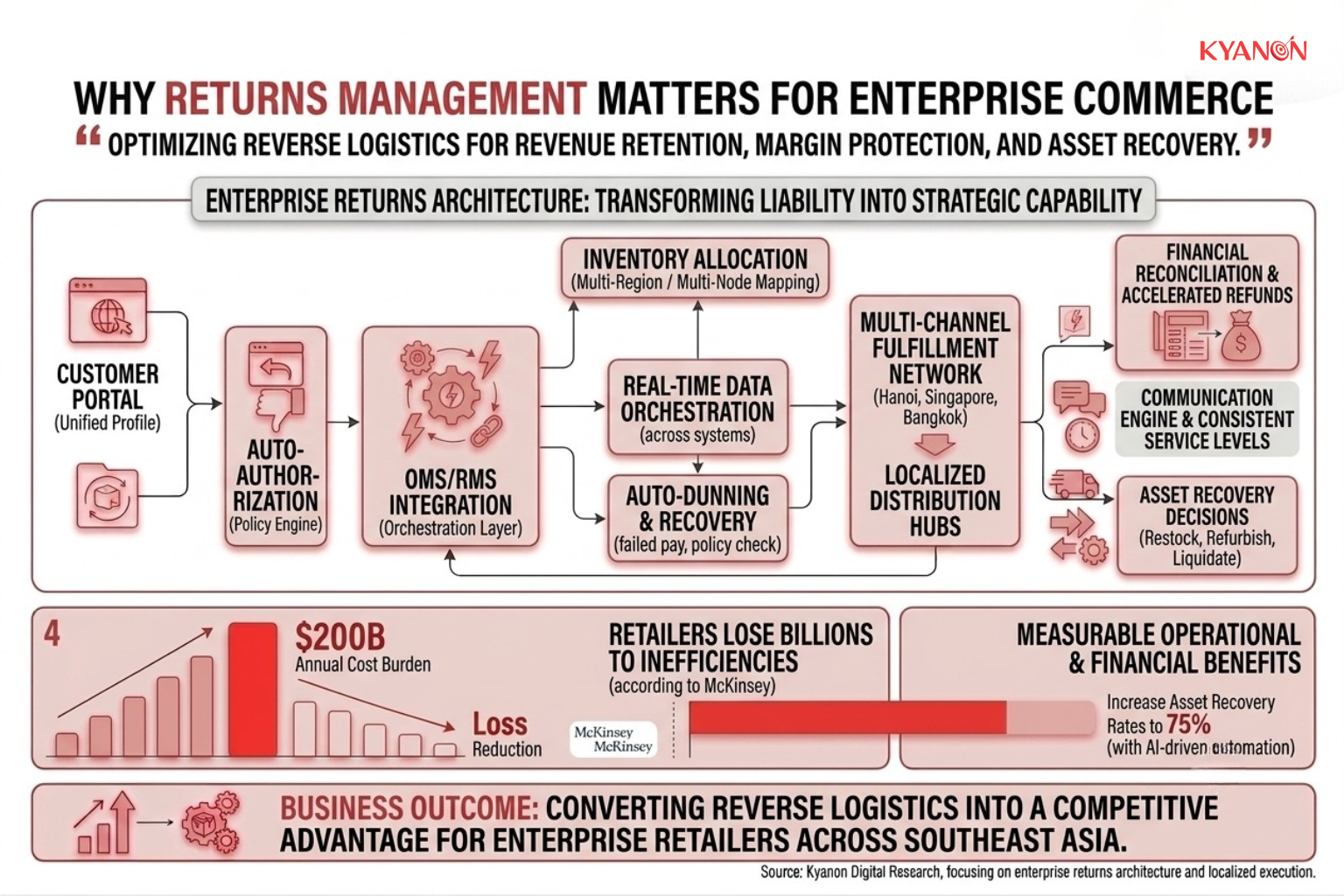
Modern returns management enables retailers to make faster, data-driven decisions about whether products should be restocked, refurbished, resold, liquidated, or recycled. This reduces unnecessary handling costs, improves inventory visibility, and allows businesses to recover more value from returned assets instead of treating them as sunk costs.
For multi-channel commerce operations, an optimized returns architecture also improves customer retention by accelerating refunds, simplifying return experiences, and maintaining consistent service levels across regions. By connecting customer portals, warehouse operations, financial systems, and inventory networks, enterprises can turn reverse logistics into a competitive advantage rather than a source of margin erosion.
Common Misconceptions
Returns management is strictly a warehouse and aftermarket logistics problem
Reality: Modern reverse flows impact your entire organizational layer, requiring strict operational alignment among digital marketing, finance, inventory controllers, and frontend customer experience teams. Preventing returns before they occur requires structural optimization of front-end product information management systems, high-fidelity media assets, and contextual sizing charts rather than just post-purchase shipping adjustments.
A standard Warehouse Management System (WMS) is sufficient to handle customer returns
Reality: Legacy WMS configurations are fundamentally optimized for predictable, forward-moving inventory flows rather than erratic receipt tracking and open-box conditions. A specialized Returns Management System (RMS) is required to govern unique gatekeeping steps, unscripted product quality grading, and multi-tiered disposition pathways efficiently.
How Kyanon Digital Applies Returns Management
Kyanon Digital implements enterprise returns management solutions by integrating composable, MACH-aligned architecture with existing ERP, Order Management Systems (OMS), Warehouse Management Systems (WMS), and third-party logistics (3PL) networks. Rather than replacing core enterprise platforms, we build API-first reverse logistics workflows that connect fragmented systems, enabling retailers to manage return authorization, inventory recovery, financial reconciliation, and disposition decisions through a unified operational framework.
Our approach focuses on eliminating data silos across customer-facing channels, fulfillment operations, and enterprise back-office systems. By orchestrating real-time data exchange between customer portals, returns management platforms, inventory systems, and logistics networks, we help retailers gain end-to-end visibility into returned merchandise and make faster recovery decisions.
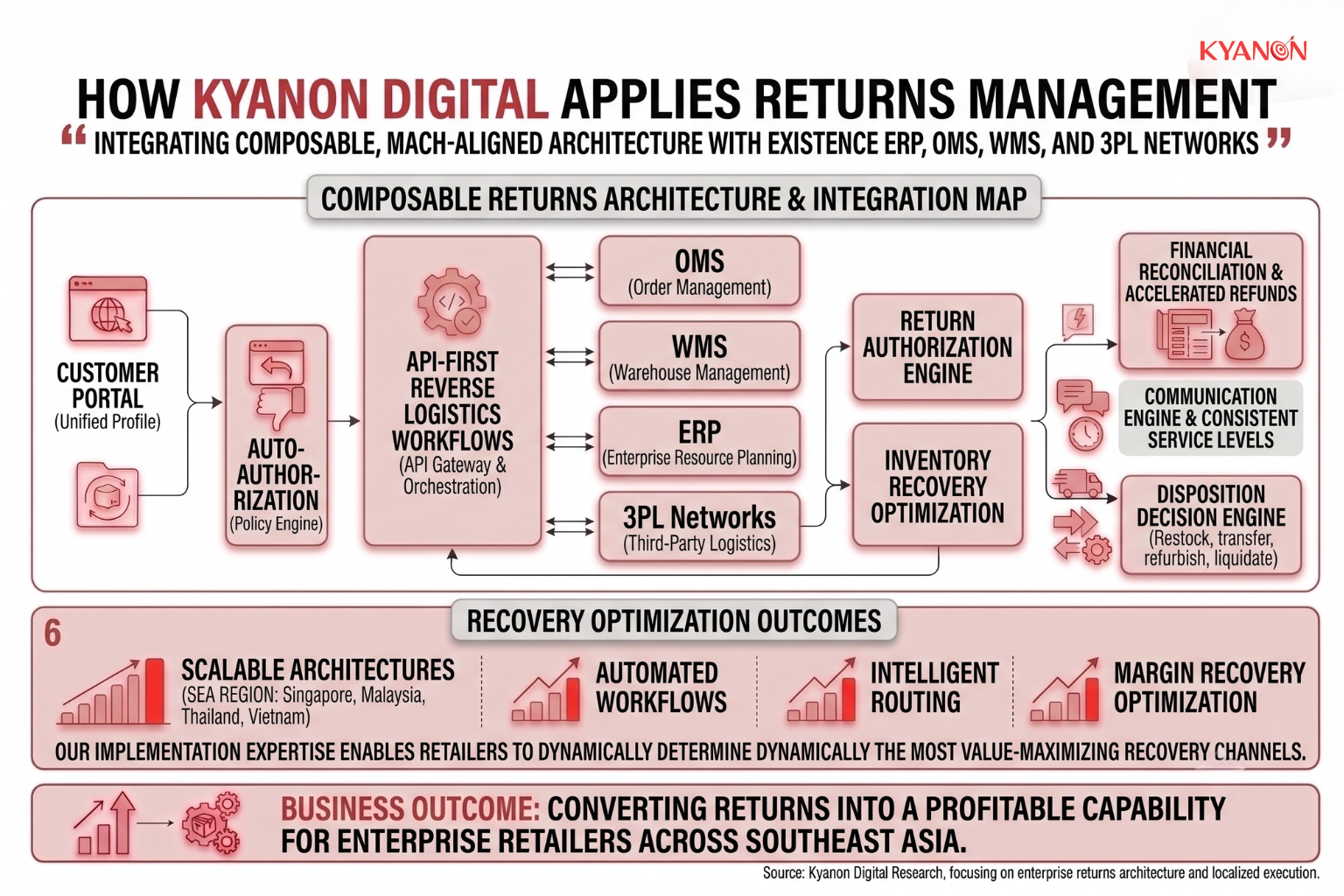
For enterprise retail organizations across Singapore, Malaysia, Thailand, and Vietnam, Kyanon Digital designs scalable returns architectures that support automated workflows, intelligent routing, and margin recovery optimization. Our implementation expertise enables businesses to dynamically determine whether returned items should be restocked, transferred, refurbished, liquidated, or processed through alternative recovery channels, reducing operational friction while maximizing the value of returned inventory.
Explore our services:











 Create project brief with AI