
What is Subscription Commerce?
Subscription commerce is a recurring revenue business model where customers make scheduled payments at predefined intervals in exchange for continuous access to physical products, digital services, or ongoing experiences. Unlike traditional one-time purchases, subscription commerce creates an ongoing relationship between businesses and customers by automating billing, fulfillment, and service delivery throughout the customer lifecycle.
Modern subscription commerce platforms manage more than recurring payments. They coordinate customer onboarding, subscription plans, inventory planning, personalization, renewals, upgrades, cancellations, and customer engagement through integrated commerce systems. This allows businesses to move beyond individual transactions and build predictable revenue streams based on customer retention and lifetime value.
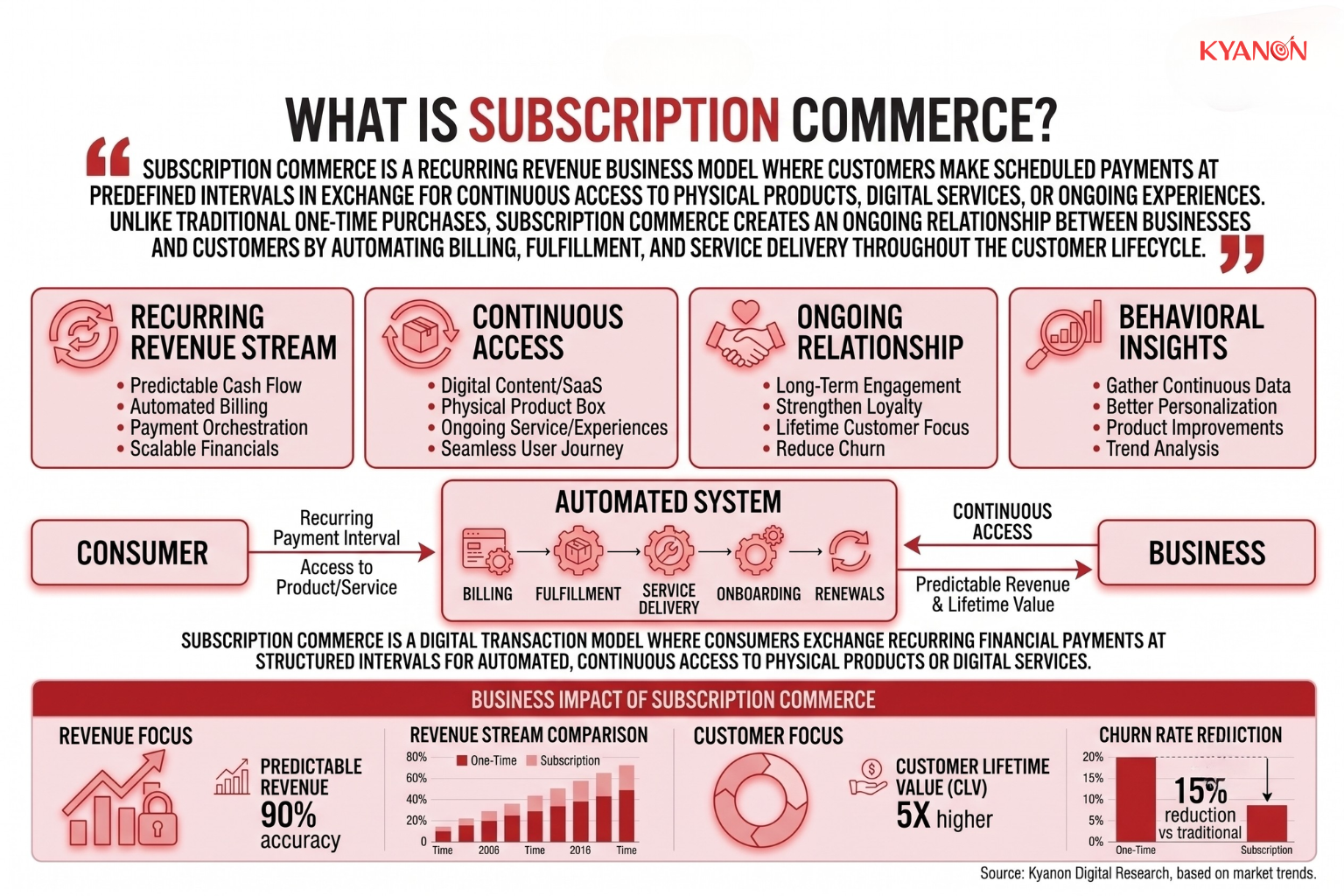
By shifting the focus from standalone acquisitions to long-term customer relationships, subscription commerce enables organizations to improve revenue forecasting, strengthen loyalty, and gather continuous behavioral insights. For enterprises, this model requires scalable architecture that can support flexible pricing models, automated workflows, payment orchestration, and seamless experiences across digital channels.
How Subscription Commerce Works
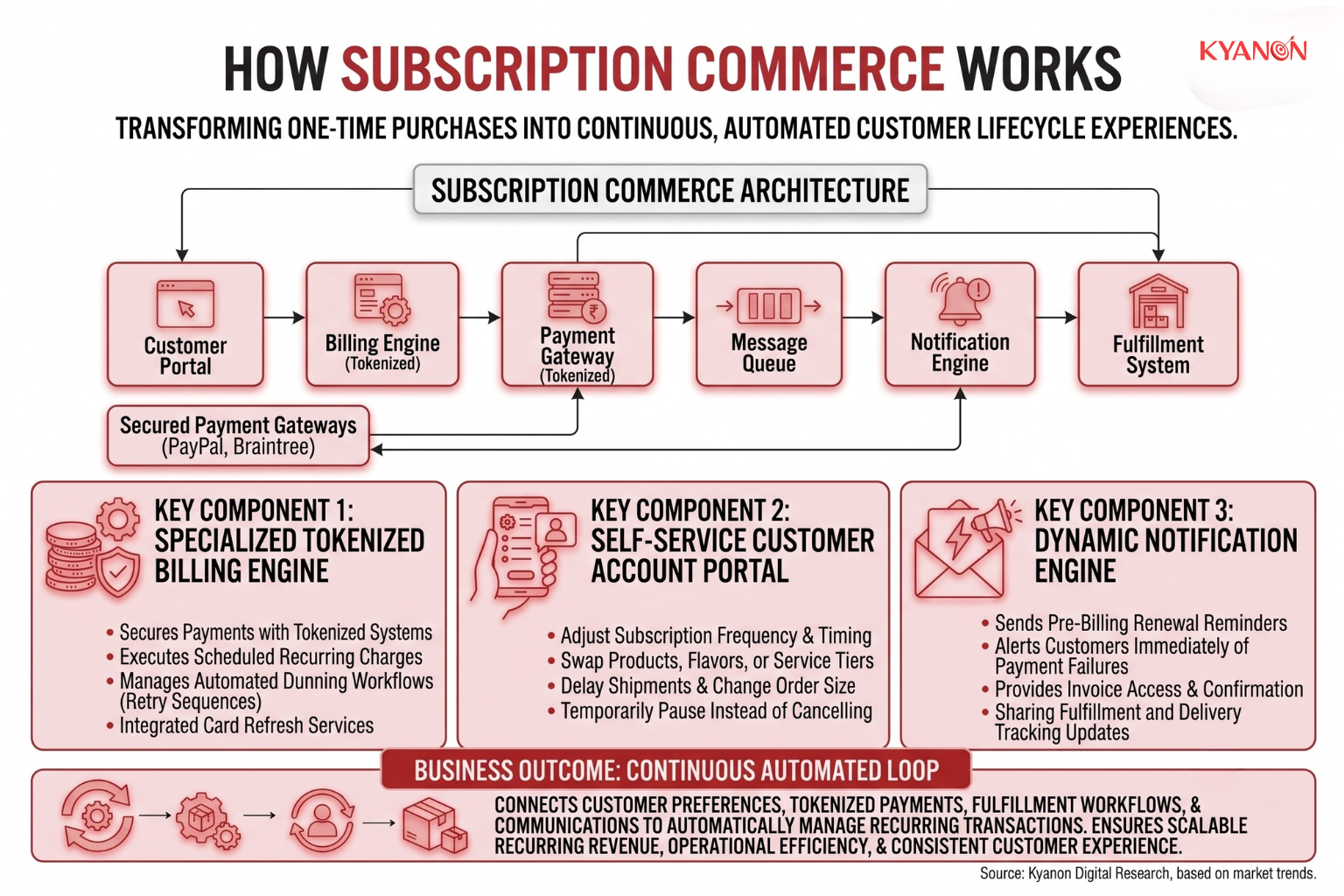
The core mechanism of subscription commerce transforms traditional one-time purchases into continuous, automated customer lifecycle experiences. Instead of requiring customers to manually complete a checkout for every purchase cycle, subscription platforms connect customer preferences, tokenized payment systems, fulfillment workflows, and communication services to automatically manage recurring transactions.
The architecture acts as an orchestration layer between customer-facing engagement platforms and back-end enterprise systems, coordinating scheduled billing, automated replenishment, payment recovery, and order fulfillment without requiring manual intervention for each cycle. To protect sensitive financial information, modern subscription platforms typically use payment tokenization, where raw credit card details are replaced with encrypted payment tokens managed through secure payment gateways such as PayPal or Braintree. This approach reduces compliance risks while enabling seamless recurring transactions.
Specialized Tokenized Billing Engine
The tokenized billing engine serves as the financial foundation of subscription commerce by managing recurring payments, payment schedules, and transaction recovery workflows. Instead of storing sensitive payment information directly, the system securely stores payment tokens linked to customer accounts and uses them to process scheduled charges through external payment gateways.
Beyond automated billing, the engine manages dunning workflows to reduce involuntary churn caused by failed payments. When a transaction fails due to expired cards, insufficient funds, or payment errors, the system automatically triggers smart retry sequences based on optimized timing rules. Advanced platforms can use machine learning to determine the most effective retry windows and integrate with card network update services to refresh expired payment credentials automatically.
This automation helps businesses recover failed payments, maintain subscription continuity, and reduce revenue leakage without requiring manual customer support intervention.
Self-Service Customer Account Portal
The customer account portal provides subscribers with direct control over their recurring purchases and subscription preferences. Instead of relying on support teams for every adjustment, customers can independently manage key subscription settings, including delivery schedules, product variations, payment preferences, and account status.
Common capabilities include:
- Adjusting subscription frequency, such as changing deliveries from monthly to quarterly
- Swapping products, flavors, sizes, or service tiers
- Delaying upcoming shipments
- Temporarily pausing subscriptions instead of cancelling
By enabling flexible self-service management, enterprises reduce operational overhead while improving customer satisfaction and retention. These controls help prevent unnecessary cancellations by allowing customers to adapt subscriptions as their needs change.
Dynamic Notification Engine
The notification engine maintains continuous communication between the business and subscribers by monitoring billing events, order status changes, and account activities. It connects with billing systems and message queues to deliver automated updates through channels such as email, SMS, and mobile notifications.
Key functions include:
- Sending pre-billing reminders several days before renewal charges to reduce unexpected payment disputes
- Alerting customers immediately when payment failures occur
- Providing invoice access and transaction confirmations
- Sharing fulfillment and delivery tracking updates
By creating transparency throughout the subscription lifecycle, the notification layer improves customer trust, reduces payment-related friction, and strengthens long-term retention.
Together, these components create a subscription commerce ecosystem where payments, customer preferences, and fulfillment operations operate as a continuous automated loop. This enables enterprises to scale recurring revenue models while maintaining operational efficiency and delivering consistent customer experiences.
Subscription Commerce vs Traditional E-Commerce
Both transaction methods enable cross-border commerce and digital product selection, but they diverge across core data configurations, customer retention behaviors, and baseline platform metrics.
|
Dimension |
Traditional E-Commerce | Subscription Commerce |
| Primary Financial Metric | Average Order Value (AOV) |
Customer Lifetime Value (LTV) and Recurring Revenue |
|
Payment Execution |
Single manual authorization per purchase event | Automated tokenized token clearing at structured intervals |
| Inventory Predictability | Variable; highly vulnerable to seasonal demands |
High; baseline distribution metrics driven by recurring logs |
|
Customer Interface focus |
Front-end conversion and 2-Step Checkout paths | Dedicated management accounts and flexible configurations |
| Revenue Continuity Architecture | Intermittent marketing campaign re-engagement |
Algorithmic dunning systems and ongoing platform usage |
When to Consider Subscription Commerce
Consider deploying subscription commerce capabilities if:
- Your inventory profile consists of highly expendable, frequently consumed goods requiring strict replenishment timelines.
- Customer acquisition analytics indicate predictable re-ordering schedules that could be managed via programmatic automated ordering.
- Your technology infrastructure can maintain dedicated data connections across fulfillment automation layers and real-time payment processing gateways.
It may not be the right priority if:
- Your digital commerce storefront is built as an early-stage MVP handling highly durable, one-off purchases that lack a logical consumption loop.
Why Subscription Commerce Matters for Enterprise Brands
Transitioning from standalone transactions to structured subscription models fundamentally changes how enterprise brands manage revenue, inventory planning, and customer relationships. Instead of relying on unpredictable purchase cycles, subscription commerce creates recurring demand patterns that improve financial visibility, optimize supply chain decisions, and reduce exposure to demand volatility.
The subscription commerce market has reached significant scale, reflecting the growing adoption of recurring revenue models across retail, digital services, and consumer industries. Chief Supply Chain Officers are facing increasing pressure to balance commercial growth with strict cost control. Subscription models help address this challenge by creating more predictable demand signals, allowing enterprises to optimize inventory allocation, fulfillment capacity, and operational investments.
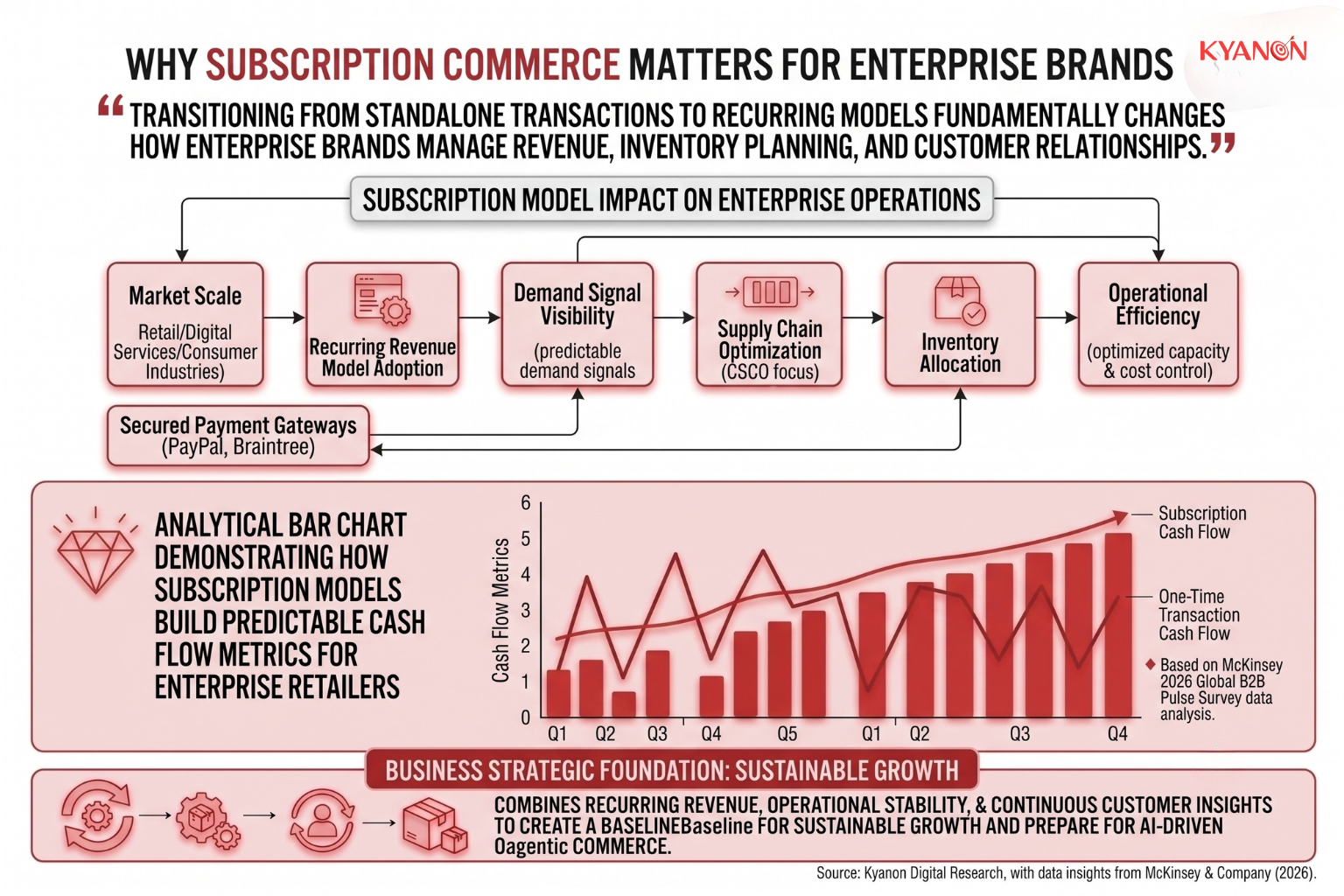
Recurring customer relationships also generate continuous behavioral data that strengthens forecasting and personalization capabilities. As enterprise commerce becomes increasingly complex across multiple channels, unified subscriber profiles provide a consistent source of customer intelligence. This is particularly important as buyers now interact across an average of 10 channels, according to McKinsey’s 2026 Global B2B Pulse Survey, making consistent omnichannel experiences a baseline expectation rather than a competitive advantage.
As commerce evolves toward AI-driven experiences and agentic commerce, subscription models provide the structured customer data, predictable demand signals, and integrated back-end systems required for intelligent automation. By combining recurring revenue, operational stability, and continuous customer insights, subscription commerce becomes a strategic foundation for enterprise brands seeking sustainable growth.
Common Misconceptions
Subscription models provide effortless, set-it-and-forget-it recurring revenue
True revenue health requires persistent management, ongoing catalog updates, and optimized retention strategies to combat constant subscription fatigue. Customer acquisition costs often rise rapidly over time, meaning brands must provide verifiable value during every renewal phase to justify continuous billing.
Auto-renewal mechanisms are sufficient for maximizing customer retention
Relying on hidden auto-renewals or rigid exit lock-ins damages brand equity and runs afoul of global regulatory bodies that now mandate easy digital cancellations. Long-term customer lifetime value stems entirely from continuous product value, accessible account tools, and proactive dunning solutions that resolve failed payments cleanly.
How Kyanon Digital Applies Subscription Commerce
Kyanon Digital builds robust subscription commerce architectures by deploying microservices-based billing modules, secure payment orchestration networks, and automated replenishment services. We implement customized recurring engines for enterprise retail clients throughout Vietnam, Singapore, and Thailand to secure reliable revenue streams. Our technical strategy avoids unnecessary platform tech stack complexity, focusing instead on connecting front-end checkout layers with automated dunning engines and localized distribution hubs.

Explore our services: AI Integration.











 Create project brief with AI