
What is Volume Pricing?
Volume pricing is a pricing model where the unit cost of a product decreases as the purchased quantity increases, allowing businesses to incentivize bulk purchases and clear inventory faster. Commonly implemented in B2B transactions and wholesale e-commerce, this mechanism uses pre-defined quantity brackets to automatically update order values during the checkout flow.
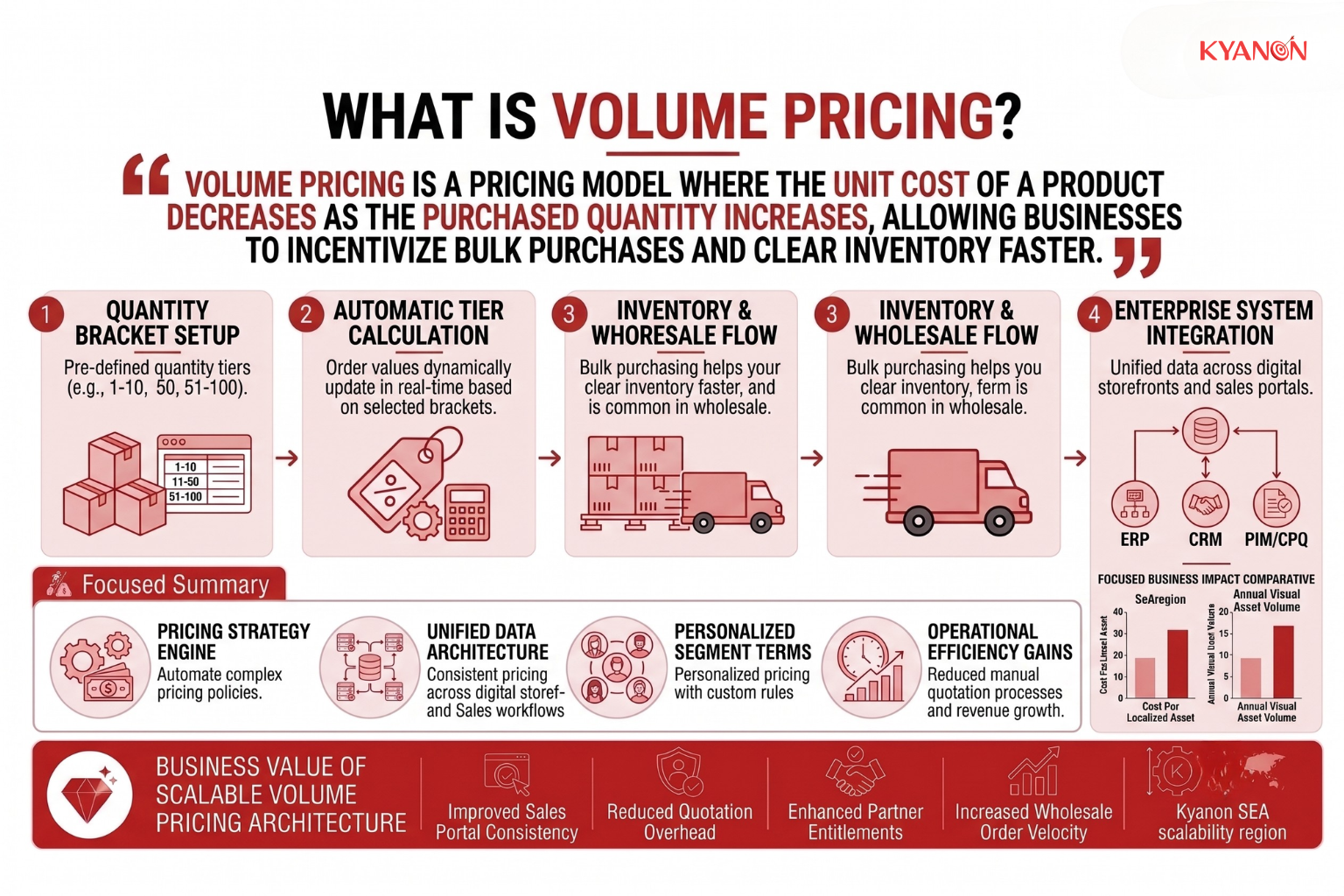
In enterprise commerce environments, volume pricing is often integrated with ERP, CRM, Product Information Management (PIM), Configure-Price-Quote (CPQ), and order management systems. These integrations ensure negotiated pricing, contract terms, inventory availability, and customer entitlements are reflected consistently across digital storefronts, sales portals, and procurement workflows.
As digital B2B commerce continues to grow, volume pricing has become a core capability of enterprise pricing architecture. It enables organizations to automate complex pricing policies, personalize commercial terms for different customer segments, reduce manual quotation processes, and deliver consistent pricing across multiple channels while supporting revenue growth and operational efficiency.
How Volume Pricing Works
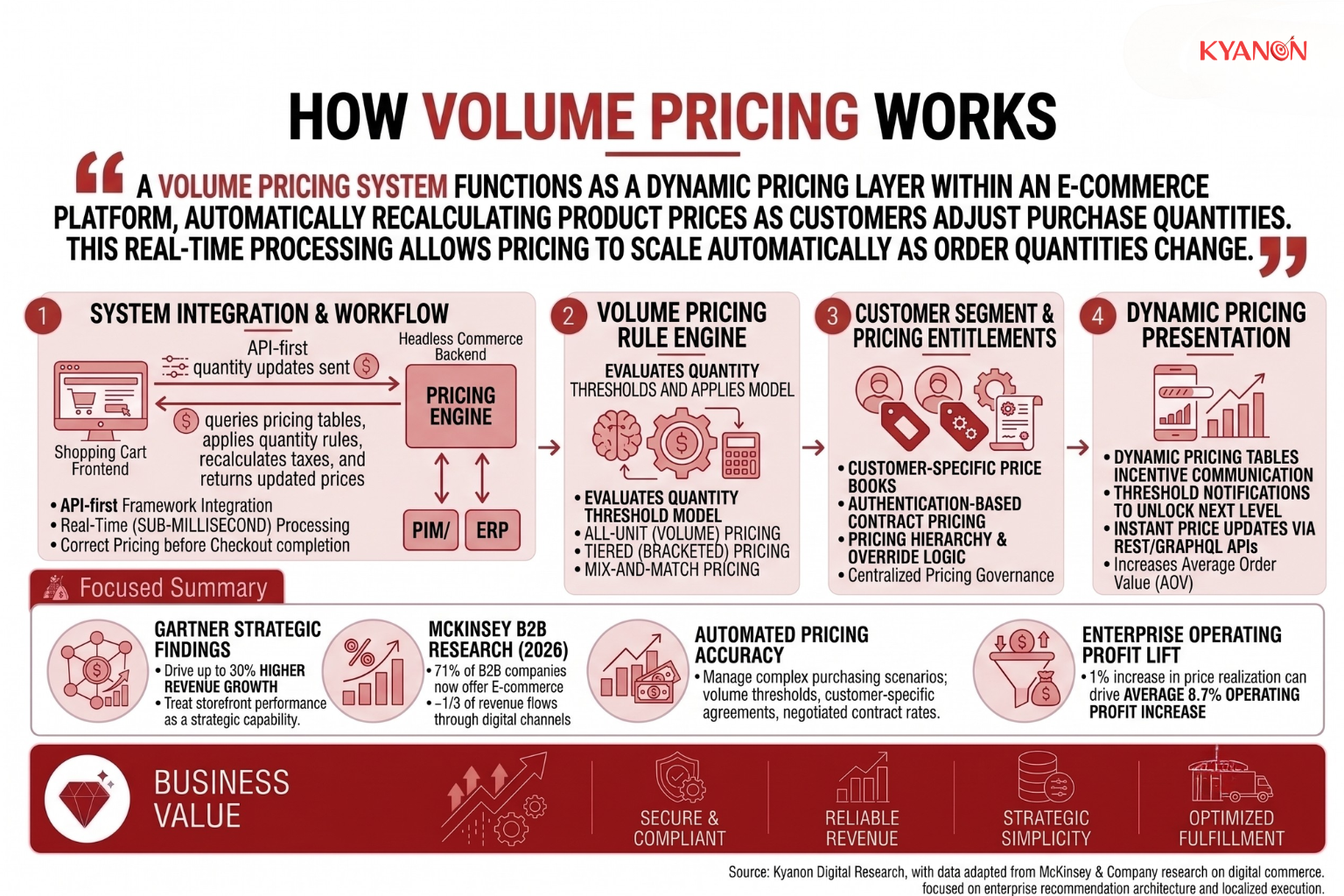
A volume pricing system functions as a dynamic pricing layer within an e-commerce platform, automatically recalculating product prices as customers adjust purchase quantities. Rather than requiring manual approval or billing intervention, the pricing engine evaluates predefined pricing rules in real time and updates the checkout session instantly.
This real-time processing allows pricing to scale automatically as order quantities change, ensuring customers always receive the correct pricing before completing their purchase.
Volume Pricing Rule Engine
The pricing engine evaluates quantity thresholds and applies the appropriate pricing model based on predefined business rules. Modern systems typically support multiple pricing methods, including:
- All-unit (volume) pricing, where reaching a quantity threshold reduces the unit price for every item in the order.
- Tiered (bracketed) pricing, where discounted prices apply only to units within specific quantity ranges, preserving profit margins on lower quantities.
- Mix-and-match pricing, which combines quantities across product variations, such as sizes or colors, to qualify for shared volume discounts.
This flexible rules engine enables businesses to implement sophisticated pricing strategies without manual calculations.
Customer Segment & Pricing Entitlement Management
Enterprise pricing platforms often maintain different pricing structures for different customer groups. Instead of exposing wholesale prices to every shopper, the backend retrieves pricing based on customer identity and contractual entitlements.
Typical capabilities include:
- Customer-specific price books assigned to distributors, wholesalers, or enterprise accounts.
- Authentication-based pricing, where logged-in users receive negotiated contract pricing rather than standard retail prices.
- Pricing hierarchy and override logic, ensuring customer-specific agreements take precedence over general volume pricing rules when applicable.
This architecture supports personalized commercial agreements while maintaining centralized pricing governance.
Dynamic Pricing Presentation
The frontend pricing interface continuously communicates pricing incentives as customers modify their orders, encouraging larger purchases through real-time feedback.
Common capabilities include:
- Dynamic pricing tables displaying available quantity tiers and corresponding unit prices.
- Threshold notifications indicating exactly how many additional units are needed to unlock the next discount level.
- Instant price updates using REST or GraphQL APIs to refresh unit prices, order totals, discounts, and savings without requiring a page reload.
Providing immediate pricing transparency helps improve the customer experience while increasing average order value by making bulk purchase incentives clear throughout the buying journey.
Volume Pricing vs Tiered Pricing
While both strategies offer cheaper unit rates for larger orders, they apply those discounts to different portions of the transaction.
|
Dimension |
Volume Pricing (All-Units) | Tiered Pricing (Incremental) |
| Calculation Logic | Flat discount applied to every single unit once a threshold is met |
Progressive discounts applied only to units within each quantity range |
|
Cart Integration Complexity |
Low; single calculation based on total count | Medium; requires bracket division math |
| Margin Protection | Lower; can experience margin drops at bracket boundaries |
Higher; protects profit by keeping initial units at full cost |
|
Buyer Motivation |
High; simpler calculation encourages pushing for thresholds | Medium; harder for buyers to calculate savings on the fly |
| Typical Use Case | Commodities and raw materials |
Software-as-a-Service (SaaS) seats and modular parts |
When to Consider Volume Pricing
Adopting a bulk pricing system is a standard progression for businesses looking to scale their wholesale operations.
Consider Volume Pricing if:
- Your sales team spends too much time negotiating individual wholesale agreements instead of allowing buyers to execute self-service bulk orders online.
- Your e-commerce store needs to support complex B2B purchase habits where customer segments demand distinct contract pricing structures.
- You need to accelerate inventory velocity for high-volume items to minimize carrying costs in regional warehouses.
It may not be the right priority if:
- Your brand sells exclusive, handcrafted, or supply-constrained products where production capacities cannot scale with bulk demand.
Why Volume Pricing Matters for B2B E-Commerce
Automating bulk discounts helps wholesale merchants streamline high-value transactions by replacing manual quotation processes with real-time, rules-based pricing. As B2B commerce moves increasingly toward digital self-service, buyers expect immediate access to accurate pricing, negotiated terms, and purchasing incentives without relying on sales representatives.

McKinsey’s 2026 Global B2B Pulse Survey found that 71% of B2B companies now offer e-commerce, and among those companies, approximately one-third of revenue flows through digital channels. This shift increases the need for automated pricing capabilities that can manage complex purchasing scenarios, including volume thresholds, customer-specific agreements, and negotiated contract rates.
Pricing accuracy also has a direct impact on profitability. McKinsey research shows that a 1% increase in price realization can translate into an average 8.7% increase in operating profit, assuming sales volume remains stable. Automated volume pricing helps enterprises improve price execution by applying consistent, data-driven pricing rules across thousands of products and customer accounts.
By displaying bulk incentives directly on digital storefronts, businesses can reduce friction in the purchasing journey, encourage larger order quantities, and improve sales efficiency. For distributors and wholesalers managing complex catalogs, automated volume pricing enables faster transactions, reduces manual quoting workloads, and creates a more transparent buying experience that strengthens long-term B2B customer relationships.
Common Misconceptions
Wholesale executives must evaluate bulk order costs carefully to prevent large-scale transactions from eroding total profit margins.
More order volume always equals more profit
Large bulk orders can trigger hidden operational costs like overtime warehouse labor, emergency logistics, or premium manufacturing fees. If your volume pricing tiers are too aggressive, the operational costs of fulfilling a massive order can outpace your profit margins.
Volume discounts are always justified because it costs less to serve bulk orders
Basing discounts purely on cost savings is a limited cost-plus mindset. Your volume tiers should align with your customer’s willingness to pay (WTP); discounting for buyers who are already prepared to pay full price simply dilutes your margins.
How Kyanon Digital Applies Volume Pricing
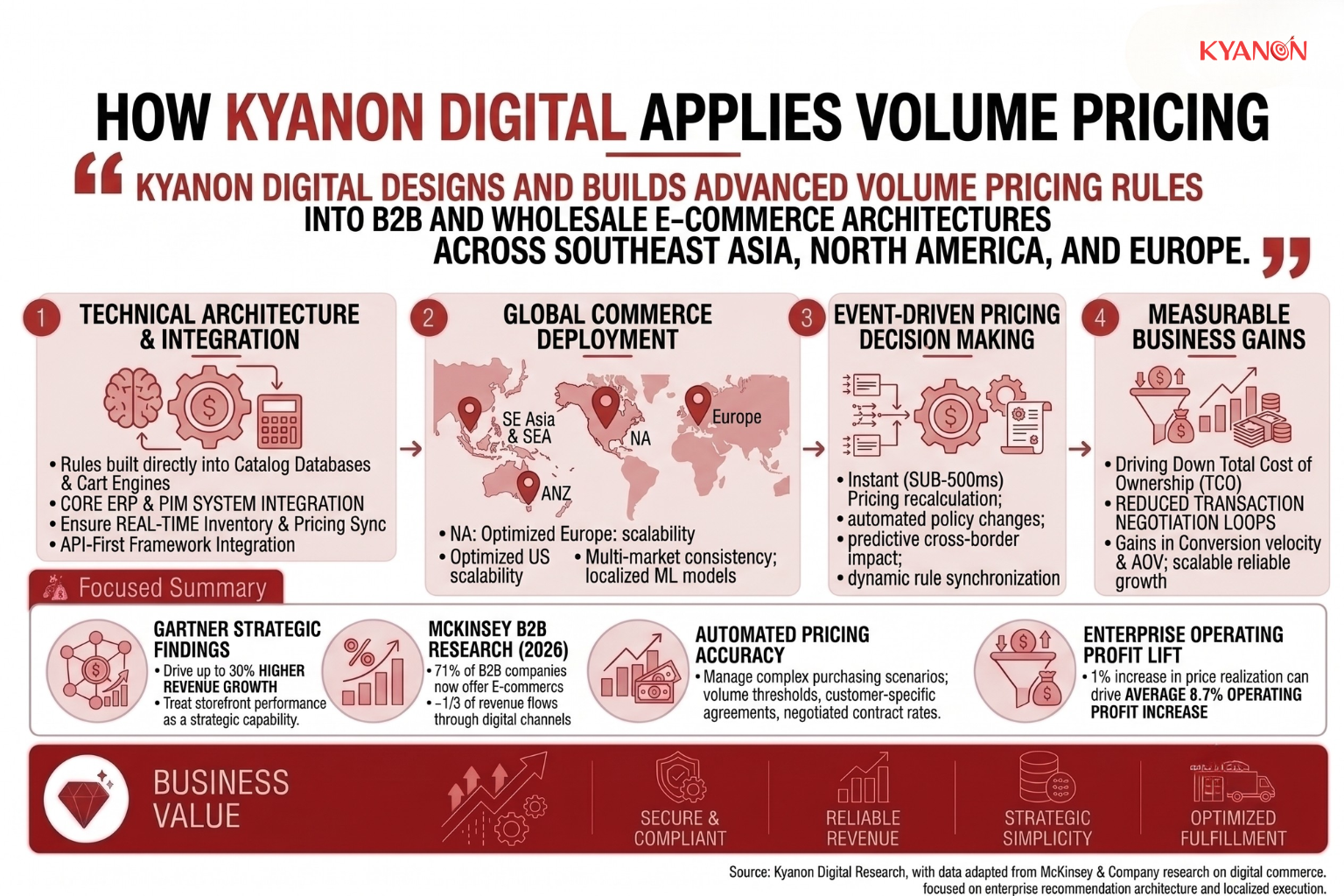
Kyanon Digital designs and builds advanced volume pricing rules into B2B and wholesale e-commerce architectures across Southeast Asia, North America, and Europe. Our technical teams build these rules directly into catalog databases and cart engines, integrating them with your core Enterprise Resource Planning (ERP) or Product Information Management (PIM) systems to ensure real-time inventory and pricing sync.
We focus on helping enterprise clients achieve measurable outcomes, such as reduced transaction negotiation loops and optimized total cost of ownership (TCO) across all digital channels.
Explore our services:











 Create project brief with AI