
What is Wishlist & Save for Later?
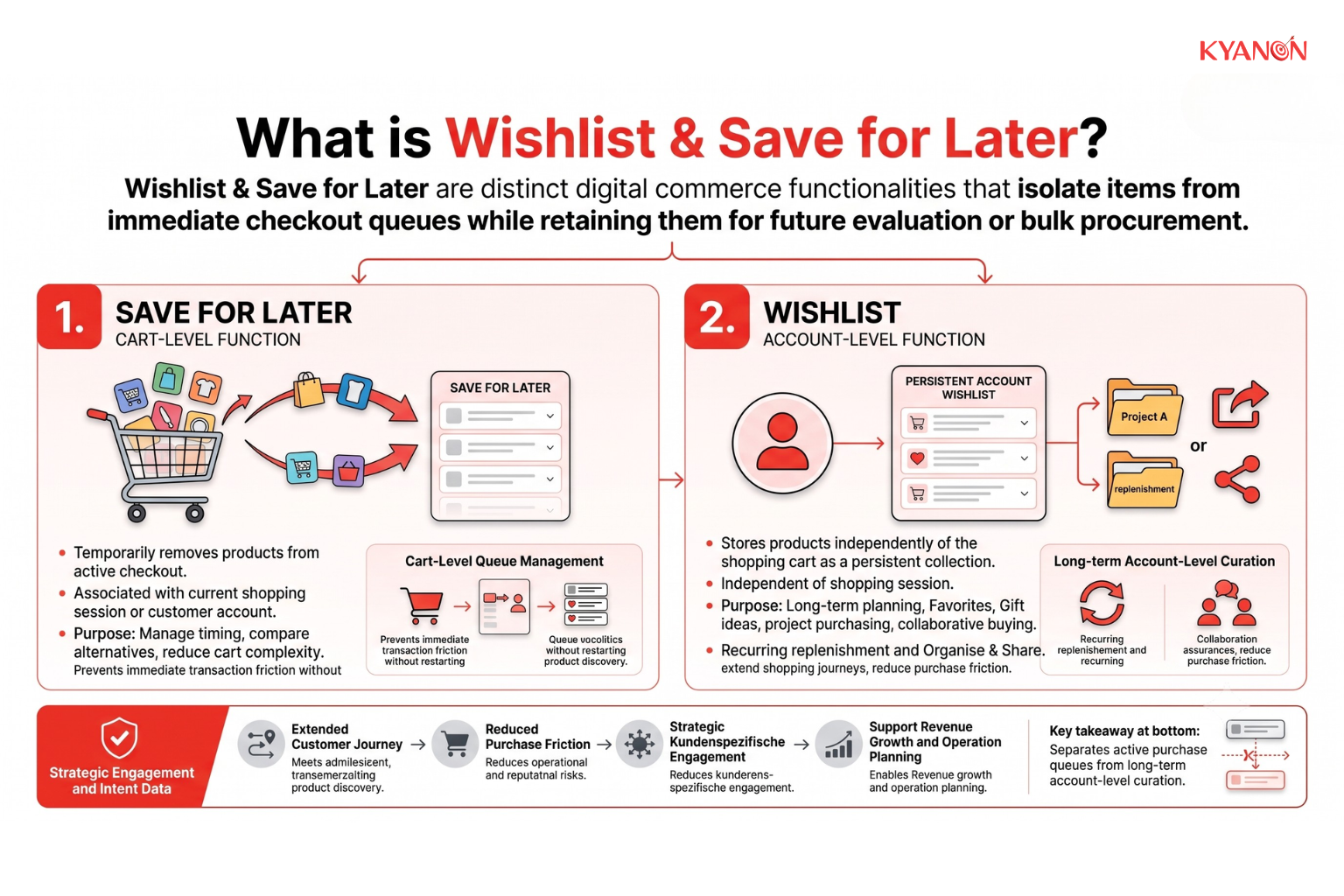
Wishlist & Save for Later are two distinct digital commerce functionalities that allow buyers to isolate items from immediate checkout queues while retaining them for future evaluation or bulk procurement. While a “Save for Later” feature modifies active shopping cart queues to prevent immediate transaction friction, a “Wishlist” stores items within persistent account profiles for long-term curation, sharing, and recurring reorder workflows.
Although often grouped together, they serve different business and user objectives:
- Save for Later is a cart-level function that temporarily removes products from the active checkout flow while keeping them associated with the current shopping session or customer account. It helps shoppers manage purchase timing, compare alternatives, wait for budget approval, or reduce cart complexity without restarting product discovery.
- Wishlist is an account-level feature that stores products independently of the shopping cart as a persistent collection. Wishlists support long-term product planning, favorites management, gift ideas, project-based purchasing, recurring replenishment, and collaborative buying by allowing users to revisit, organize, or share saved items over extended periods.
As digital commerce evolves toward more personalized and omnichannel experiences, Wishlist and Save for Later have become strategic customer engagement features that extend shopping journeys, reduce purchase friction, and provide first-party intent data that supports both revenue growth and operational planning.
How Wishlist & Save for Later Works
Wishlist and Save for Later function as strategic mid-funnel holding mechanisms that preserve buyer intent without requiring an immediate purchase. Rather than forcing customers to either complete checkout or abandon their shopping journey, these features separate product discovery from transaction timing. This enables buyers to continue researching, comparing, budgeting, or seeking internal approvals while allowing retailers to retain valuable purchase intent.
From a commerce architecture perspective, both capabilities generate high-value zero-party and first-party behavioral data before an order is placed. Saved products become strong indicators of future demand, allowing commerce platforms to improve personalization, inventory forecasting, merchandising decisions, and marketing automation. Although they share the same objective of preserving purchase intent, each feature operates within a different layer of the commerce platform.
In-Cart Queue Separation (Save for Later)
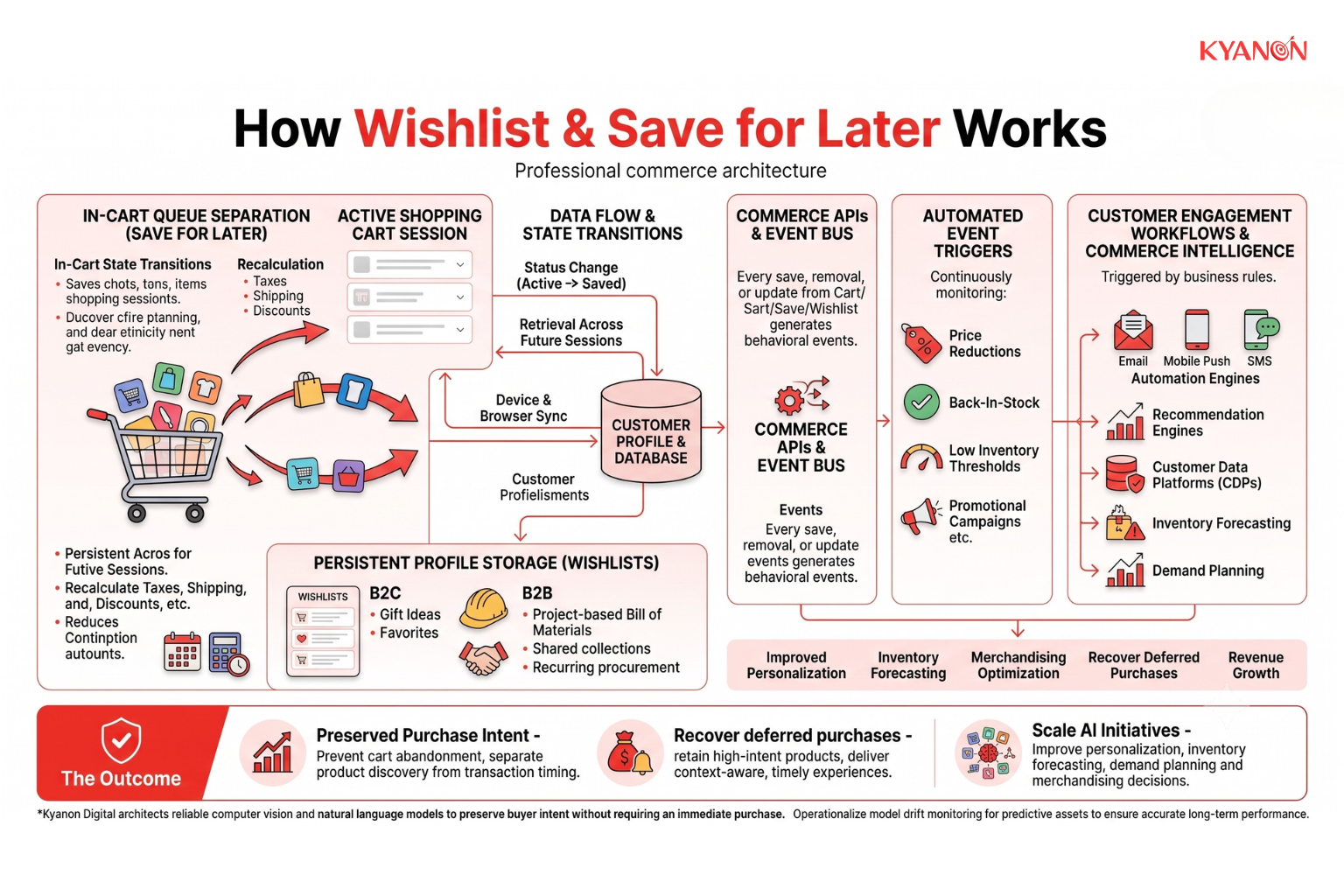
The Save for Later mechanism operates directly on the shopping cart by separating products intended for future purchase from those ready for immediate checkout. Instead of removing an item entirely, the platform changes its cart status (for example, from Active to Saved for Later) while preserving its association with the customer.
Once an item is moved, the checkout engine automatically recalculates cart subtotal, taxes, shipping costs, discounts, and promotional eligibility. This reduces checkout friction by allowing customers to simplify their purchase without losing products they may still intend to buy.
Depending on the customer’s authentication state, Save for Later items may be stored in browser storage or session caches for guest users, or synchronized with the commerce database for authenticated customers, allowing retrieval across future sessions.
For retailers, this functionality transforms potential cart abandonment into a recoverable purchase opportunity by retaining high-intent products instead of permanently deleting them.
Persistent Profile Storage (Wishlists)
Unlike Save for Later, Wishlists are stored within the customer’s persistent account profile rather than the active shopping cart. Products are linked to the user’s account and remain accessible across devices, browsers, and future shopping sessions through the platform’s customer database.
This persistent storage supports significantly broader use cases beyond delayed purchasing. B2C customers frequently use wishlists for favorites, gift planning, seasonal shopping, and recurring purchases. In B2B commerce, wishlists often evolve into project-based procurement tools, enabling buyers to build Bill of Materials (BOMs), draft purchasing lists, organize products by project, or share collections with multiple stakeholders before formal procurement begins.
Because wishlist activity often precedes purchasing by weeks or months, it provides valuable behavioral signals that help organizations understand long-term buying interests, identify emerging product demand, and improve merchandising strategies before transactions occur.
Automated Event Triggers & Alerts
Wishlist and Save for Later features also function as event-driven telemetry sources within modern commerce platforms. Every save, removal, or product update generates behavioral events that can trigger downstream business workflows through Commerce APIs, event buses, or messaging platforms.
Commerce engines continuously monitor saved products for conditions such as:
- Price reductions
- Back-in-stock availability
- Low inventory thresholds
- New product variants
- Promotional campaigns
- Volume pricing changes
When predefined business rules are met, the platform automatically triggers personalized customer engagement through email, mobile push notifications, SMS, or in-app messaging. These automated workflows help recover deferred purchases while delivering timely, context-aware experiences that encourage customers to return when purchasing conditions become more favorable.
Beyond customer engagement, these behavioral signals also feed recommendation engines, customer data platforms (CDPs), inventory forecasting models, and demand planning systems. As a result, Wishlist and Save for Later become not only customer convenience features but also valuable sources of commerce intelligence that support personalization, merchandising optimization, and revenue growth across the entire digital commerce ecosystem.
Wishlist vs Save for Later
Both features mitigate cart friction, but they serve distinct operational roles in user intent management.
|
Dimension |
Save for Later | Wishlist |
| Persistence Location | Active Shopping Cart Session |
Persistent Account Profile |
|
Primary Buyer Intent |
Short-term queue management | Long-term tracking, curation, and reordering |
| Friction Level to Save | One-click within current cart |
Account login / Profile association required |
|
Multi-User Shareability |
Low (session-bound or device-bound) | High (public URL, team sharing, project lists) |
| Primary Data Metric | Basket Abandonment Mitigation |
Mid-Funnel Demand Telemetry & Zero-Party Preference Data |
When to Consider Wishlist & Save for Later
Consider deploying structured Wishlist & Save for Later workflows if:
- Your digital channel experiences high basket abandonment rates caused by buyers using active carts as temporary holding pads or product comparison lists.
- You manage enterprise or B2B buyers who require lengthy approval chains, seasonal catalog budgeting, or multi-item project planning prior to purchase authorization.
- Your merchandising strategy relies heavily on personalized re-engagement campaigns based on explicit customer preferences and item tracking.
It may not be the right priority if:
- Your store operates exclusively on low-SKU, high-impulse single-item checkouts where product evaluation cycles are instantaneous and direct-to-checkout flows yield higher conversion efficiency.
Why Wishlist & Save for Later Matters for Enterprise Commerce
Structuring clear post-cart holding states transforms prospective delay into actionable intelligence. Isolating evaluation-stage products directly reduces cart abandonment while building granular visibility into future inventory demands.
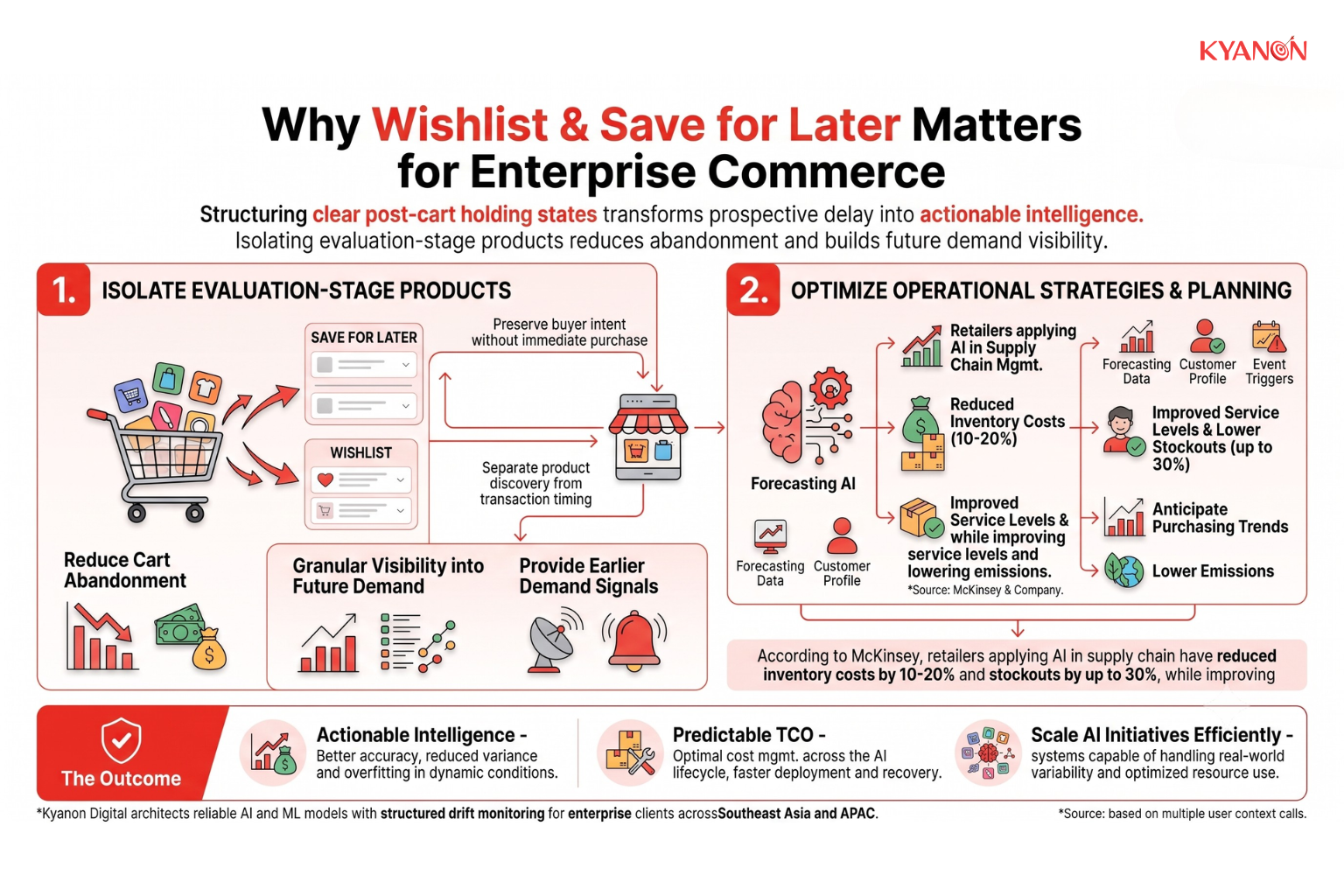
By isolating evaluation-stage products from immediate checkout, these features reduce cart abandonment while providing granular visibility into future demand before orders are formally placed. The resulting behavioral data helps retailers anticipate purchasing trends, optimize replenishment strategies, and allocate inventory more effectively. According to McKinsey, retailers applying AI in supply chain management have reduced inventory costs by 10–20% and stockouts by up to 30%, while improving service levels and lowering emissions. Wishlist and Save for Later data strengthen these AI-driven forecasting capabilities by providing earlier demand signals than completed transactions alone.
For enterprise commerce organizations, these capabilities also enable more personalized marketing, improve customer lifetime value, and create a continuous feedback loop between customer intent and operational planning, making them strategic assets rather than simply customer convenience features.
Common Misconceptions
Save for Later and Wishlists are essentially the same feature
A Save-for-Later item lives inside your active cart to streamline immediate checkout, whereas a Wishlist lives in persistent account profiles for long-term tracking, sharing, or recurring procurement.
Wishlists are passive features that rarely convert into actual sales
Reality: Wishlists sustain buyer engagement without closing the purchase window entirely, consistently driving higher downstream conversion rates as buyers return to complete orders over longer evaluation lifecycles.
Moving an item to ‘Save for Later’ guarantees a price lock or stock reservation
Moving an item to Save for Later changes its placement in the interface but does not reserve inventory or freeze prices; however, it flags the item within notification engines to trigger alerts if pricing or stock changes.
How Kyanon Digital Applies Wishlist & Save for Later
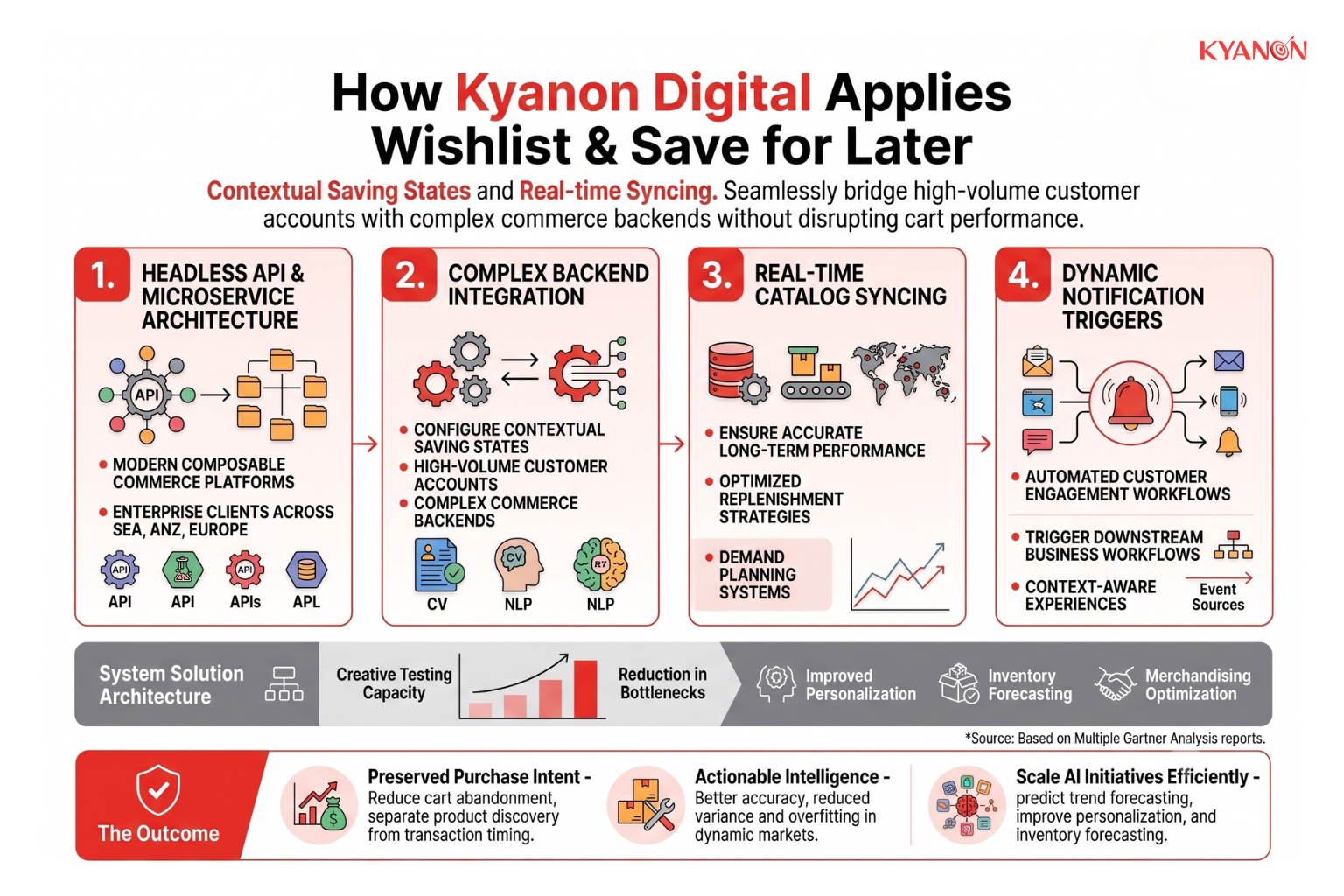
Kyanon Digital integrates advanced Wishlist & Save for Later architecture into modern composable commerce platforms using headless APIs and microservice patterns for enterprise clients across Southeast Asia, ANZ, and Europe. Our engineering teams configure contextual saving states that seamlessly bridge high-volume customer accounts with complex commerce backends, ensuring real-time catalog syncing and dynamic notification triggers without disrupting cart performance.
Explore our services:











 Create project brief with AI