
What is XML Product Feed?
An XML product feed is a standardized XML file containing detailed e-commerce catalog data, such as titles, SKUs, pricing, availability, and image URLs, formatted to automatically synchronize product inventory with external shopping platforms. It serves as the data interchange format between an online retailer’s backend systems and external channels like Google Shopping, PriceMe, and regional marketplaces.
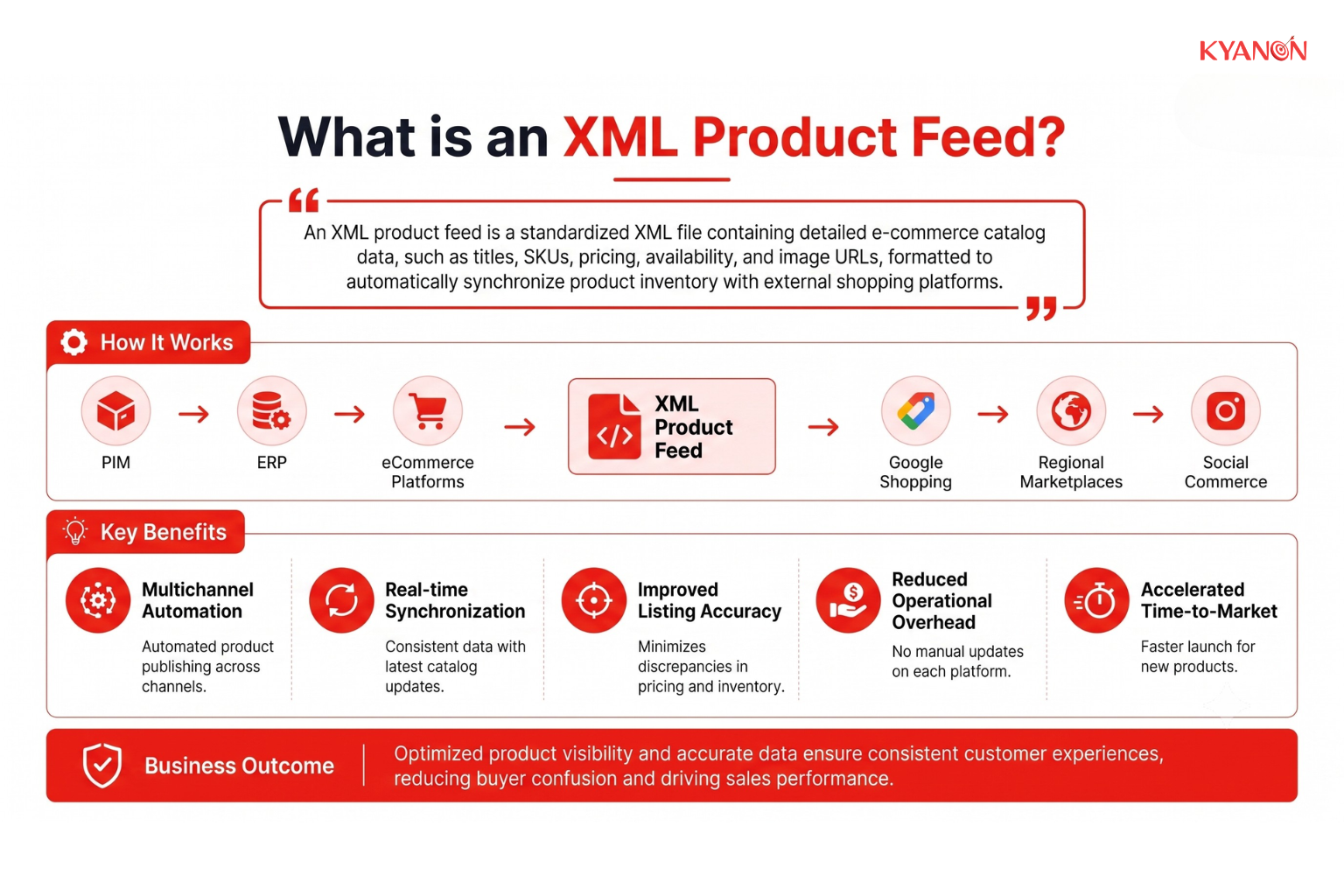
An XML product feed acts as the single source of truth for product information distributed across multiple sales and marketing channels. Instead of manually updating product details on each platform, retailers generate a structured XML file from their product information management (PIM), enterprise resource planning (ERP), or eCommerce platform. External services regularly retrieve or receive this feed to ensure listings remain synchronized with the latest catalog data, minimizing discrepancies in pricing, inventory, and product availability.
Beyond simple catalog synchronization, XML product feeds are a critical component of multichannel commerce infrastructure. They enable automated product publishing, support real-time inventory visibility, and provide the structured data required by search engines, comparison shopping engines, affiliate networks, and online marketplaces. By maintaining a consistent data format across channels, XML feeds help improve listing accuracy, reduce operational overhead, accelerate time-to-market for new products, and ensure customers receive consistent product information regardless of where they discover or purchase an item.
How XML Product Feed Works
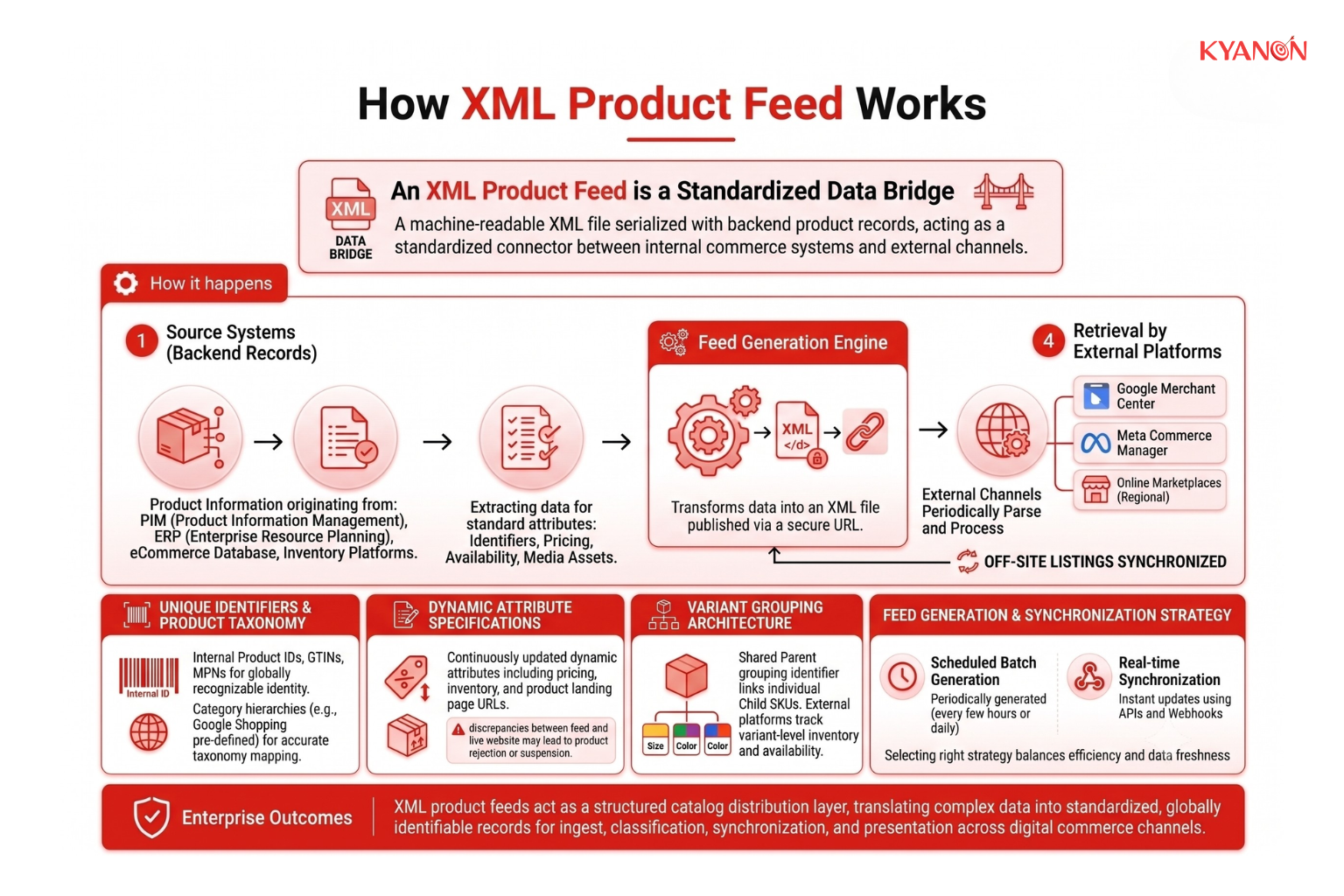
An XML product feed functions by serializing backend product records into structured Extensible Markup Language (XML) tags that external advertising, comparison shopping, and marketplace platforms can continuously parse and process. Acting as a standardized data bridge between internal commerce systems and external channels, the feed transforms complex catalog information into machine-readable records containing product identifiers, pricing, availability, attributes, and media assets.
In a typical architecture, product information originates from systems such as Product Information Management (PIM), Enterprise Resource Planning (ERP), inventory management platforms, or the eCommerce database itself. A feed generation engine then extracts, transforms, and serializes this data into an XML file that is published through a secure URL. External platforms such as Google Merchant Center, Meta Commerce Manager, and online marketplaces periodically retrieve the feed or receive real-time updates through APIs and webhooks, ensuring that off-site listings remain synchronized with the retailer’s source catalog.
Unique Identifiers & Product Taxonomy
Every product record within an XML feed requires a set of unique identifiers that allow external platforms to accurately match inventory with customer search intent and marketplace catalogs. Common identifiers include internal product IDs, Global Trade Item Numbers (GTINs), and Manufacturer Part Numbers (MPNs), which collectively establish a globally recognizable product identity.
In addition to product identification, feeds must include taxonomy mappings that align internal product categories with standardized channel-specific classification systems. For example, Google Shopping uses predefined product category hierarchies to determine where products appear within search and advertising ecosystems. Accurate taxonomy mapping improves discoverability, bidding relevance, and catalog organization while reducing classification errors that can negatively impact campaign performance.
Dynamic Attribute Specifications
Dynamic attributes contain the operational data that changes most frequently, including pricing, inventory availability, promotional information, shipping details, and product landing page URLs. These attributes are continuously updated as source database records change, ensuring that external listings reflect current business conditions.
Advertising and marketplace platforms routinely compare feed data against the information displayed on destination product pages. If discrepancies exist between XML feed values and live website content, platforms may reject products, restrict campaign delivery, or suspend merchant accounts to protect consumers from misleading pricing and availability information. Maintaining consistency across these dynamic attributes is therefore critical for both compliance and customer experience.
Variant Grouping Architecture
Enterprise product catalogs often contain multiple variations of the same product, including different sizes, colors, materials, configurations, or packaging options. Rather than representing these variations as a single generic listing, XML feeds typically model them as individual child SKUs linked through a shared parent grouping identifier.
This parent-child structure enables external platforms to track inventory, pricing, and availability at the variant level while still recognizing related products as part of the same product family. As a result, shoppers can view the most relevant variation based on their search criteria without encountering duplicate listings, while retailers maintain precise inventory control across every SKU.
Feed Generation & Synchronization Strategy
XML feeds are typically delivered using either scheduled batch generation or real-time synchronization models. Batch feeds are generated periodically, often every few hours or once per day, and are well suited for large catalogs with relatively stable inventory levels. Real-time synchronization uses APIs, webhooks, or event-driven integrations to push updates immediately when catalog data changes.
The appropriate approach depends on business requirements. Batch processing offers lower infrastructure overhead and simpler management, while real-time synchronization provides higher data freshness for businesses with rapidly changing inventory, dynamic pricing models, or high-volume promotional activity. Selecting the right synchronization strategy helps balance operational efficiency, platform performance, and listing accuracy across all external channels.
Together, these components transform XML product feeds into more than simple export files. They function as a structured catalog distribution layer that translates complex product data into standardized, globally identifiable records that external platforms can ingest, classify, synchronize, and present to high-intent shoppers across multiple digital commerce channels.
XML Product Feed vs Sitemap XML
While both formats utilize Extensible Markup Language, XML product feeds cater specifically to commerce attributes for ad channels, whereas XML sitemaps serve search engine crawlers with page indexing metadata.
|
Dimension |
XML Product Feed | Sitemap XML |
| Deployment speed | Fast (Continuous API or dynamic file generation) |
Fast (Static or dynamic URL generation) |
|
Vendor lock-in |
Low (Open specification adopted by ad channels) | Low (Universal search protocol standard) |
| Upfront complexity | High (Requires exact attribute mapping and business logic) |
Low (Requires standard URL and lastmod metadata) |
|
Best for |
Dynamic product advertising and marketplace sync | Organic search engine indexing and site crawling |
| Cost model | OpEx (Driven by ad channel consumption and sync frequency) |
OpEx (Included in base platform hosting/SEO operations) |
When to Consider XML Product Feed
Consider implementing structured XML product feeds if:
- You are scaling enterprise multi-channel retail operations across regional platforms like Google Shopping, PriceMe, and regional marketplaces requiring automated catalog updates.
- Your current inventory sync process relies on static file uploads, leading to pricing discrepancies, out-of-stock items displaying in active ad campaigns, or account suspensions.
- You manage large multi-variant product catalogs where complex attributes (e.g., sizing, dynamic pricing, localized currencies) must be mapped dynamically to ad channel specs.
It may not be the right priority if:
- Your business runs a single-storefront D2C brand with a limited product catalog (under 20 SKUs) and does not actively manage performance marketing campaigns across external sales platforms.
Why XML Product Feed Matters for E-Commerce
Maintaining structured XML product feeds directly improves revenue performance by ensuring advertising platforms, comparison shopping engines, and online marketplaces always receive accurate, up-to-date product information. Synchronizing pricing, inventory availability, product attributes, and media assets across channels helps retailers maximize product visibility, improve ad relevance, and deliver a consistent customer experience while reducing manual catalog management.
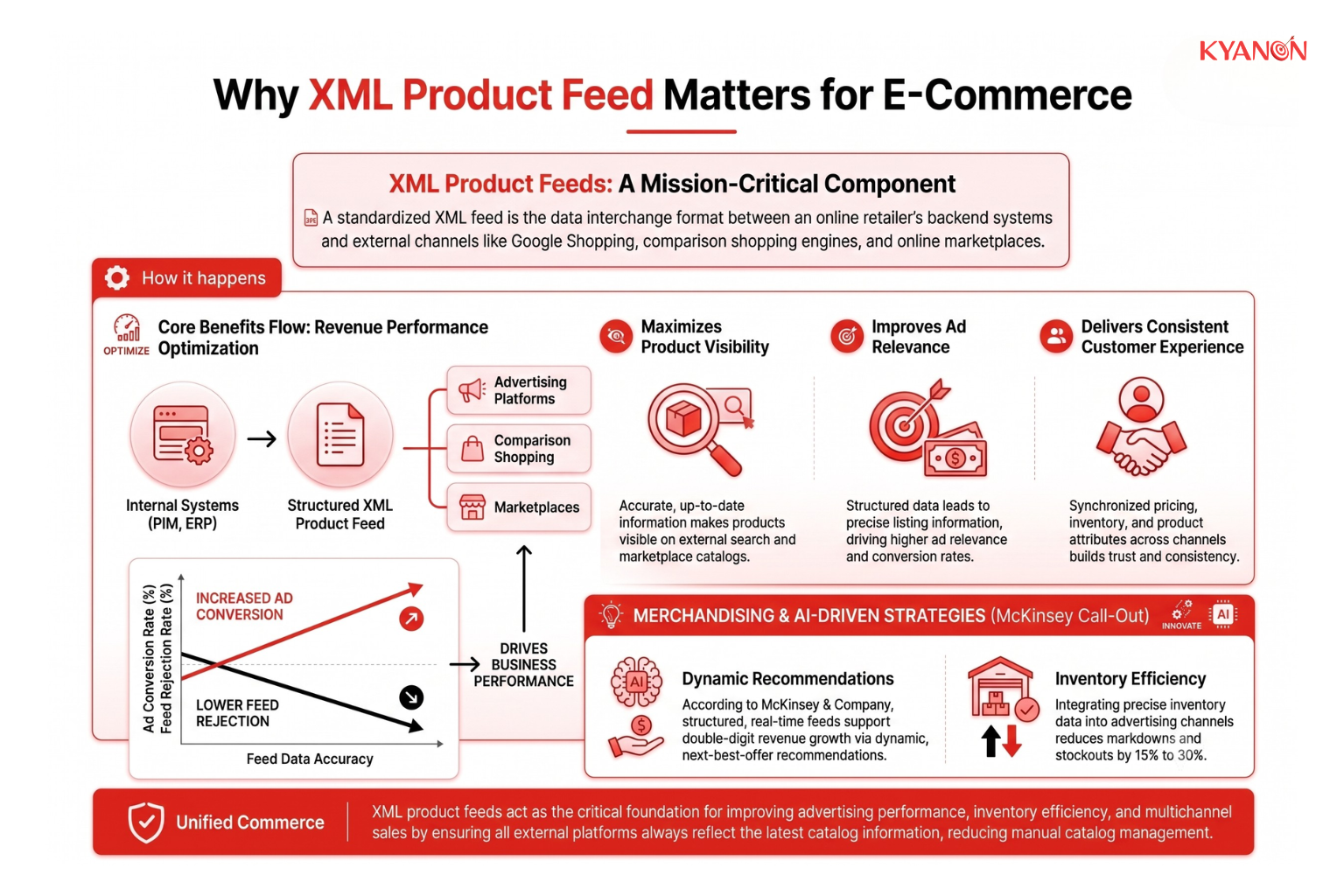
High-quality, real-time product feeds also enable more effective merchandising and AI-driven commerce strategies. According to McKinsey & Company, structured, real-time data feeds support double-digit revenue growth by enabling dynamic, next-best-offer recommendations, while integrating precise inventory data into advertising channels can reduce markdowns and stockouts by 15% to 30%. By ensuring external platforms always reflect the latest catalog information, XML product feeds become a critical foundation for improving advertising performance, inventory efficiency, and multichannel sales.
Common Misconceptions
A website sitemap is the same as a product feed
Search sitemaps only map web page URLs for organic web indexing. Advertising platforms require custom, detailed inventory files containing specific transactional attributes.
Promotional text in title tags helps performance
Placing marketing phrases like “Free Shipping” or “SALE” in your XML <title> tags is strictly prohibited by platforms like Google Merchant Center. Doing so results in product disapprovals or automated, platform-generated title rewrites that distort your brand messaging.
XML file size does not impact processing or latency
Submitting massive, uncompressed XML catalogs can cause connection timeouts and delay inventory updates. Utilizing compressed formats (such as .gz compression) or transitioning to real-time Content APIs provides significantly faster and more reliable ingestion for large catalogs.
Feed rules solve all upstream catalog errors
While platforms offer channel-level feed rules to fix minor formatting artifacts, these rules are designed for basic data transformations, not for fixing underlying missing attributes, incorrect PIM taxonomy, or corrupted database records.
All variants can share the same Product ID
Every specific product variant (e.g., size or color option) requires a strictly unique <g:id> and must be linked to a parent group via <g:item_group_id>. Reusing IDs across variants breaks channel analytics and misleads shoppers on variant availability.
How Kyanon Digital Applies XML Product Feed
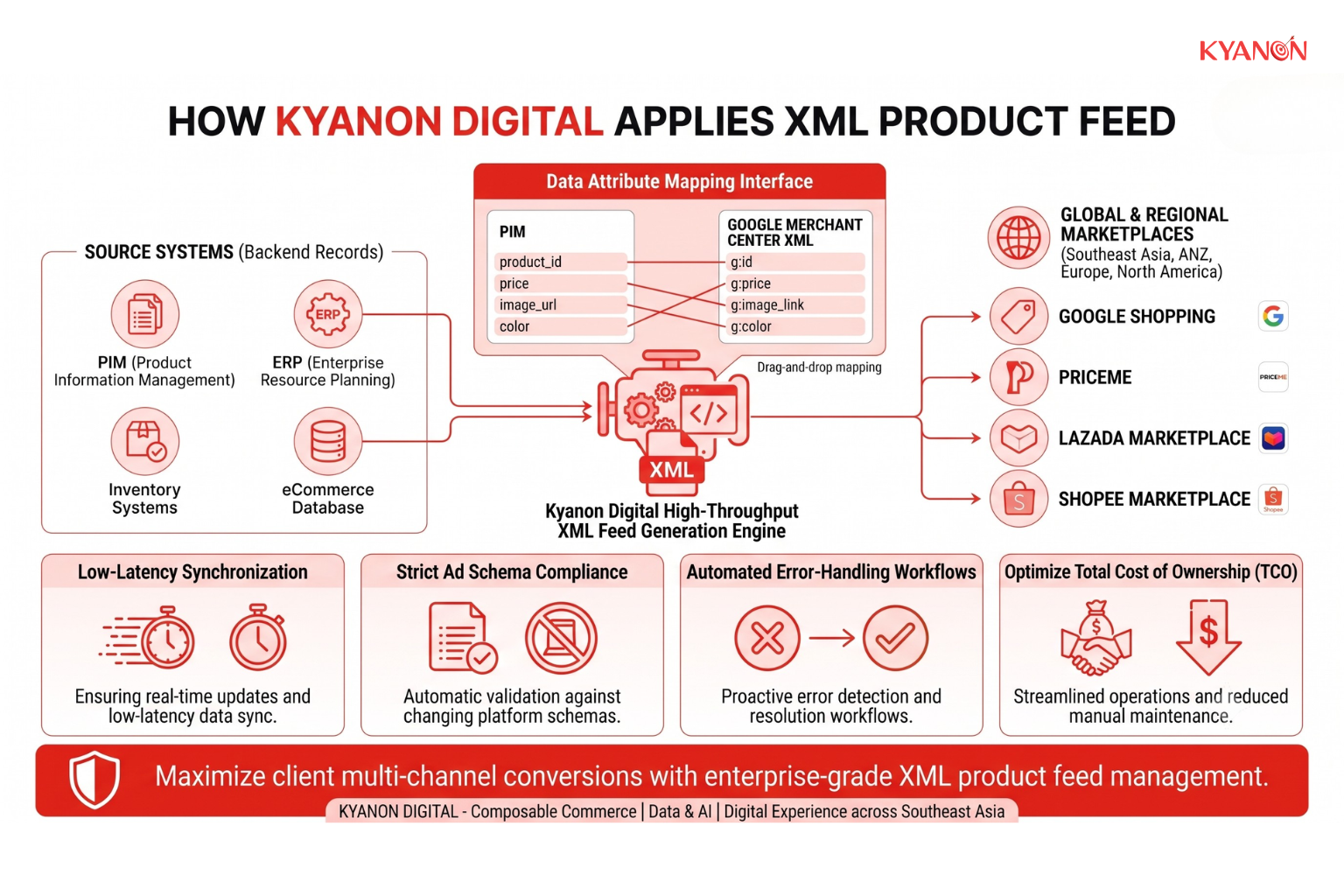
Kyanon Digital designs, generates, and manages high-throughput XML product feeds for enterprise clients integrating with Google Shopping, PriceMe, and regional marketplaces across Southeast Asia, ANZ, Europe, and North America. Utilizing enterprise architectures that bridge underlying PIM and e-commerce systems, our engineering team ensures low-latency synchronization, strict compliance with ad channel schemas, and automated error-handling workflows to optimize client total cost of ownership (TCO) and maximize channel conversions.
Explore our Ecommerce and Data services:











 Create project brief with AI