
What is Zero-Click Commerce?
Zero-click commerce is an autonomous transactional framework where order generation, payment processing, and fulfillment execution occur automatically without requiring manual user interaction at the time of purchase. By leveraging predictive analytics, pre-authorized customer payment tokens, and connected smart device telemetry, zero-click commerce converts routine replenishment into background system tasks.
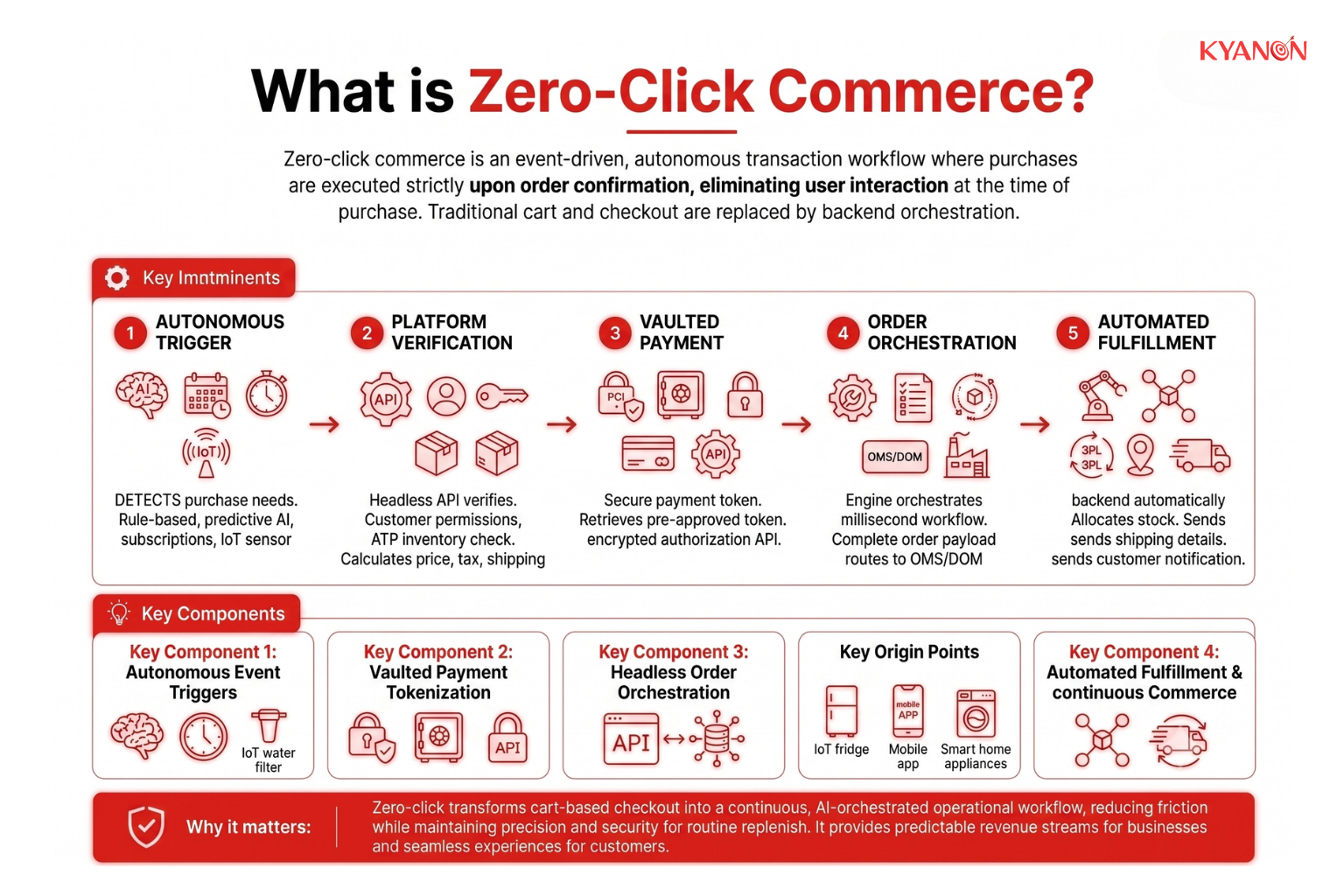
Zero-click commerce extends beyond traditional one-click checkout by eliminating the purchase decision at the point of transaction. Instead of requiring customers to browse products, add items to a cart, and confirm payment, the commerce platform continuously monitors predefined purchasing conditions and automatically initiates transactions when those conditions are met. These triggers may include inventory depletion, recurring subscription schedules, usage patterns captured by connected devices, predictive demand models, or customer-defined purchasing preferences, allowing routine purchases to occur seamlessly in the background.
How Zero-Click Commerce Works
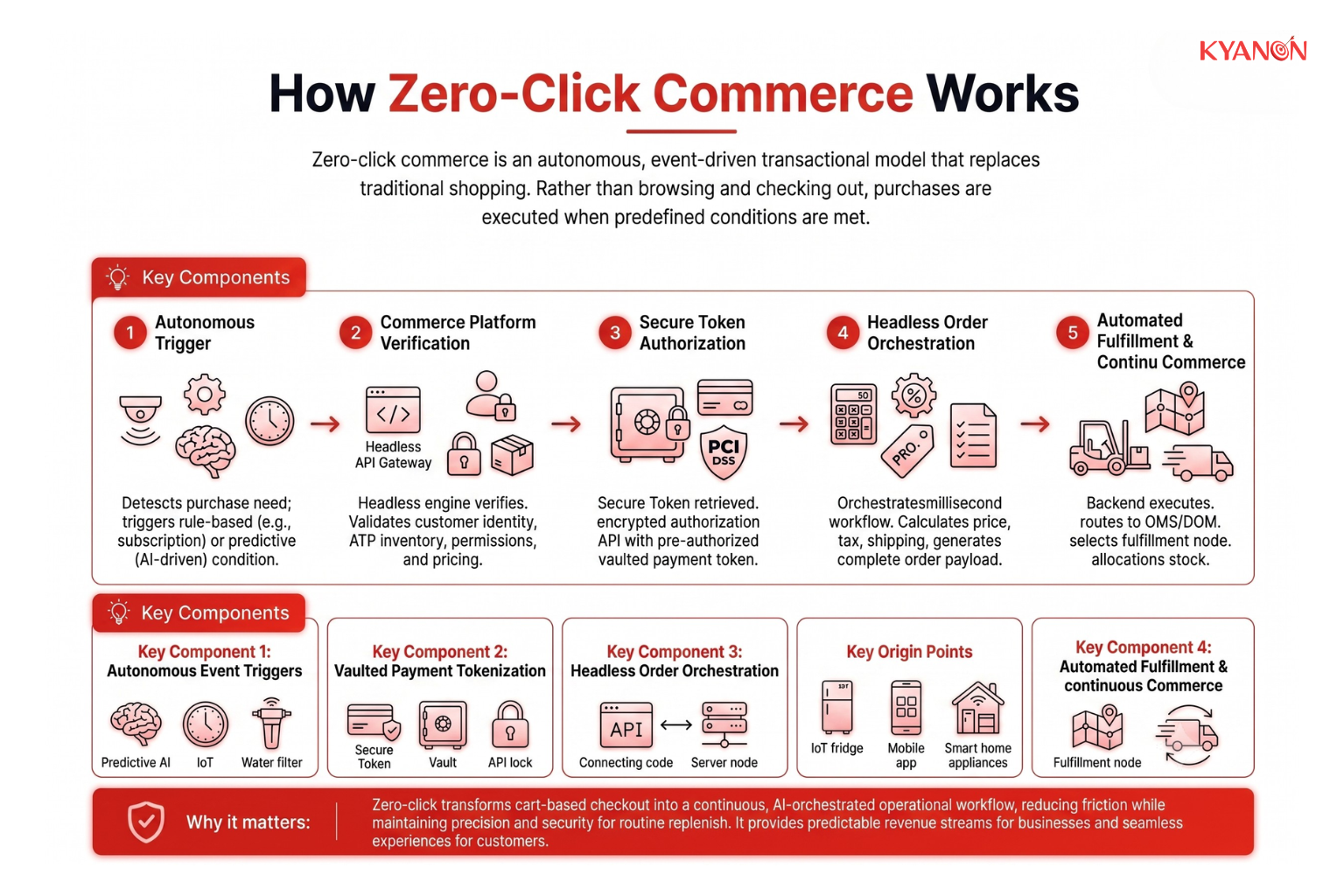
Zero-click commerce replaces the traditional shopping journey with an event-driven, autonomous transaction workflow. Rather than requiring customers to browse products, add items to a cart, and complete checkout, purchases are automatically executed when predefined business rules or predictive conditions are met.
A typical transaction flows through four stages:
- An autonomous trigger detects that a purchase should occur.
- The commerce platform verifies customer identity, permissions, and inventory.
- A secure payment token authorizes the transaction.
- The validated order is routed directly to fulfillment through the Order Management System (OMS).
Autonomous Event Triggers
Every zero-click transaction begins with an automated event that determines when an order should be placed.
Common trigger types include:
- Rule-based triggers
- Scheduled subscription renewals
- Time-based replenishment cycles
- IoT sensors detecting inventory thresholds (for example, a water filter reaching 5% remaining life)
- Predictive AI triggers
- Forecasting when a customer will run out of a consumable product
- Learning purchasing frequency from historical behavior
- Adjusting replenishment timing based on seasonality or usage patterns
Instead of waiting for customers to realize they need a product, AI proactively initiates the purchase before inventory is depleted.
Vaulted Payment Tokenization
Since there is no checkout page, payment authorization must occur securely in the background.
The process typically works as follows:
- The customer securely stores a payment method during onboarding.
- The payment provider (such as Stripe or Adyen) generates a PCI DSS-compliant payment token.
- During future purchases, the commerce platform:
- retrieves the payment token,
- verifies pre-approved purchasing permissions,
- authorizes payment through encrypted APIs,
- completes settlement without exposing raw card information.
This allows frictionless purchasing while maintaining security and regulatory compliance.
Headless Order Orchestration
Once an event is triggered, a headless commerce engine performs the entire purchasing workflow in milliseconds.
Typical orchestration steps include:
- Validate customer identity and purchase permissions.
- Verify Available-to-Promise (ATP) inventory.
- Calculate pricing, promotions, taxes, and shipping.
- Generate a complete order payload.
- Route the order to the OMS or Distributed Order Management (DOM) platform.
Because backend services operate independently from the user interface, purchases can originate from:
- IoT devices
- Mobile apps
- Voice assistants
- Subscription platforms
- Connected vehicles
- Smart home appliances
Automated Fulfillment & Continuous Commerce
After payment is approved, the transaction moves directly into fulfillment without further customer interaction.
The backend automatically:
- Allocates inventory
- Selects the optimal fulfillment location
- Sends fulfillment requests to warehouses or suppliers
- Generates shipping instructions
- Updates order status
- Sends customer notifications
This transforms commerce from a customer-driven checkout experience into a continuous, AI-orchestrated operational workflow, where routine replenishment happens automatically in the background while maintaining inventory accuracy, payment security, and fulfillment efficiency.
Zero-Click Commerce vs One-Click Commerce
Both models aim to reduce purchasing friction, but they operate on fundamentally different user interaction paradigms and decision timing.
|
Dimension |
Zero-Click Commerce | One-Click Commerce |
| User Action Required | None at execution (Fully autonomous) |
Single explicit click/tap per transaction |
|
Primary Trigger |
Sensor telemetry, predictive algorithm, or schedule | Manual impulse or active buyer intent |
| Interface Dependence | Headless/No-GUI (Background execution) |
Screen-based interface (Mobile app or Web cart) |
|
Order Confirmation Model |
Passive notification (Opt-out or pre-approved) | Immediate visual confirmation screen |
| Ideal Application | Routine replenishment, subscriptions, and IoT reordering |
High-intent D2C purchases and instant shopping |
When to Consider Zero-Click Commerce
Consider adopting a zero-click commerce model if:
- Your product catalog features high-frequency, predictable consumables where reorder friction directly increases churn risk.
- Your hardware or smart appliance ecosystem can gather usage telemetry to automate replacement supply orders before stock runs out.
- You manage subscription platforms seeking to increase customer lifetime value by removing manual renewal friction entirely.
It may not be the right priority if:
- Your offerings consist of high-consideration, subjective items requiring active customer comparison, aesthetic choices, or direct sizing verification prior to purchase.
Why Zero-Click Commerce Matters for Enterprise Brands
Zero-click commerce transforms recurring purchasing from a customer-initiated activity into an automated service, eliminating checkout friction for predictable replenishment purchases. By removing the need for customers to repeatedly browse, compare, and complete checkout, brands can strengthen customer retention, reduce opportunities for competitive switching, and generate more stable recurring revenue streams.
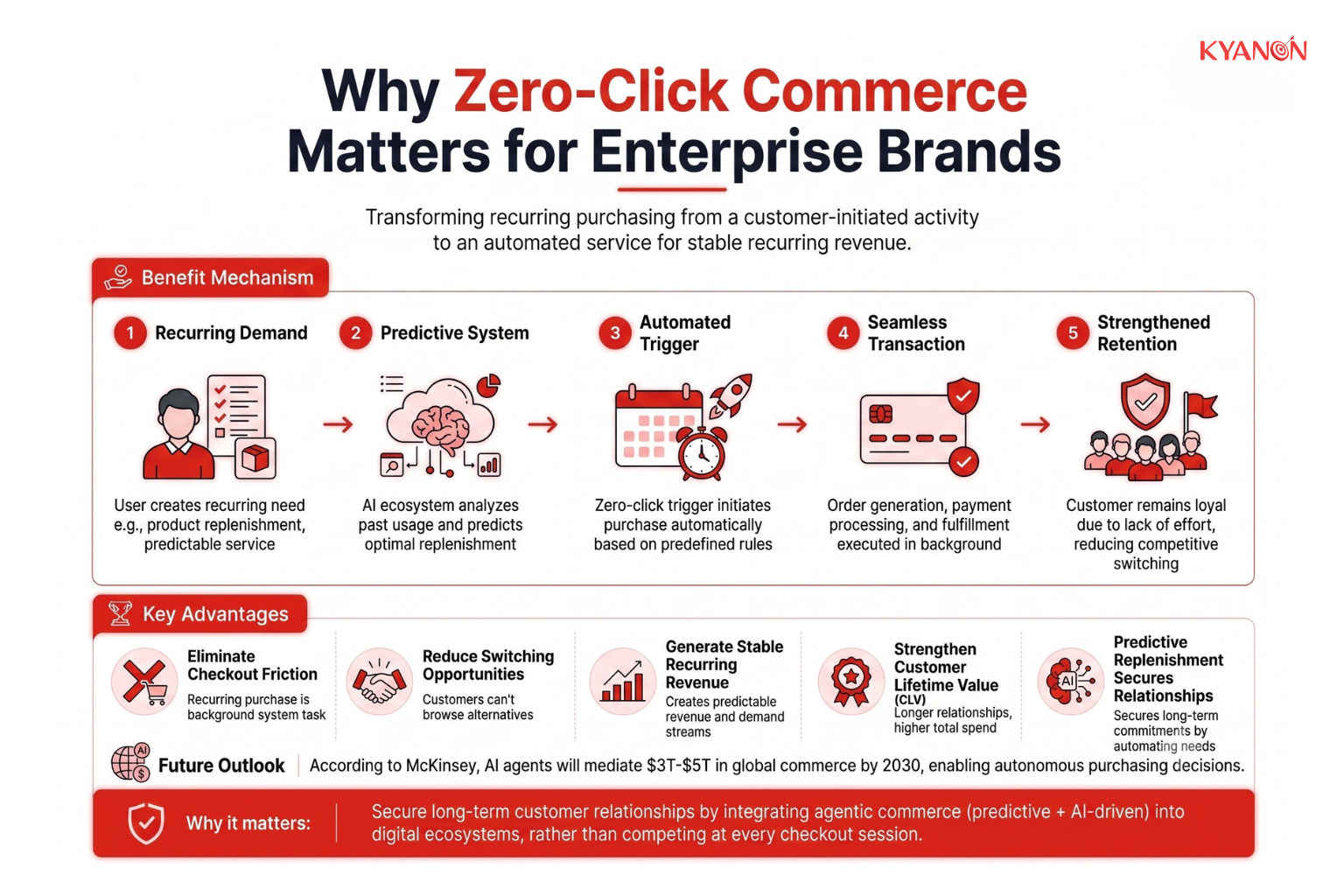
This shift is expected to reshape the future of digital commerce. According to McKinsey, industry projections estimate that AI agents will mediate between US$3 trillion and US$5 trillion in global commerce by 2030, enabling autonomous purchasing decisions on behalf of consumers and businesses. As commerce becomes increasingly agentic, brands that integrate predictive replenishment, AI-driven decision-making, and zero-click purchasing into their digital ecosystems will be better positioned to secure long-term customer relationships. Rather than competing at every checkout session, they can build continuous, automated purchasing experiences that increase customer lifetime value while creating more predictable demand and revenue.
Common Misconceptions
Zero-click commerce eliminates the need for marketing
Brand marketing does not disappear; it evolves into Answer Engine Optimization (AEO) and structured product data management so AI assistants and automated algorithms reliably select your brand over competitors.
Zero-click commerce is strictly limited to impulse buying
While spontaneous social buy-buttons exist, true zero-click commerce relies heavily on predictive replenishment, historical usage tracking, and autonomous AI agents managing routine purchases.
Zero-click commerce makes brand websites obsolete
Brand websites remain essential as authoritative data hubs, providing verified product specifications, pricing, and policy details that AI buying agents scan before approving automated orders.
How Kyanon Digital Applies Zero-Click Commerce
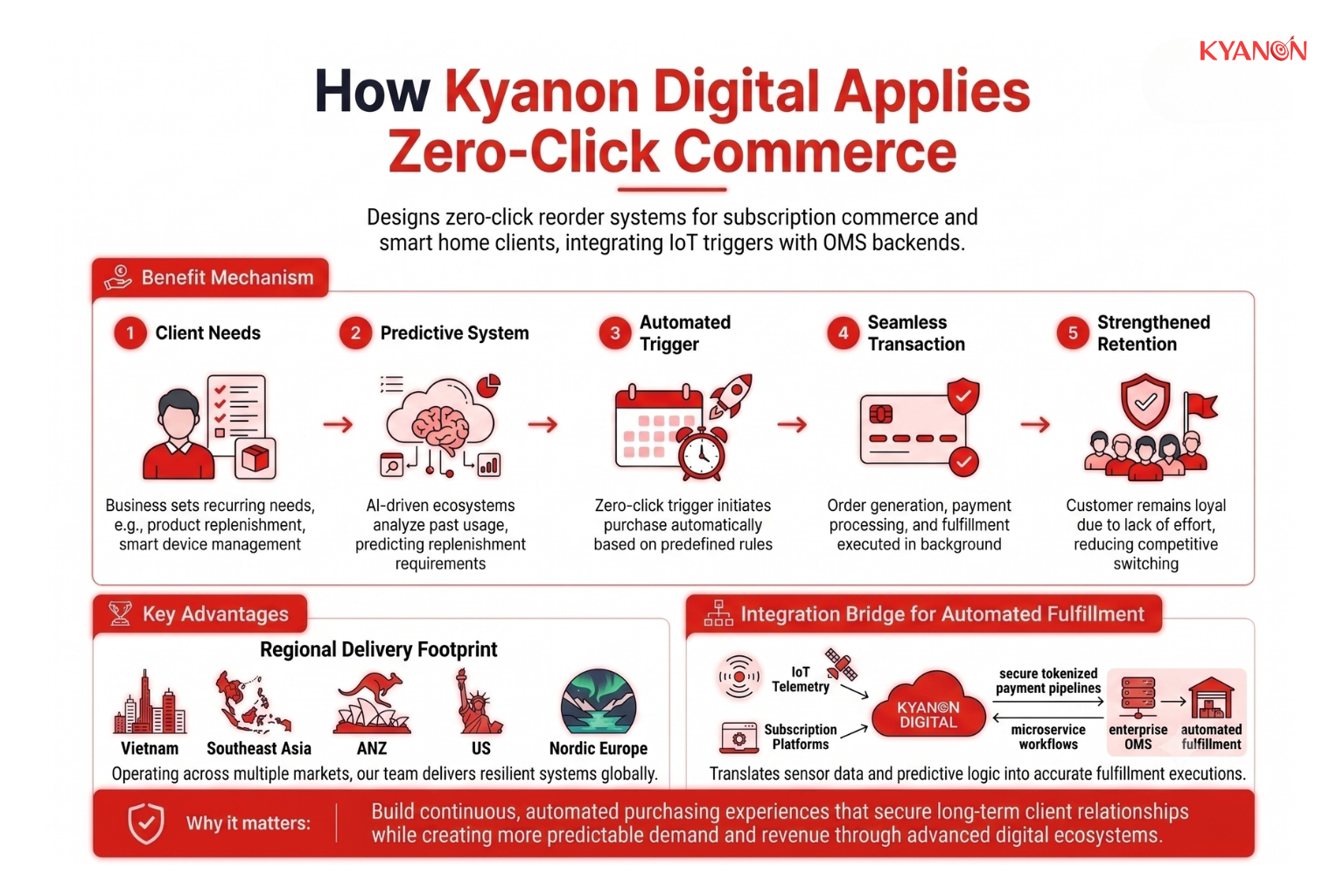
Kyanon Digital designs zero-click reorder systems for subscription commerce and smart home clients, integrating IoT triggers with OMS backends. Operating across Vietnam, Southeast Asia, ANZ, the US, and Nordic Europe, our team builds resilient API integration layers, secure tokenized payment pipelines, and microservice workflows that translate sensor data and predictive logic into automated, high-accuracy fulfillment executions.
Explore our services:











 Create project brief with AI