
What is Search-Driven Commerce?
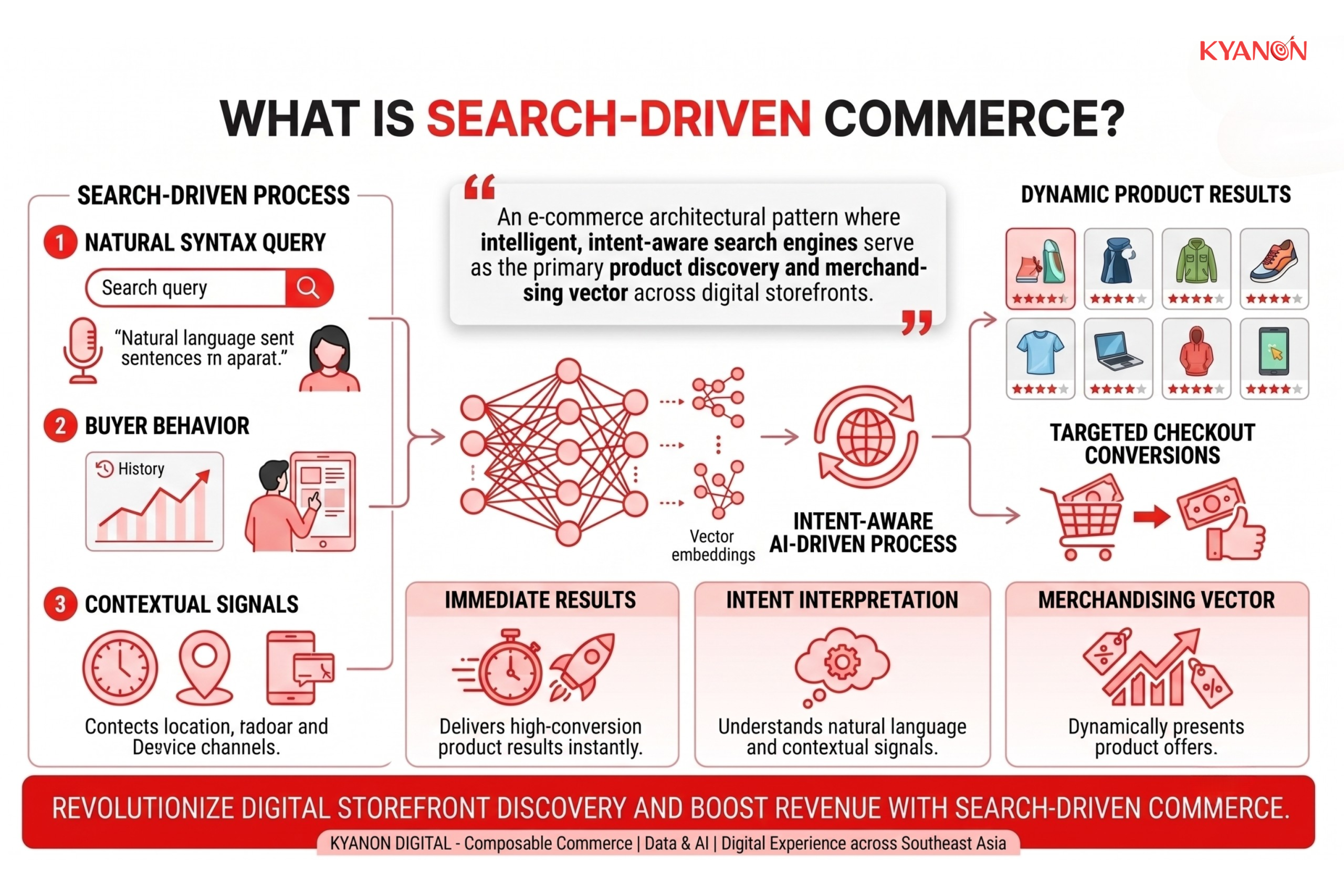
Search-driven commerce is an e-commerce architectural pattern where intelligent, intent-aware search engines serve as the primary product discovery and merchandising vector across digital storefronts. By interpreting natural syntax, buyer behavior, and real-time contextual signals rather than relying solely on static catalog navigation, it delivers immediate, high-conversion product results.
How Search-Driven Commerce Works
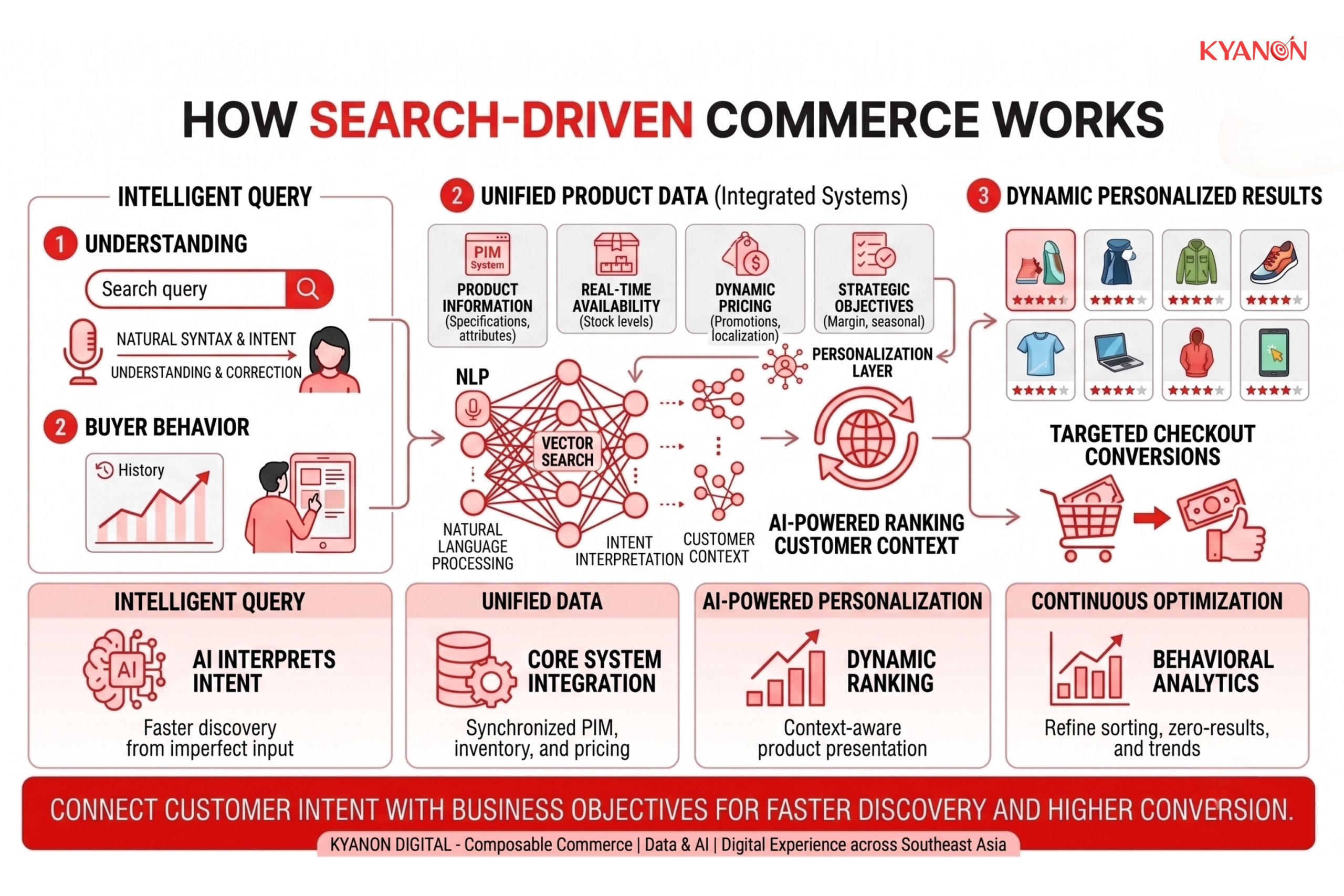
Search-driven commerce transforms product discovery from a static navigation experience into an intelligent, AI-powered capability. Rather than requiring customers to browse through multiple categories and filters, modern search platforms understand user intent and dynamically surface the most relevant products based on context, business rules, and real-time data.
Built on an API-first architecture, the search engine integrates with core enterprise systems, including the Product Information Management (PIM) platform, inventory management, pricing services, CRM, and analytics platforms, to deliver fast, personalized search experiences across every digital touchpoint.
Intelligent Query Understanding
Modern search engines go beyond keyword matching to interpret customer intent.
Key capabilities include:
- Understanding natural language queries
- Recognizing product attributes, brands, and categories
- Correcting spelling errors and identifying synonyms
- Matching customer intent instead of exact keywords
This enables shoppers to find relevant products faster, even when search terms are incomplete or conversational.
Unified Product Data and Merchandising
The search platform continuously synchronizes product information from enterprise systems to ensure search results reflect current business conditions.
It combines:
- Product catalog and specifications from the PIM
- Real-time inventory availability
- Pricing and promotional data
- Regional assortment and localization rules
Merchandising rules can then prioritize products based on strategic objectives such as relevance, inventory levels, promotional campaigns, margin targets, or seasonal collections.
AI-Powered Personalization
Search results are dynamically ranked using real-time customer context instead of displaying the same product list to every visitor.
Ranking signals may include:
- Browsing and purchase history
- Customer preferences
- Geographic location
- Current shopping session
- Cart contents and buying intent
Machine learning models continuously refine rankings to deliver more relevant product recommendations and improve conversion opportunities.
Continuous Optimization Through Analytics
Every search interaction generates behavioral data that can be used to improve both customer experience and merchandising performance.
Enterprise search platforms provide insights into:
- High-performing and low-performing search terms
- Zero-result and abandoned searches
- Product click-through and conversion rates
- Customer demand trends
- Merchandising effectiveness
These insights help commerce teams continuously optimize product discovery, while providing data leaders with actionable intelligence to improve assortment planning, inventory allocation, and digital merchandising strategies.
For enterprise organizations, search-driven commerce is no longer simply a website feature. It is a strategic capability that connects customer intent with business objectives, enabling faster product discovery, more effective merchandising, higher conversion rates, and a more scalable digital commerce operation.
Comparative Analysis: Search-Driven Commerce vs. Traditional Keyword Search
|
Operational Dimension |
Traditional Keyword Search | Search-Driven Commerce (Intent-Aware) |
| Query Processing | Literal string-matching susceptible to typos and structural phrasing errors. |
Semantic NLP and vector matching that parses intent, context, and synonyms. |
|
Catalog Discovery |
Rigid, manual navigation through deep category tree structures. | Instant access to relevant products direct from any storefront interface. |
| Result Personalization | Static output identical for every user querying the same term. |
Dynamic re-ranking based on individual history, real-time context, and margins. |
|
Zero-Result Handling |
Static “No Results Found” screens triggering session drop-off. | Automated recommendations, dynamic attribute relaxation, and alternatives. |
| SEO & Catalog Alignment | Isolated internal search decoupled from structured web metadata. |
Schema-aligned architecture feeding unified discovery across search vectors. |
Why Search-Driven Commerce Matters
For enterprises managing large product catalogs, product discovery has become a strategic business capability rather than a website feature. As assortments expand across channels and markets, traditional category navigation creates friction that slows product discovery, weakens merchandising performance, and limits revenue opportunities. Enabling customers to find the right products quickly is now essential for maximizing the value of digital traffic and improving commercial outcomes.
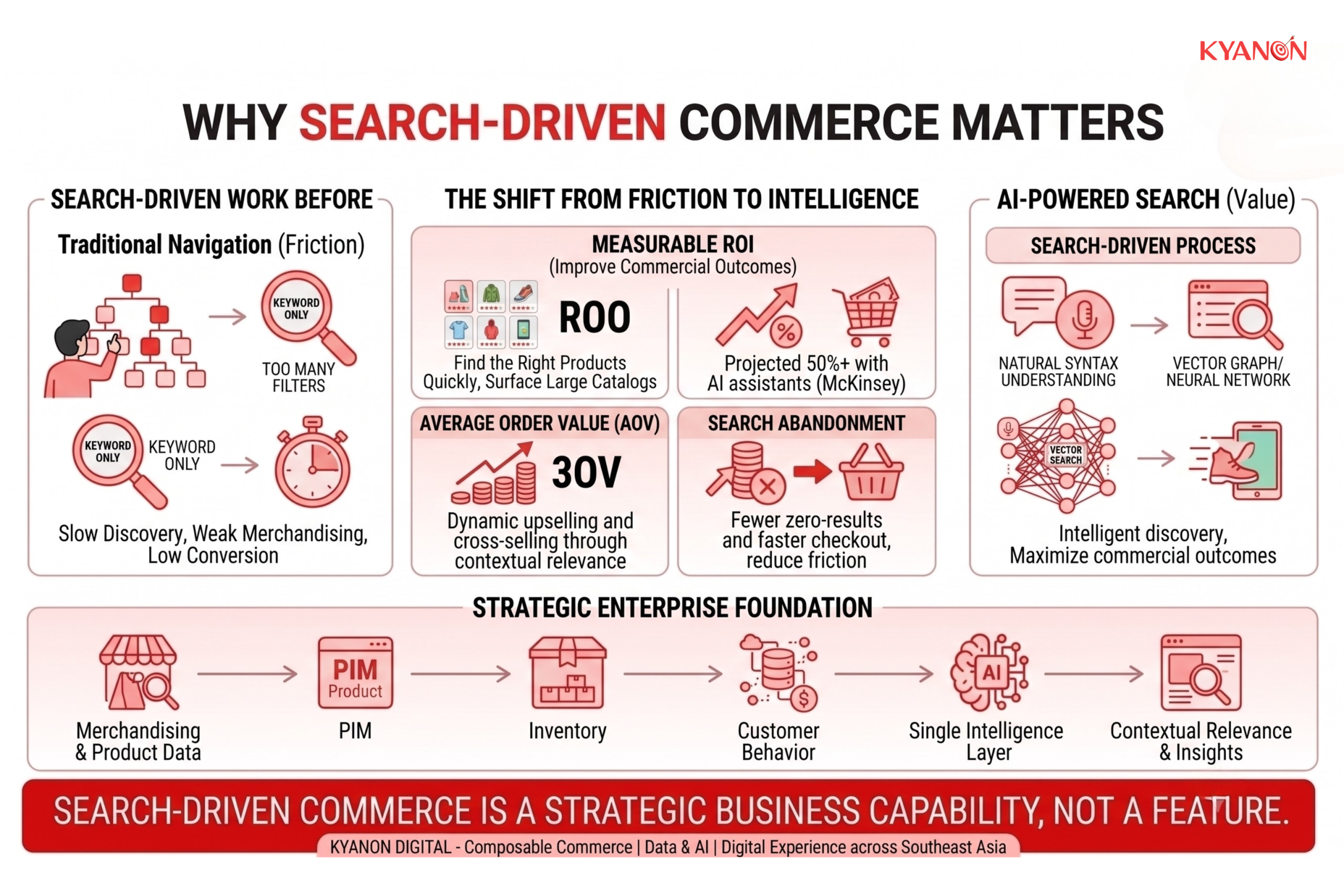
The importance of intelligent search is increasing as commerce becomes increasingly AI-driven. According to McKinsey, e-commerce is projected to grow by 5–7% annually, while 38% of European consumers already use GenAI to research products and inform purchasing decisions. McKinsey also reports that leading retailers achieve conversion rates of 50% or higher through AI-powered shopping assistants, demonstrating how conversational and intent-based product discovery can create measurable commercial value. As customer expectations shift from keyword search to natural language interactions, retailers require search capabilities that understand intent, product attributes, and contextual relevance.
For enterprise leaders, Search-Driven Commerce extends beyond improving customer experience. AI-powered search connects merchandising, product data, inventory, and customer behavior into a single intelligence layer that helps surface the most relevant products, optimize digital merchandising, and generate actionable insights into customer demand. These capabilities enable commerce teams to improve product discoverability, technology leaders to build scalable search infrastructure, and data teams to continuously optimize search performance based on real customer behavior.
As AI increasingly mediates how products are discovered and evaluated, Search-Driven Commerce becomes a foundational capability for scalable digital commerce, strengthening revenue growth, merchandising effectiveness, and long-term competitiveness.
Common Misconceptions
The Keyword Matching Fallacy
Standard keyword search fails when users enter typos, regional colloquialisms, or natural syntax phrases. Intent-driven commerce requires semantic AI search engines that interpret the underlying meaning of queries rather than relying on exact string matches against catalog text.
The Personalization is Just a Buzzword Myth
Serving identical search result lists to every user for a given query overlooks valuable behavioral data. Personalization optimizes search output by adjusting rankings dynamically based on real-time browsing patterns, geographic context, and historical preferences, directly increasing conversion efficiency.
The Three-Click Rule Illusion
Restricting catalog depth to meet rigid three-click limits often creates overcrowded interfaces and causes decision fatigue. Modern user experience data demonstrates that shoppers comfortably navigate multi-step flows provided each step offers clear visual cues, making intuitive search filters more effective than artificially flattened menus.
The Zero Results are a Dead End Oversight
A blank “no results found” page breaks user engagement and leads to immediate site abandonment. High-performing commerce architectures handle out-of-stock or unmapped queries by automatically presenting close category alternatives, related product recommendations, or contextual support options.
The SEO and On-Site Search are Separate Blind Spot
Treating external search engine optimization (SEO) and internal site search as isolated systems creates catalog inconsistencies. Aligning internal search indexing with structured schema markups and rich product descriptions improves overall content discovery across both external AI search tools and internal storefront queries.
How Kyanon Digital Applies Search-Driven Commerce
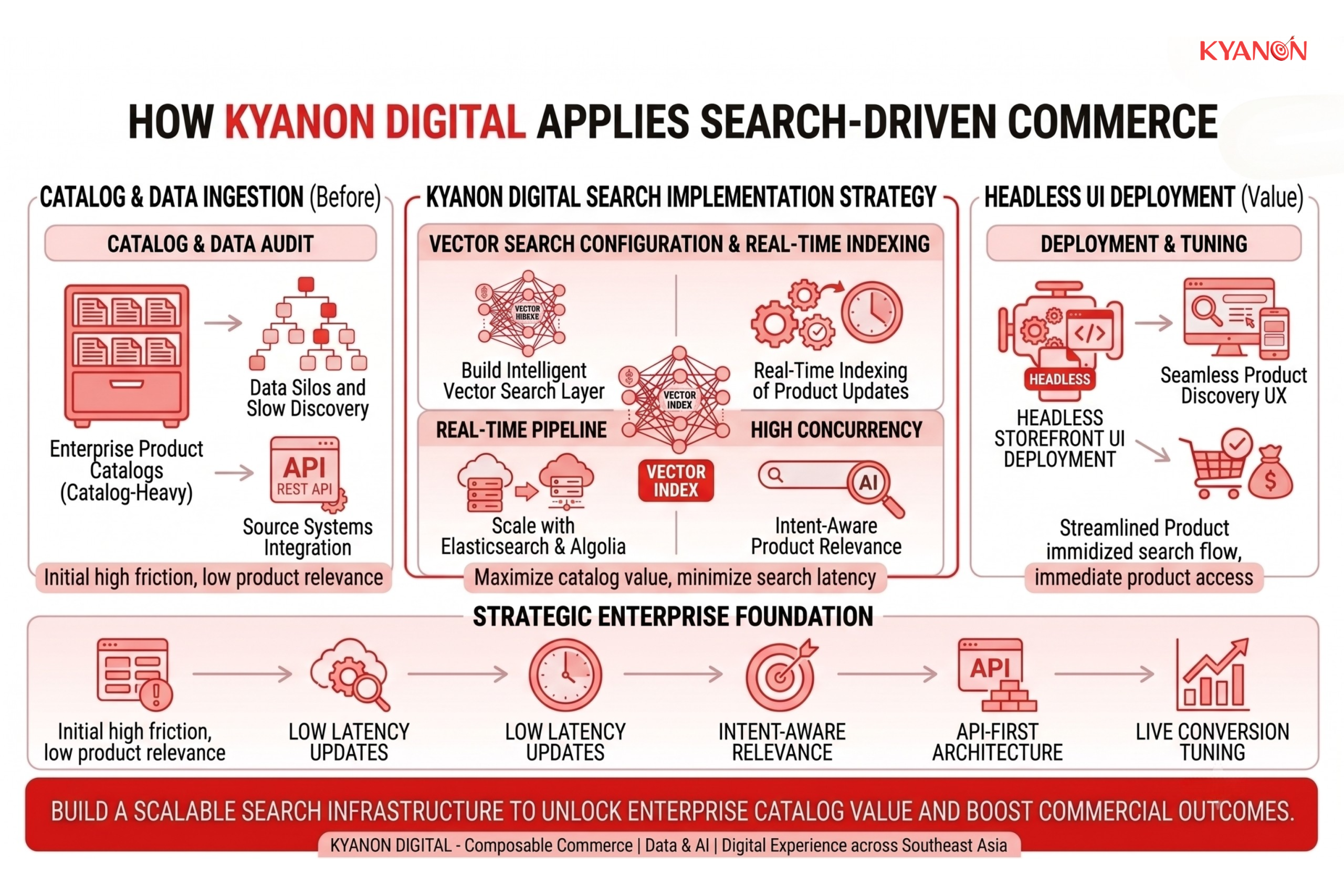
Kyanon Digital implements high-concurrency search architectures using Elasticsearch and Algolia for catalog-heavy enterprise clients across Asia-Pacific. Our software engineering teams integrate real-time indexing pipelines, custom vector search layers, and API-first commerce frameworks to streamline product discovery and maximize checkout conversions.
Explore our services:











 Create project brief with AI