
What is a Social Proof Engine?
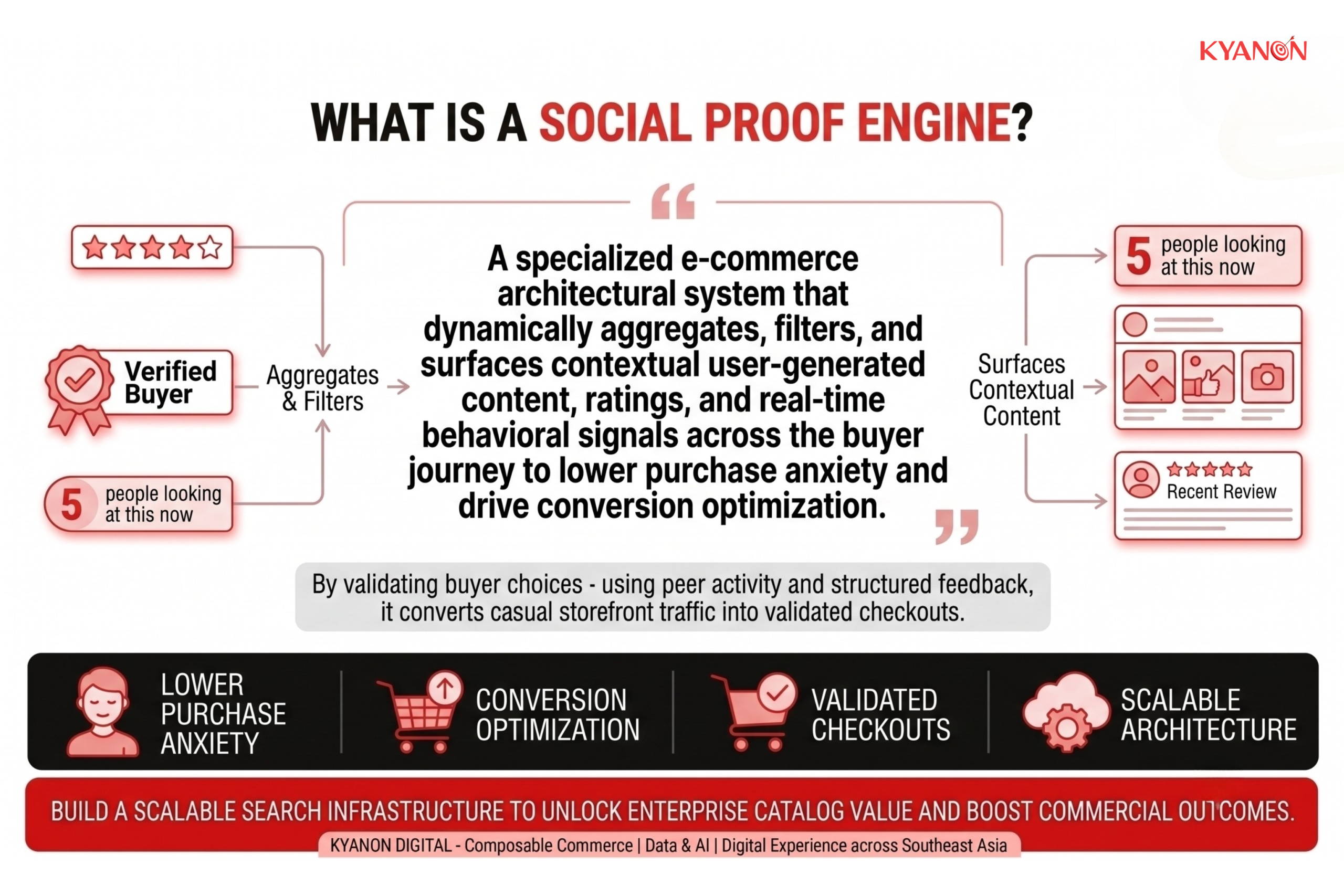
A social proof engine is a specialized e-commerce architectural system that dynamically aggregates, filters, and surfaces contextual user-generated content, ratings, and real-time behavioral signals across the buyer journey to lower purchase anxiety and drive conversion optimization. By validating buyer choices using peer activity and structured feedback, it converts casual storefront traffic into validated checkouts.
How a Social Proof Engine Works
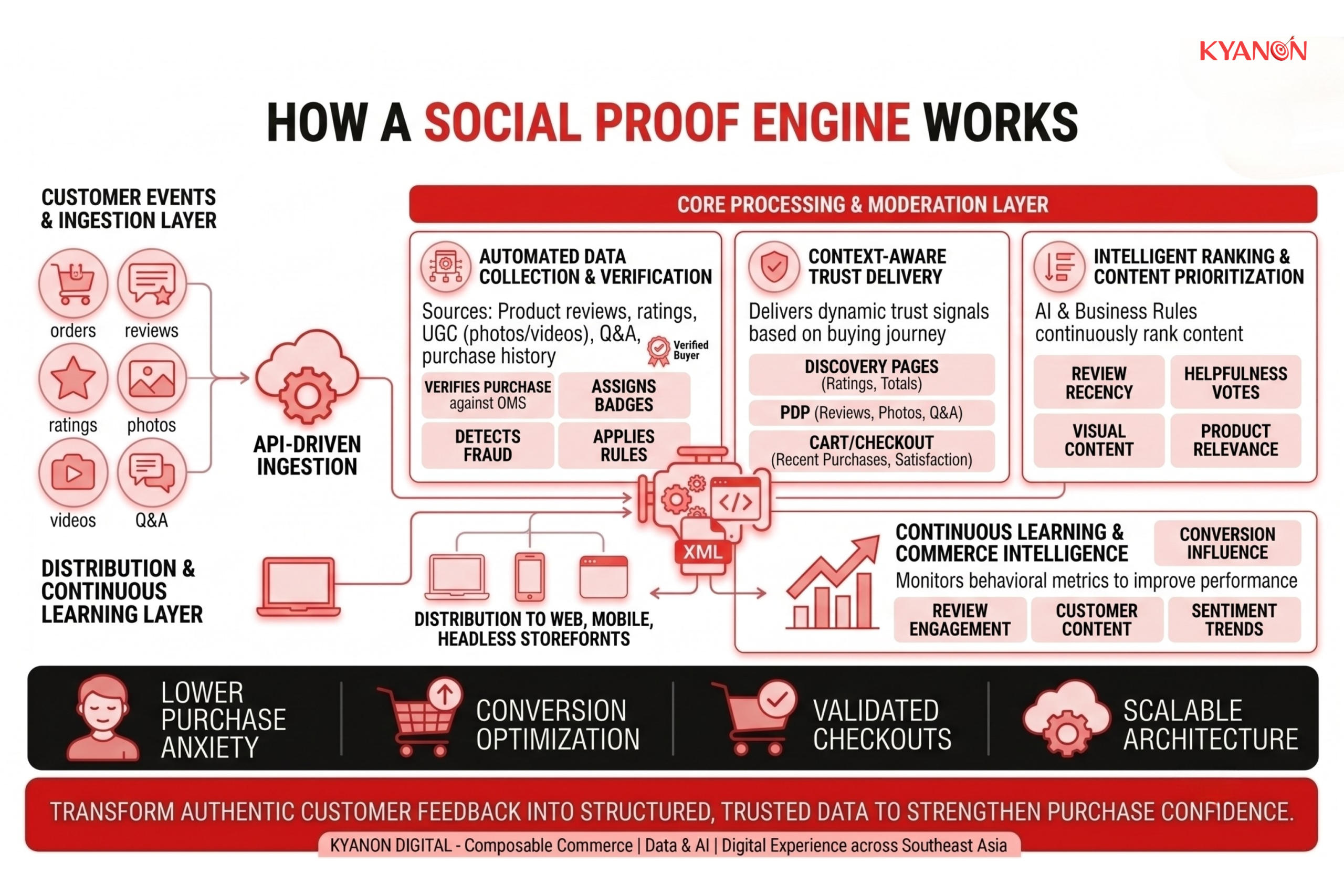
A modern social proof engine transforms customer interactions into trusted, real-time signals that reinforce purchasing decisions throughout the digital commerce journey. Rather than displaying static reviews on product pages, enterprise platforms use API-first, event-driven architectures to collect, verify, analyze, and distribute customer-generated content across every customer touchpoint.
By integrating with commerce platforms, Order Management Systems (OMS), Customer Relationship Management (CRM) platforms, and Customer Data Platforms (CDPs), the engine continuously delivers context-aware trust signals that adapt to both customer behavior and business objectives.
Automated Data Collection and Verification
The social proof engine continuously captures customer-generated content from multiple sources across the commerce ecosystem.
Common data sources include:
- Verified product reviews
- Ratings and customer feedback
- User-generated photos and videos
- Product questions and answers
- Purchase and order history
- Customer service interactions
Before publishing, the platform automatically:
- Verifies completed purchases against the Order Management System
- Assigns Verified Buyer badges
- Detects duplicate or fraudulent submissions
- Applies moderation policies and compliance rules
This automated verification process improves content quality while increasing customer confidence in review authenticity.
Context-Aware Trust Delivery
Rather than displaying identical trust signals across every page, enterprise platforms dynamically determine which social proof is most relevant based on the customer’s position in the buying journey.
Examples include:
Discovery pages
- Overall customer ratings
- Total verified reviews
- Brand awards and recognition
- Number of customers served
Product Detail Pages (PDPs)
- Verified Buyer reviews
- Customer photos and videos
- Product-specific Q&A
- Size, fit, or usage feedback
Cart and Checkout
- Recent purchase activity
- Delivery satisfaction ratings
- Return experience insights
- Trust and security indicators
Delivering the right trust signal at the right moment helps reduce purchase uncertainty while improving conversion opportunities.
Intelligent Ranking and Content Prioritization
As review volumes grow, simply displaying content chronologically becomes less effective.
Modern social proof engines continuously rank content using AI and business rules that prioritize factors such as:
- Review recency
- Helpfulness and customer votes
- Visual content (photos and videos)
- Product relevance
- Verified purchase status
- Customer engagement
This dynamic ranking ensures shoppers see the most relevant and credible content first while keeping product pages fresh and informative.
Continuous Learning and Commerce Intelligence
Every interaction with social proof generates valuable behavioral insights that can be used to improve both customer experience and commercial performance.
Enterprise platforms monitor metrics including:
- Review engagement
- Conversion influenced by reviews
- Most helpful customer content
- Frequently asked product questions
- Product sentiment trends
These insights can be shared across merchandising, marketing, product, and customer experience teams to improve product content, optimize campaigns, identify quality issues, and inform merchandising decisions.
For enterprise retailers, a social proof engine is more than a review management tool. It is a strategic commerce capability that transforms authentic customer feedback into structured, trusted data, strengthening purchase confidence, improving AI discoverability, and enabling more effective merchandising across every digital channel.
Comparative Analysis: Social Proof Engine vs. Static Native Reviews
|
Operational Dimension |
Static Native Reviews | Dynamic Social Proof Engine |
| Data Ingestion | Manual database entries or simple native text forms. |
Real-time API pipelines capturing text, visual media, and event counters. |
|
Funnel Adaptability |
Identical rating displays shown universally across all pages. | Stage-specific proof tailored to buyer position (discovery vs. checkout). |
| Trust Verification | Susceptible to unverified reviews and score manipulation. |
Automated order-matching verifying purchase authenticity and identity. |
|
Content Velocity |
Stagnant review feeds that age over long periods. | Algorithmic decay prioritizing recent activity and real-time velocity signals. |
| Personalization Capability | Generic sorting by star rating or chronological date. |
Attribute matching sorting reviews by visitor demographics and use cases. |
Why a Social Proof Engine Matters
For enterprise retailers, sustainable e-commerce growth depends not only on acquiring traffic but also on maximizing the commercial value of every customer interaction. As acquisition costs continue to rise and AI increasingly influences product discovery, trust has become a measurable business asset rather than a purely marketing objective. Building and governing trusted customer signals at scale is now essential to improving conversion, strengthening digital visibility, and supporting long-term growth.
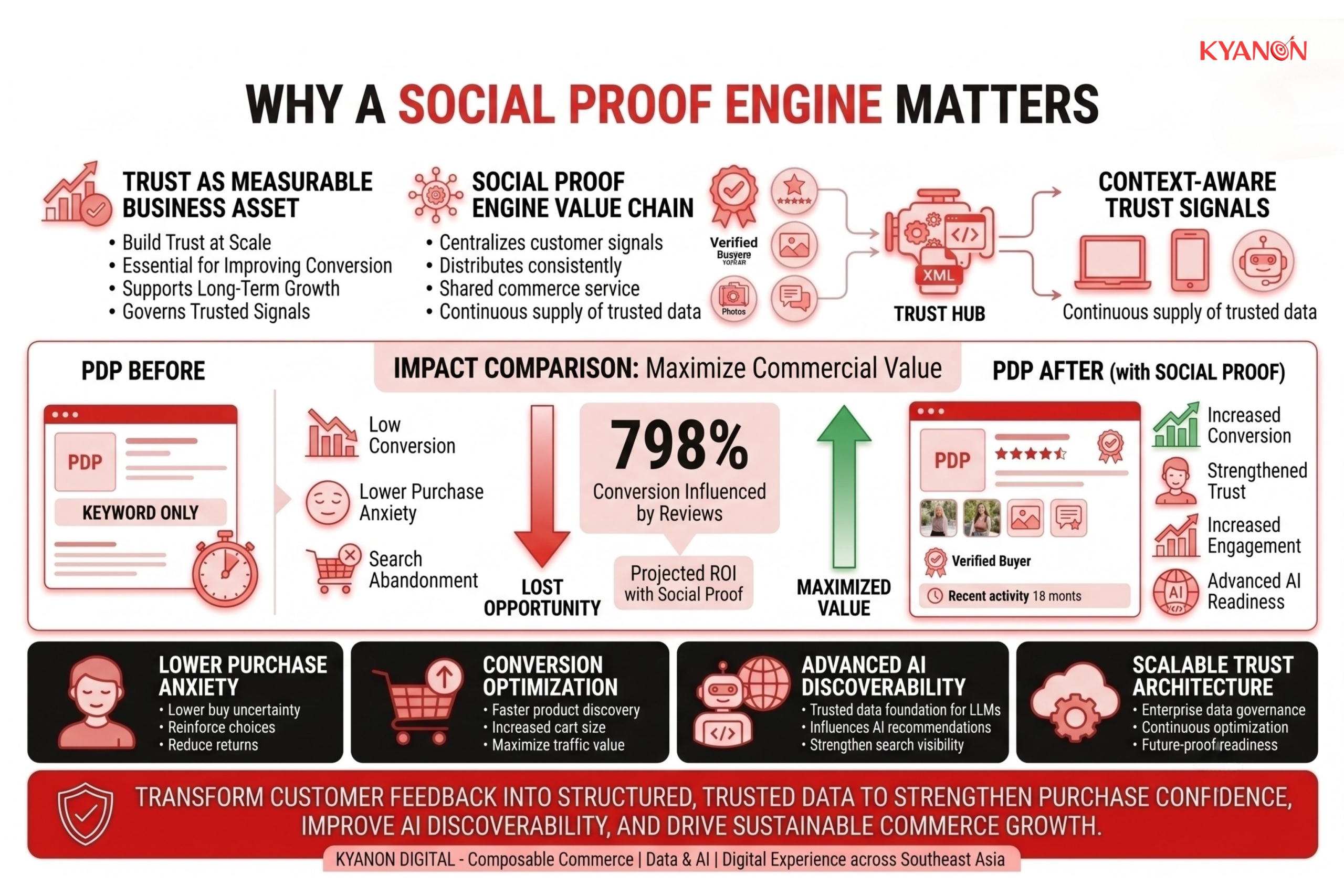
A modern Social Proof Engine centralizes customer-generated signals, including verified ratings, reviews, user-generated content (UGC), purchase validation, and customer Q&A, and distributes them consistently across Product Detail Pages (PDPs), search experiences, recommendation engines, and checkout. Rather than operating as an isolated reviews widget, it becomes a shared commerce service that continuously supplies trusted data across the entire digital ecosystem.
Its strategic value extends beyond improving on-site conversion. According to McKinsey, 23% of Gen Z consumers discover new brands through social media, while 34% rely on social media during purchase decisions, demonstrating the growing influence of peer-generated content throughout the buying journey. McKinsey also found that brand-owned websites contribute only 1–2% of the sources cited by large language models (LLMs). Instead, AI platforms increasingly rely on retailer reviews, online forums, blogs, and video platforms when generating product recommendations.
For enterprise leaders, this signals a broader shift in how digital commerce operates. Customer reviews and user-generated content are no longer simply marketing assets, they have become part of the data foundation that influences both customer decisions and AI-driven discovery. Organizations that can govern, verify, and distribute these trust signals consistently across channels are better positioned to improve search visibility, strengthen merchandising performance, and increase conversion across AI-powered commerce experiences.
As commerce evolves toward AI-assisted and agentic shopping, social proof should be treated as structured enterprise data rather than standalone content. Investing in a Social Proof Engine enables retailers to create a scalable trust architecture that supports digital merchandising, enhances AI readiness, and establishes a sustainable competitive advantage across the next generation of commerce.
Common Misconceptions
The More is Always Better Fallacy
Flooding a product detail page with constant pop-ups, badges, and review counts does not maximize buyer trust. Excessive widgets trigger immediate banner blindness and conversion fatigue; high-volume, uncalibrated notifications (such as repeating “Someone just bought this!” alerts) interrupt the checkout flow, increase bounce rates, and harm store credibility.
The Perfect 5.0 Star Illusion
Research from Northwestern University’s Medill Spiegel Research Center shows that purchase likelihood peaks when product ratings are between 4.2 and 4.5 stars, rather than a perfect 5.0. This behavioral analysis suggests that consumers view flawless ratings with skepticism, finding that a mix of feedback builds essential trust and authenticity.
The All Reviews are Created Equal Myth
Simple text reviews do not provide the same conversion lift as multimedia or verified content. High-converting social proof engines prioritize structured assets, such as user-submitted photos, videos, and verified-buyer badges, allowing modern shoppers to filter reviews by body type, skin tone, or specific use cases.
The Set It and Forget It Oversight
Installing a social proof tool once without ongoing management leads to degrading performance over time. Social proof carries a strict operational expiration date; static reviews from several years ago indicate diminishing product momentum, requiring engines to continually cycle fresh data and emphasize real-time purchasing velocity.
The One-Size-Fits-All Display Blind Spot
Displaying identical social proof widgets across every page fails to move buyers through the conversion funnel. Effective engines tailor presentation layers dynamically, serving high-level macro proof (such as press logos or celebrity endorsements) on top-of-funnel landing pages, while delivering targeted micro proof (such as secure checkout badges or explicit shipping guarantees) at payment steps.
How Kyanon Digital Applies a Social Proof Engine
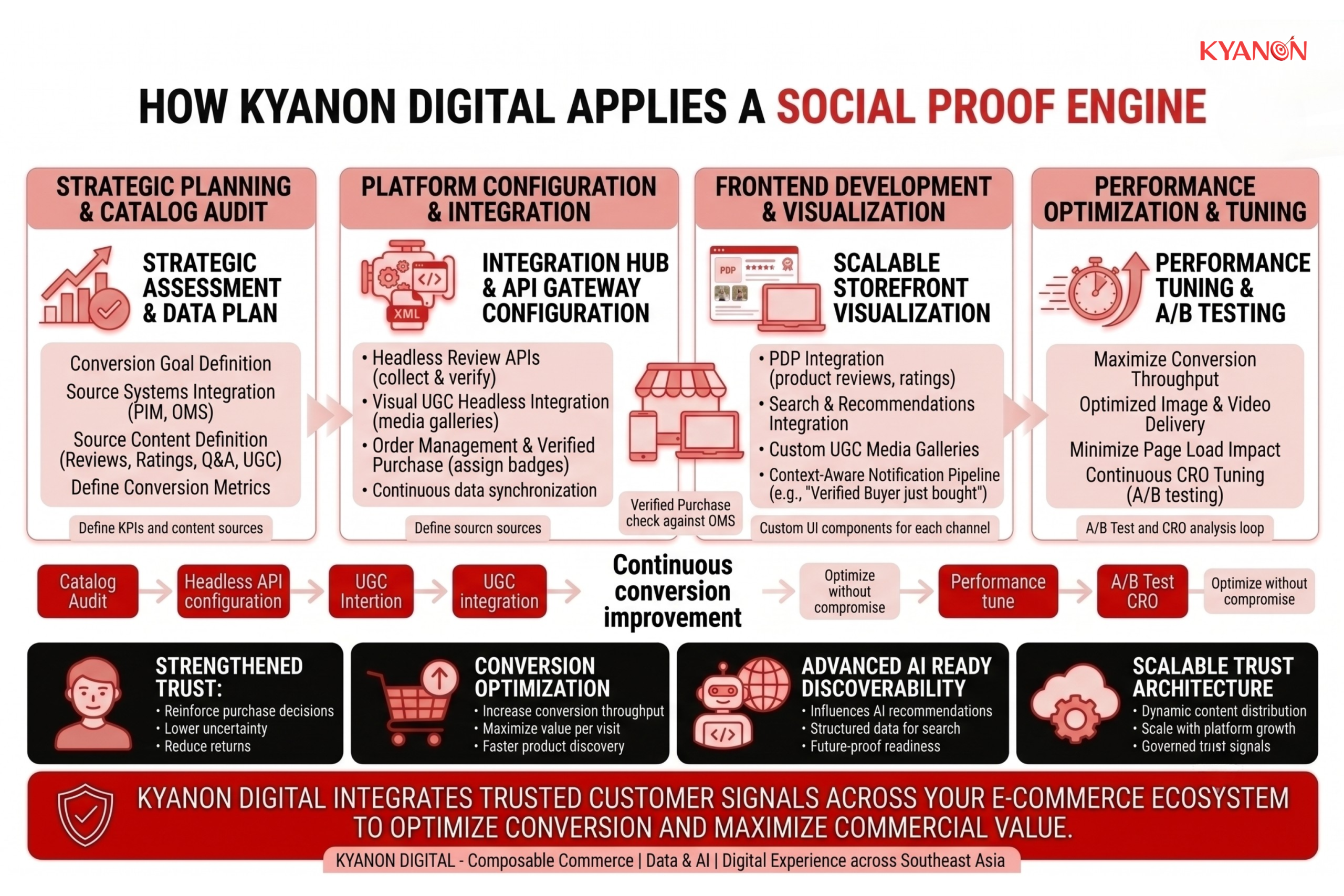
Kyanon Digital integrates social proof engines into product detail pages as a core component of conversion rate optimization (CRO) and custom e-commerce builds for retail platforms across Southeast Asia. Our engineering teams integrate headless review APIs, custom UGC media galleries, and dynamic notification pipelines into scalable storefronts to maximize conversion throughput without compromising page performance.
Explore our services:











 Create project brief with AI