
What is a Store Credit System?
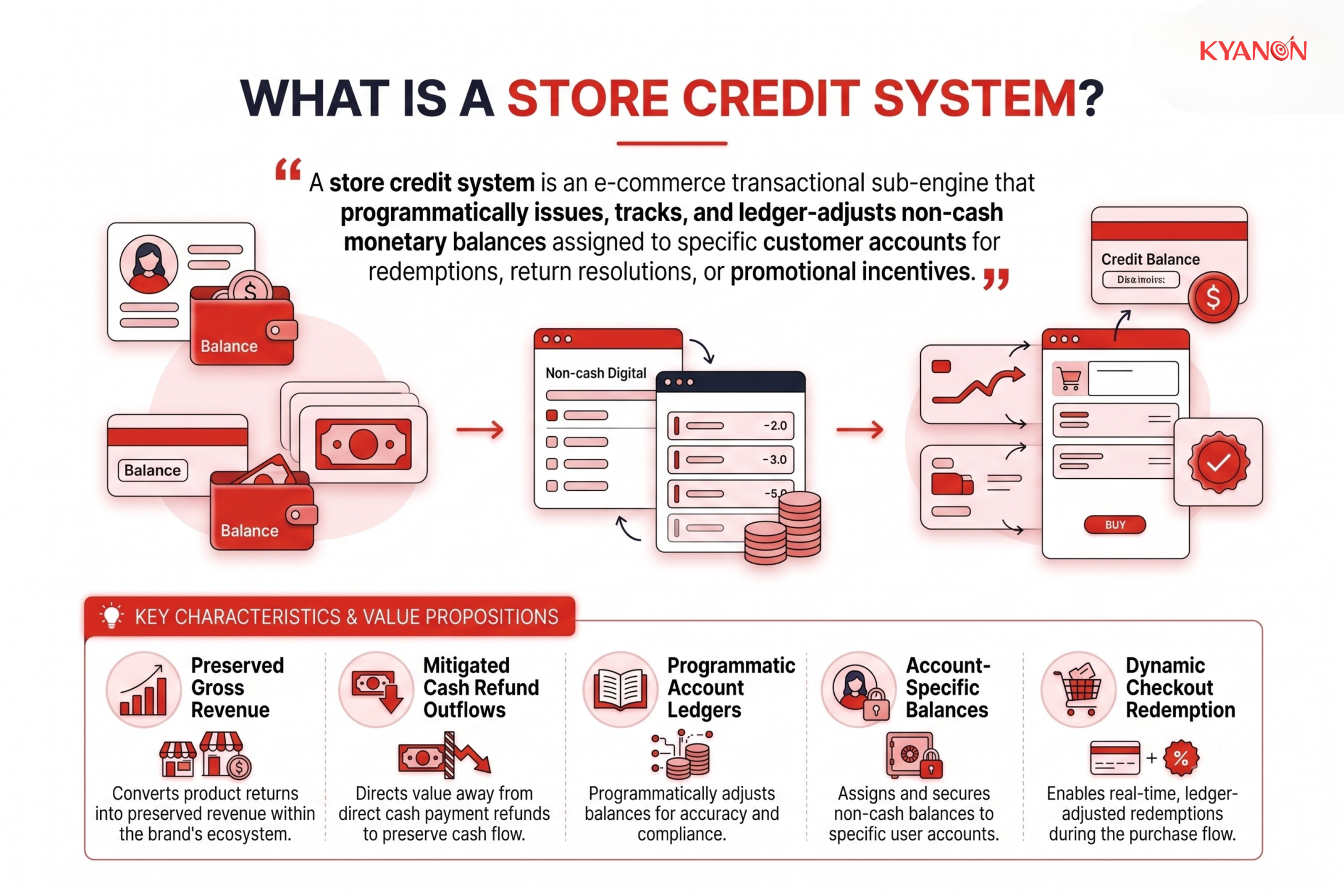
A store credit system is an e-commerce transactional sub-engine that programmatically issues, tracks, and ledger-adjusts non-cash monetary balances assigned to specific customer accounts for redemptions, return resolutions, or promotional incentives. By capturing value within the brand’s digital ecosystem, it converts product returns into preserved gross revenue while mitigating direct cash payment refund outflows.
How a Store Credit System Works
A modern store credit system is more than a digital wallet, it is a core component of the commerce architecture that manages post-purchase value across the customer lifecycle. It integrates with the commerce platform, Order Management System (OMS), Customer Relationship Management (CRM), payment gateway, and financial ledger to automate credit issuance, redemption, and reconciliation.
Rather than storing store credit as a simple database value, enterprise platforms use event-driven workflows and double-entry accounting to ensure every transaction is accurate, auditable, and synchronized across web, mobile, and in-store channels.
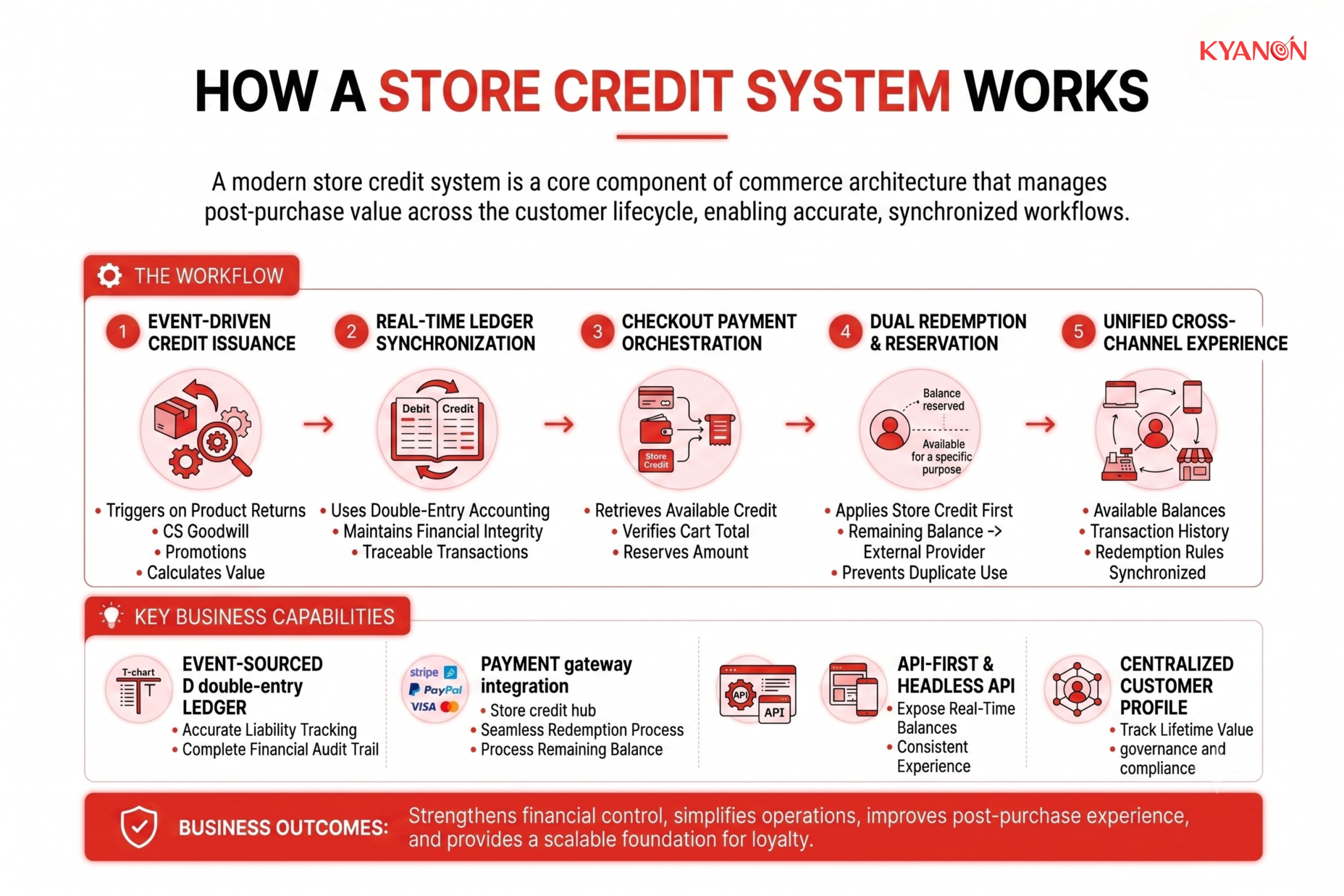
Event-Driven Credit Issuance
Store credit is automatically issued whenever predefined business events occur, allowing retailers to replace manual refund processes with standardized, policy-driven automation.
Common trigger events include:
- Product returns and exchanges
- Compensation for fulfillment or shipping issues
- Customer service goodwill credits
- Loyalty rewards and promotional campaigns
Once an event is triggered, the system automatically:
- Calculates the approved credit value based on configurable business rules
- Applies bonus incentives or promotional credit when applicable
- Generates an immutable ledger transaction with a unique transaction ID
- Updates the customer’s store credit balance through secure APIs in real time
This event-driven approach reduces operational overhead while ensuring every credit transaction is fully traceable and consistently applied.
Real-Time Ledger Synchronization
To maintain financial accuracy and prevent fraud, enterprise store credit platforms use an event-sourced, double-entry ledger rather than a single balance field.
Every credit issuance, redemption, expiration, or adjustment generates matching debit and credit entries that update customer balances instantly while maintaining accounting integrity.
This architecture enables:
- Real-time balance synchronization across web, mobile, and POS channels
- Complete audit trails for finance and compliance teams
- Accurate liability tracking and financial reconciliation
- Protection against duplicate transactions and race conditions
By treating store credit as a financial liability instead of a simple customer attribute, organizations gain stronger governance and more reliable financial reporting.
Checkout Payment Orchestration
During checkout, the store credit service operates as part of the payment orchestration layer, working alongside payment gateways, digital wallets, and credit cards.
Before payment is finalized, the system automatically:
- Authenticates the customer session and retrieves available credit.
- Verifies the balance against the current cart total.
- Reserves the required credit amount to prevent concurrent usage.
- Applies store credit as the primary or secondary payment method based on predefined rules.
- Processes any remaining balance through external payment providers.
This orchestration enables customers to redeem store credit seamlessly while ensuring accurate payment reconciliation across every transaction.
Unified Customer Experience Across Channels
Because the store credit engine is integrated across the broader commerce ecosystem, customers have a consistent experience regardless of where they interact with the brand. Whether shopping online, through a mobile app, or at a physical store, available balances, transaction history, and redemption rules remain synchronized in real time.
For enterprise retailers, this unified architecture not only improves the post-purchase experience but also strengthens financial control, simplifies operations, and provides a scalable foundation for loyalty programs, personalized promotions, and future AI-driven commerce initiatives.
Comparative Analysis: Store Credit System vs. Cash Refunds
|
Operational Dimension |
Direct Cash Refunds (Credit Card / Bank) | Automated Store Credit System |
| Cash Outflow Impact | Direct, immediate loss of working capital and gross liquidity. |
Retains capital inside the business ecosystem as deferred revenue. |
|
Transaction Processing Fees |
Incurs non-refundable interchange and payment gateway processing fees. | Zero external payment processor fees upon credit issuance and internal redemption. |
| Customer Retention Velocity | High risk of permanent customer churn post-refund transaction. |
Incentivizes immediate repeat transactions and preserves Customer Lifetime Value (LTV). |
|
Accounting Architecture |
Simple reversal of top-line revenue and asset accounts. | Requires real-time unearned liability tracking, breakage calculation, and escheatment compliance. |
| Incentive Flexibility | Fixed strictly at 100% of the original net purchase price. |
Configurable to offer variable bonus values (e.g., 110% value in credit) to retain sales. |
Why a Store Credit System Matters
For enterprise retailers, returns are no longer simply a post-purchase service process, they represent a strategic financial and operational challenge. As transaction volumes grow and customer acquisition costs remain high, every cash refund impacts working capital, reduces recoverable revenue, and increases reverse logistics costs. Managing returns efficiently has therefore become a critical lever for protecting profitability while supporting sustainable growth.
A modern Store Credit System enables retailers to retain value within their commerce ecosystem by replacing immediate cash refunds with digital store credit. Beyond preserving liquidity, it encourages future purchases while automating the end-to-end management of store credit across the commerce platform, Order Management System (OMS), payment infrastructure, CRM, and financial systems. This creates a standardized, scalable process that reduces manual effort, improves financial accuracy, and simplifies reconciliation across channels.
The strategic value of a Store Credit System extends beyond returns management. According to McKinsey, 28% of Gen Z consumers already use GenAI tools for shopping, compared with 16% of Baby Boomers, while 60% of Gen Z regularly use AI-generated search overviews during product research. As AI increasingly influences how consumers discover, evaluate, and purchase products, expectations for seamless digital experiences now span the entire customer journey, including returns and post-purchase interactions. Retailers that modernize these experiences are better positioned to strengthen customer loyalty, improve retention, and maximize customer lifetime value.
For enterprise leaders, a Store Credit System is more than a refund mechanism. It is a strategic commerce capability that strengthens cash flow management, standardizes post-purchase operations, and creates a scalable foundation for omnichannel commerce and AI-enabled customer experiences.
Common Misconceptions
The Free Money Fallacy
Issuing store credit costs the business nothing since it requires no immediate cash payout. Store credit represents deferred liability and a legally binding obligation to deliver future physical or digital inventory. If an e-commerce organization over-issues credit without accounting for future margin compression and cost-of-goods-sold (COGS) impacts, it risks creating an artificial surge in future sales volume that yields zero new working capital.
The Breakage is Always Profitable Illusion
Maximizing breakage, the percentage of issued credit that expires unused, is a win for the bottom line. While unredeemed balances eventually allow finance teams to write off unearned liabilities, high breakage rates typically signal customer disengagement. Forcing aggressive expiration dates or complex redemption rules alienates buyers, permanently destroying their long-term Customer Lifetime Value (LTV).
The Equivalent to Cash Refunds Myth
Customers view store credit and direct-to-card cash refunds as interchangeable options for product returns. Shoppers experience immediate friction when forced to accept store credit for returned items against their preference. To drive voluntary store credit adoption over cash refunds, merchants must offer a tangible incentive to offset the perceived restriction of funds.
The Set and Forget Expirations Oversight
A business can set any expiration policy it wants for store credit to clear outstanding liabilities off its balance sheet. Store credit systems are bound by regional regulatory legal frameworks, gift card statutes, and escheatment laws. In many global jurisdictions, setting premature expiration dates or deducting inactivity fees from unused balances can lead to regulatory non-compliance fines and class-action legal liability.
The Siloed from Loyalty Programs Blind Spot
Store credit engines and customer loyalty point systems should be operated as entirely separate tech stacks. Isolating credit from loyalty architectures creates a fragmented, confusing user experience. Modern digital commerce stacks unify store credit balances, promotional gift cards, and earned loyalty point conversions into a single digital wallet, giving customers complete visibility and redemption control at checkout.
How Kyanon Digital Applies a Store Credit System
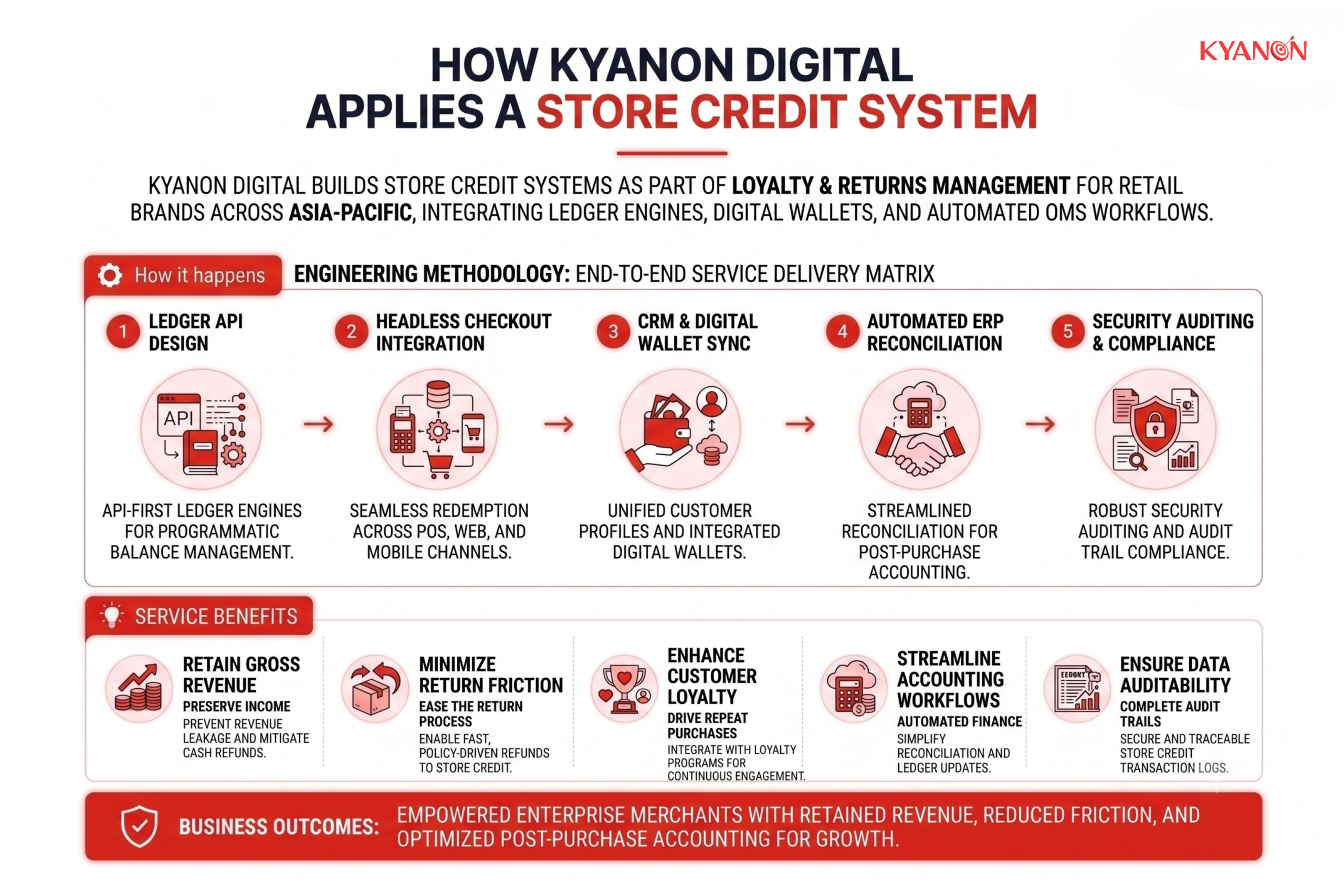
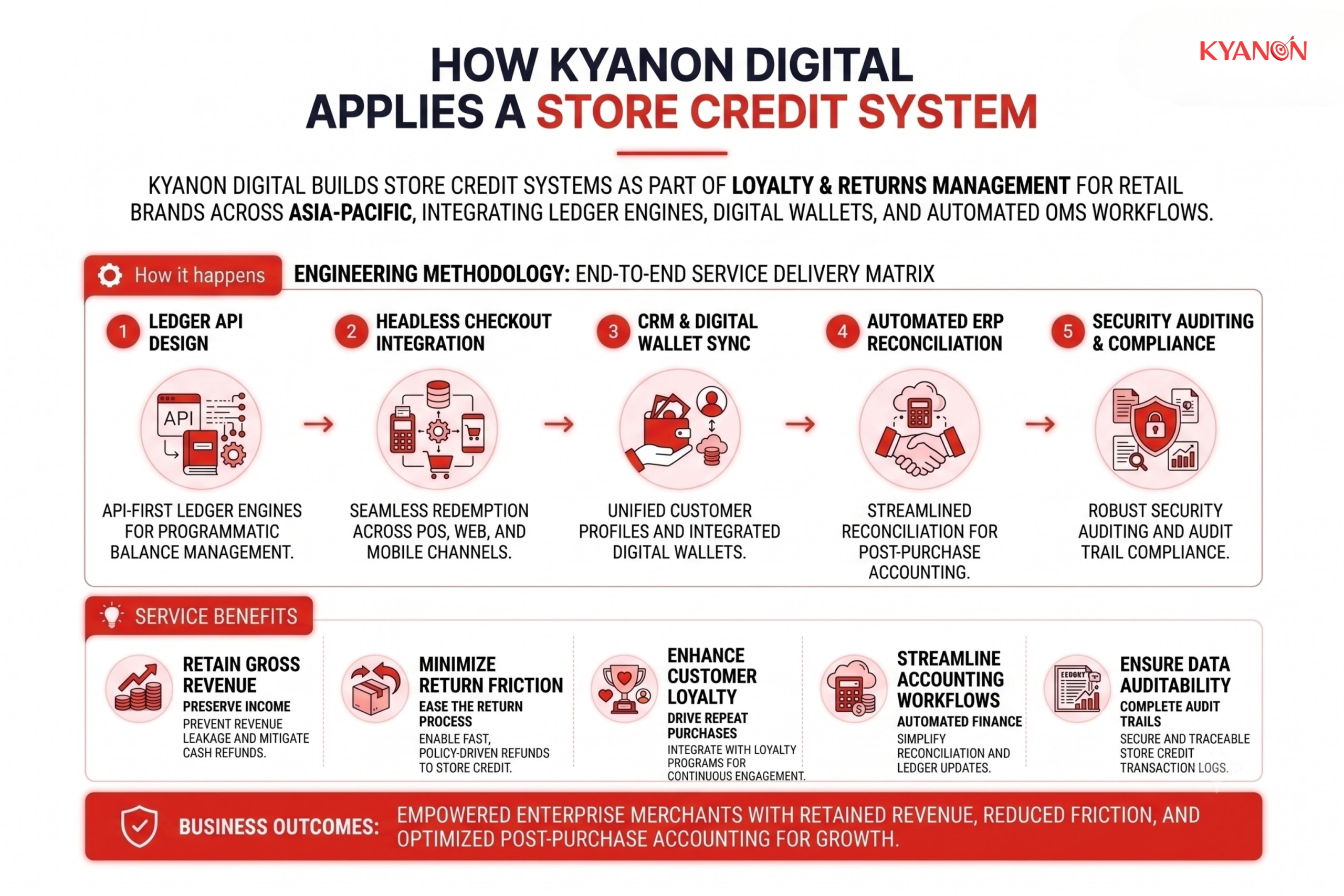
Kyanon Digital builds store credit as part of loyalty and returns management in eCommerce systems for retail brands across Asia-Pacific. Our software engineering teams integrate API-first ledger engines, unified CRM digital wallets, and automated OMS workflows to help enterprise merchants retain gross revenue, minimize return friction, and streamline post-purchase accounting workflows.
Explore our services:











 Create project brief with AI