


What is Virtual Try-On?
Virtual Try-On (VTO) is an e-commerce technology leveraging augmented reality (AR), computer vision, and artificial intelligence (AI) to enable consumers to visualize products, such as apparel, eyewear, footwear, and cosmetics, directly on themselves in real time. By mapping digital product models onto user images or video feeds, VTO eliminates pre-purchase fit and aesthetic uncertainty without requiring physical trial.

How Virtual Try-On Works
Virtual Try-On (VTO) combines computer vision, 3D rendering, and real-time graphics processing to accurately overlay digital products onto a live camera feed. By continuously analyzing user movement and updating product positioning, the system delivers a realistic visualization that closely reflects how an item would appear in real-world use.

Computer Vision & Landmark Detection
AI-powered computer vision models analyze each video frame to identify and track key anatomical landmarks, such as facial features, body joints, or foot contours. These landmarks establish a dynamic coordinate system that continuously adapts to the user’s movement, posture, and orientation.
Core capabilities
- Real-time body and facial landmark detection
- Continuous pose and motion tracking
- Dynamic coordinate mapping for accurate product placement
3D Asset Modeling & Texture Mapping
Product catalogs are digitized into optimized 3D models or high-resolution 2D overlays. The rendering engine aligns these assets with the detected body coordinates, automatically adjusting scale, perspective, and positioning to maintain visual accuracy throughout user interactions.
Rendering considerations
- Proportional scaling
- Perspective correction
- Dynamic positioning
- High-fidelity texture mapping
Physics-Based Simulation
To improve visual realism, advanced VTO platforms simulate material properties such as fabric weight, elasticity, and surface behavior. The rendering pipeline also evaluates lighting conditions and mesh deformation to replicate how products respond to movement and environmental illumination.
Simulation factors
- Material behavior and deformation
- Fabric drape and elasticity
- Ambient lighting and shadow interaction
- Surface reflections
Real-Time Rendering & Composition
The processed visual assets are composited with the live camera feed through a real-time rendering engine, typically leveraging WebGL or equivalent graphics technologies. Depending on the deployment architecture, processing may occur on the client device or edge infrastructure to minimize latency and maintain a responsive user experience.
Business outcome
- Low-latency visualization
- Stable product alignment during movement
- High-quality interactive experience
- Scalable real-time rendering across devices
Comparative Analysis: Virtual Try-On vs. Traditional Static Merchandising
Traditional e-commerce relies on flat studio photography, whereas Virtual Try-On provides interactive, personalized visualization tailored directly to individual consumers.
|
Dimension |
Traditional Static Merchandising | Virtual Try-On Merchandising |
| Customer Engagement | Passive photo browsing |
Interactive real-time visualization |
|
Sizing & Fit Accuracy |
High reliance on generic size charts | Precise digital mapping to user proportions |
| Return Rate Drivers | High rate due to fit/aesthetic expectation gap |
Lower rate due to pre-purchase visual validation |
|
Integration Complexity |
Low (standard 2D asset upload) | Moderate (AR SDKs, WebGL/WebGPU pipelines) |
| Conversion Impact | Baseline e-commerce conversion rates |
20% to 30% higher conversion lift |
Why Virtual Try-On Matters
Virtual Try-On addresses one of the most persistent challenges in eCommerce: the inability for customers to evaluate how a product will fit, look, or suit them before making a purchase. Unlike physical stores, where shoppers can assess size, appearance, and style firsthand, online retail relies on product images and descriptions that often fail to provide sufficient confidence. This uncertainty contributes to lower conversion rates, higher product return volumes, and increased operational costs.
By enabling customers to visualize products on themselves in real time, Virtual Try-On reduces this information gap and creates a more engaging, informed purchasing experience. Shoppers gain greater confidence in their buying decisions, while retailers benefit from improved conversion rates, higher average order values (AOV), and fewer fit-related returns. Beyond enhancing the customer experience, Virtual Try-On also supports broader digital commerce objectives by strengthening product discovery, increasing customer engagement, and improving merchandising effectiveness across online channels.
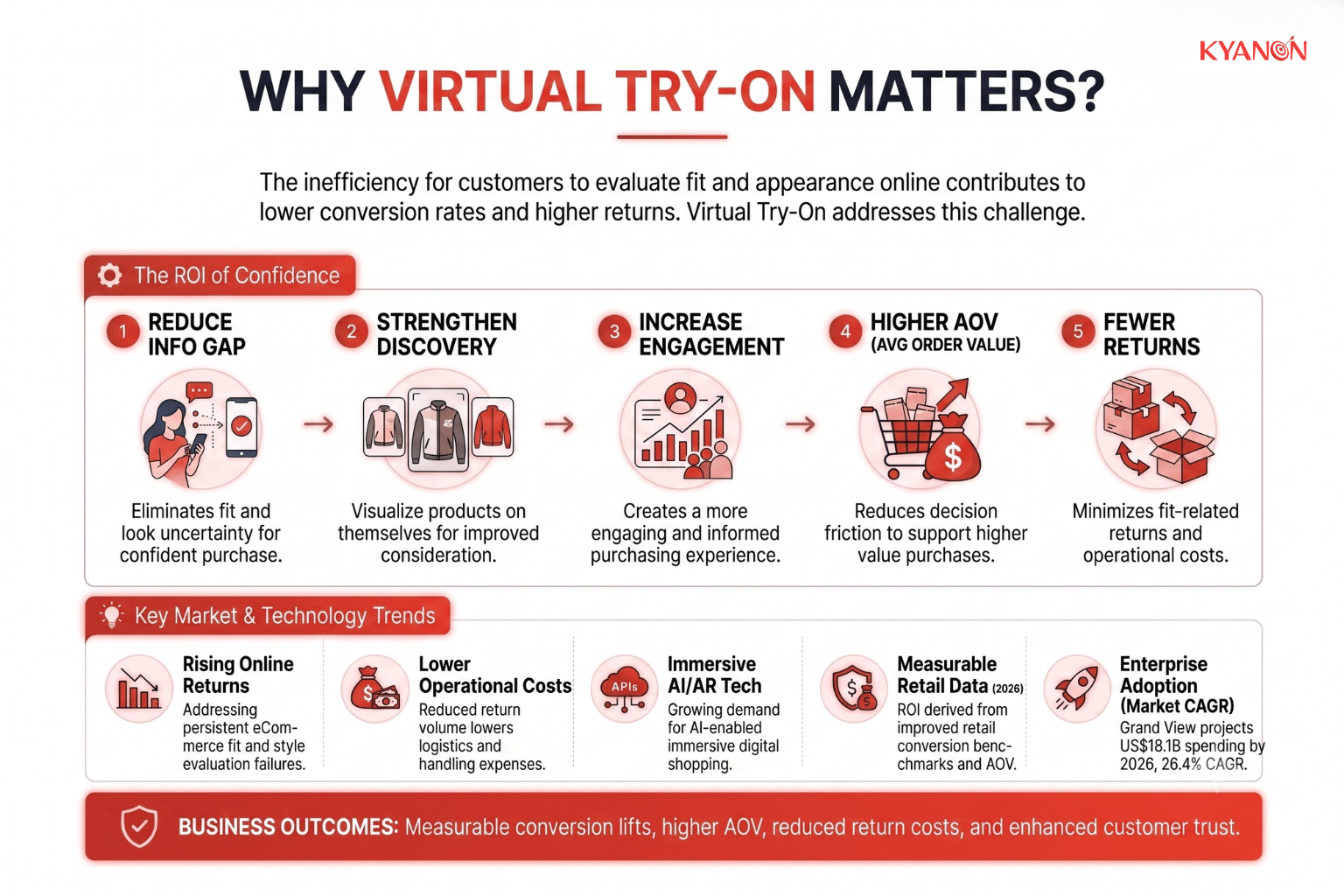
The growing strategic importance of Virtual Try-On is reflected in enterprise technology investment trends. According to Research and Markets, the global Virtual Try-On technology market reached US$15.29 billion in 2026, driven by increasing online apparel return rates and rising demand for more immersive digital shopping experiences. Complementing this outlook, Grand View Research projects global enterprise spending on Virtual Try-On technologies to reach US$18.1 billion in 2026, with the market expected to expand at a 26.4% compound annual growth rate (CAGR) through 2030 as retailers continue investing in digital storefront optimization and AI-enabled customer experiences.
Common Misconceptions
Virtual Try-On is Just a Static Filter
Modern VTO relies on sophisticated AI, computer vision, and 3D simulation engines rather than static image overlays. It dynamically calculates fabric drape, body articulation, surface textures, and ambient lighting shifts in real time.
One Size Fits All Digital Avatars
Advanced VTO systems do not project garments onto standardized digital mannequins. They analyze individual user measurements and biomechanical keypoints, mapping clothing and accessories to unique, user-specific body structures.
Colors Match Perfectly Every Time
Digital displays use varying screen calibrations, color spaces (sRGB vs. DCI-P3), and brightness levels that alter rendered hues. Variable ambient lighting in user photos and videos also introduces color variances compared to physical items under standardized light.
It Requires Expensive Dedicated Hardware
Modern web-based VTO relies on WebGL, WebGPU, and WebAssembly to execute computer vision models directly within standard mobile browsers. Enterprise deployments operate smoothly on standard consumer smartphones without requiring depth sensors or specialized hardware.
Virtual Try-On is Only for Apparel
Retailers across multiple verticals deploy VTO solutions effectively. The technology is widely utilized across eyewear, cosmetics, fine jewelry, luxury watches, and footwear categories with high visual fidelity.
Retailer Integration Takes Months
Enterprise SaaS try-on platforms provide modular, API-first widgets and software development kits (SDKs). Merchants can embed VTO capabilities into modern storefronts using lightweight code snippets and headless integration APIs within days.
Virtual Try-On Completely Eliminates Product Returns
While VTO significantly cuts returns caused by incorrect sizing or visual mismatch, it cannot eliminate returns driven by tactile fabric preferences, shipping delays, or impulse purchasing behavior.
Virtual Try-On is an Unproven Gimmick That Fails to Convert
Empirical retail performance data demonstrates that VTO acts as a core conversion engine. Interactive visualization increases dwell time on product pages and boosts add-to-cart velocity among high-intent shoppers.
How Kyanon Digital Applies Virtual Try-On
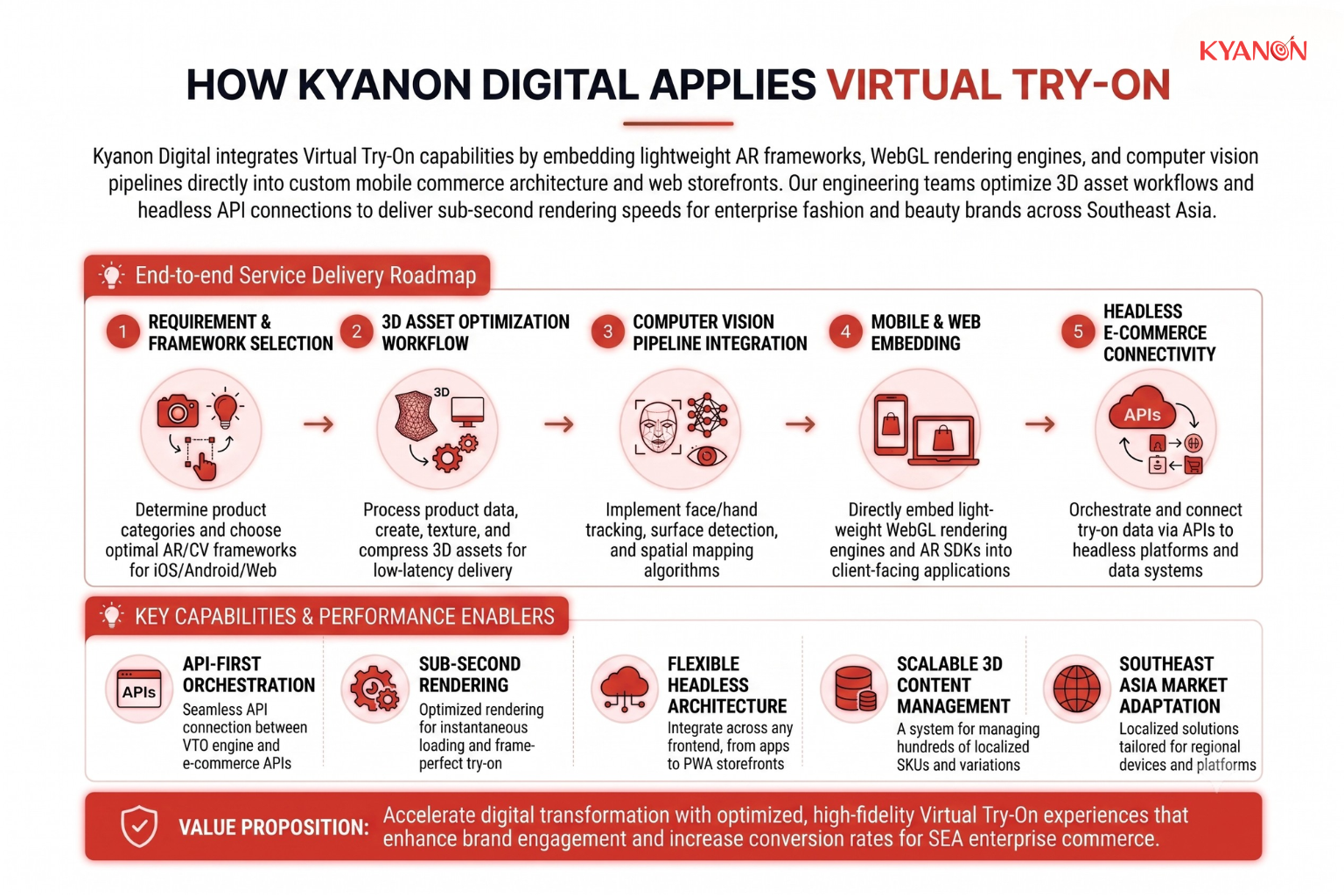
Kyanon Digital integrates Virtual Try-On capabilities by embedding lightweight AR frameworks, WebGL rendering engines, and computer vision pipelines directly into custom mobile commerce architecture and web storefronts. Our engineering teams optimize 3D asset workflows and headless API connections to deliver sub-second rendering speeds for enterprise fashion and beauty brands across Southeast Asia.
Explore our services:











 Create project brief with AI