
What is XD (Experience Design) for Commerce?
XD (Experience Design) for Commerce is the holistic strategic discipline of designing end-to-end digital purchasing journeys across every customer touchpoint, including discovery, transaction execution, and post-sale engagement, to minimize cognitive friction and maximize lifetime customer value.
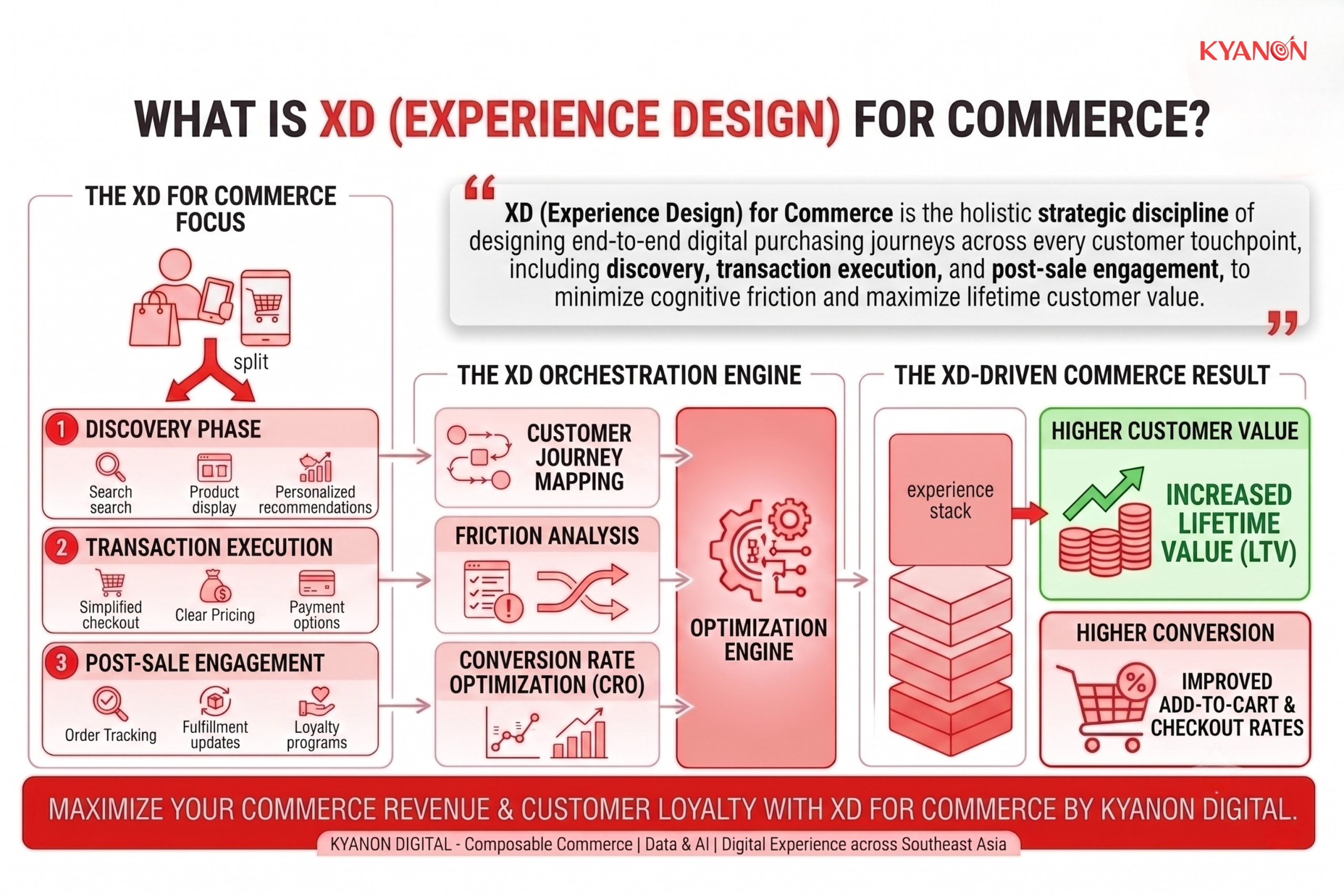
How XD (Experience Design) for Commerce Works
Experience Design (XD) for Commerce combines user-centered design principles with commerce technology to create seamless, efficient, and conversion-focused digital experiences. Rather than focusing solely on visual design, XD aligns customer behavior, business objectives, and technical architecture to optimize every stage of the buying journey, from product discovery to post-purchase engagement. Every interaction is designed to reduce friction, improve usability, and guide customers toward successful transactions.

Behavioral Discovery Architecture
The customer journey begins with helping users quickly find, evaluate, and compare products with minimal effort. This layer structures information architecture, navigation, and search experiences around customer intent, making product discovery both intuitive and efficient.
Core capabilities include:
- Organizing product catalogs through intuitive taxonomy
- Delivering intelligent search and filtering experiences
- Presenting product information with clear hierarchy and visual consistency
- Reducing cognitive load to accelerate purchase decisions
Business value: Better product discoverability, higher engagement, longer browsing sessions, and improved conversion rates.
Transactional Workflow Optimization
Once customers are ready to purchase, the experience shifts toward minimizing friction throughout the checkout process. Every interaction is optimized to reduce unnecessary steps while maintaining security and transactional accuracy.
This layer focuses on:
- Streamlined shopping cart management
- Secure payment gateway integration
- Real-time form validation and address verification
- Progressive disclosure to simplify complex checkout flows
- Responsive interactions across desktop and mobile devices
Business impact: Reduced cart abandonment, faster checkout completion, improved payment success rates, and a more consistent purchasing experience across channels.
Post-Purchase Continuity Engine
The customer experience extends beyond payment confirmation. XD for Commerce integrates post-purchase services into the overall brand journey, transforming fulfillment and customer support into opportunities for long-term engagement and loyalty.
The continuity engine typically includes:
Experience Component | Purpose |
| Order tracking | Real-time shipment visibility |
Customer self-service | Returns, exchanges, and support requests |
| Personalized communications | Order updates and product recommendations |
Loyalty and re-engagement | Promotions, rewards, and repeat purchases |
By connecting post-purchase interactions with CRM, order management, and customer service platforms, organizations maintain a consistent customer experience after checkout. This continuous engagement strengthens customer trust, improves retention, and creates additional opportunities for repeat purchases and long-term customer value.
Comparative Analysis: Strategic XD for Commerce vs. Surface-Level UI Design
Strategic XD structures functional transactional systems and user psychology across the entire customer lifecycle, whereas surface-level UI design focuses narrowly on aesthetic elements and visual layouts.
Dimension | Strategic XD for Commerce | Surface-Level UI Design |
| Primary Focus | Conversion velocity, cognitive load, and end-to-end retention | Visual aesthetics, color schemes, and typography |
Scope | Full lifecycle: discovery, checkout, logistics, and returns | Pre-purchase digital storefront and product display pages |
| Optimization Driver | Behavioral analytics, heatmaps, and usability testing | Subjective visual trends and brand style guidelines |
Error Handling | Proactive workflow validation and inline error prevention | Reactive error messaging design |
| Business Value | Total Cost of Ownership (TCO) reduction and higher Lifetime Value (LTV) | Visual brand alignment and short-term aesthetic appeal |
Why XD (Experience Design) for Commerce Matters
Implementing a systematic experience design strategy enables organizations to reduce friction throughout the customer journey, improve conversion efficiency, and strengthen long-term customer relationships. By aligning user research, interface design, and commerce technology, enterprises can deliver consistent experiences across every digital touchpoint while improving operational efficiency and customer satisfaction.
A systematic XD strategy reduces friction, boosts conversion rates, and drives long-term customer loyalty through data-driven optimization.
As customer expectations continue to evolve, experience design has become a strategic capability rather than a purely creative discipline. Organizations are increasingly investing in AI-powered personalization, customer journey orchestration, and data-driven experience optimization to deliver seamless interactions across digital channels. Gartner predicts that 60% of brands will use agentic AI to deliver one-to-one customer interactions by 2028, fundamentally shifting customer engagement from channel-based experiences to intelligent, personalized journeys. Gartner also identifies personalization as a rapidly growing technology market, reporting that the personalization engine market grew 26.1% in 2024 to US$1.2 billion, underscoring continued enterprise investment in technologies that enhance customer experience.
Common Misconceptions
XD is Just UI Design and Aesthetics
User Interface (UI) design represents only a single visual layer of experience design. True commerce design is deeply structural, mapping complex transactional workflows, checkout logic, error prevention rules, and data loading states to balance visual design with conversion prioritization.
Optimization Ends at the Buy Button
The post-purchase journey directly determines whether a customer returns or abandons the brand. XD extends into order tracking interfaces, transactional notifications, self-service returns portals, and physical unboxing experiences to prevent spikes in post-sale customer support volume.
Best Practices Can Be Blindly Copied
Copying design templates from high-volume marketplaces like Amazon does not guarantee success for every business model. XD decisions must reflect contextual audience data; for example, while a multi-step checkout may increase abandonment for low-cost impulse buys, it builds necessary consumer trust for high-value luxury purchases.
Friction is Always Bad
Intentional, strategic friction builds consumer confidence and prevents operational errors. Temporarily pausing a user to verify high-cost shipping details, confirm specialized product sizing, or validate address information prevents costly post-purchase fulfillment errors and return logistics.
Accessibility is an Afterthought Checklist
Digital accessibility compliance cannot be treated as a final technical patch prior to system launch. Inclusive design principles, such as screen-reader compatibility, keyboard navigation, and high contrast standards, must be integrated into foundational design systems to expand the total addressable market and mitigate legal risk.
How Kyanon Digital Applies XD (Experience Design) for Commerce
Kyanon Digital applies Experience Design (XD) as a strategic component of enterprise digital commerce, combining user-centered design, behavioral research, and data-driven optimization to create intuitive, high-performing customer experiences. Rather than focusing solely on visual interfaces, Kyanon Digital designs end-to-end commerce journeys that align customer needs with business objectives, ensuring every interaction contributes to higher engagement, smoother transactions, and long-term customer loyalty.
The dedicated UX/UI team collaborates closely with business stakeholders, product owners, and engineering teams to optimize each stage of the customer journey, from product discovery and navigation to checkout, order management, and post-purchase engagement. Through user journey mapping, information architecture, interaction design, usability testing, and accessibility best practices, Kyanon Digital identifies friction points that impact conversion and continuously refines the experience using real user behavior and performance data.
To support continuous improvement, the team incorporates A/B testing, analytics, heatmaps, and customer feedback into an iterative optimization process. This enables enterprise eCommerce clients to validate design decisions, improve conversion funnels, reduce transactional friction, and increase repeat purchase rates while delivering consistent, omnichannel experiences across international markets and multiple customer touchpoints.

Explore our services:











 Create project brief with AI