

Business intelligence (BI) tools are often sold as a silver bullet for retail performance issues. But decision-makers in retail operations, marketing, and analytics know the real world is messier: dashboards alone don’t fix fractured data, inconsistent metrics, or execution gaps that cost money.
This article explains 5 reasons why buying BI tools alone fails to solve retail analytics challenges and what leaders should evaluate instead.
Key takeaways
- BI tools are visualization layers, not retail analytics systems.
- Poor data quality and fragmented sources undermine BI reporting.
- Generic dashboards lack retail-specific context and decision relevance.
- Low adoption and workflow mismatch turn BI tools into shelfware.
- Governance and execution layers matter more than BI tool selection.
Further reading:
- AI-Driven BI for FMCG & Retail Leaders in Singapore
- Building an Enterprise Data Warehouse for Commerce
- Pick the Best Data Visualization Tools for Wins
What BI tools actually do in retail?
Retail leaders often equate BI tool rollout with analytics transformation. In reality, most BI platforms (including dashboards built with power bi tools) excel at descriptive reporting – showing what happened rather than solving complex retail challenges.

BI tools as reporting and visualization layers
At their core, BI tools aggregate and visualize data from source systems. They answer questions like:
- “What were last quarter’s sales?”
- “Which stores underperformed last week?”
They do not inherently:
- Fix data quality issues
- Standardize KPIs across teams
- Diagnose causes of trends
- Connect insights to execution systems
These limitations are consistent with industry findings that 60% of BI users struggle with data quality and governance, undermining trust in reports. (Dataversity)
Why retail analytics requires more than dashboards
Retail operations involve inventory flows, omnichannel demand signals, pricing strategies, promotions, and customer behavior streams. Without models that reconcile these complexities, dashboards remain descriptive and largely tactical – not strategic.
According to Forrester, BI adoption alone doesn’t guarantee real value unless backed by data alignment and governance disciplines that support decision-making architecture. To address these challenges, organizations can turn to the four pillars of data governance that are supported by a strong foundation of partners, practices, and platforms enabling an insights-driven business.

Understanding what BI tools are designed to do makes it easier to see why relying on them alone often fails to fix deeper retail analytics challenges.

Reason 1 – Data quality issues (“garbage in, garbage out”)
Before dashboards can deliver insight, the underlying data must be accurate, consistent, and trusted. Without strong data quality foundations, BI tools simply amplify existing errors – turning “garbage in” into more visible, but still unreliable, output.
Fragmented retail data sources
Retail environments typically consist of:
- POS systems
- ERP
- CRM and loyalty data
- eCommerce platforms
- Supply chain systems
Disparate systems lead to inconsistent records and KPIs. As industry reports note, 70% of professionals identify data quality as a primary barrier to BI trust, and 60% of BI projects encounter data migration or integration issues. (Digital Defynd)
Without aligning these sources, dashboards visualize fragmentation, not insight.
Inconsistent metric definitions across teams
Different teams often define key metrics (like “net sales” or “inventory turnover”) differently, leading to endless disputes over which reports are “correct”. This inconsistency is a known barrier to analytics adoption and accelerates BI project failure.

Reason 2 – Lack of retail context and domain expertise
Even with clean data, retail analytics fails when dashboards lack operational context. Without retail domain expertise embedded in metrics and analysis, BI tools show numbers, but not the business logic behind them.
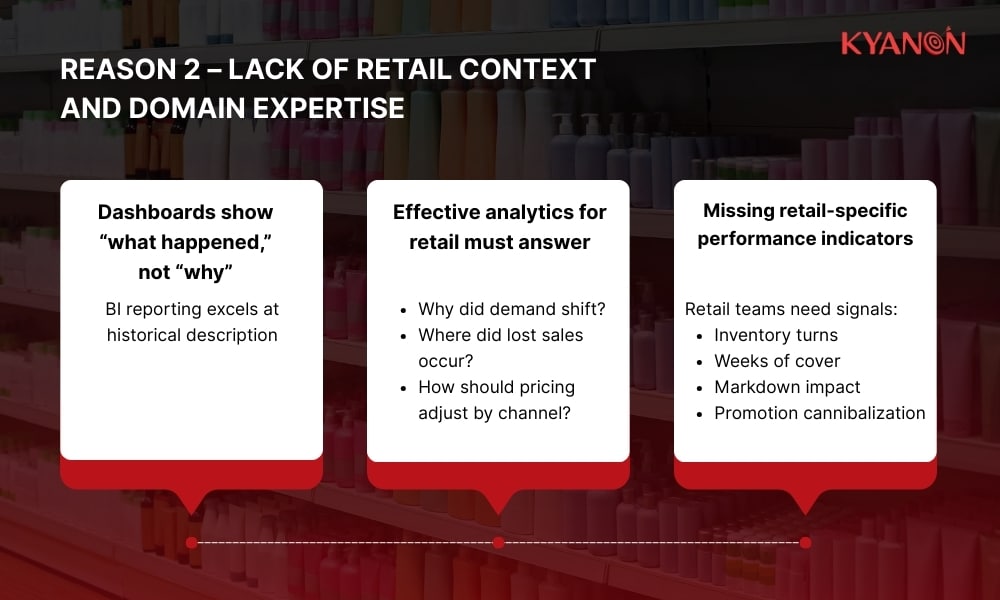
Dashboards show “what happened,” not “why”
BI reporting excels at historical description. But effective analytics for retail must answer:
- Why did demand shift?
- Where did lost sales occur?
- How should pricing adjust by channel?
Without deeper analytics models, dashboards tell you yesterday’s story – often too late to act.
Missing retail-specific performance indicators
Generic BI dashboards focus on high-level KPIs such as revenue, but retail teams need signals like:
- Inventory turns
- Weeks of cover
- Markdown impact
- Promotion cannibalization
A static BI report often fails to map to these nuanced operational levers, diminishing strategic value.
Reason 3 – Low adoption and workflow misalignment
Even well-built BI tools lose impact if they do not fit how retail teams actually work. When dashboards are disconnected from daily workflows, adoption drops and analytics becomes optional instead of operational.
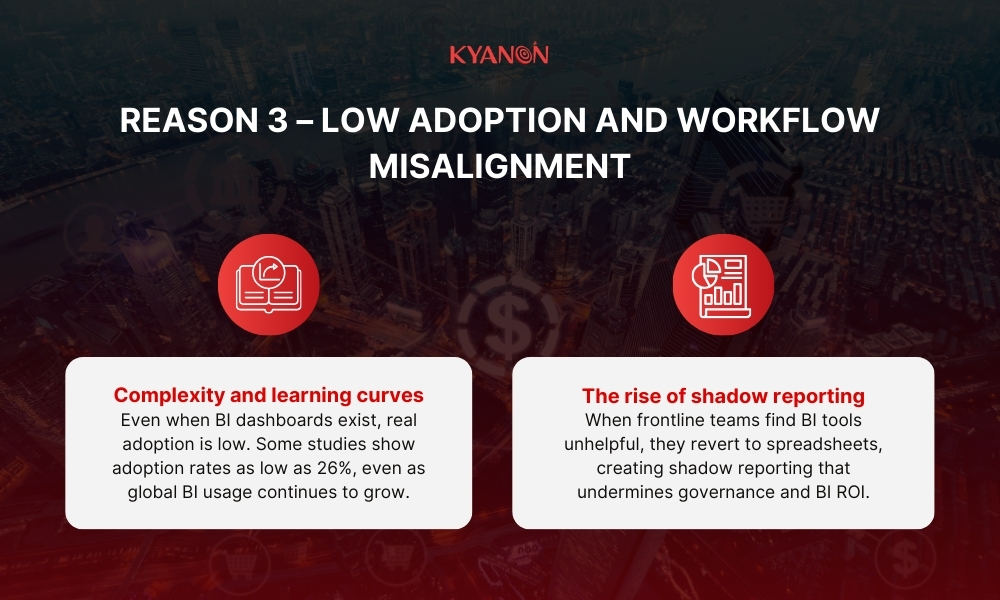
Complexity and learning curves
Even when BI dashboards exist, real adoption is low. Some studies show adoption rates as low as 26%, even as global BI usage continues to grow (BARC). When dashboards are complex or disconnected from users’ daily workflows, they become ignored tools rather than decision engines.
The rise of shadow reporting
When frontline teams find BI tools unhelpful, they often revert to spreadsheets, creating “shadow reporting” systems that undermine governance and defeat the purpose of BI investments.
Reason 4 – BI tools don’t drive action or execution
Retail performance depends on execution, not just visibility. When BI tools stop at reporting and fail to connect insights to operational actions, analytics remains informative but not transformative.
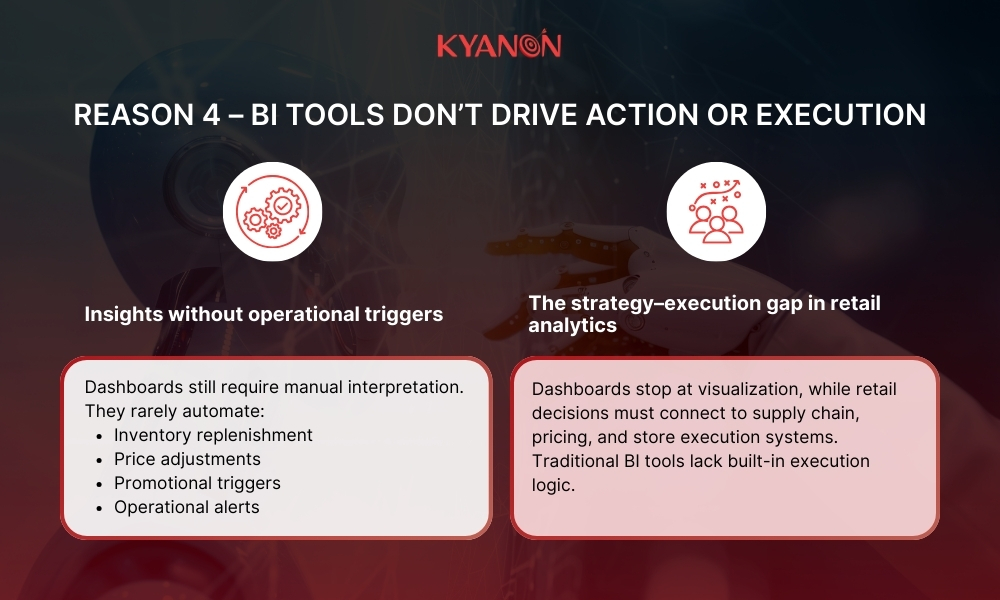
Insights without operational triggers
Dashboards still require manual interpretation. They rarely automate:
- Inventory replenishment
- Price adjustments
- Promotional triggers
- Operational alerts
If insights don’t translate to action, they remain academic rather than impactful.
The strategy–execution gap in retail analytics
Dashboards stop at visualization, while retail decisions must connect to supply chain systems, pricing platforms, and store-level execution flows. Traditional BI tools lack embedded execution logic as standard.
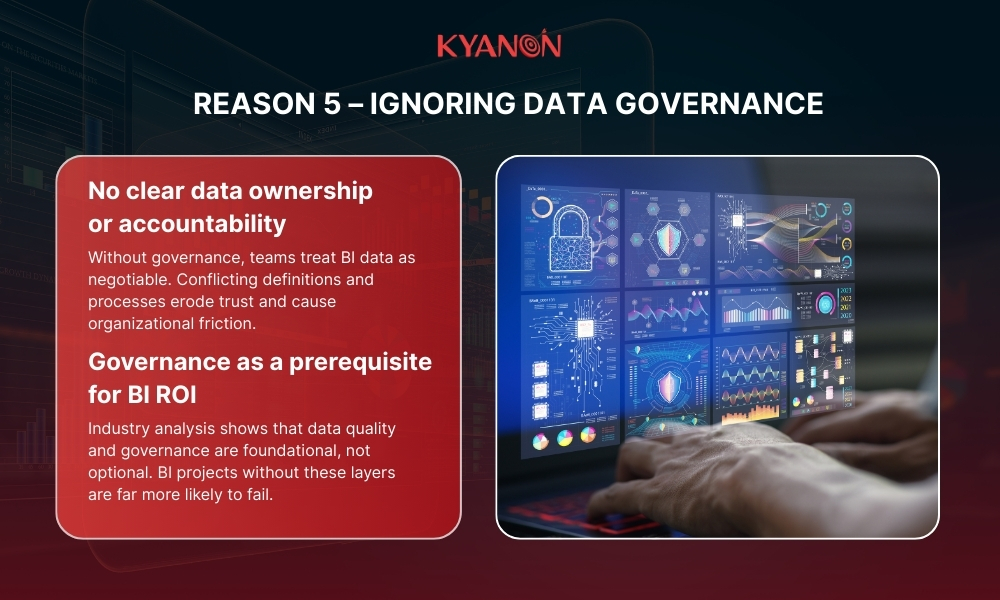
Reason 5 – Ignoring data governance
Data governance is often overlooked in BI initiatives, yet it determines whether analytics can scale and be trusted. Without clear ownership, standardized definitions, and accountability, even the most advanced BI tools struggle to deliver consistent business value.
No clear data ownership or accountability
Without governance, teams treat BI data as negotiable. Conflicting definitions and processes erode trust and cause organizational friction.
Governance as a prerequisite for BI ROI
Industry analysis repeatedly highlights that data quality and governance are foundational, not optional. BI projects without these architectural layers are significantly more likely to fail.
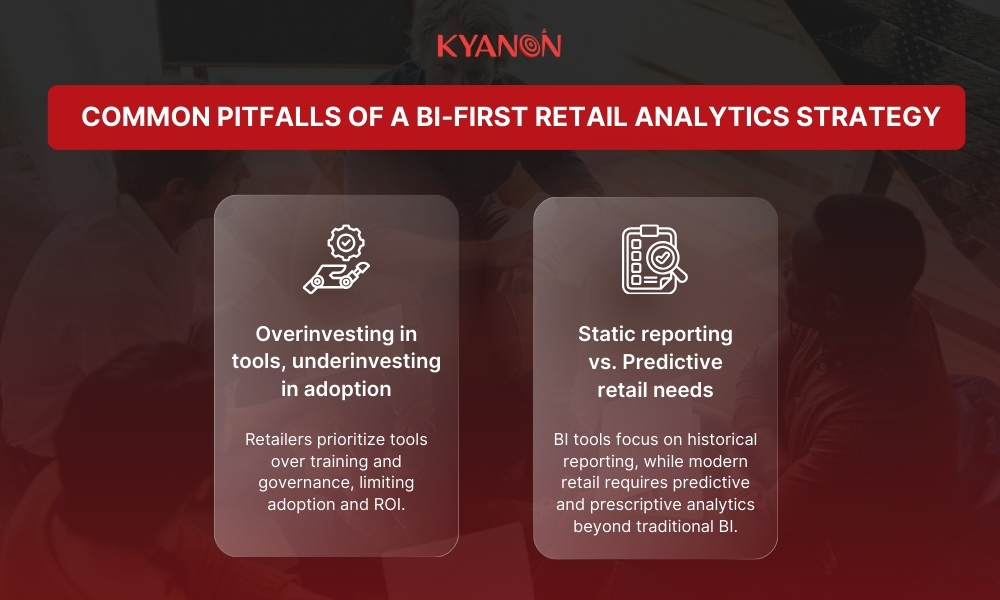
Common pitfalls of a BI-first retail analytics strategy
A BI-first strategy assumes better dashboards equal better retail analytics. In reality, it often exposes deeper gaps in data, governance, and execution that limit real business impact.
Overinvesting in tools, underinvesting in adoption
Retailers often prioritize licensing costs and dashboards while overlooking training, data alignment, and governance frameworks – the actual engines of adoption and ROI.
Static reporting vs. Predictive retail needs
While BI tools shine in historical reporting, modern retail demands predictive and prescriptive analytics to anticipate demand, optimize pricing, and reduce markdown risk – capabilities beyond traditional BI.
How retail leaders should rethink analytics decisions
Retail analytics decisions should begin with business outcomes, not software selection. Instead of prioritizing BI tool features, retail leaders should first clarify which operational decisions require improvement and what data foundations are necessary to support them.
From BI tools to retail analytics systems
Instead of asking, “Which BI tool should we buy?”, leaders must clarify:
- What decisions need improving?
- What data sources feed those decisions?
- What governance supports consistent KPIs?
- How will insights trigger operational actions?
Retail analytics systems compile integrated data models, standardized KPIs, and execution pathways – with BI tools as one component.
What to fix before buying BI tools
Before investing in BI tools, organizations should formally evaluate the following foundational elements:
- Data quality and integration readiness
- KPI governance and definitions
- Workflow alignment with reporting outputs
- Defined decision use cases
If gaps exist, building those foundations should precede BI tool investment.
When BI tools are the right investment
BI tools make sense after:
- Data sources are unified
- Governance frameworks are established
- Decision workflows are defined
- Adoption strategies are in place
Under these conditions, bi tools for reporting can accelerate insight visibility and operational alignment.
When retail analytics requires a broader system approach
If data sources are disjointed, metrics are inconsistent, and teams lack analytics alignment, broader investment in data infrastructure, governance, and activation layers is essential before expanding BI dashboards.
Evaluation questions for decision-makers
To assess organizational readiness before expanding BI investments, leaders should consider the following questions:
- Do we have a single source of truth for retail metrics?
- Are BI dashboards driving specific actions?
- Do frontline teams use analytics daily?
- Is governance mature and consistent?
- Are analytics outcomes tied to business impact?
These questions help assess readiness more accurately than vendor feature checklists.
How Kyanon Digital approaches retail analytics
Retail analytics transformation requires systemic thinking – not just tool rollout.
Kyanon Digital partners with retailers to:
- Align data architecture with business strategy
- Establish governance and KPI frameworks
- Integrate analytics with operational systems
- Implement BI tools as part of a complete analytics ecosystem
This ensures BI tools amplify insight rather than surface fragmented information.
Case study: Data Hub & BI Analytics for Vietnam’s Largest Port & Logistics Operator

Challenges
The largest port and logistics operator in Vietnam faced several structural data issues:
- Fragmented data across multiple operational systems
- Heavy reliance on manual reporting processes
- Limited real-time visibility into operations, finance, and HR performance
- Inconsistent data standards and lack of centralized governance
Solutions
Kyanon Digital implemented a comprehensive data and analytics transformation initiative built on three pillars:
Enterprise Data Hub
- Centralized and integrated large volumes of logistics and operational data
- Enabled scalable and real-time data processing
Reference Data Management & Governance Framework
- Established standardized data definitions
- Created a unified, trusted source of truth
BI & AI-Enhanced Analytics Layer
- Developed real-time dashboards using Power BI
- Embedded AI models to enhance insight generation
- Delivered executive-level visibility across business functions
This structured approach ensured data alignment before expanding visualization capabilities.
Impact
The transformation delivered measurable operational improvements:
- Faster and more stable data integration
- Reduced manual workload and reporting errors
- Real-time performance visibility across departments
- Improved decision confidence at executive level
- Stronger foundation for scalable digital growth
Explore the full case study here: Data Hub & BI Analytics for Vietnam’s Largest Port & Logistics Operator
Rethinking the role of BI tools in retail
Investing in BI tools can create the perception of progress, cleaner dashboards, centralized reports, improved visibility. But retail performance doesn’t improve because charts look better. It improves when data is reliable, KPIs are aligned, teams trust the numbers, and insights translate directly into pricing, inventory, and promotion decisions.
If you’re looking to move beyond visualization and build an analytics system that supports scalable retail performance, connect with Kyanon Digital for a structured discussion on your next steps.