

Across the retail industry, a consistent pattern continues to emerge: many metrics retail leaders rely on are measured accurately yet interpreted in ways that misguide decisions. They appear polished on dashboards, feature prominently in board reports, and influence incentives across the organization. However, despite their visibility, these retail metrics often fail to reflect true business health, sustainable profitability, and operational resilience.
This article reexamines how metrics in retail are traditionally used and explains why several commonly accepted indicators may quietly distort strategic decision-making.
Key takeaways
- Many metrics in retail are tracked in isolation and distort decision-making.
- Vanity and lagging metrics hide structural issues in people, processes, and profitability.
- Retail leaders must shift from volume-based metrics to behavior- and margin-driven retail field metrics.
- Misused KPIs often optimize short-term results at the expense of long-term sustainability.
- Correct retail industry metrics require cross-functional data and shared accountability across marketing, operations, finance, and HR.
Further reading:
- 7 Retail Analytics Decisions That Impact Revenue Most
- Building an Enterprise Data Warehouse for Commerce
- 8 Questions to Ask Before Hiring a Retail Analytics Partner
Why are retail metrics being measured wrong today?
Many retail metrics were designed for a different economic environment, one that prioritized expansion and top-line growth. Today’s market demands profitability, agility, and capital efficiency, yet many retailers still rely on outdated measurement frameworks. As a result, metrics in retail often reflect activity rather than value, leading to decisions that optimize visibility instead of sustainable performance.
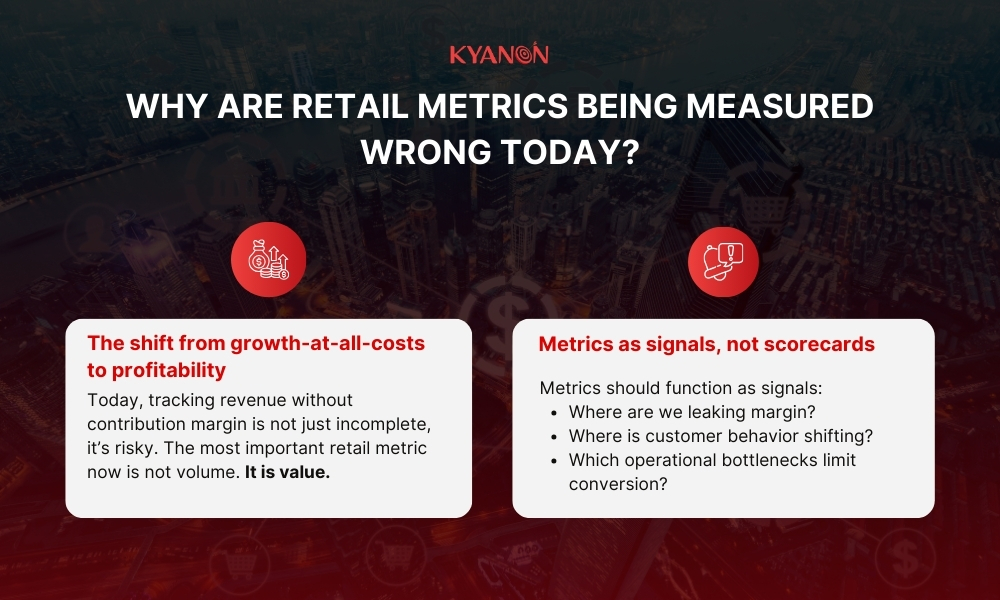
The shift from growth-at-all-costs to profitability
For over a decade, low interest rates allowed retailers to prioritize:
- Revenue growth
- Market share
- Customer acquisition
- Store expansion
But according to the McKinsey & Company, rising capital costs and margin pressure have forced retailers to pivot from growth-at-all-costs to profitability and capital efficiency.
Today, tracking revenue without contribution margin is not just incomplete, it’s risky. The most important retail metric now is not volume. It is value.
Metrics as signals, not scorecards
Many executives treat KPI in retail store environments as scorecards, something to report monthly. But metrics should function as signals:
- Where are we leaking margin?
- Where is customer behavior shifting?
- Which operational bottlenecks limit conversion?
When retail metrics become political scorecards instead of diagnostic tools, they stop guiding decisions.
Metric 1 – Foot traffic instead of conversion rate
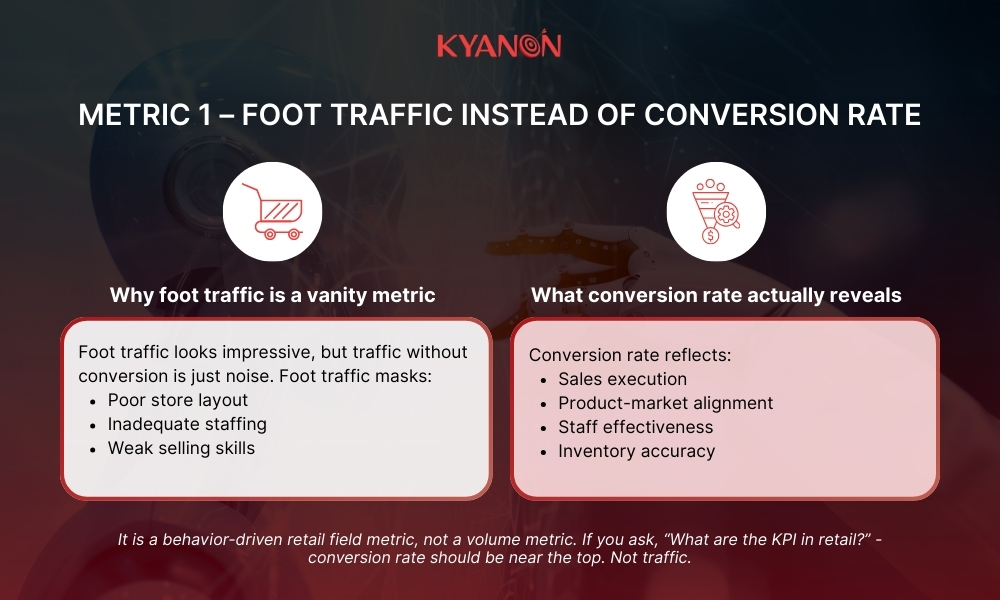
Foot traffic is one of the most common retail metrics, but volume alone does not equal performance. In a margin-driven market, what matters is not how many people enter the store, but how many actually buy. Conversion rate reveals execution quality, while traffic only reflects exposure.
Why foot traffic is a vanity metric
Foot traffic looks impressive, but traffic without conversion is just noise. A retailer can increase traffic by:
- Heavy discounting
- Aggressive promotions
- Broad targeting campaigns
Yet if staffing, merchandising, or in-store experience is weak, conversion suffers. According to the National Retail Federation, conversion rate variability explains more performance differences between stores than traffic volume alone.
Foot traffic masks:
- Poor store layout
- Inadequate staffing
- Weak selling skills
What conversion rate actually reveals
Conversion rate reflects:
- Sales execution
- Product-market alignment
- Staff effectiveness
- Inventory accuracy
It is a behavior-driven retail field metric, not a volume metric. If you ask, “What are the KPI in retail?” – conversion rate should be near the top. Not traffic.
Metric 2 – Revenue instead of profitability
Revenue is one of the most celebrated retail metrics, but top-line growth alone does not guarantee business health. In today’s margin-sensitive environment, sales without profit can quietly erode value. What matters is not how much you sell, but how much you actually keep.
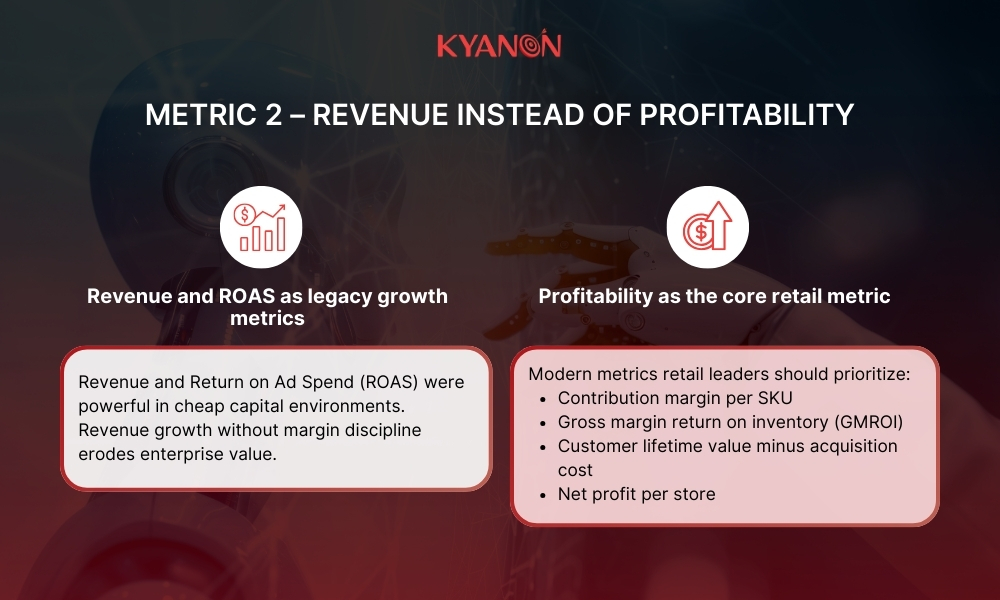
Revenue and ROAS as legacy growth metrics
Revenue and Return on Ad Spend (ROAS) were powerful in cheap capital environments. But revenue ignores:
- Discount depth
- Fulfillment cost
- Returns
- Marketing acquisition cost
Research from Deloitte Global Retail Outlook shows margin pressure remains the top concern for retail CEOs worldwide. Revenue growth without margin discipline erodes enterprise value.
Profitability as the core retail metric
Modern metrics retail leaders should prioritize:
- Contribution margin per SKU
- Gross margin return on inventory (GMROI)
- Customer lifetime value minus acquisition cost
- Net profit per store
These metrics in retail connect commercial performance with financial health. Revenue is output. Profitability is sustainability.
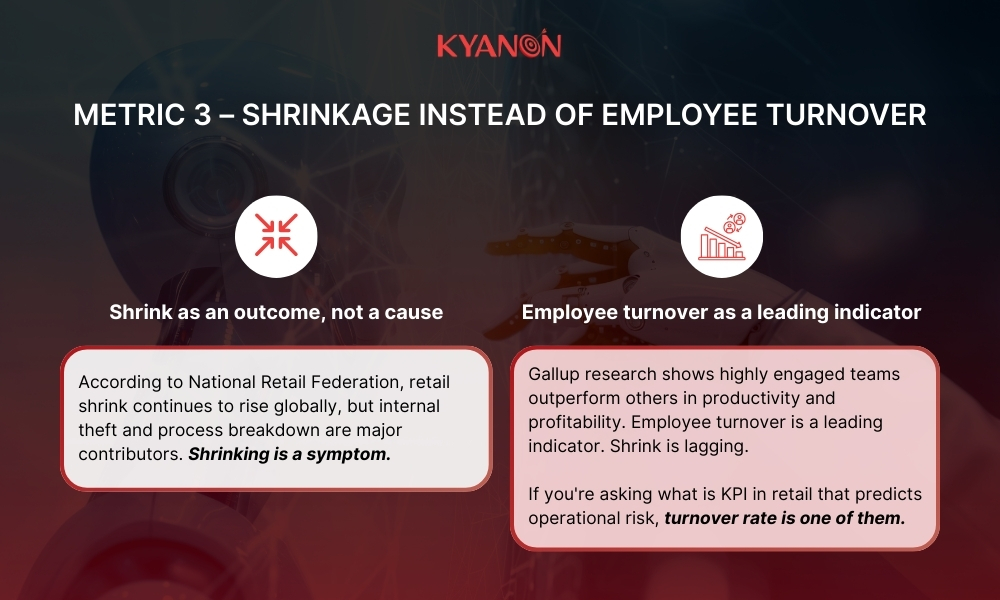
Metric 3 – Shrinkage instead of employee turnover
Shrinkage is a commonly tracked retail metric, often treated as a direct measure of operational risk. But shrink is usually a symptom, not the root cause. Behind inventory loss are deeper issues such as employee engagement, training gaps, and high turnover. Focusing only on shrink can hide the people problems that truly impact retail performance.
Shrink as an outcome, not a cause
Shrinkage is heavily tracked in most retail industry metrics dashboards.
But shrink is usually downstream of:
- Low employee engagement
- Inadequate training
- High turnover
- Weak operational controls
According to National Retail Federation, retail shrink continues to rise globally, but internal theft and process breakdown are major contributors. Shrinking is a symptom.
Employee turnover as a leading indicator
High turnover impacts:
- Customer experience
- Loss prevention
- Sales execution
- Training cost
Gallup research shows highly engaged teams outperform others in productivity and profitability. Employee turnover is a leading indicator. Shrink is lagging.
If you’re asking what is KPI in retail that predicts operational risk, turnover rate is one of them.
Metric 4 – Customer satisfaction scores instead of customer behavior
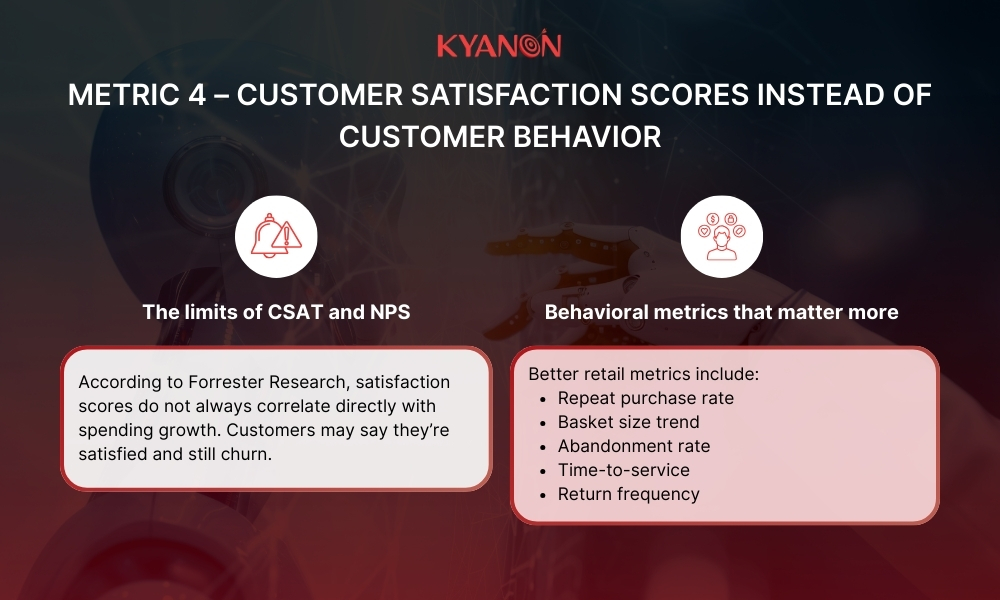
Customer satisfaction scores are widely used retail metrics, but surveys often reflect perception rather than action. While CSAT and NPS provide sentiment snapshots, they rarely predict purchasing patterns or long-term value. In retail, actual behavior such as repeat purchases and basket growth reveals far more than stated satisfaction.
The limits of CSAT and NPS
CSAT and NPS are common answers to: What are the KPI in retail store performance? But they are:
- Lagging
- Easily gamed
- Biased toward extreme responses
According to Forrester Research, satisfaction scores do not always correlate directly with spending growth. Customers may say they’re satisfied and still churn.
Behavioral metrics that matter more
Better retail metrics include:
- Repeat purchase rate
- Basket size trend
- Abandonment rate
- Time-to-service
- Return frequency
Behavior reveals truth. Surveys reveal sentiment. Retail is behavioral economics not opinion polling.
Metric 5 – Labor cost instead of labor productivity
Labor cost is one of the most tightly managed retail metrics, often viewed purely as an expense to control. But reducing hours or headcount without measuring output can damage service quality and sales performance. In reality, what matters is not how little you spend on labor, but how effectively each labor hour drives revenue and margin.
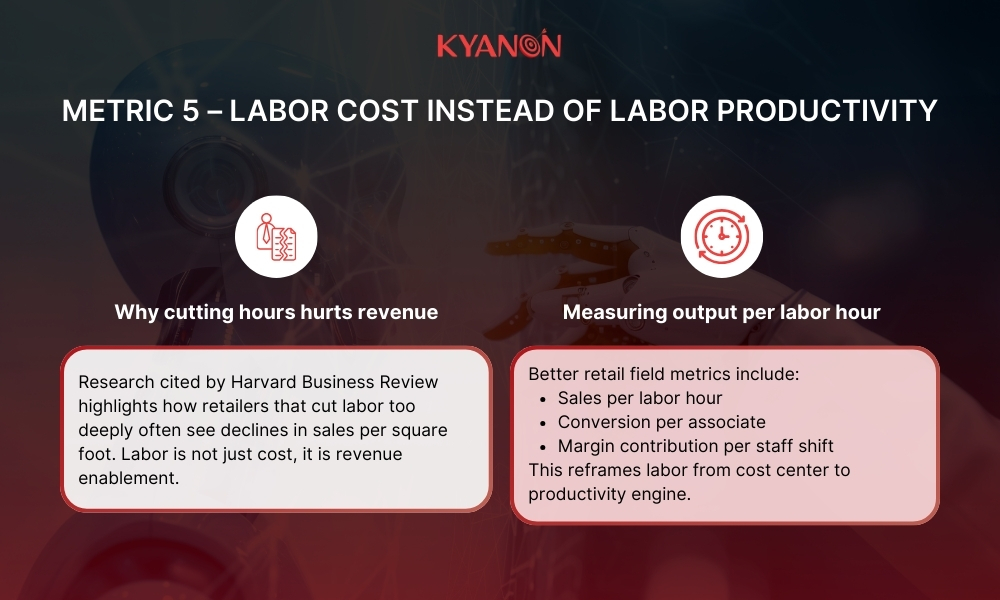
Why cutting hours hurts revenue
Labor is often treated as a controllable cost. But aggressive labor cuts lead to:
- Long checkout lines
- Poor replenishment
- Missed upselling opportunities
Research cited by Harvard Business Review highlights how retailers that cut labor too deeply often see declines in sales per square foot. Labor is not just cost, it is revenue enablement.
Measuring output per labor hour
Better retail field metrics include:
- Sales per labor hour
- Conversion per associate
- Margin contribution per staff shift
This reframes labor from cost center to productivity engine.
Metric 6 – Marketing performance in isolation
Marketing KPIs are often optimized separately from commercial realities, making them misleading retail metrics. Strong ROAS or high engagement may look impressive, but without margin, inventory, and fulfillment context, campaigns can erode profitability. Marketing performance only creates value when it is aligned with product economics and operational capacity.
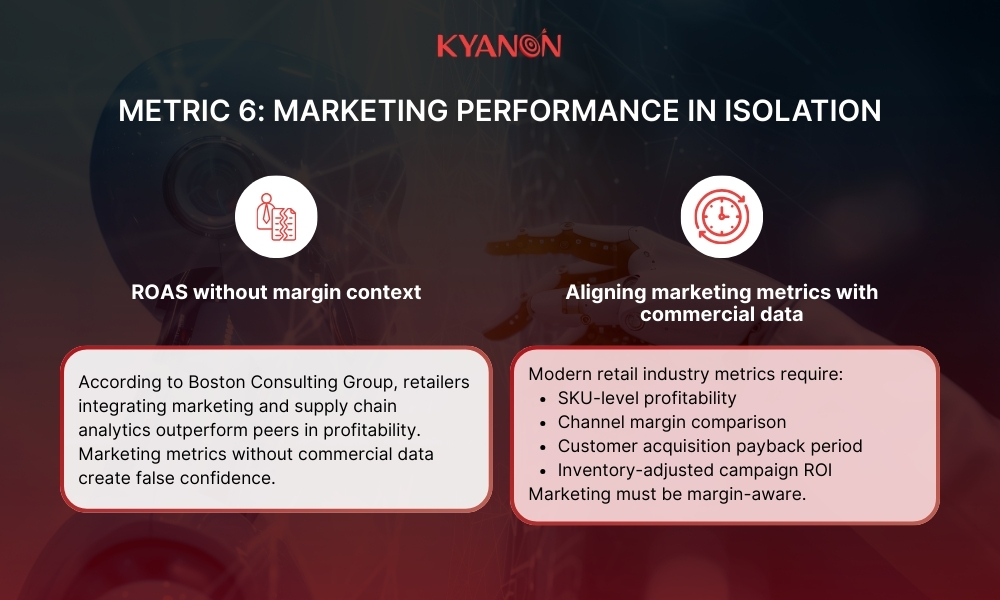
ROAS without margin context
High ROAS can still destroy profit if:
- Discounts are too deep
- Return rates are high
- Fulfillment cost exceeds margin
According to Boston Consulting Group, retailers integrating marketing and supply chain analytics outperform peers in profitability. Marketing metrics without commercial data create false confidence.
Aligning marketing metrics with commercial data
Modern retail industry metrics require:
- SKU-level profitability
- Channel margin comparison
- Customer acquisition payback period
- Inventory-adjusted campaign ROI
Marketing must be margin-aware.
Metric 7 – Static reports instead of decision-speed metrics
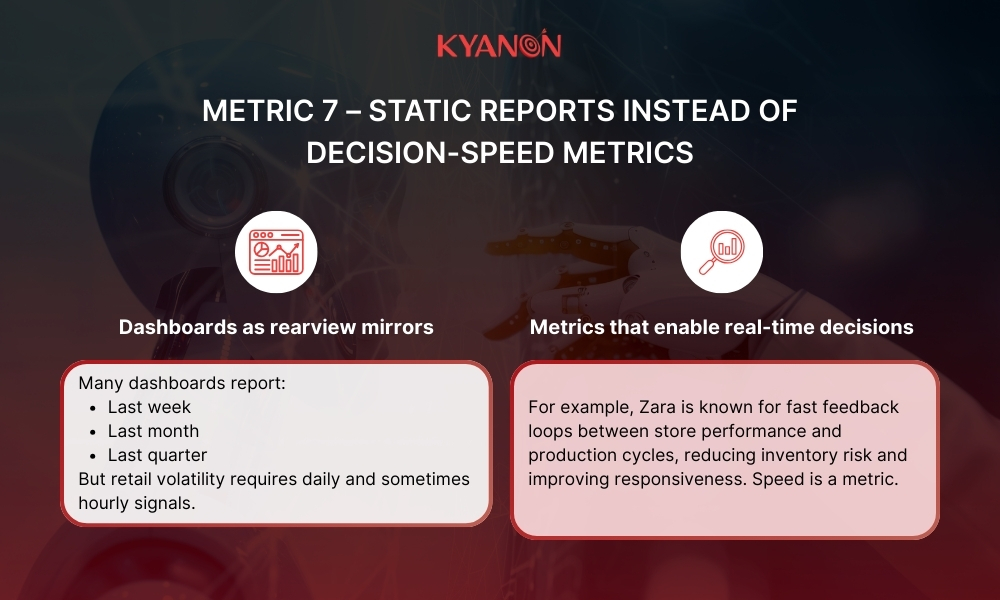
Many retail metrics are delivered through weekly or monthly reports that explain what already happened. While accurate, static dashboards often slow reaction time in a fast moving market. Retail performance today depends not only on what you measure, but how quickly those metrics enable action.
Dashboards as rearview mirrors
Many dashboards report:
- Last week
- Last month
- Last quarter
But retail volatility requires daily and sometimes hourly signals. Historical dashboards are rearview mirrors.
Metrics that enable real-time decisions
Leading retailers now track:
- Intraday conversion
- Stockout alerts
- Real-time markdown elasticity
- Promotion lift vs margin erosion
For example, Zara is known for fast feedback loops between store performance and production cycles, reducing inventory risk and improving responsiveness. Speed is a metric.
What retail leaders should track instead?
There is no universal fixed framework. But strong retail metrics share principles.
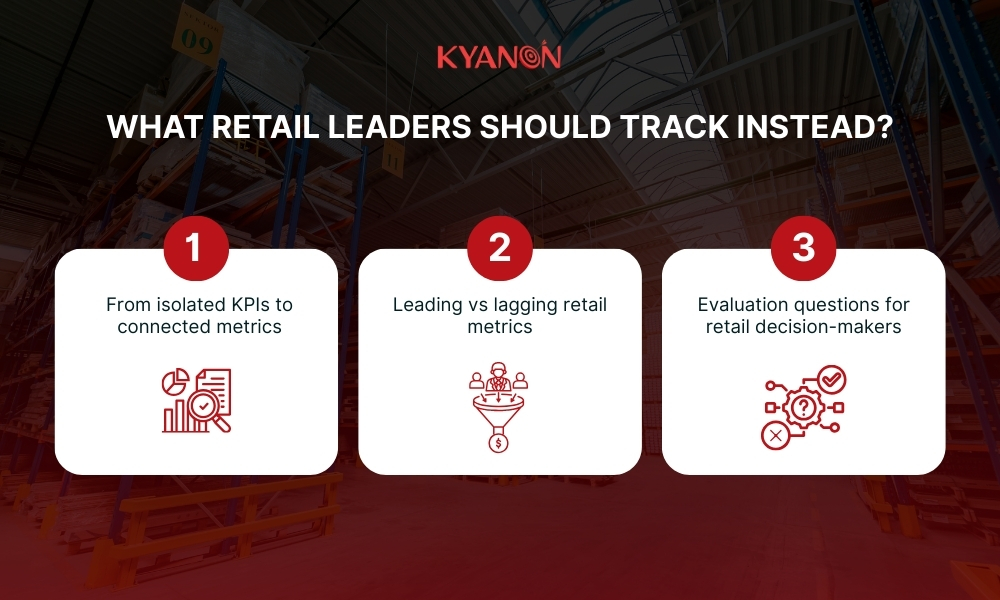
From isolated KPIs to connected metrics
Metrics must connect:
- People (turnover, productivity)
- Operations (inventory, shrink, stockouts)
- Commercial (margin, conversion)
- Marketing (acquisition cost, channel ROI)
Disconnected KPIs in retail store dashboards create local optimization and global inefficiency.
Leading vs lagging retail metrics
Lagging metrics:
- Revenue
- Shrink
- CSAT
- Quarterly profit
Leading metrics:
- Conversion trend
- Staff turnover
- Inventory accuracy
- Repeat purchase rate
- Margin per SKU
Leading metrics predict. Lagging metrics explain.
Evaluation questions for retail decision-makers
Before redesigning your metrics, ask:
- Are our KPIs driving short-term incentives over long-term health?
- Do store managers and marketing teams share the same profitability view?
- Are we measuring behaviors or just outcomes?
- Do our retail industry metrics predict risk, or explain it after damage occurs?
- How fast can we move from insight to decision?
If these questions reveal gaps, your metrics system needs redesign, not just optimization.
When to rethink retail metrics?
Rethinking retail metrics means shifting from tracking volume to understanding value. Instead of focusing on isolated numbers, retail leaders must connect customer behavior, operational execution, and profitability into one aligned performance system.
The goal is not more KPIs, but better ones that predict outcomes, protect margin, and drive smarter decisions across the entire retail organization.
When retail metrics start driving the wrong decisions
You may have a metric problem if:
- Revenue is growing but profit is shrinking
- Marketing ROAS is strong but cash flow is tight
- Traffic is high but conversion is flat
- Shrink rises despite more audits
These are structural misalignments, not reporting errors.
What a modern retail metrics system requires
A modern metrics in retail framework requires:
- Unified data architecture
- Real-time operational visibility
- Margin-aware dashboards
- Governance and accountability alignment
Metrics must integrate finance, marketing, store operations, and HR.
How Kyanon Digital helps retailers redesign metrics that matter
At Kyanon Digital, we don’t build dashboards for reporting. We design decision systems. Our approach:
- Diagnose misaligned retail metric frameworks
- Map leading and lagging indicators
- Integrate cross-functional data
- Design executive-level performance visibility
- Enable actionable, real-time retail analytics
We focus on impact, not just visualization.
Build retail metrics that drive profit, not just reports
Retail success today depends on tracking the right retail metrics, those that connect customer behavior, operations, and profitability in one aligned system. When metrics in retail are volume driven or disconnected from margin, they push short term wins at the expense of long term value.
If your current metrics retail framework feels fragmented or reactive, it may be time to redesign the foundation, not just the dashboard.
At Kyanon Digital, we help retailers build margin aware, decision driven performance systems that turn KPIs into real business impact. Contact Kyanon Digital to start building metrics that truly matter.