
Retailers generate vast amounts of retail analytics data every day, yet many still struggle to turn that data into measurable commercial impact. The global retail analytics market is expanding rapidly, with the total market projected to reach US 26.9 billion by 2030 due to growing investments in customer insights, pricing optimization, and operational analytics. (Market Research)
In an increasingly competitive environment of thin margins, unpredictable demand, and omnichannel complexity, investing in retail analytics is not enough. Retailers must prioritize the most impactful use cases first to drive profitability, operational efficiency, and customer lifetime value. This article outlines the nine retail analytics use cases worth investing in first based on their potential business impact.
Key takeaways
- Not all retail analytics use cases deliver equal ROI.
- Early investments should focus on inventory, pricing, and customer economics.
- Predictive and behavioral data analytics in retail outperform descriptive reporting.
- Retail analytics data creates value only when insights connect to execution systems.
- Sequencing use cases matters more than analytics sophistication.
Further reading:
- 7 Retail Analytics Decisions That Impact Revenue Most
- AI-Driven BI for FMCG & Retail Leaders in Singapore
- Unlock Retail Growth with CI360: Real-Time Personalization at Scale
What is predictive analytics in retail?
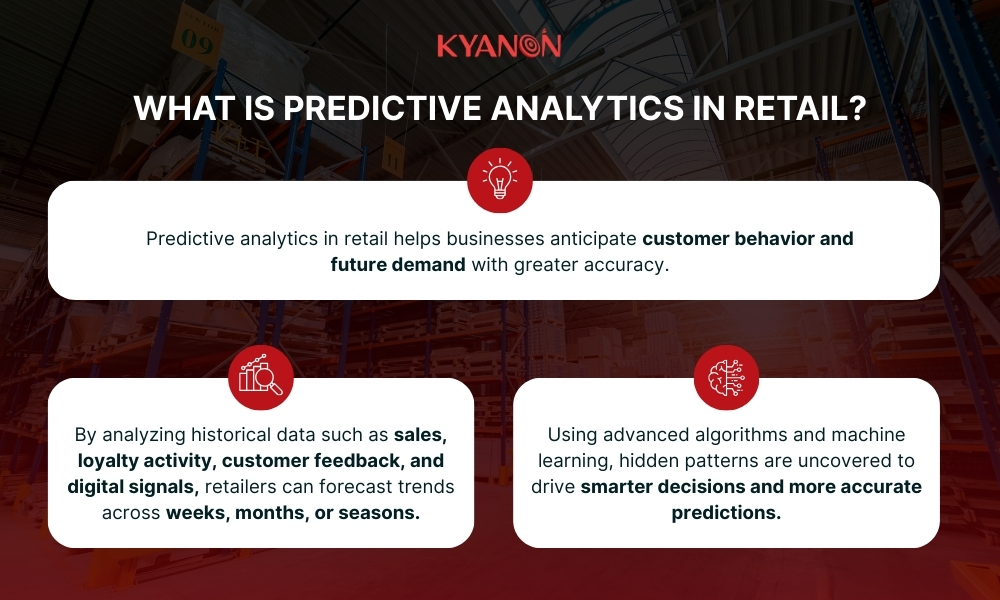
The deeper a retailer understands its customers, the more effectively it can anticipate and fulfill their expectations. Predictive analytics in retail enables businesses to forecast future trends and customer behaviors with greater accuracy. When applied strategically, it helps retailers anticipate demand shifts across weeks, months, or seasonal cycles.
Fundamentally, predictive analytics in retail relies on analyzing historical data to generate informed projections about future outcomes. This data may include sales transactions, customer feedback, loyalty activity, and digital engagement signals. By applying advanced algorithms and machine learning models, retailers can detect hidden patterns and correlations that traditional reporting methods may overlook.
Why retail analytics investment needs prioritization?
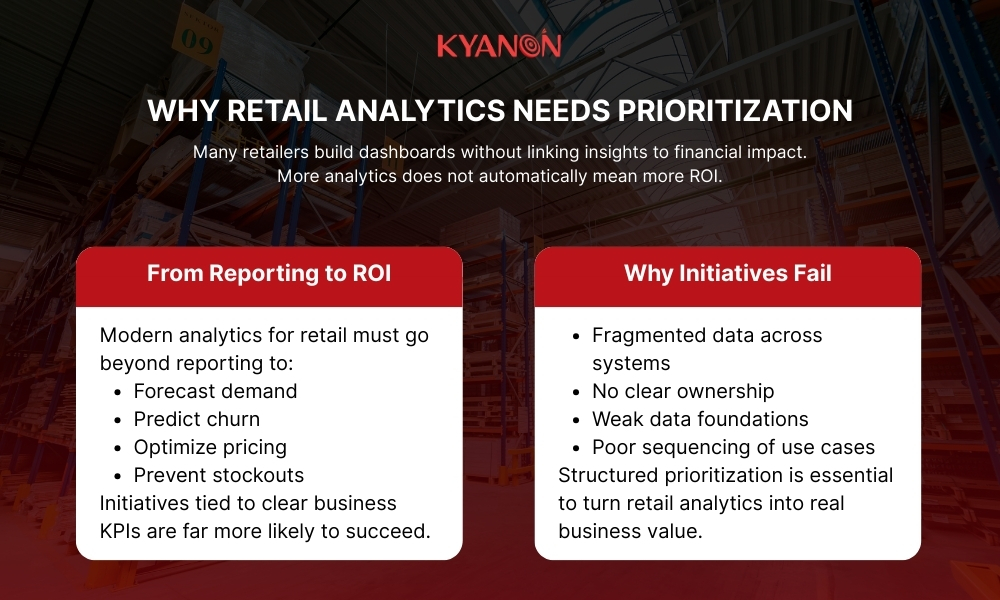
Retailers often fall into the “analytics everywhere” trap, building dashboards across departments without clarity on financial impact.
From “analytics everywhere” to “analytics that pays back”
Early retail analytics initiatives focused on reporting: sales by store, stock levels, campaign performance. Today, the shift is toward predictive and prescriptive analytics for retail:
- Forecast what will sell.
- Predict who will churn.
- Optimize price before margin erodes.
- Allocate inventory before stockouts happen.
Research from Gartner indicates that analytics projects tied to measurable commercial KPIs are significantly more likely to scale than experimentation-led initiatives. The question is no longer “Can we build analytics?”. The question is “Which use case pays back first?”
Why most retail analytics initiatives fail to scale
Common failure patterns include:
- Fragmented retail analytics data across POS, eCommerce, CRM, and supply chain systems
- No clear business owner for insights
- Advanced models built on poor data foundations
- Poor sequencing – starting with AI before mastering forecasting
Retailers need structured prioritization.
Use case 1 – Demand forecasting and inventory planning
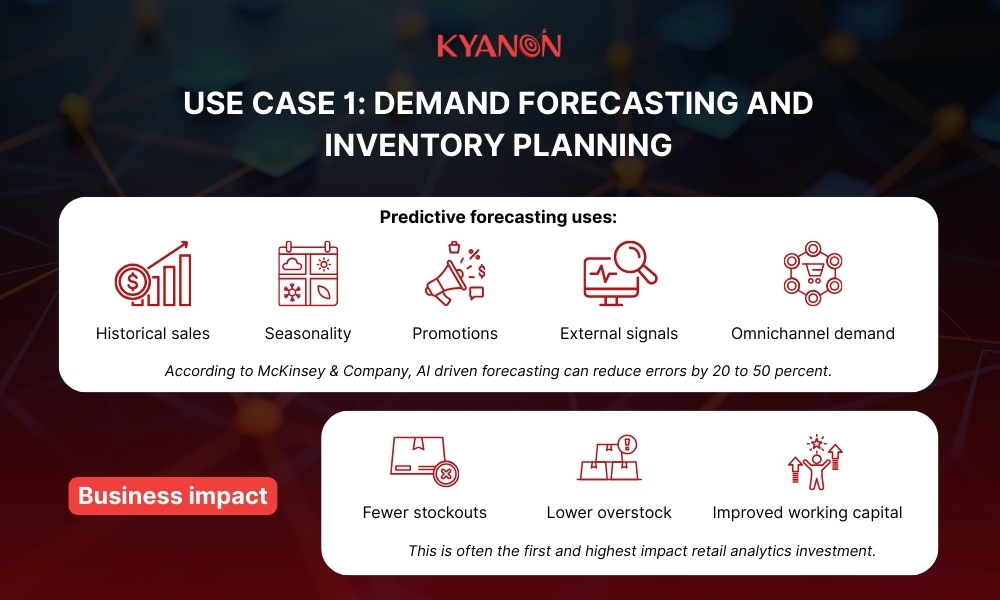
Demand forecasting and inventory planning form the foundation of profitable retail operations. With the right retail analytics, retailers can reduce stockouts, minimize excess inventory, and improve cash flow.
Predicting demand, not reacting to it
Reactive replenishment leads to markdowns and stockouts. Predictive data analytics for retail demand forecasting incorporates:
- Historical sales
- Seasonality
- Promotions
- External signals (weather, events)
- Omnichannel demand shifts
According to McKinsey & Company, AI-driven demand forecasting can reduce errors by 20–50%.
Impact on stockouts, overstock, and working capital
Better forecasting directly reduces:
- Stockouts (lost revenue)
- Overstock (margin erosion)
- Working capital pressure
This is why demand forecasting should be the first serious analytics retail investment.
According to research by Deloitte, businesses that implemented predictive inventory solutions reduced stockouts by up to 35%, leading to higher customer satisfaction and retention rates.
Real-world example
Walmart uses AI-driven demand forecasting to improve inventory planning across its stores. By analyzing real-time sales data, seasonal trends (e.g., holiday shopping or weather-driven demand), and local buying patterns, Walmart predicts future product demand more accurately and adjusts inventory levels accordingly.
This helps them reduce stockouts, lower excess inventory, and improve product availability, especially during peak periods like storms or holiday seasons.
Use case 2 – Dynamic pricing and promotion optimization
Dynamic pricing and promotion optimization help retailers protect margin in volatile markets. With retail analytics, pricing decisions shift from reactive discounting to data driven strategies that maximize profitability and promotional ROI.
Price elasticity and competitive awareness
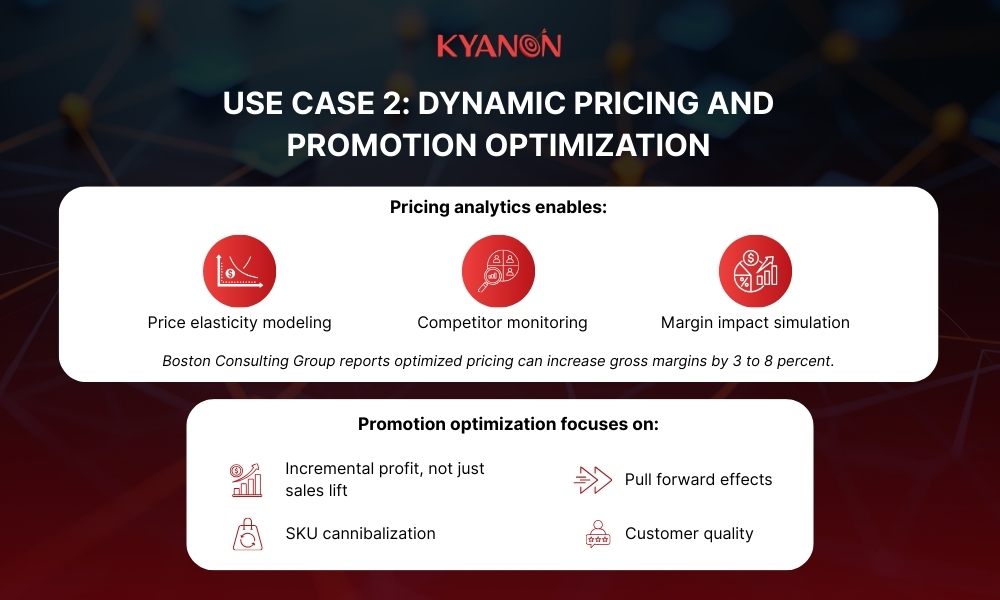
Advanced retail data analytics helps retailers:
- Model price elasticity
- Monitor competitor pricing
- Simulate margin impact
Boston Consulting Group reports that optimized pricing strategies can increase gross margins by 3–8%.
Promotion ROI instead of discount volume
Many retailers measure promotions by sales uplift alone. This approach often hides margin erosion.
Smarter retail analytics measures:
- Incremental profit, not just revenue lift
- Cannibalization across SKUs
- Pull forward effects
- Customer quality attracted by the promotion
A significant portion of trade promotions fail to generate positive incremental ROI when measured beyond sales volume. This is why promotion analytics should focus on profitability, not discount depth.
Real-world example
Amazon uses dynamic pricing to constantly adjust product prices in real-time based on factors like competitor pricing, demand signals, inventory levels, and market trends. For example, some product prices on Amazon can change multiple times per day as algorithms work to stay competitive and maximize revenue while responding to shopper behavior and competitor shifts.
Use case 3 – Customer segmentation and personalized marketing
Customer segmentation and personalized marketing enable retailers to move beyond generic campaigns. Using retail analytics, businesses can target high value segments with relevant offers that increase conversion, loyalty, and marketing ROI.
Behavioral and value based segmentation
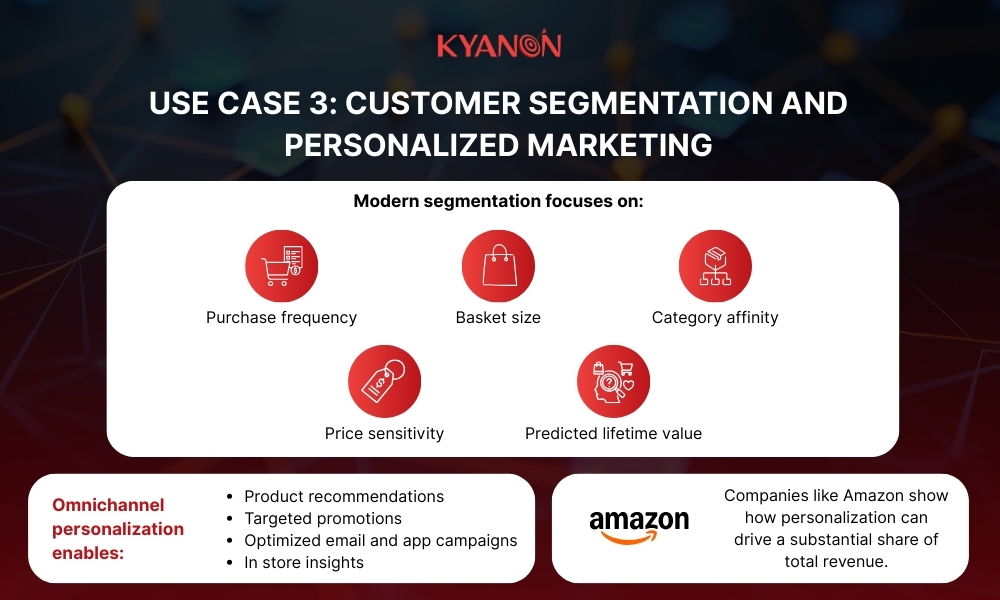
Traditional segmentation relies on demographics or channel usage. Modern analytics for retail focuses on:
- Purchase frequency
- Basket size
- Category affinity
- Price sensitivity
- Predicted lifetime value
Research from Deloitte shows that personalization leaders generate significantly higher revenue growth than competitors that rely on broad campaigns. Behavioral segmentation powered by retail analytics data allows retailers to identify high value segments and allocate resources more precisely.
Personalization across channels
Customers move fluidly between store, mobile, website, and marketplace. Retail data analytics enables:
- Personalized product recommendations
- Targeted promotions
- Optimized email and app campaigns
- In store associate insights
Companies such as Amazon have demonstrated how recommendation engines can drive a substantial share of total revenue through personalization.
Real-world example
Sephora uses advanced customer segmentation to tailor personalized marketing experiences. By analyzing data from their loyalty program (purchase history, preferences, behaviors), Sephora divides customers into distinct groups and then delivers targeted marketing messages, product recommendations, and special offers tailored to each segment.
This approach boosts engagement, increases repeat purchases, and deepens customer loyalty.
Use case 4 – Customer lifetime value prediction
Customer lifetime value prediction helps retailers focus on long term profitability instead of single transactions. With retail analytics, businesses can identify high value customers early and allocate retention and marketing budgets more strategically.
Identifying high value customers early
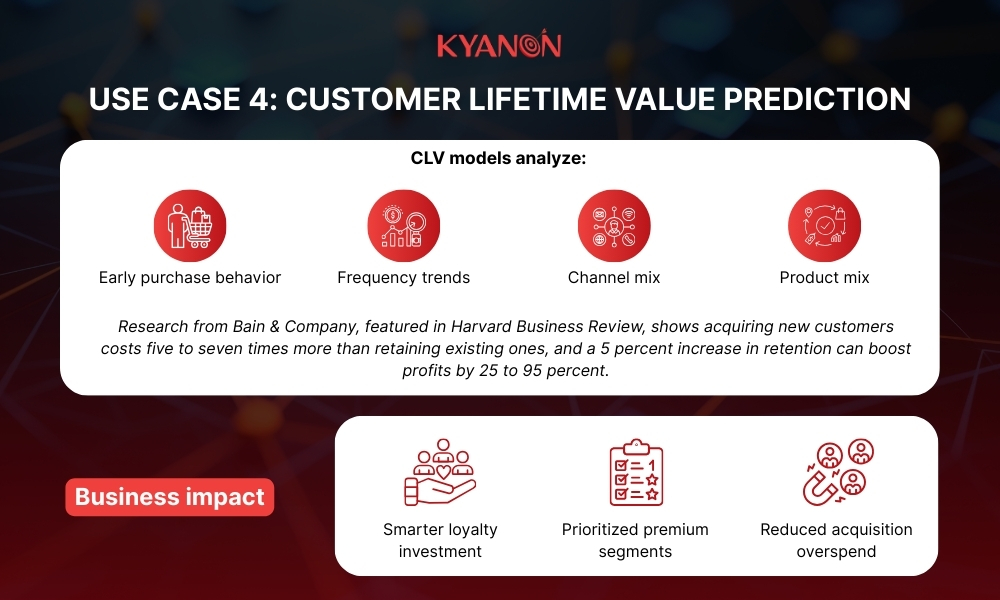
Predictive CLV models use:
- Early purchase behavior
- Frequency trends
- Channel mix
- Product mix
This form of data analytics in retail helps retailers identify customers worth nurturing before they become top spenders. Acquiring new customers is five to seven times more expensive than retaining existing ones, according to research from Bain & Company featured in Harvard Business Review. The same research found that increasing customer retention by just 5% can boost profits by 25% to 95%. By focusing on their customer retention plan, businesses can budget more resources to enhance their product or service and improve their reputation. (Outreach)
Aligning retention spend with value
CLV insights allow retailers to:
- Allocate loyalty budgets strategically
- Prioritize premium service tiers
- Reduce acquisition overspend
Retail analytics ensures marketing investment aligns with long term economics.
Use case 5 – Churn prediction and retention analytics
Churn prediction and retention analytics help retailers prevent revenue loss before it happens. Using retail analytics, businesses can detect early risk signals and take targeted action to retain valuable customers.
Early warning signals in customer behavior
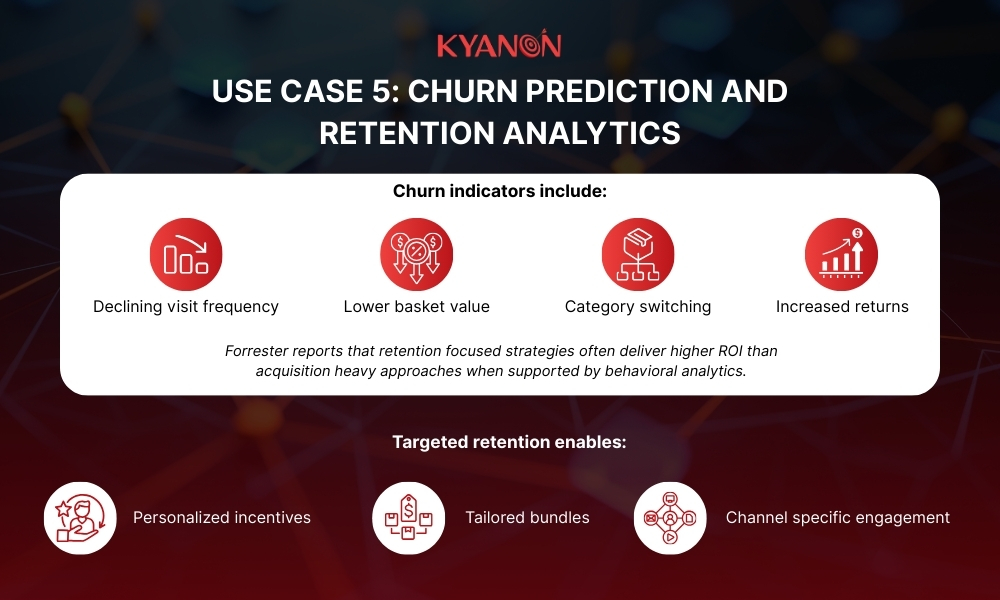
Churn risk signals include:
- Declining visit frequency
- Reduced basket value
- Category switching
- Increased return behavior
Predictive analytics retail models identify churn probability before customers disappear. According to Forrester, retention focused strategies typically deliver higher ROI than acquisition heavy strategies when supported by behavioral analytics.
Targeted retention actions
Instead of blanket reactivation campaigns, retailers can:
- Trigger targeted incentives
- Offer personalized bundles
- Engage through preferred channels
This transforms retention from reactive to proactive.
Use case 6 – Store layout and footfall analytics
Store layout and footfall analytics reveal how physical space influences sales performance. With retail analytics, retailers can optimize traffic flow, product placement, and revenue per square foot to improve in store profitability.
Understanding customer movement patterns
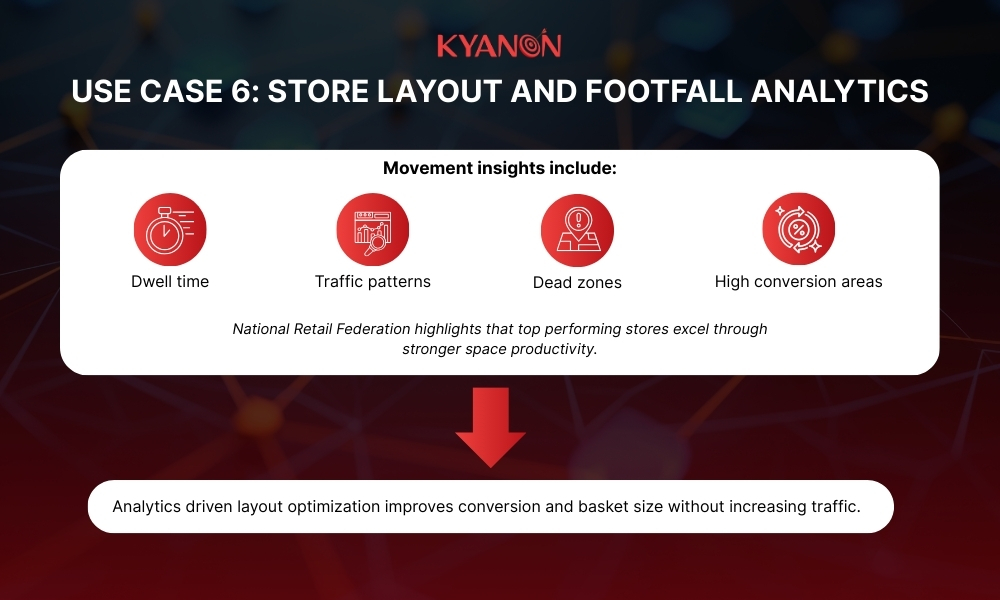
Footfall sensors, POS data, and computer vision analytics provide insights into:
- Dwell time
- Traffic flow
- Dead zones
- High conversion areas
Retail analytics data turns physical behavior into measurable insights.
Optimizing revenue per square foot
Revenue per square foot is a critical KPI for brick and mortar retailers. According to National Retail Federation, top performing stores consistently outperform peers through better space productivity.
Analytics-driven layout optimization improves conversion and average basket size without increasing traffic.
Use case 7 – Fraud detection and loss prevention
Fraud detection and loss prevention use retail analytics to identify suspicious transactions and reduce shrinkage. By detecting anomalies early, retailers can protect margin while maintaining a smooth customer experience.
Anomaly detection in transactions and returns
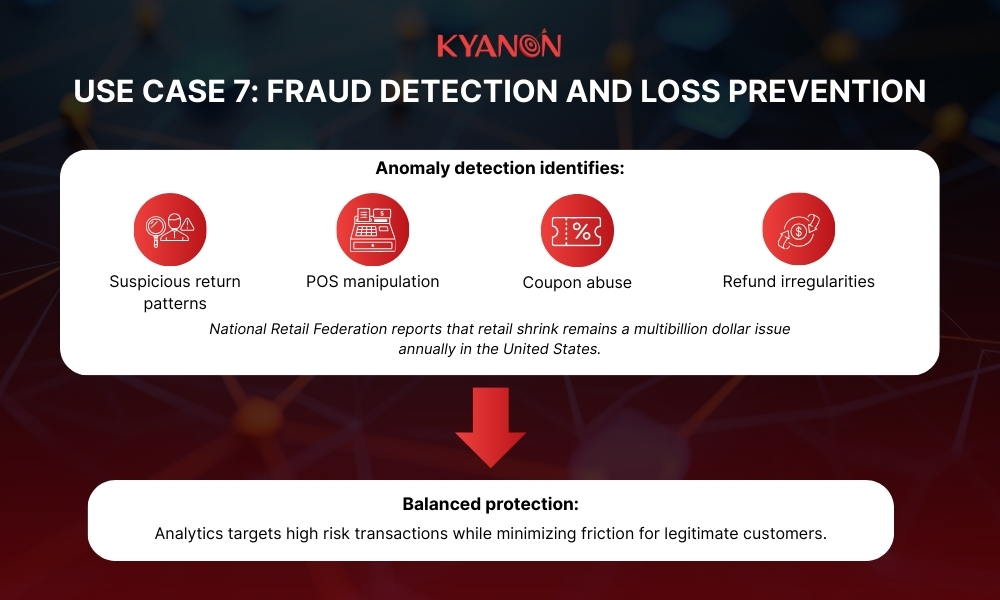
Retail data analytics detects:
- Suspicious return patterns
- POS manipulation
- Coupon abuse
- Refund anomalies
According to National Retail Federation, retail shrink remains a multi billion dollar issue annually in the United States. Advanced analytics helps detect patterns humans cannot easily see.
Balancing security and customer experience
Overly aggressive controls create friction. Analytics allows retailers to target high risk transactions while minimizing disruption to legitimate customers.
Use case 8 – Assortment and merchandising optimization
Assortment and merchandising optimization help retailers align product mix with real demand. Through retail analytics, businesses can localize assortments, eliminate low performing SKUs, and improve overall margin productivity.
Localized demand and regional preferences
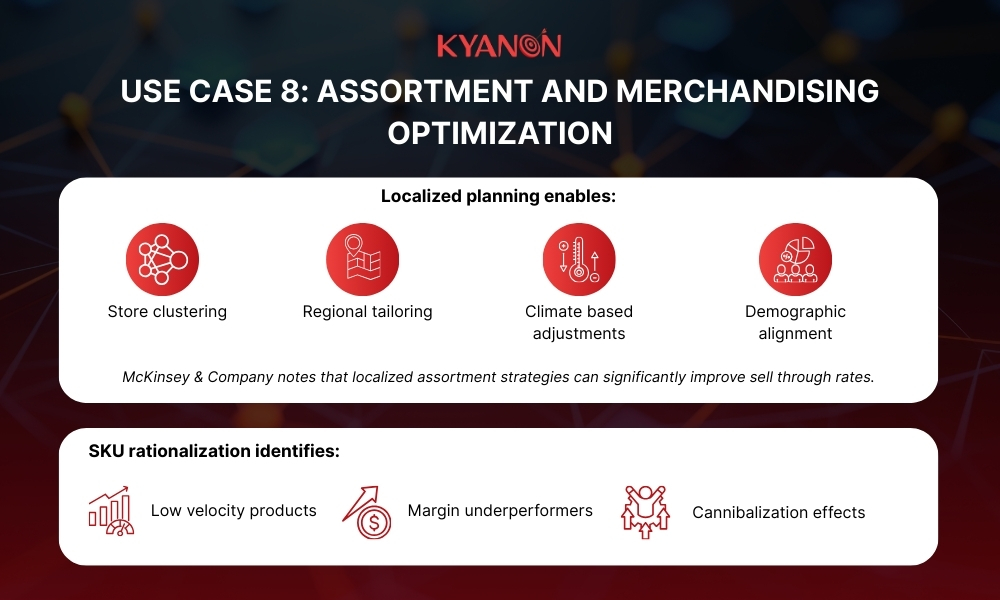
Retail analytics enables:
- Store cluster analysis
- Regional assortment tailoring
- Climate based planning
- Demographic sensitivity
According to McKinsey & Company, localized assortment strategies can materially improve sell through rates.
SKU rationalization and margin improvement
Too many SKUs increase complexity and reduce clarity. Data analytics for retail identifies:
- Low velocity SKUs
- Margin underperformers
- Cannibalization effects
This supports smarter merchandising decisions.
Use case 9 – Omnichannel customer journey analytics
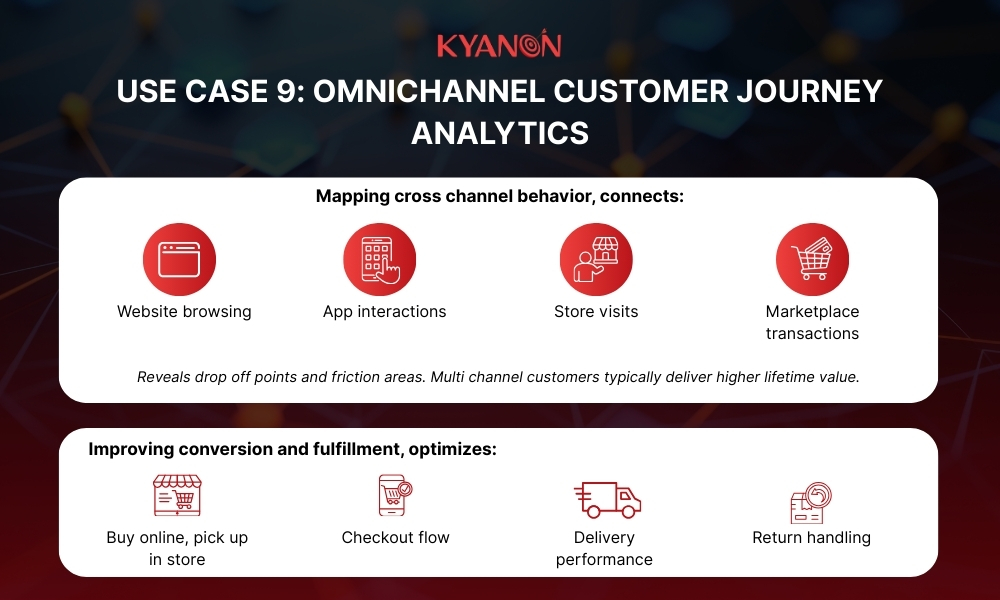
Omnichannel customer journey analytics connects online and offline behavior into a single view. With retail analytics, retailers can identify friction points, improve conversion across touchpoints, and enhance fulfillment performance.
Mapping cross channel customer behavior
Journey analytics connects:
- Website browsing
- App interactions
- Store visits
- Marketplace transactions
Retail analytics data reveals drop off points and friction areas. According to Accenture, customers who engage across multiple channels typically deliver higher lifetime value than single channel shoppers.
Improving conversion and fulfillment flows
Analytics can optimize:
- Buy online pick up in store flows
- Checkout processes
- Delivery performance
- Return handling
Omnichannel analytics directly influences revenue and operational efficiency.
How to sequence retail analytics use cases
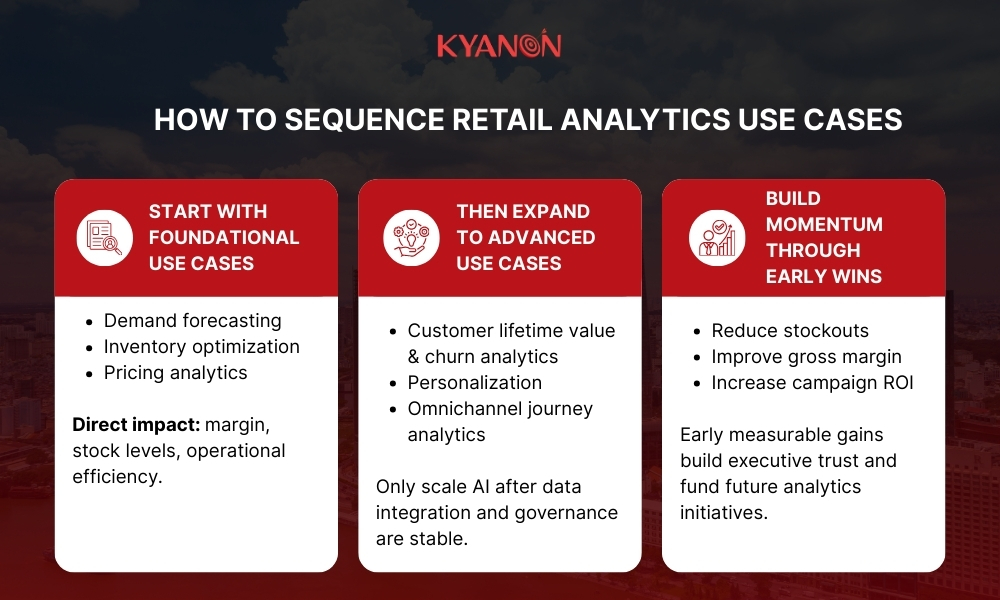
Sequencing retail analytics use cases determines how quickly value is realized. Retailers should start with foundational initiatives such as demand forecasting and pricing, then scale into customer and omnichannel analytics once data quality, governance, and ownership are firmly established.
Foundational vs advanced use cases
Retailers should begin with foundational retail analytics initiatives that directly impact margin and operational efficiency, including:
- Demand forecasting
- Inventory optimization
- Pricing analytics
Once these capabilities are established and delivering measurable results, organizations can progressively expand into more advanced use cases, such as:
- Customer lifetime value prediction and churn analytics
- Personalization strategies
- Omnichannel journey analytics
Advanced AI initiatives should only be pursued after data integration, governance frameworks, and ownership models are stable and scalable.
Building momentum through early wins
Early wins:
- Reduce stockouts
- Improve gross margin
- Increase campaign ROI
These measurable gains build executive trust and fund more advanced analytics retail initiatives.
Turning retail analytics use cases into business impact
Turning retail analytics use cases into business impact requires more than models and dashboards. Real value emerges when insights are embedded into daily decisions, operational workflows, and measurable financial outcomes.
When retail analytics delivers ROI and when it does not
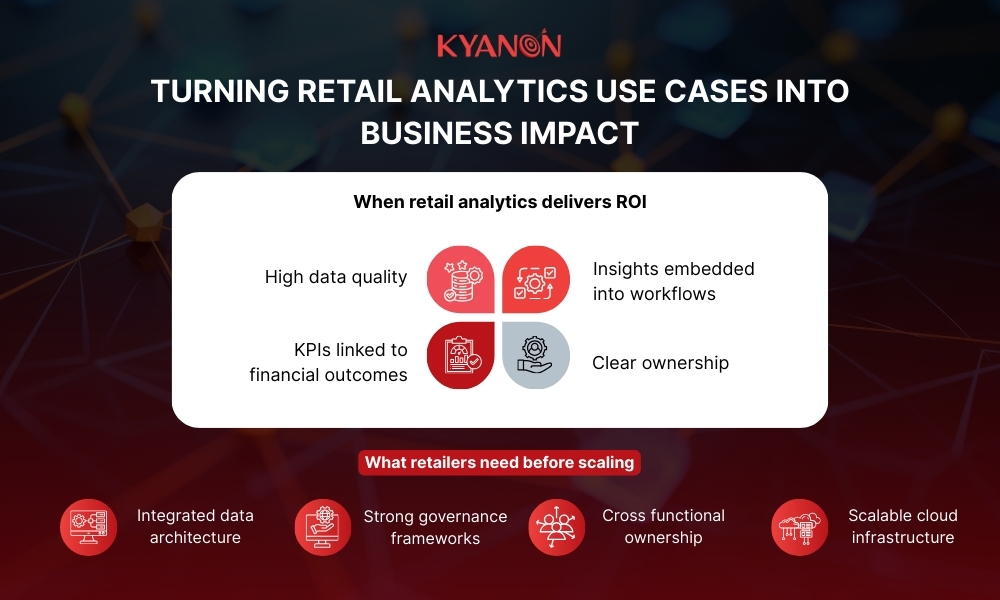
Retail analytics delivers ROI when:
- Data quality is high
- Insights are embedded into workflows
- Ownership is clearly defined
- KPIs are linked to financial outcomes
It fails when analytics remains isolated from operations.
What retailers need before scaling analytics use cases
Prerequisites include:
- Integrated data architecture
- Governance frameworks
- Cross functional ownership
- Scalable cloud infrastructure
How Kyanon Digital helps retailers execute high ROI use cases
At Kyanon Digital, retail analytics is not just model building.
We support retailers across:
- Data engineering and integration
- Analytics model development
- Dashboard and insight design
- Activation into CRM, ERP, POS, and eCommerce systems
- Performance measurement frameworks
Our approach focuses on execution first, sophistication second.
Case study: AI-Driven BI & Data Warehouse For A Leading Retail Corporation
Challenges
- Manual and error-prone reporting processes reduced efficiency and delayed insights.
- No centralized data repository, causing fragmented information and slow data retrieval.
- Leadership lacked real-time visibility into store performance and operational trends.
Solutions
- Designed and implemented a centralized Data Warehouse with automated reporting workflows.
- Built a standardized, centralized report submission and multi-tiered approval system.
- Integrated Microsoft Power BI to deliver real-time, visual dashboards for leadership.
Impact
- Reporting and approval cycles became faster with fewer errors and higher data quality.
- Standardized data and centralized storage improved consistency and reduced reconciliation time.
Explore the full case study here: AI-Driven BI & Data Warehouse For A Leading Retail Corporation
Evaluation questions for retail leaders
Before scaling retail analytics initiatives, retail leaders should critically assess their readiness and priorities. The right questions help distinguish experimentation from real commercial impact:
- Which use case directly improves margin this year
- Is our inventory accuracy above 95 percent
- Can we measure promotion profit, not just sales
- Do we know our top 20 percent customers by predicted value
- Are analytics insights embedded into daily workflows
If the answer is unclear, sequencing should be revisited.
From retail analytics strategy to measurable business impact
Retail analytics creates value only when it is prioritized and executed with clear commercial goals. Demand forecasting, pricing optimization, and customer economics consistently deliver the strongest early ROI, while advanced initiatives succeed only after strong data foundations are in place.
The difference between insight and impact is execution.
At Kyanon Digital, we help retailers turn retail analytics data into measurable margin improvement, operational efficiency, and customer growth. If you are ready to invest in the right use cases and scale with confidence, contact Kyanon Digital to accelerate your retail analytics strategy.