

AI-driven software development is redefining how enterprises build, scale, and innovate. Instead of relying on manual processes and intuition, organizations can now accelerate delivery, enhance customer experiences, and reduce operational risks through intelligent automation and data-driven decisions.
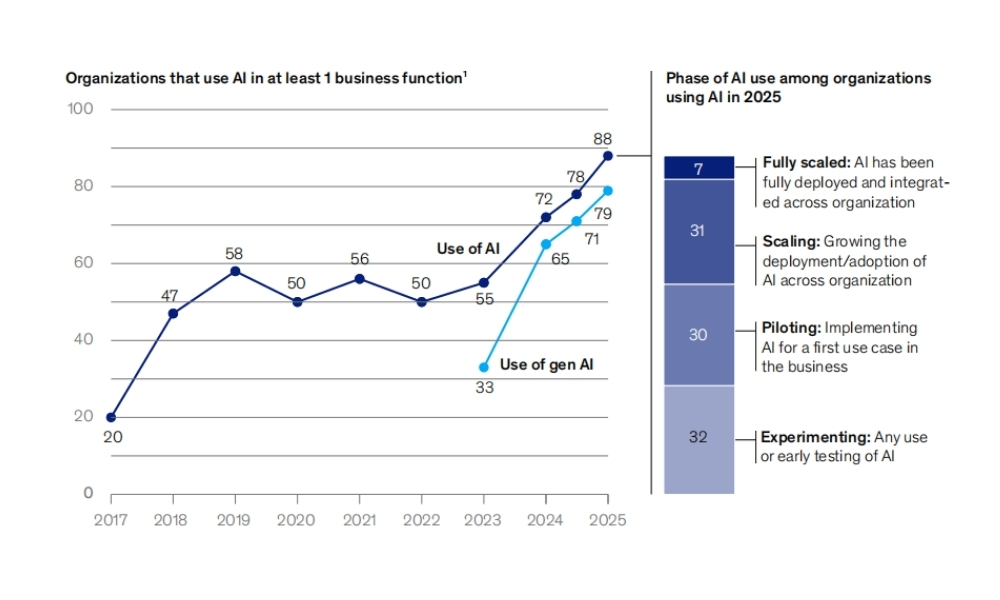
Adoption is rising quickly. McKinsey’s State of AI 2025 reports that 88% of companies use AI, yet only 31% have scaled it enterprise-wide, revealing a significant competitive gap.
Houlihan Lokey further highlights a shift from “manual creation to automated assembly,” proving how AI is transforming engineering efficiency and value creation.
In this article, Kyanon Digital breaks down what AI-driven development truly means, how it enhances the software development life cycle (SDLC), and why scaling AI now is becoming a strategic advantage for global enterprises.
Key takeaways
- What AI-driven software development means: AI augments the SDLC through automation, intelligent insights, and AI agents that improve developer productivity and system resilience.
- Key benefits for enterprises: AI accelerates delivery, enhances software quality, increases scalability, drives hyper-personalization, and unlocks cross-functional efficiency.
- Use cases of AI in the SDLC: AI enables automation across planning, coding, testing, deployment, and maintenance to streamline end-to-end engineering workflows.
- Implementation considerations: Enterprise adoption requires clear objectives, strong governance, secure data practices, legacy integration planning, and the right technology partners.
- Challenges and considerations: Organizations must address data quality gaps, talent shortages, ethical risks, automation overreliance, and integration complexities.
- Future trends in enterprise AI: Autonomous engineering, multi-model AI ecosystems, AI-first architectures, hyper-personalized applications, and predictive observability are reshaping enterprise digital operations.
Further reading:
- AI And Software Development in Vietnam
- How AI Is Redefining Customer Loyalty in SEA
- Vietnam’s Advantages for Enterprise AI Outsourcing
- AI Predictive Analytics in Ecommerce in the SEA
- How to Build Your Business with AI Assisted Software Development Services
What is AI-driven software development?
AI-driven software development is the use of AI models, machine learning, and automation across the entire software development lifecycle. Instead of relying only on manual coding and human judgment, AI supports or automates tasks like planning, coding, testing, deployment, monitoring, and optimization. In practice, it acts as an intelligent collaborator that helps teams move faster with fewer defects.
Why AI-driven development is rising now
- AI is now embedded across engineering workflows: AI-assisted development grew 70% in 2024 (Developer Survey), showing AI is no longer experimental. Teams use it for coding, testing, and issue detection, gaining faster releases and a clear operational edge.
- AI tools are becoming faster, cheaper, and more capable: Small models now rival large LLMs, and dropping inference costs make enterprise AI accessible. Developers using AI complete tasks 55% faster with fewer errors, and AI suggestions improve code accuracy and delivery speed (GitHub).
- Engineering is shifting from manual creation to smart automation: AI handles repetitive coding, architectural analysis, and automated reviews, allowing engineers to focus on innovation and modernization. While Stanford’s AI Ethics Institute notes that 23% of AI-generated code may contain subtle vulnerabilities, enterprises can mitigate these risks through guardrails and secure-by-design practices.
How AI works across the software development lifecycle (SDLC)
Traditional software development follows a linear cycle, from discovery to validation, build, and launch, with fragmented data, slow feedback loops, and teams working in silos.

In an AI-enabled lifecycle, these steps become continuous and interconnected: customer data flows across every phase, insights are generated instantly, and discovery and build cycles accelerate together.
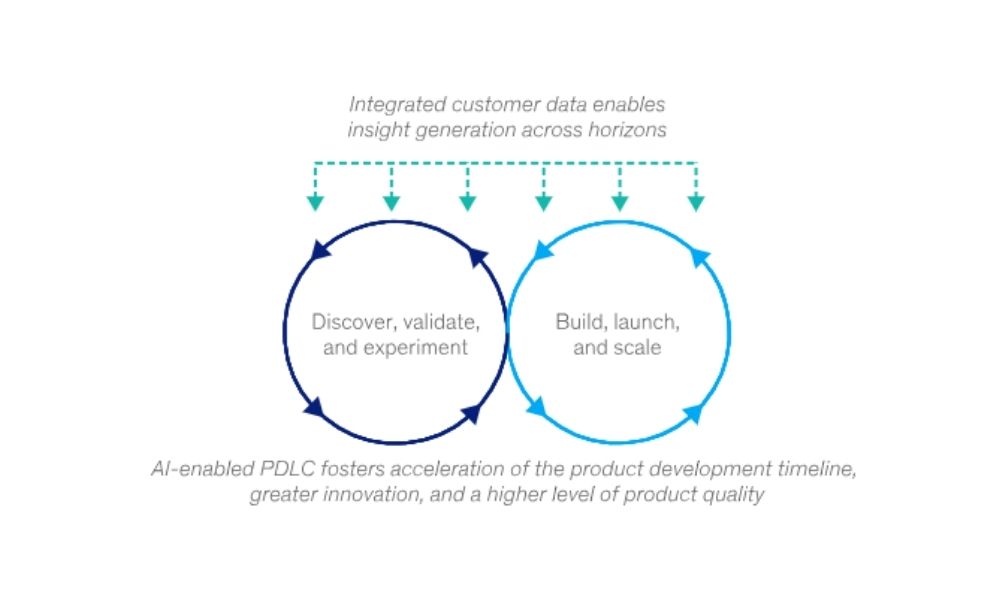
This shift reduces delays, improves decision-making, and allows teams to develop, launch, and scale products faster with higher confidence.
Below is how AI elevates each stage of the SDLC.
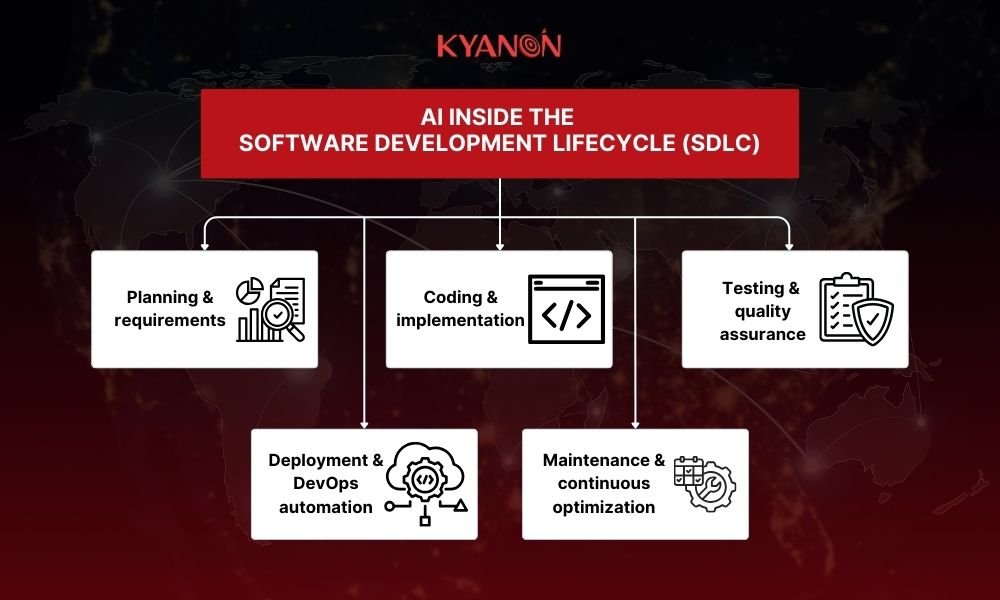
Planning & requirements
AI analyzes feedback, system data, and market signals to help teams identify high-value features and make better product decisions.
AI capabilities:
- Requirement clustering and deduplication.
- Natural-language summarization of customer input.
- Backlog prioritization based on projected business impact.
Business impact: Faster alignment on product direction and reduced risk of building low-value features.
Coding & implementation
AI accelerates development by generating code, spotting issues early, and improving code quality in real time.
AI capabilities:
- Boilerplate code generation and code suggestions.
- Real-time vulnerability detection.
- Automated refactoring and quality improvements.
Business impact: Shorter development cycles and 25–45% productivity gains for engineering teams (McKinsey’s State of AI 2025)
Testing & quality assurance
AI enhances QA by automating test creation, detecting defects sooner, and simulating diverse user behaviors.
AI capabilities:
- Automatic test case generation.
- Intelligent defect detection.
- User journey simulation for edge cases.
Business impact: Higher test coverage, fewer manual QA hours, and faster release confidence.
Deployment & DevOps automation
AI strengthens DevOps pipelines by predicting failures, optimizing capacity, and automating monitoring workflows.
AI capabilities:
- Deployment risk analysis.
- Capacity and performance forecasting.
- Automated incident alerts and diagnostics.
Business impact: More reliable deployments and minimized downtime during high-traffic events.
Maintenance & continuous optimization
AI agents continuously monitor systems to detect anomalies, recommend fixes, and resolve low-complexity incidents automatically.
AI capabilities:
- Performance anomaly detection.
- Automated issue resolution for routine incidents.
- Log analysis and patch recommendations.
Business impact: More stable systems, lower operational workload, and improved digital resilience for long-term innovation.
Key benefits for enterprises
AI-driven software development is transforming how modern enterprises build and scale digital products.
For leaders, this shift represents a chance to increase efficiency, improve customer experience, and future-proof their technology investments.

Accelerated development cycles
What it means: AI shortens development time by automating tasks that previously required long manual effort.
How AI helps:
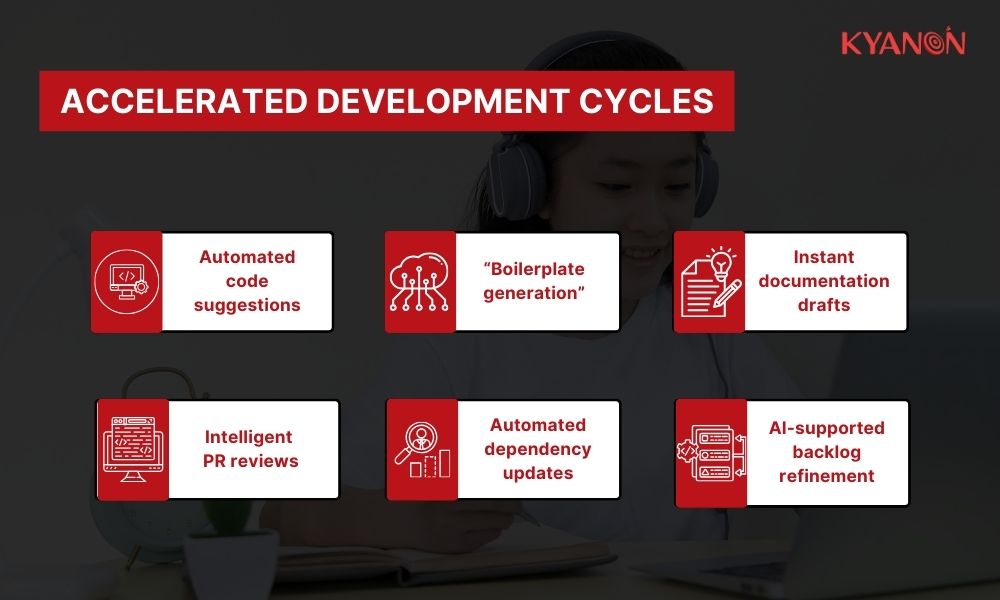
- Generates boilerplate code and intelligent code suggestions.
- Draft documentation instantly.
- Reviews pull requests with context-aware recommendations.
- Refines backlogs and sprint plans automatically.
Enterprise impact: McKinsey reports up to 45% faster development throughput, helping teams ship features sooner, increase velocity, and redirect engineering time to innovation instead of repetitive work.
Enhanced software quality
What it means: AI continuously improves code quality by detecting issues earlier and automatically expanding test coverage.
How AI helps:
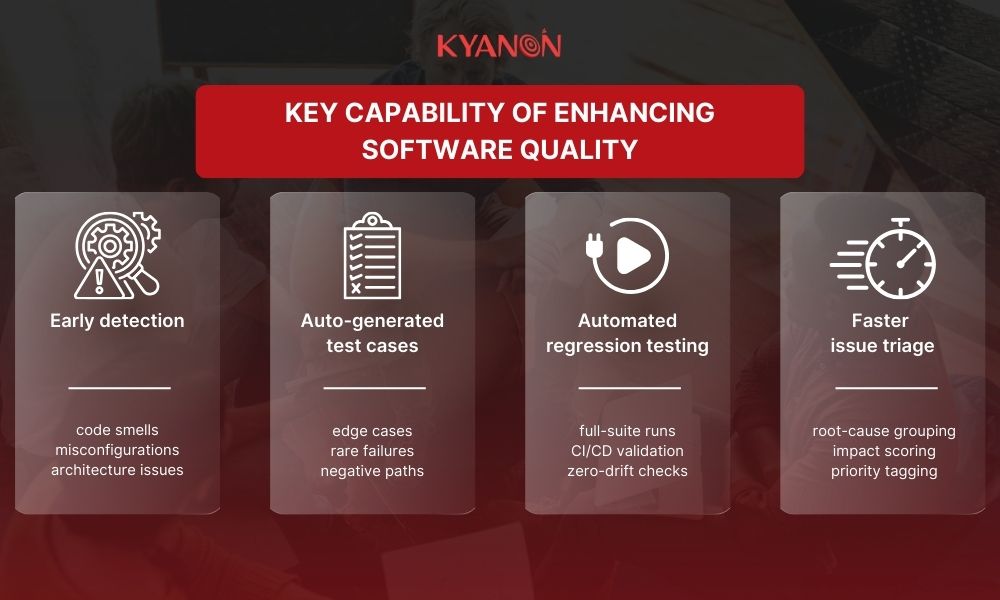
- Flags code smells, misconfigurations, and security vulnerabilities.
- Auto-generates test cases for edge scenarios.
- Runs automated regression tests across CI/CD.
- Speeds up issue triage and prioritization.
Enterprise impact: More stable, secure applications and significantly lower long-term maintenance and remediation costs, with measurable savings in risk reduction.
Data-driven insights
AI analyzes product data, customer behavior, and system patterns to help engineering and product teams make better decisions. This leads to clearer priorities, smarter roadmaps, and features that actually meet user needs.
Typical AI insights include:
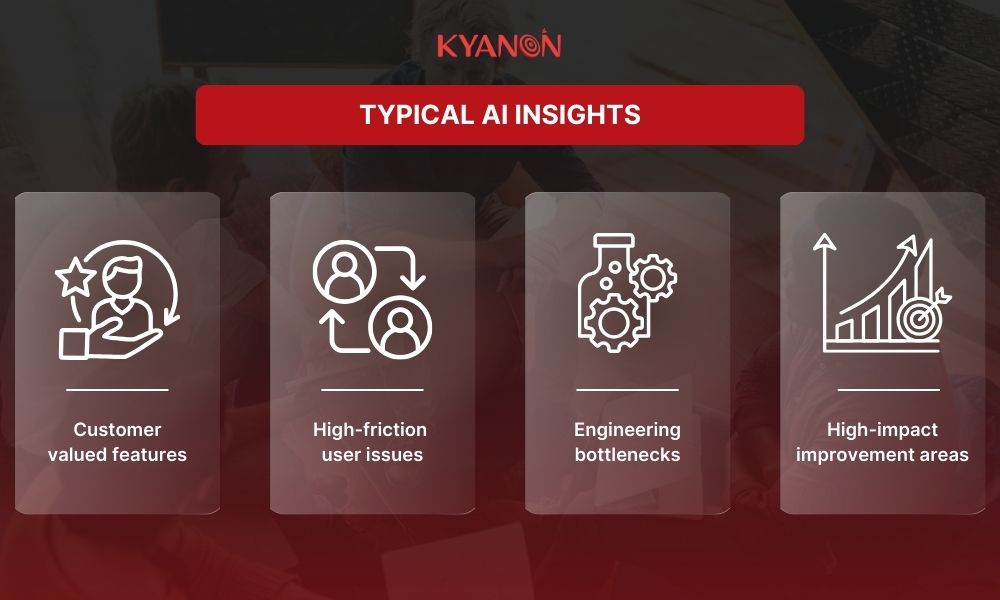
- Which features customers actually value
- Which issues cause the most friction in workflows
- Where engineering bottlenecks occur
- Which product improvements will maximize business impact
Enterprise impact
- More confident decision-making
- Better product–market alignment
- Stronger collaboration across teams
Scalability and adaptability
What it means: AI enables systems to scale automatically and adapt to shifting business demands.
How AI helps:
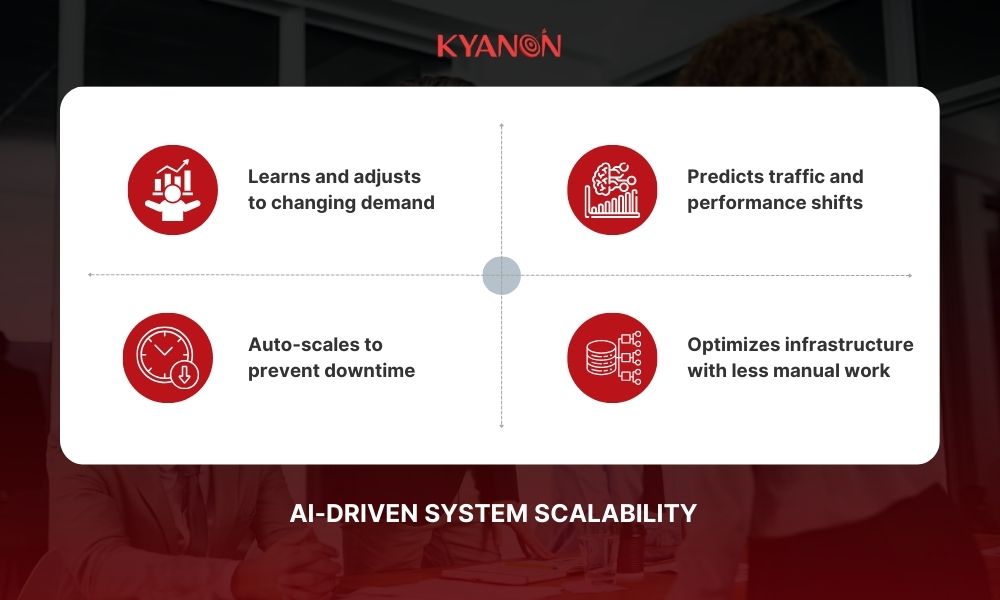
- Predicts traffic spikes and capacity needs.
- Detects early performance degradation.
- Optimizes cloud and infrastructure usage.
- Prevents bottlenecks through proactive scaling.
Enterprise impact: Higher uptime, fewer disruptions, and reduced cloud overspending, making operations more resilient as workloads evolve.
Hyper-personalization
What it means: AI delivers real-time personalized experiences that adapt instantly to individual user behavior.
How AI helps:
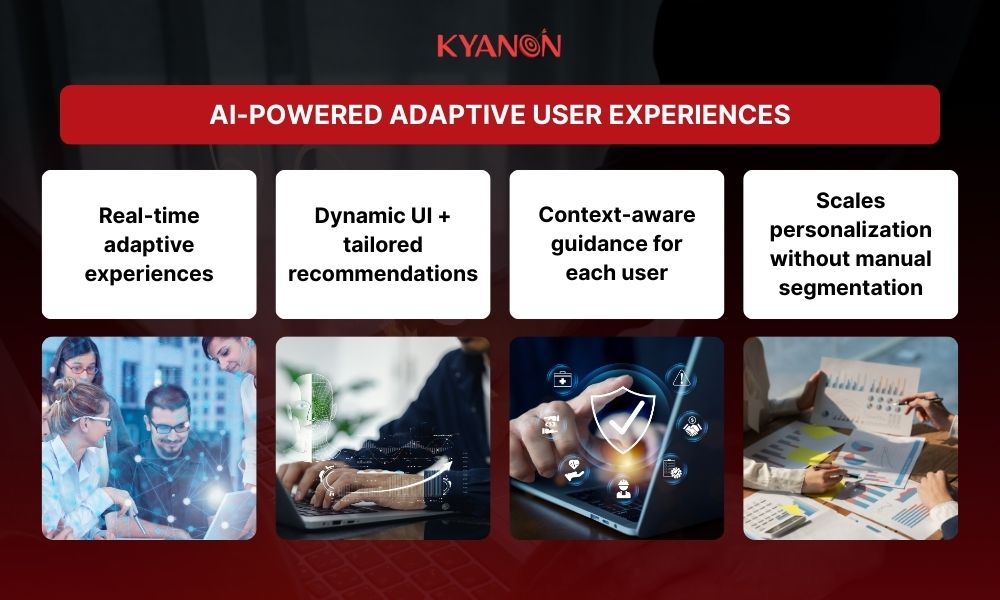
- Recommends features or next steps dynamically.
- Adjusts UI and journeys based on behavior patterns.
- Automates segmentation and personalization logic.
- Continuously improves journeys using live product data.
Enterprise impact: Higher engagement, improved retention, and stronger conversion rates, with less manual effort from product and engineering teams.
Improved efficiency across business functions
What it means: AI-driven development elevates not just engineering but enterprise-wide performance across sales, finance, HR, operations, and CX.
How AI helps:
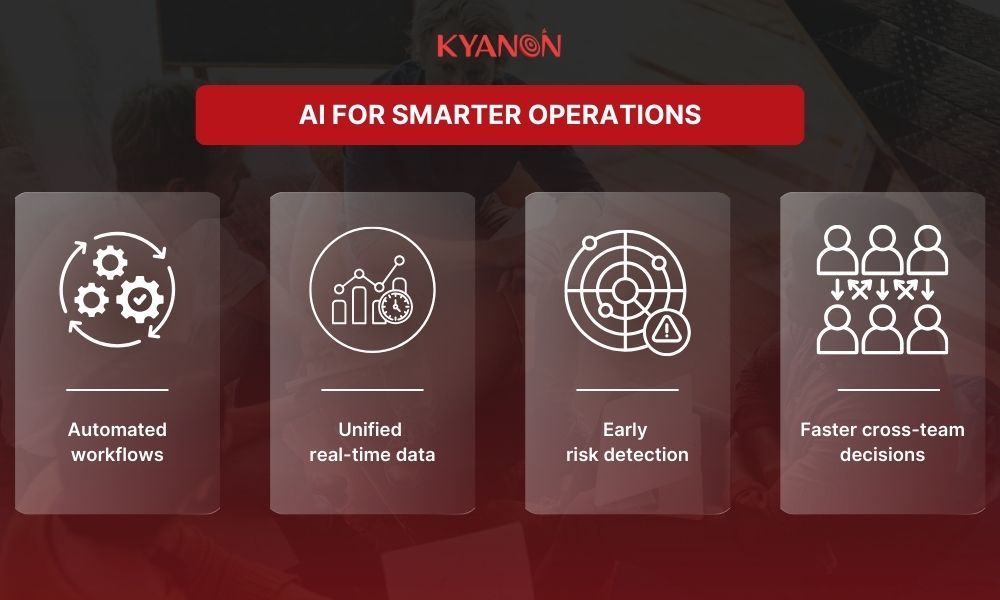
- Automates routine cross-functional workflows.
- Unifies data for real-time insights.
- Identifies operational risks early.
- Accelerates decision-making across teams.
Enterprise impact: Lower operational costs, faster cross-team processes, better business–engineering alignment, and more predictable, resilient operations.
Implementation Considerations
Adopting AI-driven software development is a strategic transformation that reshapes engineering culture, system architecture, workflows, compliance, and operating models. Large enterprises that succeed do not simply “add AI tools”, they redesign how software is planned, built, deployed, governed, and optimized.
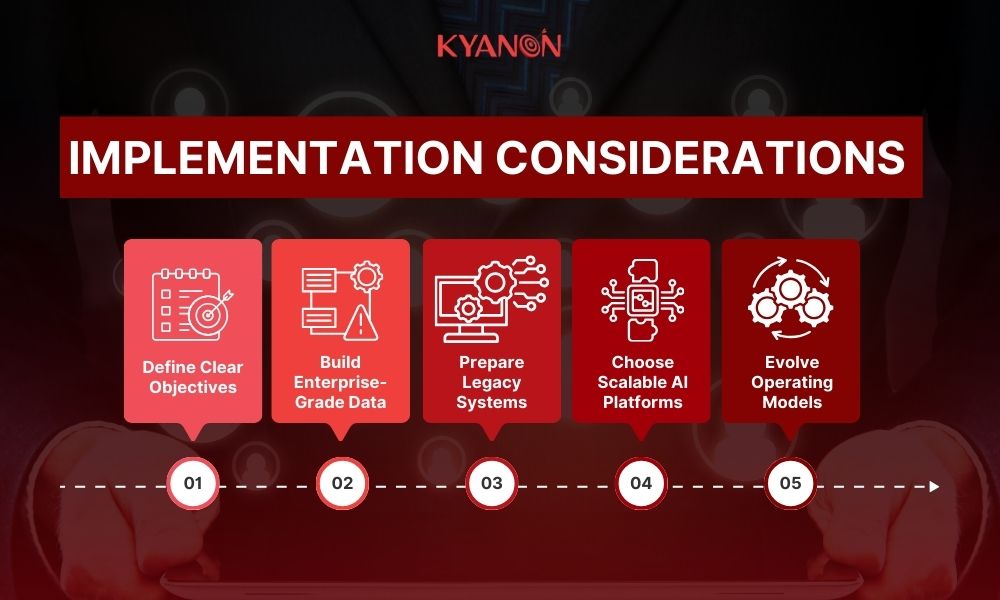
Below are the five critical considerations that global AI-mature organizations prioritize when scaling AI across the enterprise.
Quick check table for business
|
Area |
What to prepare | Why it matters |
|
Objectives & guardrails |
Clear outcomes + rules for data and AI-generated code. |
Avoids pilot trap; aligns AI with business value. |
|
Data & security foundations |
Clean engineering data; policy-as-code; AI code scanning. |
Ensures safe, reliable AI workflows. |
|
Architecture readiness |
Modern APIs, CI/CD, observability, cloud/hybrid setup. |
AI works only in modular, automated systems. |
|
Scalable AI platforms |
Integrations across dev tools; multi-model support; trusted partners. |
Faster scaling and lower integration friction. |
| Skills & operating model | AI coding literacy, MLOps, new workflows (AI pair programming). |
Unlocks true AI productivity gains. |
Define clear objectives, guardrails, and business alignment
- Set measurable goals (faster releases, higher defect detection, lower cloud spend).
- Define guardrails: data access, code deployment, AI usage in critical systems.
Why it matters: Avoids “pilot trap” and ensures executive alignment.
Build enterprise-grade data, security, and responsible AI foundations
- Clean engineering data (code, tests, incidents).
- Secure-by-design: policy-as-code, AI code scanning, audit trails.
- Responsible AI: bias checks, transparency, retention rules.
Why it matters: Enables safe, reliable AI engineering at scale.
Prepare legacy systems and architecture for AI augmentation
Most large enterprises have monolithic systems, fragmented CI/CD pipelines, or outdated infrastructure, all of which limit AI’s impact.
Organizations must modernize in three layers:
- Architecture: Break monoliths into services, adopt event-driven patterns, and standardize APIs so AI can automate consistently.
- Developer platforms: Provide unified environments, strong observability, automated testing, and internal developer platforms (IDPs).
- Cloud & compute: Ensure dynamic scaling, GPU-ready infrastructure, and standardized deployment pipelines for AI workloads.
Why it matters: AI only works when systems are modular and automation-friendly.
Choose scalable AI platforms and the right strategic partners
- Platform integration: Must plug into GitHub/GitLab, Jira/Azure DevOps, CI/CD, Kubernetes, observability, and security tools; otherwise, teams revert to old workflows.
- Multi-model support: Ability to run proprietary, open-source, small domain models, and on-prem models for sensitive workloads.
- Enterprise-grade performance: SLA-backed uptime, low-latency inference, data residency controls, and robust SDKs/logging.
- Strategic partners: Combine cloud hyperscalers with AI and platform engineering experts.
Why this matters: Enterprises that adopt a hybrid ecosystem scale AI 2–3× faster than those building in isolation.
Evolve engineering skills, roles, and operating models
- Role shifts: Coding → reviewing/validating; manual testing → automated governance; reactive ops → predictive, AI-assisted ops.
- New skills: AI-assisted coding, prompt engineering, MLOps/LLMOps, data fundamentals, AI QA, automated testing design.
- New ways of working: AI pair programming, shift-left AI, autonomous DevOps agents, cross-functional pods, continuous discovery with AI insights.
- Change management: Engineers must trust AI; PMs must understand limitations; compliance teams must adapt review processes.
Why it matters: True AI productivity gains only appear when teams redesign how they work—not just add new tools.
AI in action: A loyalty transformation delivered by Kyanon Digital
A major beverage-brand engagement platform seeking to transform consumer loyalty through real-time data, CRM, and AI-powered reward flows.
Challenge:
Difficulty capturing real consumption behavior in real time, limiting the ability to respond when it matters.
Fragmented data sources and a lack of unified customer tracking lead to weak personalization and poor retention efforts.
Solution:
The team developed a full-stack AI-driven loyalty engagement platform with:
- QR-code and IoT-enabled tracking at point-of-sale/consumption
- Seamless mobile/web onboarding to reduce friction
- Real-time consumption event capture (receipt scanning or IoT triggers)
- Automated CRM flows for rewards, retargeting, and personalized offers based on user behavior
Results & Impact:
- Real-time behavioral data allowed precise personalization and timely engagement.
- Increased customer retention through relevant rewards and re-engagement campaigns.
- Scalable loyalty infrastructure that transforms first-party data into long-term customer value and repeat purchases.
Read more: AI-Powered Loyalty Engagement Platform For A Leading Beverage Brand
Challenges and key considerations for adopting AI-driven software development
While AI-driven software development delivers strong benefits, enterprises face several structural and operational challenges when scaling it across teams. These obstacles often determine whether organizations unlock AI’s full value or remain stuck in the pilot stage.
Key challenges to implementing AI in the software development lifecycle
AI adoption in the SDLC is limited by fragmented data, legacy systems, governance gaps, cost uncertainty, and a lack of AI fluency across engineering roles. Successful enterprises address these early to enable reliable, scalable AI-driven development.
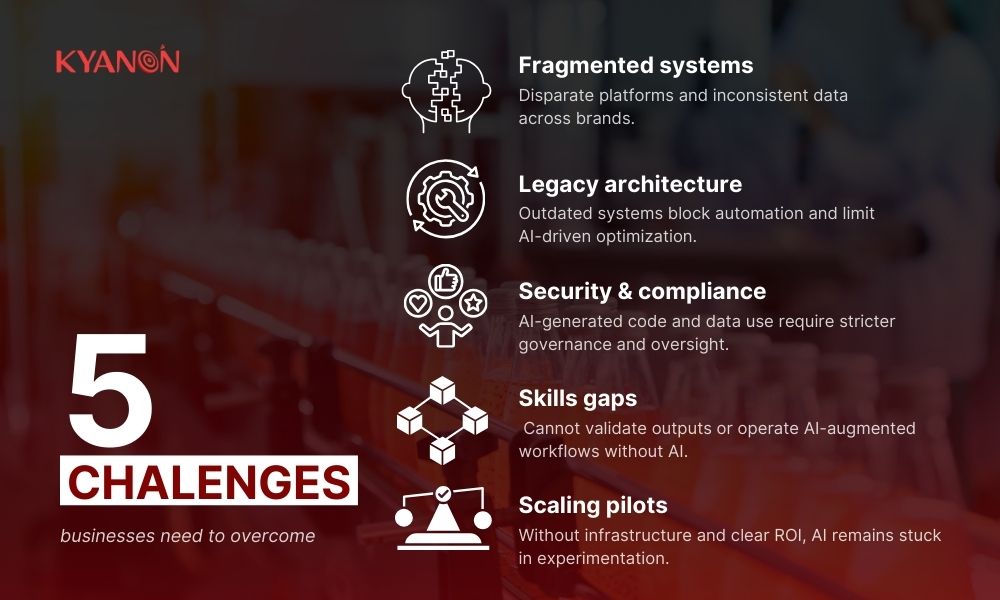
Quick overview table
|
Challenge |
Impact on enterprises |
|
Fragmented data |
AI accuracy drops when data sits in silos across tools and systems. |
|
Legacy architecture |
Outdated systems block automation and limit AI-driven optimization. |
|
Security & compliance |
AI-generated code and data use require stricter governance and oversight. |
|
Skills gaps |
Teams without AI fluency cannot validate outputs or operate AI-augmented workflows. |
| Scaling pilots |
Without infrastructure and clear ROI, AI remains stuck in experimentation. |
Why these challenges matter:
- AI’s value decreases without clean data and modern architecture.
- Governance gaps increase operational and security risks.
- Skills and processes must evolve for AI-augmented engineering.
- Scaling requires clear business alignment, not isolated experiments.
In conclusion
AI-driven software development is no longer a future concept; it is rapidly becoming the new foundation of enterprise engineering. Organizations that integrate AI across their SDLC gain faster delivery cycles, stronger software quality, smarter product decisions, and a more resilient digital infrastructure
The shift is clear: automation, prediction, and intelligent orchestration will separate the enterprises that lead from those that lag.
But unlocking this value requires more than adopting AI tools. It demands modernized architecture, unified engineering data, strong governance, and new operating models that blend human expertise with AI capabilities. Enterprises that begin this transformation now will build platforms that learn, adapt, and scale far beyond what traditional development methods can deliver.
Why choose Kyanon Digital as your partner?
Kyanon Digital helps enterprises modernize platforms, build AI-enabled systems, and adopt engineering practices that drive real business outcomes.
Whether you want to improve development velocity, enhance product quality, or scale AI across your digital ecosystem, our experts can guide you with proven frameworks and end-to-end delivery capabilities.
Transform your software development with AI-driven innovation.
Contact Kyanon Digital today to get started!












 Create project brief with AI