An AI-native software development company in Singapore designs systems where AI is embedded in core business logic from day one, not bolted onto legacy software. For enterprise clients, this means data pipelines, model evaluation, MLOps, and governance are scoped from discovery, not retrofitted after go-live. Kyanon Digital delivers full-spectrum AI-native development for Singapore enterprises across finance, retail, logistics, manufacturing, and EdTech.
Singapore’s AI market is on course to reach US$4.64 billion by 2030 (Statista, 2025), and the race to build AI-native systems has moved well beyond the pilot phase, yet most enterprises still struggle to find an AI-native software development company in Singapore that can deliver production-grade results, not just demos.
The pain is real. A SAP/Oxford Economics study (November 2025) found that only 6% of Singapore businesses are fully prepared to deploy and scale AI agents, and 58% lack confidence in their ability to integrate and share data across business functions. That gap, between AI ambition and actual AI execution, is where the wrong development partner costs enterprises the most.
This guide is built for businesses that are past the “Should we do AI?” conversation and are now asking the harder question: Who should build it, how will the engagement work, and how do we avoid the common traps that burn budget without delivering value. It covers what AI-native software development actually means for enterprise contexts in Singapore, which industries are seeing the strongest outcomes, how to structure the evaluation of a development partner, and what separates credible AI-native firms from traditional software houses relabeling their services.
Key takeaways
- AI-native development is not “traditional software plus an LLM.” It includes data pipelines, retrieval, orchestration, evaluation, monitoring, and human control from the start.
- Finance, retail, logistics, manufacturing, and EdTech are the five sectors seeing the strongest ROI from AI-native implementations in Singapore.
- A full AI-native engagement runs through six phases: discovery, architecture, data & model development, integration & deployment, and ongoing MLOps.
- The four most common mistakes enterprises make when choosing an AI-native software development partner are prioritizing generic AI features over business fit, underestimating data readiness, skipping MLOps and post-launch planning, and selecting vendors based on price instead of delivery capability.
- Enterprise AI development in Singapore typically ranges from S$60,000 for focused use cases to S$1,000,000+ for large-scale, multi-system integrations.
- Kyanon Digital brings an AI-native software development strategy for enterprises in Singapore with a 500+ strong R&D team, delivering across data, CX, AI, automation, and commerce.
Further reading:
- The Future of AI-Native Software in Singapore
- AI-Driven Software Development for Enterprises
Singapore’s Shortcut to Reliable Software Delivery
What AI-native software development actually covers
AI-native software is software where AI is part of the core operating logic, not an add-on feature. That matters more now because enterprise buying is shifting toward domain-specific models, agentic workflows, and production AI systems with measurable business value.
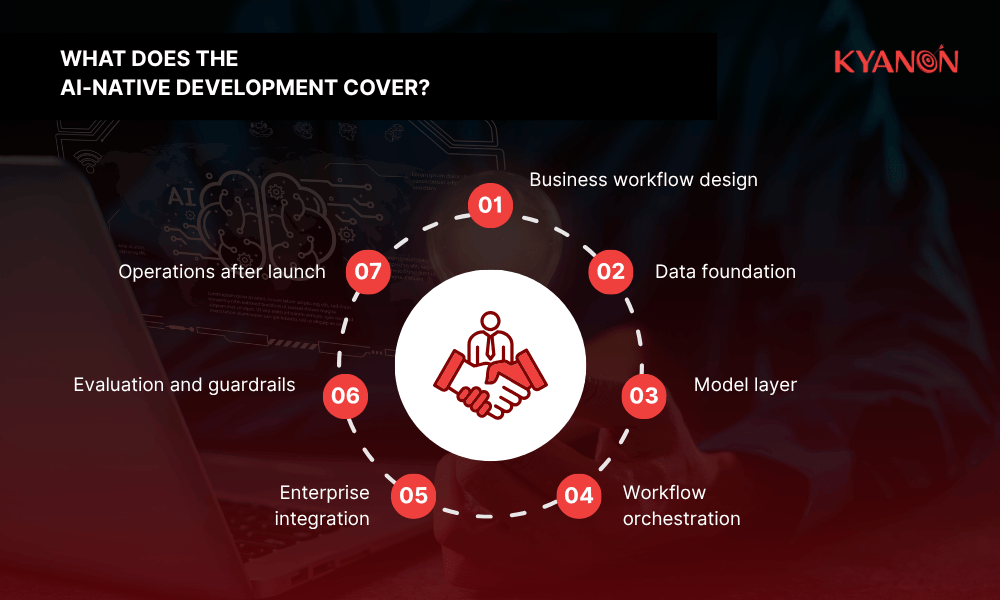
The core components
- Machine learning models embedded at the decision layer, not the UI layer
- Real-time and batch data pipelines that feed, retrain, and monitor models continuously
- MLOps infrastructure: model versioning, drift detection, automated retraining, and performance dashboards
- AI governance layers covering bias monitoring, explainability, and compliance (particularly relevant under MAS guidelines and Singapore’s Model AI Governance Framework)
- Integration architecture that connects AI outputs to enterprise systems, ERP, CRM, WMS, and core banking, without creating data silos
What it is not
- Adding a ChatGPT API to an existing product is not AI-native development
- Building a recommendation widget on top of legacy code is not an AI-native architecture
- Purchasing an AI SaaS tool and configuring workflows is not AI-native software development
The distinction matters because traditional software firms can execute any of the above and often market them as AI development. What they cannot readily do is design systems where the model is the product: where business logic is probabilistic, where data strategy and software strategy are the same decision, and where the system becomes more accurate over time.
AI-native vs traditional development: What changes for enterprise
The biggest mistake in this market is treating AI-native delivery like normal custom software. The build may look similar on the surface, but the operating model is different.
|
Area |
Traditional software development |
AI-native software development |
|
Starting point |
Requirements and screens |
Workflow, decision points, and data quality |
|
Core asset |
Features and business logic |
Data, models, retrieval, orchestration, and features |
|
Architecture |
App + database + integrations |
App + data pipeline + model layer + evaluation + monitoring |
|
Testing |
Functional QA and UAT |
Functional QA + model evaluation + safety + drift checks |
|
Change cycle |
Release when code changes |
Release when code, prompts, models, or data logic change |
|
Risk model |
Downtime, bugs, security |
Downtime, bugs, security, hallucination, bias, access leakage |
|
Team shape |
Product + design + engineering + QA |
Product + engineering + data + AI + governance + domain owners |
|
KPI style |
Adoption, uptime, delivery speed |
Adoption, accuracy, cycle-time reduction, cost-to-serve, business lift |
| Post-launch work |
Bug fixes and enhancements |
Continuous tuning, retraining, monitoring, and policy updates |
What this means for businesses
- Vendor selection must go deeper than frontend quality.
- Data and integration maturity often matter more than model brand.
- Procurement should ask about monitoring, rollback, and human escalation from day one.
- Security review must include model behavior, not just application security.
Enterprise use cases in Singapore – by industry
Singapore’s digital economy is now driven mostly by non-I&C sectors, with finance & insurance, wholesale trade, and manufacturing among the largest contributors. At the same time, government and ecosystem efforts are pushing AI adoption into manufacturing, logistics, workforce enablement, and business-specific MVP development.
That is why the strongest use cases are no longer generic chatbots. They are workflow-specific systems tied to sector economics.
Finance & banking – fraud detection, MAS-aligned compliance reporting
For financial services businesses, the value of a custom AI software development partner depends on how well it can support secure customer engagement, loyalty workflows, and cross-channel integration in a regulated environment.
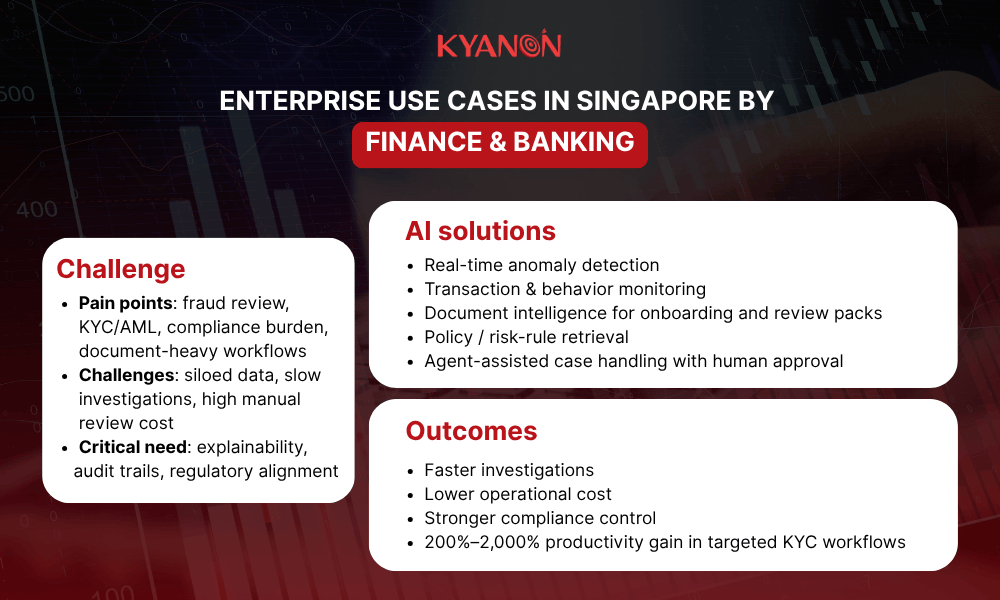
Pain point
- Fraud review, KYC/AML checks, and compliance workflows are still document-heavy.
- Many teams have data across multiple systems, which slows investigations and increases manual review costs.
- In regulated environments, speed is not enough; explainability and audit trails matter.
AI-native solution
- Real-time anomaly detection on transactions and behavior.
- Document intelligence for onboarding, review packs, and policy-heavy workflows.
- Retrieval over internal policies, risk rules, and operating procedures.
- Agent-assisted case handling with mandatory human approval for high-risk actions.
Outcome: McKinsey reports that agentic KYC workflows can produce 200% to 2,000% productivity gains in targeted processes when humans supervise AI agent teams.
How Kyanon Digital delivers AI-native loyalty solutions for banking
Challenges
- Legacy rewards systems were disconnected from core banking services.
- Customer experience was fragmented across mobile, web, branch, and partner channels.
- Generic rewards reduced relevance and engagement.
- Expanding partner integrations was slow under the existing architecture.
- Security and compliance requirements added complexity to platform modernization.
Solution from Kyanon Digital
- Built a unified rewards and payment integration platform.
- Created a shared API layer for more consistent cross-channel experiences.
- Added a personalization engine based on customer behavior and preferences.
- Applied machine learning to optimize offer timing and relevance.
- Designed a secure, compliant, API-first architecture to support scale and partner growth.
Results & impact
- Rewards became more seamless within everyday banking journeys.
- Personalized offers helped improve customer engagement.
- Automated settlement and processing reduced manual overhead.
- The platform created a stronger foundation for future services and partnerships.
Read more: Digital Rewards & Customer Loyalty Platform for Banking
Retail & e-commerce – demand forecasting, personalization
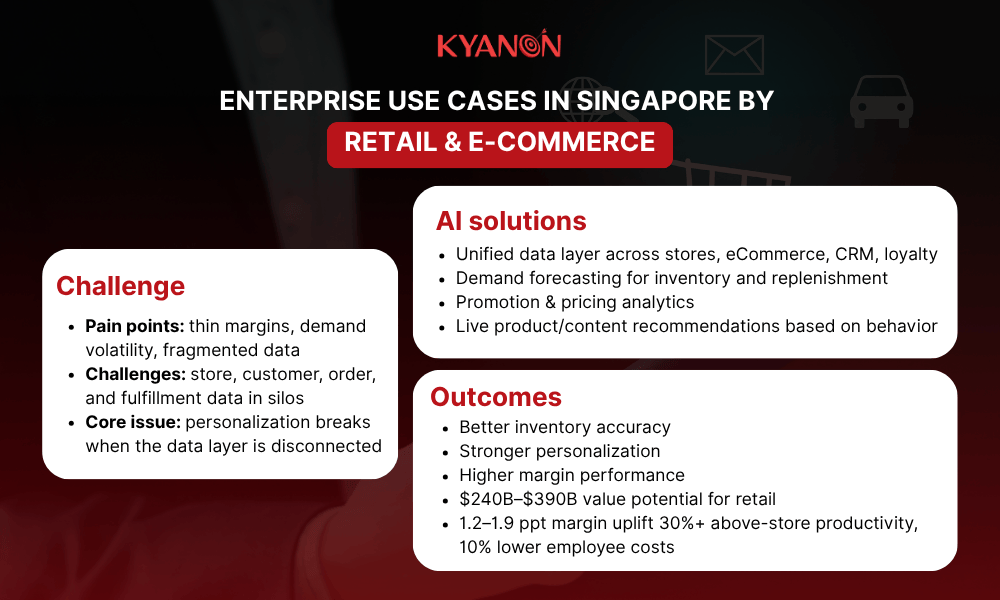
For retail and eCommerce businesses, the value of an AI-native software development partner depends on how well it can solve fragmented customer, store, and order data across fast-moving commercial operations.
Pain point
- Retail margins are thin.
- Demand shifts quickly.
- Customer data, store data, order data, and fulfillment data often sit in different systems.
- Personalization fails when the data layer is fragmented.
AI-native solution
- Unified data layer across stores, eCommerce, CRM, and loyalty.
- Demand forecasting for inventory and replenishment.
- Promotion and pricing analytics.
- Product and content recommendations tied to live behavior.
Outcome
- The upside is material. McKinsey estimates generative AI could unlock $240 billion to $390 billion in value for retail, equal to a 1.2 to 1.9 percentage-point margin increase across the industry.
- The operating model can improve too. BCG estimates AI-mature retail organizations can raise above-store productivity by more than 30% while reducing total employee costs by 10%.
How Kyanon Digital delivers AI-native solutions for retail & e-commerce
Challenges
- Thin margins make slow decisions costly.
- Reporting and operational data are often fragmented across stores and functions.
- Manual reporting creates delays, inconsistencies, and a higher error risk.
- Leadership lacks real-time visibility to respond quickly to performance changes.
Solution from Kyanon Digital
- Built a centralized reporting system on top of a data warehouse.
- Standardized report submission across stores using pre-designed templates.
- Automated approval workflows to reduce follow-up and improve control.
- Integrated Power BI dashboards for real-time monitoring and store-level visibility.
Results & impact
- Faster reporting cycles through automation.
- More consistent and reliable data across store reports.
- Less manual reconciliation and fewer reporting errors.
- Better visibility for leadership through live dashboards and KPI tracking.
- A stronger operational foundation for scaling analytics across a large retail network
Explore more: AI-Driven BI & Data Warehouse For A Leading Retail Corporation
Logistics – route optimization, predictive maintenance
For logistics businesses, the value of an AI-native software development partner depends on how well it can solve fragmented data, reporting delays, and visibility gaps across complex logistics operations.
Pain point
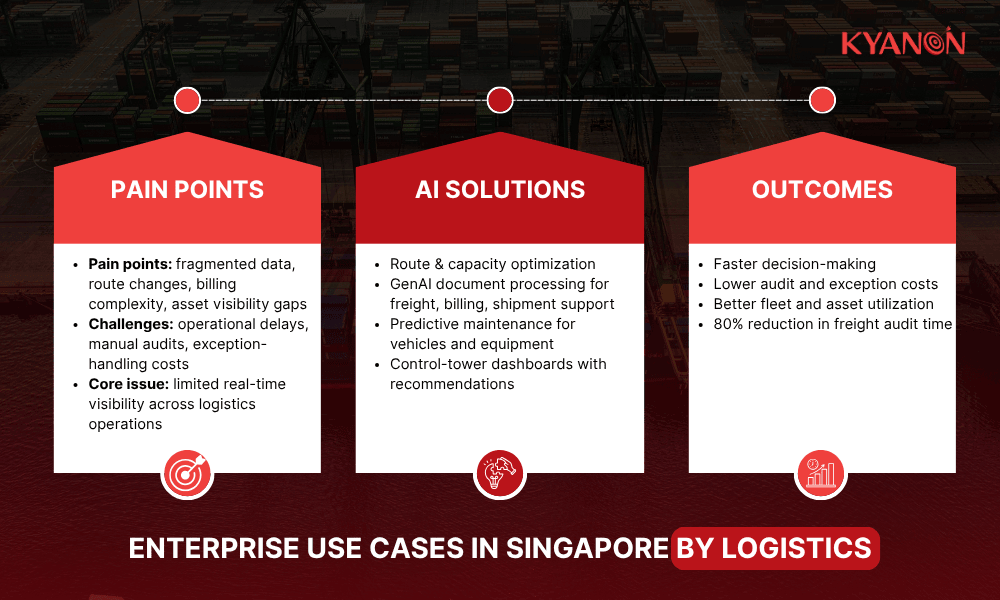
- Logistics teams deal with route changes, billing documents, asset availability, and fragmented operational data.
- Small delays compound fast.
- Manual audit and exception handling create avoidable costs.
AI-native solution
- Route and capacity optimization.
- GenAI document processing for freight, billing, and shipment support.
- Predictive maintenance for vehicles and equipment.
- Control-tower dashboards with recommendations, not just reporting.
Outcome: At Singapore’s AWS Innovation Hub launch, MTI cited a GenAI freight-bill audit solution used by a Fortune 500 food and beverage company that reduced freight audit time by 80%.
How Kyanon Digital delivers AI-native data solutions for logistics
Challenges
- Operational data was difficult to access and consolidate across the logistics network.
- Reporting processes were still manual and siloed, which slowed decisions and increased error risk.
- Customer data was fragmented across entities, limiting visibility and personalization.
- The organization lacked a centralized platform for real-time sharing, integration, and advanced analytics.
- Leadership had limited visibility across operations, customer management, and human resources.
Solution from Kyanon Digital
- Built a scalable data hub to support real-time data sharing across systems and departments.
- Designed a centralized reference data catalog with standardized structures and governance rules.
- Developed Power BI dashboards for operations, finance, HR, and customer metrics.
- Added AI-driven analytics to identify trends, generate predictive insights, and support faster decisions.
- Created an architecture designed to scale with future data growth across the logistics ecosystem.
Results & impact
- Data integration became faster and more stable across business systems.
- Manual reporting workload and human error were reduced.
- Reporting became more accurate and consistent through centralized data standards.
- Leadership gained a clearer real-time view of performance through BI dashboards.
- The organization strengthened its ability to respond faster and scale operations with a more reliable data foundation.
Kyanon Digital applies the same data architecture and AI integration standards across all markets. The following logistics case study from Vietnam demonstrates the model and governance framework directly applicable to Singapore-based port and logistics operators.
Explore more: Data Hub & BI Analytics for Vietnam’s Largest Port & Logistics Operator
Manufacturing – quality inspection AI, production scheduling
For manufacturing businesses, the value of AI-driven software development depends on how well it can improve operational visibility, production efficiency, and decision-making across complex industrial environments.
Pain point
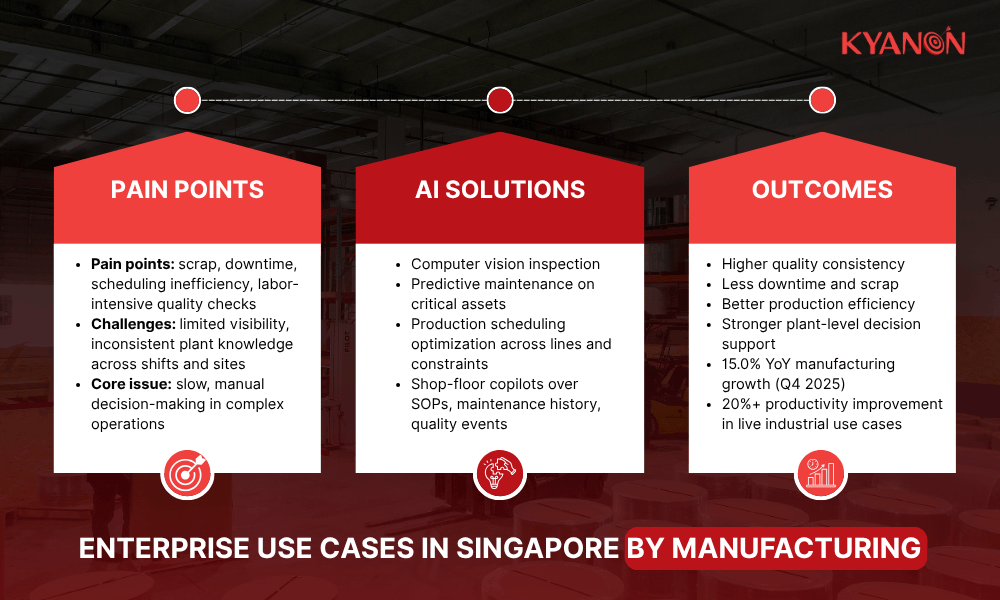
- Manufacturers lose margin through scrap, downtime, and scheduling inefficiency.
- Quality checks are often labor-intensive.
- Plant knowledge is hard to standardize across shifts and sites.
AI-native solution
- Computer vision for inspection.
- Predictive maintenance on critical assets.
- Scheduling optimization across lines and constraints.
- Shop-floor copilots over SOPs, maintenance history, and quality events.
Outcome
- Singapore has launched AIMfg to help manufacturers apply AI in quality assurance, predictive maintenance, operations optimization, and industrial automation.
- The sector is already showing real momentum, with manufacturing growing 15.0% year-on-year in Q4 2025 (MTI, 2025).
- Singapore’s smart manufacturing ecosystem has also delivered 18 breakthrough technologies and more than 20% productivity improvement in live industrial use cases (MTI, 2025).
For enterprises, the signal is clear: industrial AI in Singapore is moving from theory to sector infrastructure.
Education / EdTech – adaptive learning, automated assessment
For education and EdTech businesses, the value of an AI-native software development partner depends on how well it can support personalized learning, content delivery, and progress tracking at scale.
Pain point
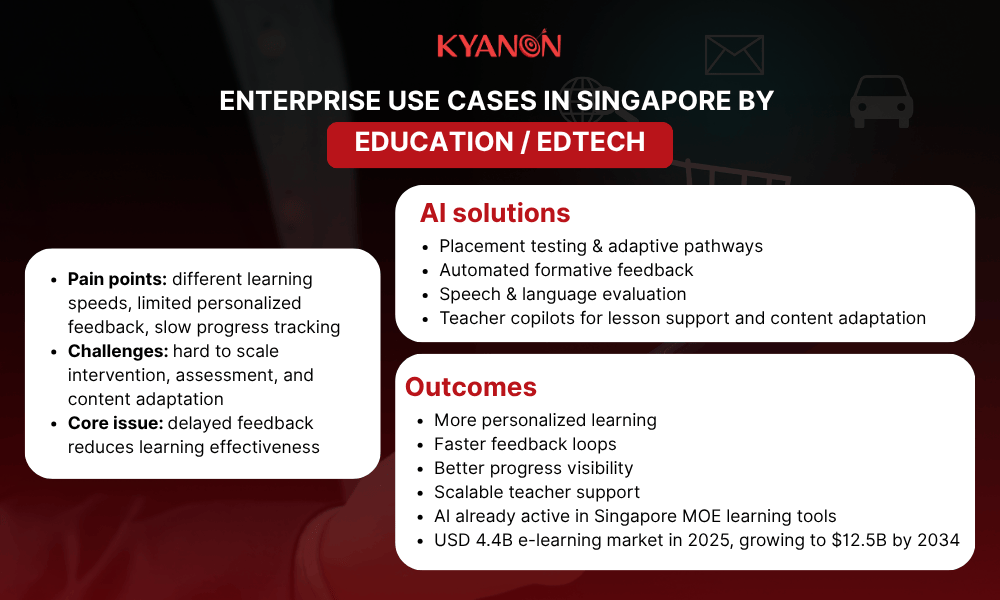
- Learners move at different speeds.
- Teachers and content teams struggle to personalize feedback at scale.
- Assessment and progress tracking are often too slow to shape the next intervention.
AI-native solution
- Placement testing and adaptive pathways.
- Automated formative feedback.
- Speech and language evaluation.
- Teacher copilots for lesson support and content adaptation.
Outcome:
- Singapore MOE says AI-enabled features in the Student Learning Space already include a Speech Evaluation Tool, Learning Feedback Assistants, and an Adaptive Learning System.
- The market direction is also growing. IMARC estimates Singapore’s e-learning market reached USD 4.4 billion in 2025 and could grow to USD 12.5 billion by 2034, supported by digital education investment and AI adoption.
How Kyanon Digital delivers AI-native learning solutions for education & EdTech
Challenges
- Traditional learning models were often too rigid for different learner levels and speeds.
- Learners lacked real-time feedback on pronunciation, grammar, and comprehension.
- Content and engagement needed to scale without relying fully on human tutors.
- Local payment barriers created friction for adoption and monetization.
Solution from Kyanon Digital
- Built a mobile-first AI learning app with free and premium learning paths.
- Added AI placement testing and adaptive lesson recommendations.
- Applied speech recognition and NLP-based grammar correction for real-time support.
- Developed a custom CMS and integrated local payment gateways for smoother operations and access.
Results & impact
- Delivered a feature-complete MVP in 6 months.
- Enabled more personalized learning through adaptive assessments and tailored content.
- Improved learner support with real-time pronunciation and grammar feedback.
- Built a stronger foundation for retention, monetization, and future platform expansion.
While this project was deployed in the consumer EdTech space, the AI-native engineering principles embedded in SDLC, microservices architecture, and governance-first delivery apply directly to enterprise software builds across Singapore and APAC.
Explore more: Building An AI-Powered English Learning Solution With Kyanon Digital
What an AI-native engagement looks like phase by phase
One of the most common sources of misalignment between enterprises and AI development partners is an expectation mismatch on process. AI-native projects are not structured like traditional software projects.
Understanding the phase structure before signing a contract prevents scope disputes, budget overruns, and failed deployments.
|
Phase |
Timeline | Key deliverable |
What happens |
|
1. Discovery & AI readiness |
2–3 wks | AI Feasibility Report |
Data audit, use case prioritisation, ROI sizing, risk assessment |
|
2. Architecture & design |
3–4 wks | Solution Blueprint |
AI/ML stack selection, data pipeline design, security and compliance plan |
|
3. Data & model development |
6–10 wks | Trained baseline model + test results |
Data labelling, model training, validation, bias checks |
|
4. Integration & testing |
4–6 wks | Integrated system in staging |
API integration, load testing, edge case coverage, user acceptance testing |
|
5. Deployment & handover |
2–3 wks | Live production system |
CI/CD pipeline setup, monitoring dashboards, team enablement |
|
6. MLOps & optimization |
Ongoing | Monthly performance reports |
Model drift detection, retraining cycles, accuracy benchmarking |
What businesses should expect at each phase?
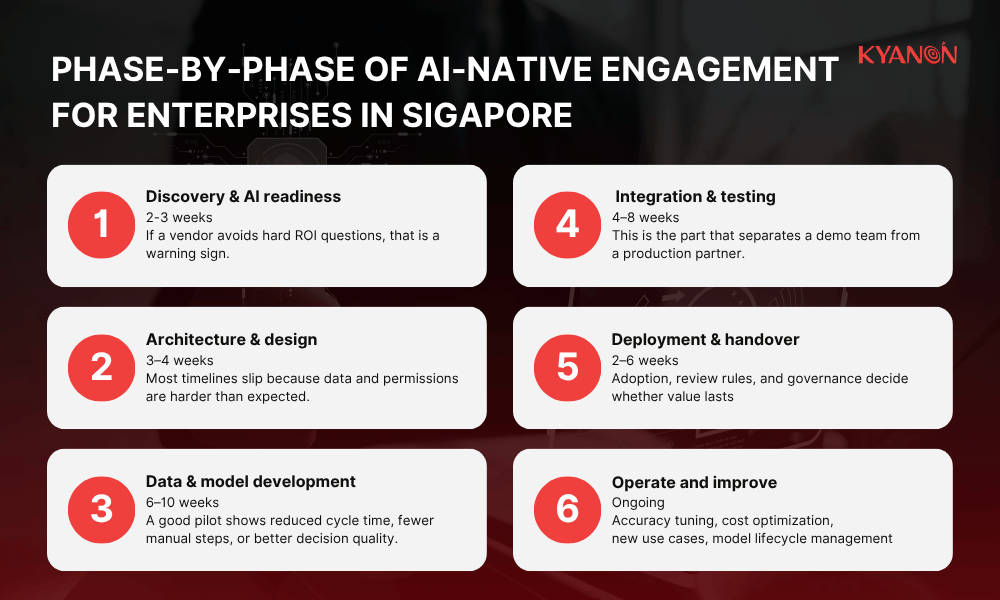
- Phase 1 should kill weak ideas early: If a vendor avoids hard ROI questions, that is a warning sign.
- Phase 2 should expose data reality: Most timelines slip because data and permissions are harder than expected.
- Phase 3 should prove workflow value, not just model output: A good pilot shows reduced cycle time, fewer manual steps, or better decision quality.
- Phase 4 is where many vendors disappear: This is the part that separates a demo team from a production partner.
- Phases 5 and 6 matter because AI changes behavior, not just software: Adoption, review rules, and governance decide whether value lasts.
Two phases deserve special attention from enterprises:
- Phase 1 (Discovery) is not a sales formality. A credible AI-native firm will surface data readiness gaps, compliance constraints, and scope risks at this stage, sometimes recommending a smaller initial build. Firms that skip this or compress it into a half-day workshop is optimizing for deal closure, not project success.
- Phase 6 (MLOps) is where most projects fail. A model deployed without ongoing monitoring degrades. Industry benchmarks suggest that without active MLOps, most production models see measurable accuracy decay within 3–6 months of deployment. Budget and contractual commitments for this phase should be established before the project starts, not after go-live.
How to evaluate an AI-native software development partner
Singapore’s market is getting more selective. Budget 2025 introduced the Enterprise Compute Initiative, with up to S$150 million to support Singapore-based companies with cloud resources, AI tools, and consultancy services. That raises the bar for vendor selection because businesses now have more room to demand a real roadmap instead of a vague pilot (MTI, 2025).
A practical evaluation framework
|
What to evaluate |
What strong looks like |
Red flag |
|
Business-case discipline |
Vendor starts with workflow economics and target KPI |
Vendor starts with model brand or demo gallery |
|
Data and integration depth |
Can map systems, permissions, retrieval, APIs, and fallback |
Talks only about prompts and UI |
|
Governance and security |
Can explain auditability, access control, logging, and residency |
Says governance can be “added later” |
|
Evaluation and monitoring |
Has test sets, review loops, thresholds, rollback plan |
Relies only on human impression of output quality |
|
Delivery maturity |
Shows phased plan, owners, cadence, and support model |
Gives one large estimate with no phase gates |
|
Change management |
Includes training, adoption, and process redesign |
Assumes users will adapt automatically |
|
Commercial clarity |
Clear scope, exclusions, IP, and post-launch ownership |
Vague SOW and hidden support costs |
|
Production references |
Similar industry, similar complexity, live environment | Only sandbox demos or hackathon-style examples |
Questions every business should ask
- What exact workflow will improve first, and how will success be measured?
- What data sources are required, and who owns the cleanup?
- How are access rights enforced inside retrieval and agent actions?
- What happens when the model is wrong?
- What part of the solution remains usable if the model provider changes?
- What will the operating cost look like after launch?
- Who owns improvement after month three?
What matters more in Singapore
- Data residency and sovereignty: This is a strategic concern for many businesses in Singapore (Deloitte, 2025).
- Partner’s ability to work inside supported ecosystem programs: Local businesses may have access to cloud, tooling, training, and consultancy support through public-private programs.
- Workforce enablement: AI projects now need training and process redesign, not only delivery. IMDA highlights that more than two-thirds of companies already using AI plan to prioritize workforce upskilling.
4 mistakes enterprises make when hiring AI development partners
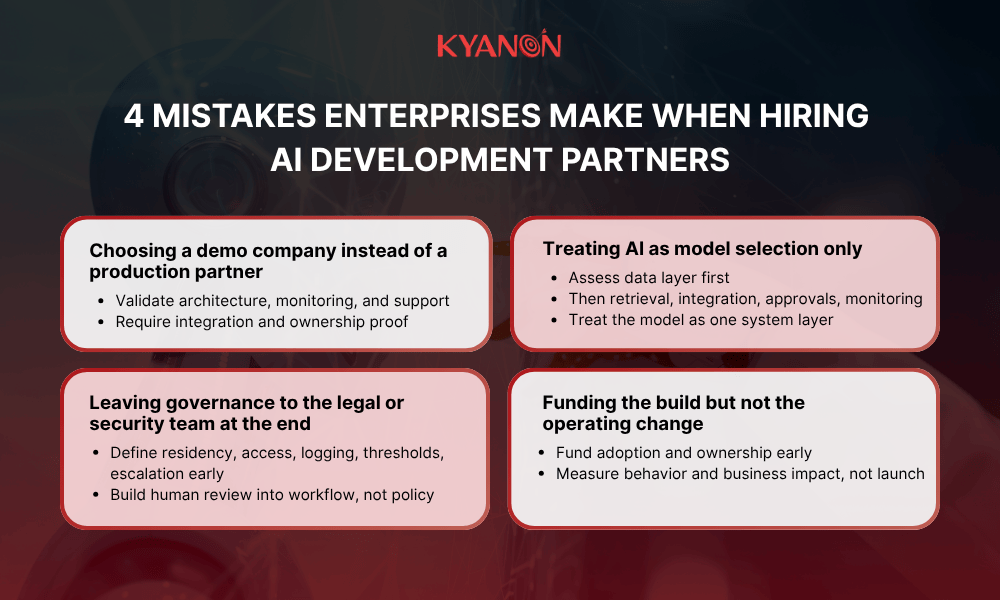
Choosing a demo company instead of a production partner
Why it happens
- Demos are fast.
- Procurement often sees AI as a front-end feature decision.
- Early vendor shortlists reward visual polish.
What to do instead
- Ask for architecture, evaluation, monitoring, and support details before commercial discussions.
- Require evidence of integration and post-launch ownership.
- Deloitte’s Singapore data already shows that moving from pilot to production is the real divide in this market. Gartner also notes dissatisfaction with early proof-of-concept work and a shift toward more predictable implementation paths.
Treating AI as model selection only
Why it happens
- The market talks about LLM brands more than workflow design.
- Buyers are often sold on the model before the data problem is understood.
What to do instead
- Evaluate the data layer first.
- Then retrieval, integration, human approval, and monitoring.
- Treat the model as one layer in a larger system.
Gartner’s 2025 model forecast is a useful signal here: enterprises are moving toward domain-specific models because relevance, reliability, and cost control matter more than generic model breadth.
Leaving governance to the legal or security team at the end
Why it happens
- Teams want speed.
- Governance feels like a blocker during the pilot stage.
What to do instead
- Define data residency, permissions, logging, review thresholds, and escalation paths in the initial design.
- Put human-in-the-loop decisions into the workflow, not into a policy PDF.
This is especially important in Singapore, where sovereign AI and residency concerns are already part of strategic planning for many businesses.
Funding the build but not the operating change
Why it happens
- AI budgets are often scoped like software budgets.
- Training, workflow redesign, and KPI ownership are left out.
What to do instead
- Fund adoption and process ownership from the start.
- Tie success to team behavior and business metrics, not just launch date.
McKinsey’s 2025 workplace report says nearly all companies are investing in AI, but only 1% believe they are mature, and the biggest barrier is leadership, not employee readiness. IMDA’s 2025 workforce messaging points in the same direction: training and capability deepening are now core parts of scaling AI.
Why Kyanon Digital for AI-native development in Singapore
Businesses require a partner that combines global engineering standards with local market agility.
- Full-spectrum AI and data capability, not a software shop with AI add-ons
- Kyanon’s core practice areas span data, CX, AI, automation, and commerce.
- Data engineering, ML model development, and integration architecture sit within the same delivery team, reducing the coordination overhead and accountability gaps that emerge when these are contracted separately.
- High-performance AI engineering
- Kyanon Digital’s data scientists design proprietary models that consistently achieve over 95% accuracy in specialized tasks like NLP and image recognition.
- This minimizes the risk of AI “hallucinations” and ensures your enterprise software is reliable enough for mission-critical operations.
- Enterprise-grade governance
- With ISO 9001 and ISO 27001 certifications, Kyanon Digital follows a “security-by-design” approach to AI development.
- Enterprises maintain compliance with global and local regulations, protecting their own data and the brand’s reputation.
- Proven across enterprise-grade complexity
- Trusted by Fortune 500 clients, Kyanon Digital leverages a dedicated Center of Excellence (CoE) to drive innovation across diverse industries.
- The businesses get a partner capable of moving from a small PoC to a full-scale enterprise system without outgrowing their capabilities.
- Engagement model built for enterprise realities
- Kyanon offers dedicated development teams, IT staff augmentation, and project-based models.
- This gives enterprises the flexibility to engage at the appropriate level of commitment depending on build maturity, internal capability, and governance requirements.
- Commerce and CX integration as a differentiator
- Many AI-native firms deliver model capability but lack the commerce and customer experience architecture needed to connect AI outputs to customer-facing systems. Kyanon’s dual capability in AI and omnichannel commerce closes this gap.
- This is the advantage for retail, financial services, and logistics clients who need AI that affects end-customer outcomes, not just internal operations.
Explore now: Transform How Your Business Thinks, Works, and Scales – with Generative AI
Conclusion
Choosing an AI-native software development company in Singapore is not primarily a technical decision; it is a strategic one. The right partner brings together ML engineering depth, enterprise integration experience, data governance maturity, and the commercial flexibility to grow with the engagement as the AI system proves value and scales.
Ready to transition from experimental AI to AI-native leadership?
Partner with Kyanon Digital to build scalable, secure, and high-performance software tailored for the Singapore market. Contact us today!