
Autonomous systems are now executing tasks across order management, supply chains, and customer experience without human intervention. Combined with AI-driven personalization, predictive logistics, and cloud-native architecture, these software trends are transforming how enterprise retail platforms operate, integrate, and scale.
In 2026, growth in retail and ecommerce increasingly depends on operational intelligence and software maturity. For enterprise retailers, this requires redesigning core systems into integrated, scalable platforms that maximize the value of technology investments.
Why are traditional retail systems no longer sufficient in 2026?
Because modern retail ecosystems now require:
- Real-time data processing
- Intelligent automation
- Seamless omnichannel experiences
Legacy systems struggle to deliver these capabilities at scale, often resulting in inefficiencies, limited visibility, and slower responses to market changes.
This article explores the biggest software trends in retail and ecommerce for 2026 and provides practical insights for enterprise retailers planning to build, modernize, or scale their commerce platforms.
Key Takeaways
- Agentic AI becomes the execution layer: AI moves from support to autonomous execution because retailers need real-time operations at scale.
- Competition shifts to operational speed: Enterprise retailers win on execution efficiency because real-time systems drive cost, scalability, and experience.
- Product discovery becomes AI-driven: Hyper-personalization replaces search because intent-driven recommendations increase conversion and revenue.
- Commerce expands beyond owned channels: Social and creator platforms become core revenue drivers because transactions happen in external ecosystems.
- Supply chains become predictive: AI-driven logistics replaces reactive models because real-time data enables proactive decision-making.
- Data becomes a core foundation: Unified data and AI security are critical because retailers must ensure trust, compliance, and fraud prevention.
- Architecture becomes strategic: Cloud-native systems are essential because they enable scalability, reliability, and continuous innovation.
Further Reading:
- Custom eCommerce Systems for Complex Retail Ops
- Building an Enterprise Data Warehouse for Commerce
- Enterprise Digital Commerce Transformation in Singapore
Agentic AI & Autonomous Commerce
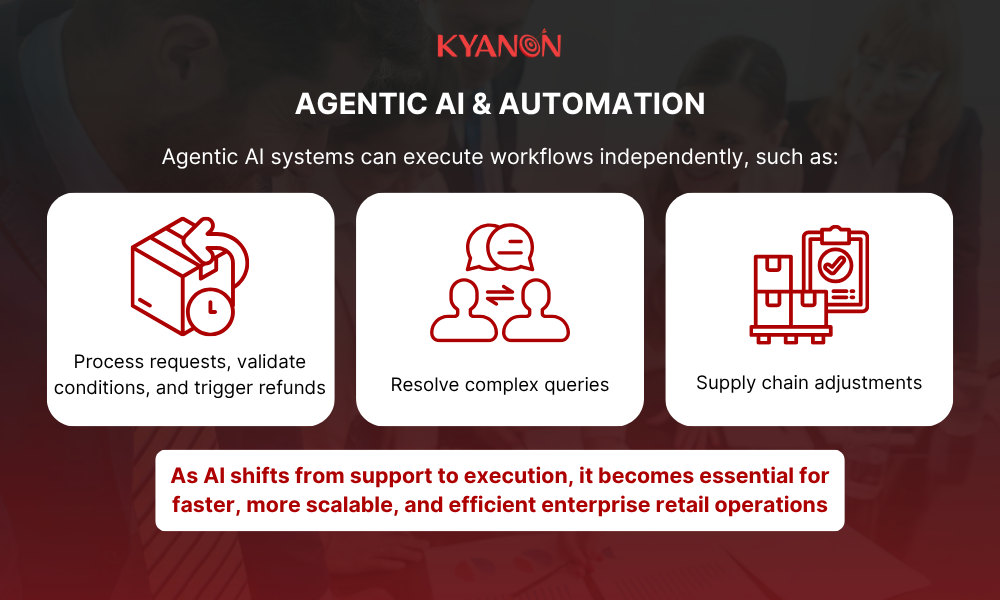
Agentic AI is emerging as one of the most important software trends in retail and eCommerce in 2026 as AI agents move beyond traditional chatbots to execute operational tasks independently. Instead of only responding to queries, these agents can manage returns, resolve complex customer inquiries, and adjust supply chain workflows without human intervention.
This shift is vital for enterprise retailers as agentic automation replaces manual coordination across teams and systems. By handling order tracking, refunds, and service resolution in real time, autonomous agents enhance operational speed, consistency, and scalability.
As a result, AI is evolving from a support tool into an execution layer within retail operations, acting as a 24/7 digital operator that streamlines customer service and backend workflows simultaneously.
How agentic AI is transforming retail operations
Agentic AI is transforming retail by taking over high-impact operational workflows that previously required human involvement, particularly in customer operations, returns management, and supply chain coordination.
Key execution areas include:
- Returns & refunds: AI agents automatically process requests, validate conditions, and trigger refunds.
- Customer inquiries: complex queries are resolved end-to-end without escalation.
- Supply chain adjustments: systems detect disruptions and dynamically reroute or rebalance inventory.
Why enterprise retailers must invest in AI-driven execution now
Agentic AI is becoming a competitive requirement because retail environments are increasingly defined by speed, complexity, and real-time expectations.
Traditional systems cannot keep up because they rely on:
- Batch processing instead of real-time data.
- Human intervention for critical workflows.
- Siloed platforms across commerce, logistics, and operations.
AI-driven execution changes this model:
- Real-time decisions → systems react instantly to demand and supply changes.
- End-to-end automation → workflows are executed without human dependency.
- Scalable operations → growth without linear increase in cost.
Key capability gap in 2026
Enterprise retailers are no longer competing on features or channels alone. They are competing on how fast and efficiently their systems can execute operations in real time.
The divide between legacy and AI-driven systems impacts costs, customer experience, and scalability. This gap represents a major business risk in 2026 as retail platforms struggle to modernize.
| Capability | Legacy Systems |
AI-Driven Systems |
|
Data Processing |
Delayed, batch-based | Real-time, continuous |
| Workflow Execution | Manual or rule-based |
Autonomous, adaptive |
|
System Integration |
Fragmented | Unified |
| Scalability | Limited by teams |
Scales with system capacity |
Key capability gap in 2026
This gap is critical as it dictates real-time operational efficiency. Retailers using legacy systems face slower execution and higher costs due to a lack of dynamic adaptability. To remain competitive, enterprises must prioritize unified, real-time systems that support AI-driven execution over fragmented architectures.
Hyper‑Personalization & AI‑Driven Curation
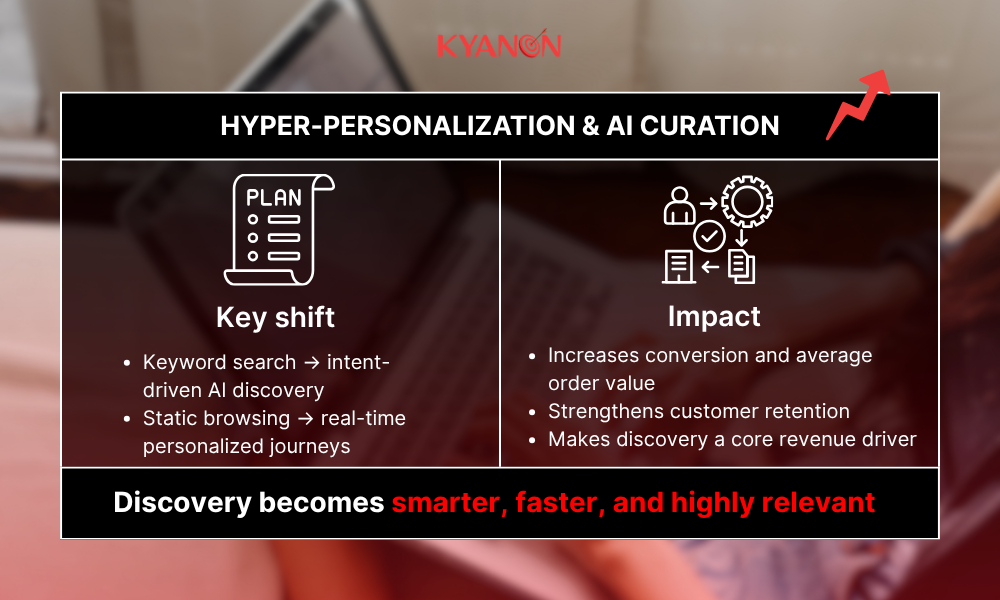
Hyper-personalization is becoming a core software capability in retail and eCommerce because generative AI is replacing traditional search with intent-driven product discovery.
Instead of relying on keyword-based navigation, modern retail platforms use AI systems similar to ChatGPT to:
- Interpret natural language queries.
- Understand customer intent in context.
- Generate personalized product recommendations in real time.
For enterprise retailers, this is not just a UX improvement. It is a shift from static product discovery → dynamic, AI-curated commerce experiences that directly impact conversion and revenue.
How AI-powered curation is changing product discovery
Generative AI is transforming product discovery by moving from user-driven search → system-driven recommendation.
In traditional eCommerce systems, customers:
- Search using keywords.
- Browse through categories.
- Manually compare products.
In AI-driven systems, platforms:
- Interpret full-sentence queries and behavioral signals.
- Anticipate customer needs before explicit input.
- Guide users through decisions with conversational interfaces.
According to TechRadar, recent industry analysis shows that AI-driven commerce is evolving toward “AI-native shopping experiences”, where customers can discover and purchase products directly through conversational interfaces without traditional browsing.
Traditional search vs AI-driven discovery systems
Product discovery is no longer just a UX layer. It is a core revenue driver that determines how effectively customers can find, evaluate, and purchase products.
For enterprise retailers, the shift from traditional search to AI-driven discovery is critical because it directly impacts conversion rate, average order value, and customer retention. The comparison below highlights how discovery systems are evolving, and why legacy approaches are becoming a limitation.
|
Feature |
Traditional Discovery |
AI-Powered Discovery (2026) |
|
Search Type |
Keyword-based | Intent-driven, conversational |
| Recommendations | Generic suggestions |
Hyper-personalized in real-time |
|
Homepage |
Static | Personalized storefront per visitor |
| Decision Support | Manual review reading |
Automated summarization of reviews |
|
User Effort |
High browsing effort | Guided experience, reduced friction |
| Experience | Same for all users |
Unique journey per individual |
Comparing traditional and AI-powered discovery
The analysis reveals that traditional keyword-based discovery fails to meet modern expectations for instant, personalized experiences. Systems that cannot interpret intent or adapt dynamically will struggle to capture customer demand and drive conversions.
Retailers must prioritize AI-driven discovery built on unified data and real-time processing. Moving beyond simple tools to continuous learning platforms allows AI to generate relevant recommendations throughout the entire customer journey.
Social & Creator Commerce
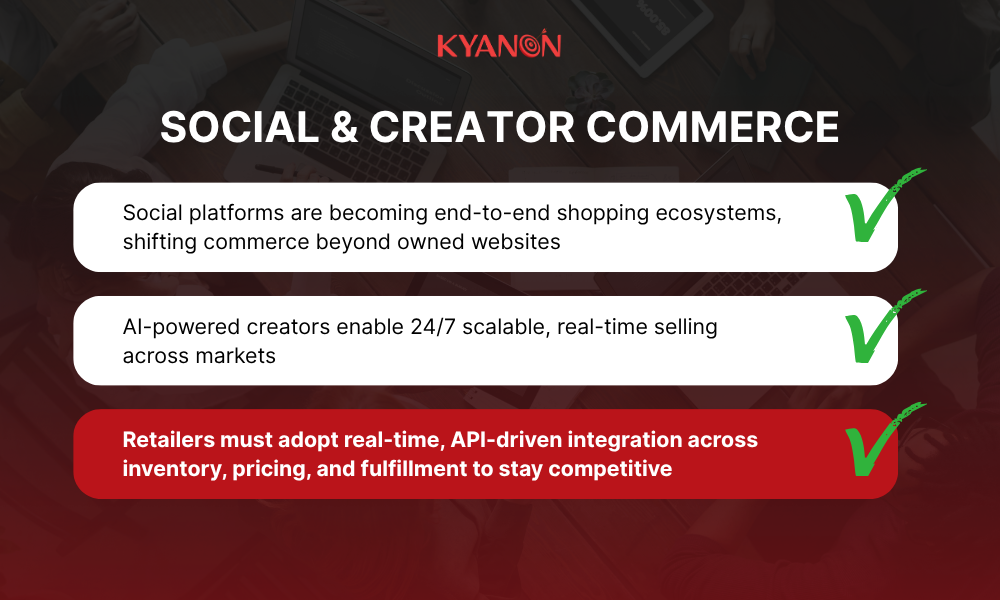
Social and creator commerce is becoming a primary revenue channel in 2026 because platforms like TikTok, Instagram, and YouTube Shorts are evolving into all-in-one shopping hubs where discovery, engagement, and checkout happen within a single ecosystem.
For enterprise retailers, this is not just a channel shift. It fundamentally changes how commerce systems must operate, because transactions are no longer happening only on owned platforms but across external, real-time, high-volume ecosystems.
According to Goat Agency, platforms such as TikTok Shop and YouTube Shorts are increasingly functioning as integrated commerce environments with native checkout and fulfillment capabilities.
How AI-driven creator commerce is changing retail execution
The rise of AI-powered creators is enabling always-on commerce, where digital agents act as scalable sales channels operating 24/7.
These AI-driven systems can:
- Run continuous livestream sessions without human limitation.
- Respond to customer questions and guide purchase decisions in real time.
- Localize content and interactions across multiple markets simultaneously.
More importantly, they can connect directly with backend commerce systems to:
- Update pricing and promotions dynamically.
- Reflect real-time inventory availability.
- Trigger order and fulfillment workflows instantly.
What this means for enterprise retailers and what to do next
This shift is vital as commerce moves to external platforms. Retailers lacking integrated systems will face inventory errors, fulfillment delays, and poor customer experiences because their backends cannot support high-velocity social commerce.
To compete, enterprise retailers must invest in integrated commerce architectures that link social platforms with core inventory, pricing, and fulfillment systems in real time. This necessitates building unified data layers, API-driven integrations, and automation so social and creator commerce function as seamless extensions of the core retail platform.
Predictive Supply Chain & Logistics
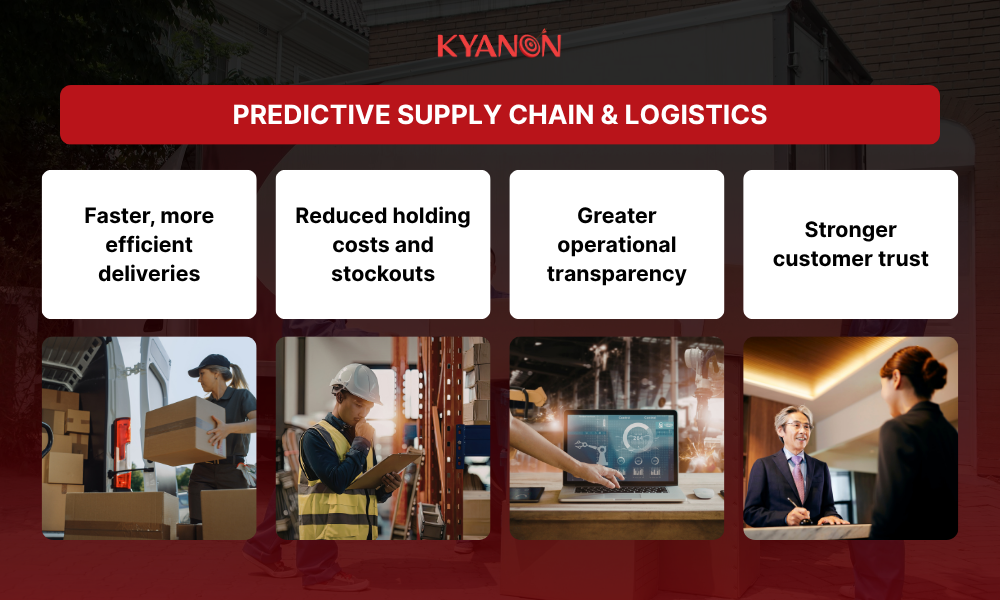
Predictive supply chain systems are becoming a core capability in retail and eCommerce because AI can now optimize inventory, manage logistics proactively, and provide real-time post-purchase transparency.
Instead of reacting to demand and disruptions, modern retail platforms use AI and real-time data to:
- Anticipate demand fluctuations.
- Adjust inventory levels dynamically.
- Coordinate logistics workflows automatically.
For enterprise retailers, this is a structural shift from reactive operations → predictive, system-driven execution, directly impacting cost efficiency and delivery performance.
According to Slimstock, technologies such as Digital Product Passports (DPPs) are enabling end-to-end product traceability, supporting both operational visibility and regulatory compliance.
How AI is transforming supply chain and logistics operations
AI-driven supply chains operate on continuous data and automated decision-making rather than periodic planning cycles.
Core capabilities include:
- Inventory optimization: AI predicts demand and continuously adjusts stock levels to prevent overstocking or stockouts.
- Proactive logistics management: systems dynamically reroute shipments, rebalance warehouse loads, and anticipate bottlenecks.
- Post-purchase transparency: real-time tracking provides full visibility for both customers and operations teams.
These capabilities allow retailers to move from fragmented coordination to end-to-end, real-time orchestration across supply chain systems.
Core capabilities, insights, and performance metrics driving efficiency
The table below highlights the core AI-driven supply chain capabilities in 2026, outlining their key functions and the measurable business impact they deliver across inventory, logistics, transparency, and security:
|
Capability |
Function in 2026 | Business Impact |
| Inventory Forecasting | Predicts stock requirements based on behavior, sales trends, and market signals |
Lower holding costs, fewer stockouts |
|
Dynamic Logistics |
AI adjusts routes, fulfillment, and warehouse priorities in real time | Faster delivery and operational efficiency |
| Post-Purchase Transparency | Real-time tracking updates for customers |
Improved customer satisfaction and trust |
|
Fraud & Data Security |
AI-driven protection and verification for all transactions |
Reduced risk and compliance with global standards |
Predictive Supply Chain: Core capabilities and business value
Datafication & Security
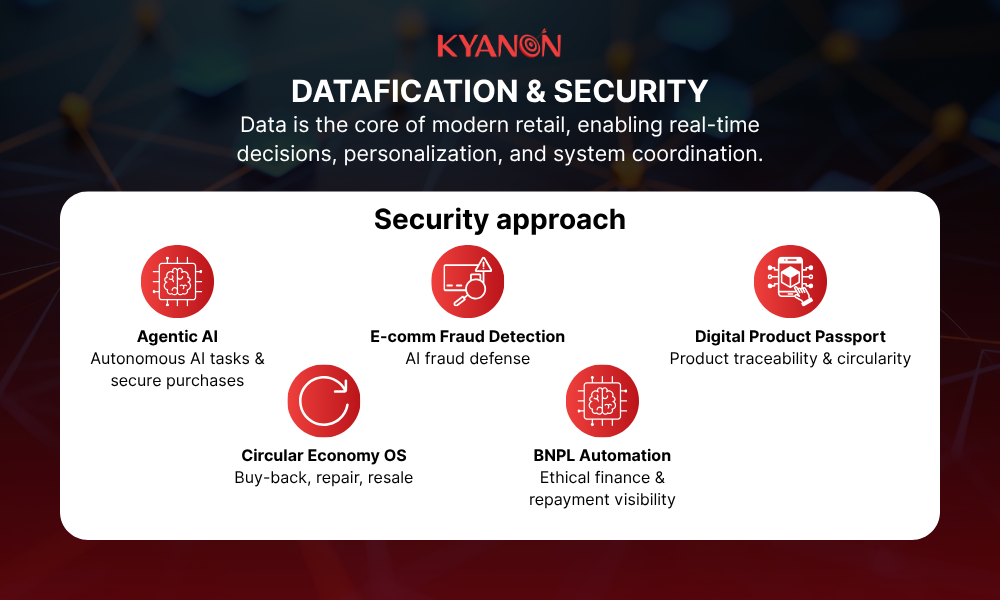
Data is becoming a core layer of retail and eCommerce systems in 2026 because advanced analytics and AI are required to detect fraud in real time, while Digital Product Passports (DPPs) enable full supply chain transparency.
For enterprise retailers, this is no longer just about data management. It is about building systems that can ensure trust, compliance, and secure transactions at scale.
Modern retail platforms must:
- Unify data across customer, transaction, and supply chain systems
- Apply AI to detect and prevent fraud in real time
- Provide traceability of products across the entire lifecycle
According to APS Security, agentic defense is now the standard, where AI independently identifies and neutralizes fraud at machine speed.
How data and AI are redefining security and transparency
Retail environments in 2026 face two parallel challenges:
- Rising fraud complexity (synthetic identities, automated attacks)
- Increasing regulatory pressure (product traceability, sustainability compliance)
AI and data platforms are now used to address both simultaneously.
Core capabilities include:
- AI-driven fraud detection: systems analyze transaction patterns and user behavior in real time to detect anomalies and prevent fraud.
- Digital Product Passports (DPP): provide end-to-end visibility into product origin, materials, and lifecycle for compliance and trust.
- Unified data layer: connects customer, transaction, and supply chain data to enable both security and transparency.
These capabilities require centralized, real-time data architecture, not fragmented data systems.
Key data and security capabilities in 2026
For enterprise retailers, data and security have become essential business requirements due to complex fraud, strict regulations, and higher ethical standards.
Global retailers must address:
- Regulatory mandates like Digital Product Passports (DPP).
- AI-driven and synthetic cross-border fraud.
- Demands for transparent, secure payment options.
The following table details key 2026 security capabilities and their corresponding risks.
|
Technology/Approach |
2026 Status |
Primary Purpose |
|
AI-Driven Fraud Detection |
Rapid adoption across enterprise platforms | Real-time defense against synthetic fraud |
| Agentic AI Security | Increasing adoption |
Autonomous detection and response to threats |
|
Digital Product Passport (DPP) |
Mandatory pilot in multiple markets | Product traceability, compliance, sustainability |
| Circular Economy Platforms | Emerging core capability |
Lifecycle tracking, resale, and sustainability |
|
BNPL Automation |
Embedded in wallets and ERP systems | Transparent and responsible payment management |
Key data and security capabilities in 2026
These capabilities are essential for secure operations, regulatory compliance, and customer trust. Retailers lacking embedded fraud detection, traceability, and transparency face increased risk and rising compliance costs.
To stay competitive, enterprises must prioritize unified data architectures that integrate security and intelligence into core systems. Early investment is vital, as retrofitting fragmented platforms later is far more complex, expensive, and disruptive.
Sustainable & Ethical Technology
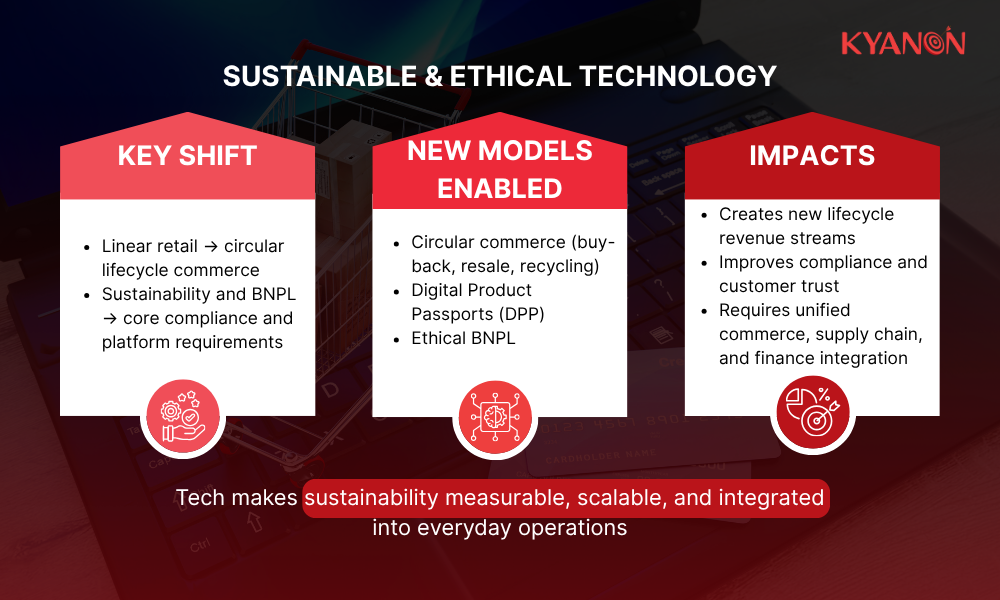
Sustainable and ethical technology is becoming a core requirement in retail and eCommerce because software must now support circular economy models and enable responsible financial practices such as Buy Now Pay Later (BNPL).
For enterprise retailers, this is no longer a brand or CSR initiative. It is a regulatory and operational priority that directly impacts compliance, revenue models, and customer trust.
Modern retail platforms must be able to:
- Track product lifecycle from production to resale or recycling.
- Support circular commerce models such as buy-back and resale.
- Embed transparent and compliant payment solutions.
How circular systems and BNPL are reshaping retail platforms
Retail systems are evolving from supporting one-time transactions to enabling continuous product and financial lifecycle management.
Circular economy capabilities include:
- Product lifecycle tracking: systems monitor products from origin to resale or recycling.
- Buy-back and resale workflows: platforms calculate residual value and enable secondary transactions.
- Digital Product Passports (DPP): provide traceability for compliance and sustainability.
Ethical BNPL capabilities include:
- Predictive affordability checks: AI evaluates customer ability to repay in real time.
- Transparent repayment management: clear visibility of payment schedules and obligations.
- Regulatory compliance: built-in alignment with evolving affordability and lending regulations.
These capabilities require integration across commerce, supply chain, and financial systems, not standalone tools.
Linear vs circular commerce models
The shift from linear to circular commerce is not just a sustainability initiative. It represents a fundamental change in how retail platforms generate revenue and manage product value over time.
The comparison below highlights how these two models differ in structure and business outcomes.
| Model | Approach | Impact | Transaction |
|---|---|---|---|
| Linear | Buy → Use → Dispose | High waste, short lifecycle | One-time sale |
|
Circular |
Buy → Use → Resell/Repair/Recycle | Reduced impact, extended lifecycle |
Continuous value cycle |
Linear vs Circular Model Comparison
Enterprise retailers must integrate circular commerce and BNPL into core operations via unified, real-time data platforms. Early investment creates new revenue and ensures compliance, whereas delaying adoption risks increased complexity as market and regulatory standards evolve.
Operational Maturity & Unified Commerce
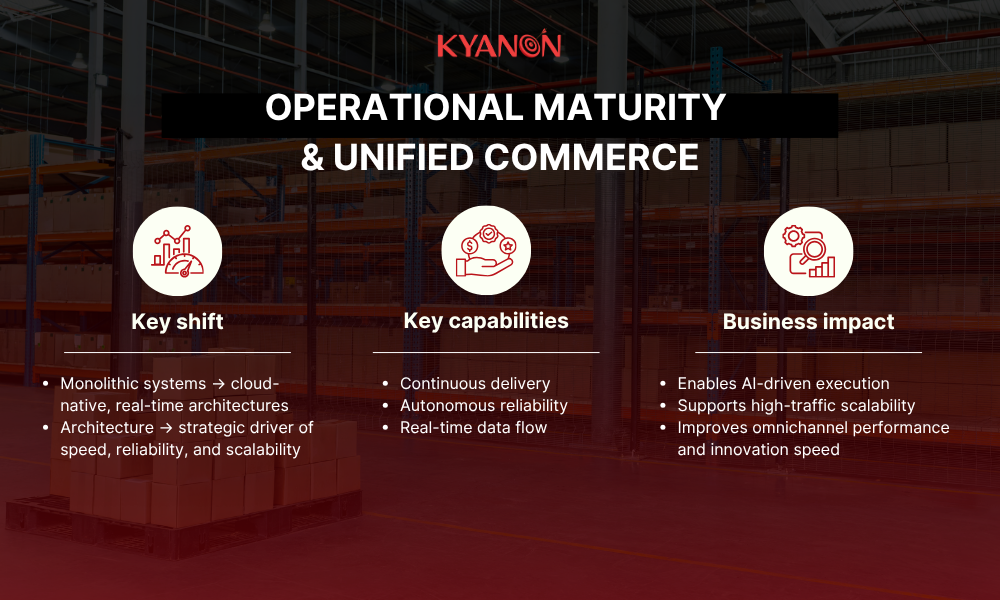
Operational maturity is becoming a critical competitive factor in retail and eCommerce because modern platforms must deliver high reliability, real-time data flow, and continuous performance under unpredictable demand spikes.
From AI-driven commerce to social shopping and real-time fulfillment, retail systems are now expected to operate continuously, at scale, and without failure.
For enterprise retailers, this means architecture is no longer just a technical foundation. It directly determines:
- How fast new capabilities can be deployed.
- How reliably systems perform during peak demand.
- How effectively data flows across the entire commerce ecosystem.
How modern architectures enable reliable, real-time retail operations
Retail platforms in 2026 are shifting from static, monolithic systems to cloud-native architectures designed for continuous operation and real-time execution.
Key capabilities include:
- Continuous delivery: new features and updates can be deployed rapidly without disrupting operations.
- Autonomous reliability: systems detect and resolve issues automatically, reducing downtime and manual intervention.
- Real-time data flow: data moves instantly across channels, enabling synchronized inventory, pricing, and customer experiences.
These capabilities are essential for supporting:
- High-traffic events (flash sales, livestream commerce).
- Real-time personalization and AI-driven execution.
- Omnichannel operations across digital and physical touchpoints.
Traditional vs cloud-native retail architectures
As retail systems evolve toward real-time, AI-driven operations, architecture is becoming a key factor that determines performance, scalability, and reliability.
The comparison below highlights how these two approaches differ in their ability to support modern retail requirements.
|
Capability |
Traditional Architecture | Cloud-Native Architecture |
| Deployment | Infrequent, large releases | Continuous, incremental delivery |
| Scalability | Manual, limited scaling | Predictive auto-scaling in real time |
| Reliability | Human-led incident response | Self-healing, automated recovery |
| Integration | Siloed systems | API-driven, unified architecture |
| Data Flow | Delayed, centralized | Real-time, distributed processing |
Traditional vs cloud-native retail architectures
Modern retail demands real-time execution and constant uptime. Traditional architectures risk slow innovation and downtime during peaks. To compete, enterprise retailers must adopt cloud-native, API-driven systems that ensure autonomous reliability and seamless data flow. This foundation is vital for scaling AI personalization, predictive supply chains, and omnichannel commerce.
Choosing the right retail & eCommerce software development partner for 2026
Choosing the right software development partner in 2026 is critical because retail platforms must evolve into unified, AI-driven systems that operate in real time across commerce, supply chain, and customer experience.
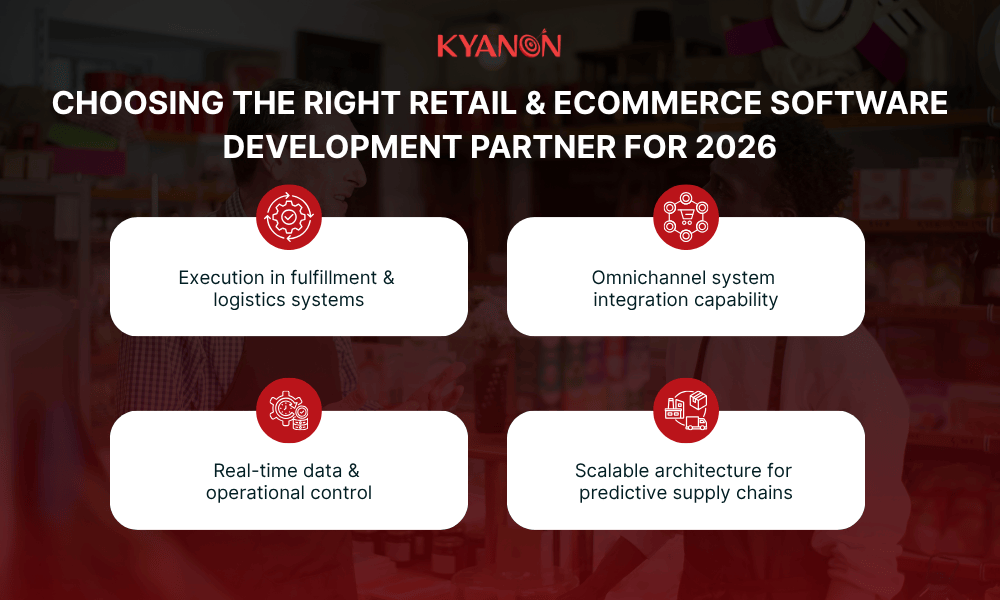
To support modern retail requirements, enterprise buyers should prioritize partners with proven capability in building integrated, real-time systems, not isolated applications.
Key evaluation criteria include:
- Execution in fulfillment & logistics systems: The partner should be able to design and implement integrated fulfillment and transportation management systems, ensuring real-time coordination across orders, inventory, and delivery workflows.
- Omnichannel system integration capability: Look for experience in unifying eCommerce, warehouse, POS, and logistics systems into a single platform, eliminating data silos and enabling end-to-end visibility.
- Real-time data & operational control: The partner must demonstrate the ability to build centralized data layers that support live tracking, dynamic routing, and real-time decision-making across operations.
- Scalable architecture for AI-driven operations: Choose a partner that delivers cloud-native, API-driven systems capable of evolving into predictive supply chains and AI-powered commerce platforms.
Case Study: Integrated Omnichannel Fulfillment & Transportation Management for Retail Operations
Kyanon Digital has built an integrated omnichannel fulfillment and transportation management platform for large-scale retail operations because enterprise retailers need real-time coordination across inventory, orders, and logistics to maintain efficiency and scalability. The solution is designed for complex supply chains where fragmented systems limit visibility, slow down operations, and prevent the adoption of predictive, AI-driven commerce models.
A retail enterprise partnered with Kyanon Digital to transform its fulfillment and logistics operations, moving from siloed systems to a unified, data-driven platform that enables real-time visibility, operational control, and scalability aligned with evolving eCommerce demands.
Challenges:
- Disconnected systems across order management, warehouse, and transportation.
- Limited real-time visibility into inventory and delivery status.
- Inefficient workflows leading to delays and increased operational costs.
Solution:
- Developed a unified omnichannel fulfillment platform integrating order, inventory, and logistics data.
- Implemented a transportation management system (TMS) for real-time routing and delivery optimization.
- Built a centralized data layer enabling real-time tracking and operational coordination.
Business impact:
- End-to-end visibility across fulfillment and logistics operations.
- Faster and more efficient delivery with reduced manual intervention.
- Scalable foundation for predictive supply chain and AI-driven optimization.
In conclusion
The leading 2026 retail trend is the integration of AI, real-time data, and scalable architecture into autonomous, unified systems. To succeed, enterprise retailers must operationalize these platforms across fulfillment, customer experience, and supply chains to drive efficiency and growth.
Kyanon Digital has helped retail enterprises build unified fulfillment and AI-driven commerce platforms across Southeast Asia and ANZ. If you’re evaluating your 2026 technology roadmap, start a conversation here.