

SaaS time-to-market is now a competitive weapon, not a technical milestone.
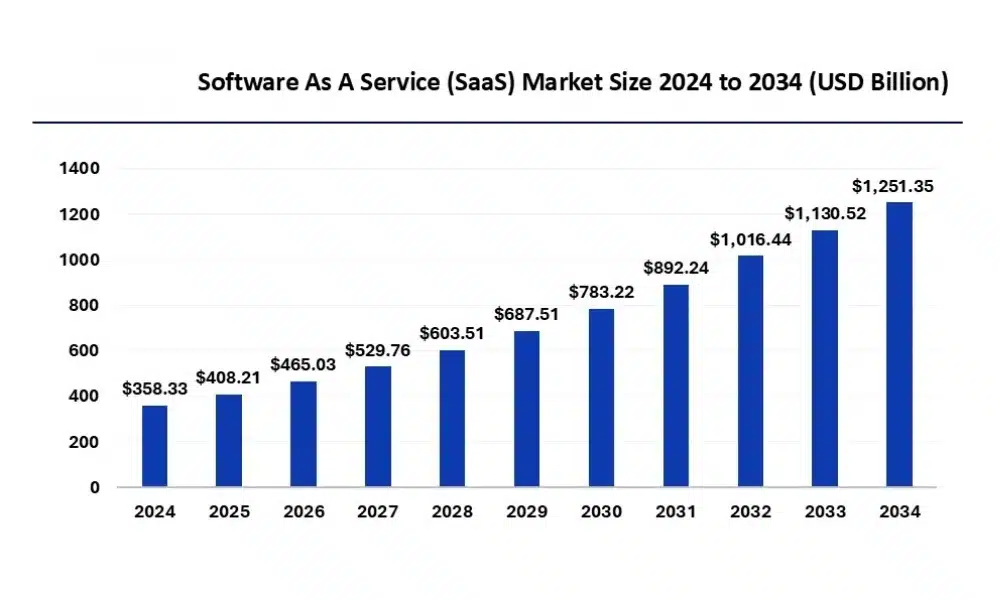
SaaS speed has become a competitive requirement in 2025, as enterprise software spending reached USD 358.33 billion in 2024 and continues growing at a 13.32% CAGR, pushing companies to ship MVPs and iterate faster than ever (Precedence Research).
Yet rising development costs and limited access to scalable product teams are slowing SaaS execution, even as market windows shrink.
This is why more businesses are turning to Vietnam product teams. With cloud infrastructure growing and a rapidly scaling engineering workforce, Vietnam enables companies to build SaaS faster without inflating delivery costs.
Building on these dynamics, in this article, Kyanon Digital examines how leaders can build SaaS faster by structuring, integrating, and scaling Vietnam-based product teams as part of a modern delivery strategy.
Key takeaways
- SaaS speed is a competitive requirement, as faster MVPs and iteration cycles directly affect market validation and growth.
- Modern SaaS is cloud-native and AI-enabled, shifting from standalone tools to scalable business infrastructure.
- Vietnam product teams enable faster SaaS delivery, combining scalable engineering talent with cost-efficient execution.
- SaaS costs depend on delivery speed and uncertainty, making staged investment and the right delivery model critical.
- Offshore SaaS risks are controllable when leaders enforce clear ownership, communication, and quality governance.
Further reading:
- SaaS Development Services
- Enhancing SaaS Products with Advanced Features
- Top 12 SaaS UI/UX Design Agencies in Singapore
- Top 9 Best SaaS Development Companies in Singapore
What is SaaS software today?
Software as a Service (SaaS) is a cloud-based software delivery model in which applications are hosted by a provider and accessed via the internet, while infrastructure, security, maintenance, and updates are fully managed by the vendor (Microsoft).
This model eliminates the need for local installation and enables organizations to scale usage on demand.
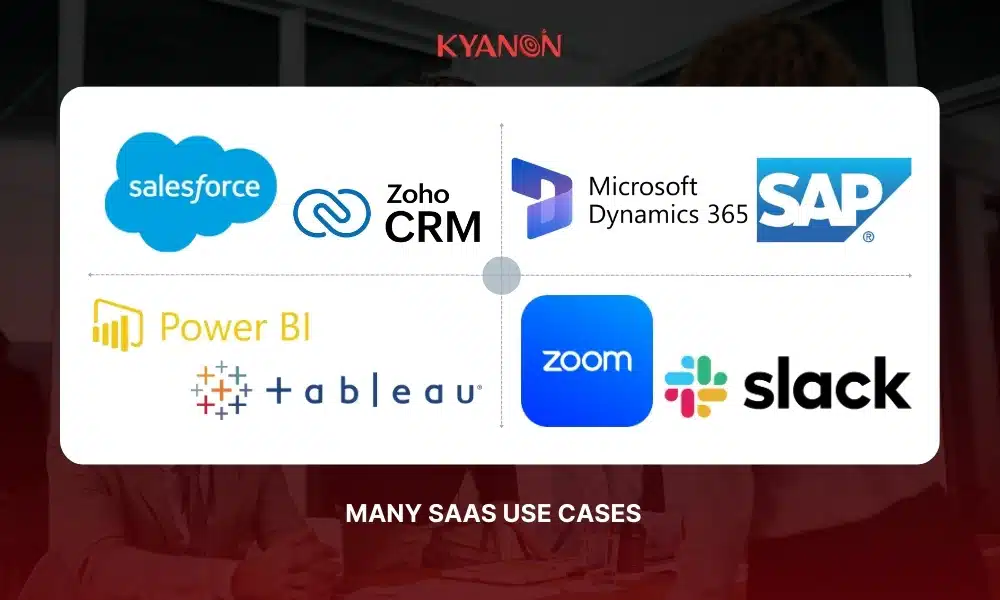
- Common SaaS use cases: CRM platforms (Salesforce), ERP systems (Microsoft Dynamics 365), and internal tools (Power BI).
Why SaaS architecture is shifting
Two structural forces are reshaping how SaaS products are built:
- AI and automation are now core, not optional: In the 2025 B2B SaaS Rising 100 cohort, 27 out of 100 of the fastest-growing SaaS startups are AI-native, and over 32% report “fully” AI-focused product roadmaps, signaling that AI is foundational to product design, not an add-on.
- Vertical SaaS is gaining ground over horizontal tools: Industry cloud and vertical SaaS categories (e.g., healthcare, financial services, and manufacturing) are prominent segments in the broader cloud/SaaS market, reflecting enterprise demand for domain-specialized platforms that deliver tighter integration and deeper workflow value than one-size-fits-all horizontal solutions.
Why Vietnam is emerging as a SaaS product hub
Vietnam is emerging as a SaaS product hub not because of cost alone, but because of scalable engineering talent and modern technical readiness. According to TopDev’s Vietnam IT Market Reports, the country has over 530,000 IT professionals, adds around 50,000 new IT graduates annually, and sees 20–25% yearly growth in software engineering demand, driven largely by SaaS and cloud adoption. This combination enables faster team ramp-up, cloud-native execution, and sustained SaaS delivery at scale.
| Signal | What it shows | SaaS impact |
| Scalable engineering talent | Large, SaaS-ready developer pool | Faster team ramp-up and iteration |
| Cloud-native execution | Strong adoption of modern SaaS stacks | Shorter MVP-to-market cycles |
| Product-focused delivery | Shift from outsourcing to product teams | Better alignment with business goals |
| Cost–speed efficiency | Competitive costs with senior capability | Faster builds without budget strain |
Discover more reasons: Build Scalable SaaS Products with Vietnam Talent
How much does it cost to build a SaaS product?
The cost of building a SaaS product varies widely based on scope, delivery model, and team structure. For business leaders, the real cost question is how effectively to spend converts into speed, validation, and scalable growth.
What businesses should expect to spend
When leaders plan a SaaS product, cost rarely comes from a single line item. It emerges from how much uncertainty the product carries, how quickly it must reach the market, and how enterprise-ready it needs to be from day one.
In practice, SaaS build budgets naturally fall into three tiers, reflecting different stages of product maturity and business risk tolerance, not just feature count.
| SaaS scope | Typical investment range (USD) | What leaders gain |
| MVP / Early-stage SaaS | $30,000-$100,000 | Core workflows, limited users, fast validation. Best for testing demand and pricing. |
| Growth-stage SaaS | $100,000-$300,000 | Product–market fit phase with integrations, analytics, scalability, and role-based access. |
| Enterprise SaaS | $300,000-$600,000+ | Compliance, security, high availability, multi-region scaling, complex workflows. |
Costs escalate the fastest due to architecture decisions and delivery speed, not feature count alone.
The four SaaS cost drivers leaders must understand
|
Cost driver |
Why it matters |
|
Engineering model |
Talent location and seniority mix determine the highest recurring cost over the product lifecycle |
|
Architecture & cloud design |
Cloud-native choices influence long-term operating costs as usage scales |
|
Delivery speed |
Slower delivery increases opportunity cost even if nominal spend is lower |
| Compliance & security |
Requirements expand as SaaS products move into regulated or global markets |
Cost comparison: Local teams vs offshore product teams
Quick SaaS delivery cost comparison table by region
|
Dimension |
Singapore | Eastern Europe | India | Vietnam |
| Typical hourly rates |
$90–160+ / hour |
$40–90 / hour | $25–70 / hour |
$20–60 / hour |
|
MVP build cost |
$100,000 – $250,000+ |
$50,000 – $150,000 | $40,000 – $120,000 |
$30,000 – $100,000 |
|
Team scalability |
Slow, talent-constrained |
Moderate, supply-limited | High volume, variable quality |
Fast ramp-up, balanced supply |
|
Delivery model fit |
Enterprise-grade, high cost | Strong engineering focus | Cost-driven, management-heavy |
Product-oriented, execution-focused |
| Cost structure | High fixed CAPEX | Semi-fixed | Semi-flexible |
OPEX-aligned, scalable spend |
Why must the cost be evaluated with speed
As SaaS becomes core business infrastructure, the true cost question is no longer “How much does it cost to build?” but:
- How fast can we validate value?
- How flexibly can we scale delivery?
- How efficiently does spending translate into learning and revenue?
This is why delivery models and team location have become central to SaaS cost strategy, setting the stage for Vietnam-based product teams as a practical execution choice.
Rule leaders follow in practice:
- When uncertainty is high, prioritize speed.
- When execution is predictable, optimize cost.
Types of Vietnam product team models
Vietnam product teams can be structured in different ways depending on how much ownership, speed, and control a SaaS business needs at each stage.
Quick comparison table
|
SaaS stage |
Primary goal | Best-fit model | Why it works |
|
Idea to MVP |
Validate demand fast | Project-based outsourcing |
Fixed scope, rapid execution, low commitment |
|
MVP to PMF |
Iterate quickly | Dedicated team |
Stable velocity and growing product context |
|
Scaling SaaS |
Balance speed & cost | Hybrid model |
Leadership control with scalable execution |
| Mature SaaS |
Optimize delivery |
Staff augmentation |
Fill gaps without disrupting core teams |
Dedicated team model
A dedicated Vietnam product team works exclusively on your SaaS product as a long-term extension of your organization.
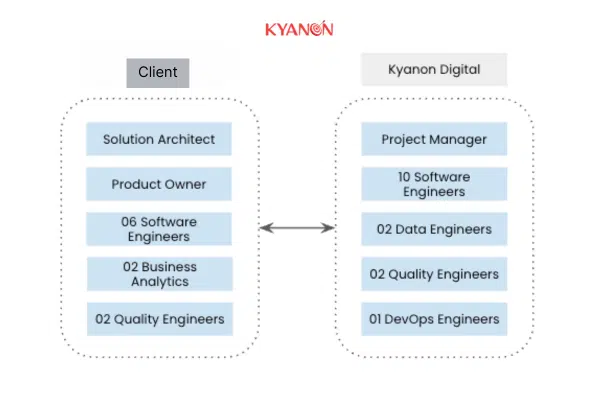
- Best for: SaaS products moving from MVP toward scale
- Structure: Engineers, QA, and DevOps aligned under a shared roadmap
- Why it works: Continuous context reduces rework and improves delivery velocity
Dedicated teams maximize speed when SaaS delivery requires sustained focus and ownership.
For more information, check out: Need Help? A Dedicated Software Development Team Delivers!
Staff augmentation
Staff augmentation embeds individual Vietnam-based specialists into your existing in-house team.
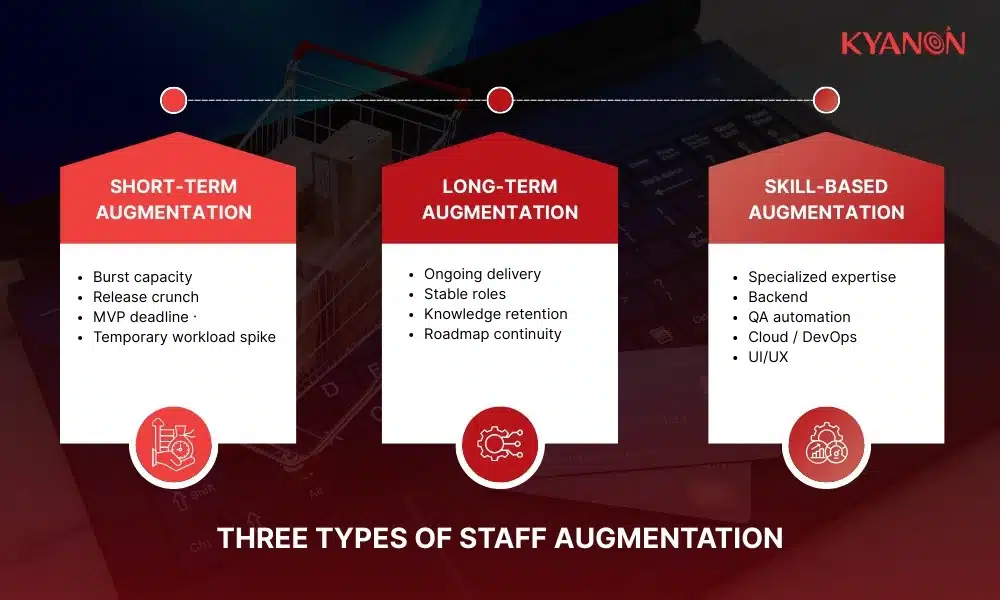
- Best for: Filling capability gaps (backend, QA, cloud, UI/UX)
- Structure: Day-to-day direction remains with your internal leaders
- Why it works: Adds capacity quickly without changing team structure
Staff augmentation is effective when product strategy and architecture are already defined.
Project-based outsourcing
Project-based outsourcing engages a Vietnam partner to deliver a defined SaaS scope, typically an MVP or a major feature.
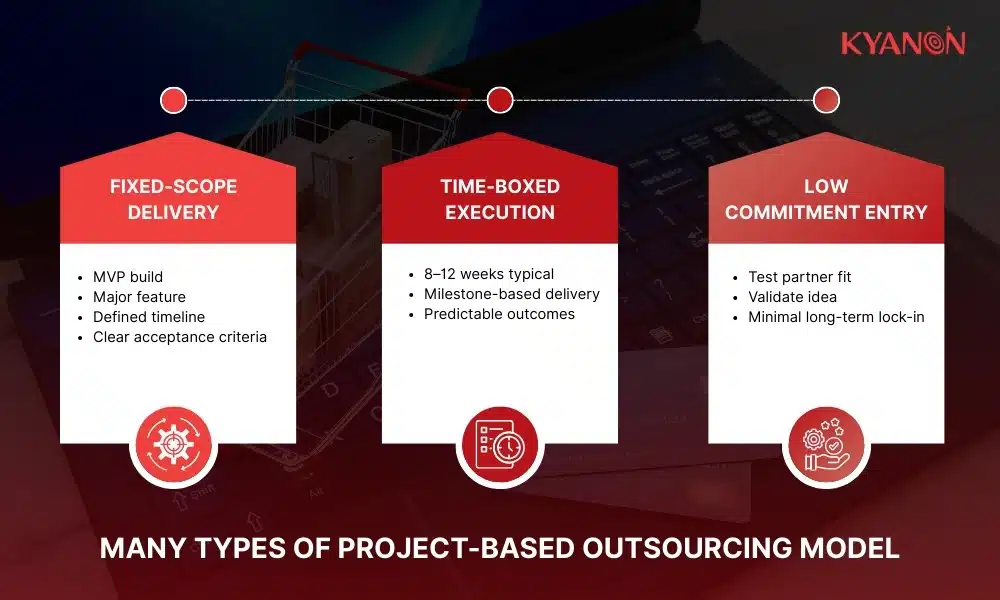
- Best for: Fast validation with fixed timelines
- Structure: Milestones, acceptance criteria, and handover plan
- Risk to manage: Knowledge transfer when scaling beyond the project
Project-based models prioritize speed early but require a clear transition path.
Hybrid model
The hybrid model combines in-house product leadership with a Vietnam execution team.
- Best for: Scale-stage SaaS needing both control and flexibility
- Structure: Strategy and decisions stay in-house; execution scales offshore
- Why it works: Balances governance, speed, and cost efficiency
Hybrid teams deliver the strongest cost-to-speed balance for growing SaaS businesses.
How to build SaaS software with a Vietnam product team
Building SaaS with a Vietnam product team works best when companies define clear ownership, integrate teams into their product operating model, and measure delivery speed with shared metrics.
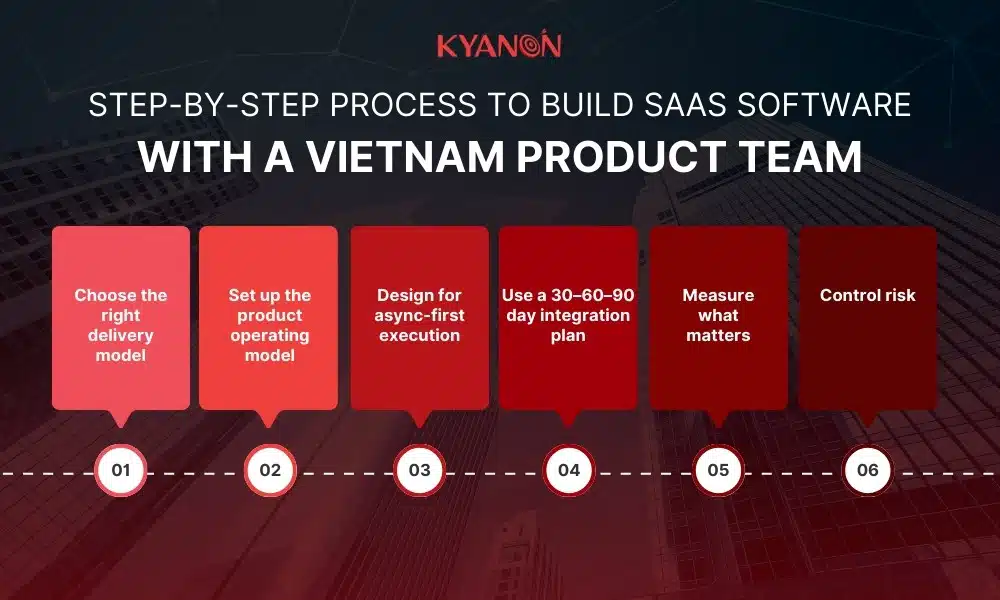
Step 1: Choose the right delivery model
|
Model |
When to use it | What makes it work |
|
Dedicated product team |
MVP → scale |
End-to-end ownership, stable velocity |
|
Staff augmentation |
Skill gaps (backend, QA, DevOps) |
Clear role scope, strong internal PO |
|
Project-based MVP |
Fast validation |
Fixed scope, short timeline, clean handover |
| Hybrid | C-level control with scale |
Clear decision rights, shared roadmap |
SaaS speed depends less on team size and more on how ownership is structured.
For better engagement model selection, check out: IT Staff Augmentation vs. Outsourcing: Which Model Fits Your Needs?
Recommended Vietnamese SaaS partner
|
Company |
Rate (USD/hr) | SaaS focus |
Best fit / Strength |
|
Kyanon Digital |
$25–49 | UX-led SaaS, multi-tenant architecture, cloud-native products |
Strong product & UX orientation, startup-friendly, global B2B SaaS |
|
FPT Software |
Not disclosed | Enterprise SaaS engineering, cloud & platform modernization |
Large-scale delivery, compliance maturity, global SaaS platforms |
|
NashTech |
$35–60 | Custom SaaS engineering, APIs, DevOps |
Long-term SaaS roadmaps, strong CI/CD governance |
|
TMA Solutions |
$25–49 | Full-cycle SaaS development, QA, cloud integration |
Scalable teams, cost-efficient enterprise SaaS builds |
|
Saigon Technology |
$25–49 | MVP & early-stage SaaS, agile teams |
Fast iteration, strong fit for startups & SMB SaaS |
Step 2: Set up the product operating model
Most offshore failures happen before code is written. High-performing teams align on:
- Single product owner (PO): one backlog, one priority queue
- Clear decision rights: who owns roadmap, architecture, security, releases
- Shared tools: Jira/Linear, GitHub/GitLab, CI/CD, cloud dashboards
- Rule of thumb: If priorities change weekly, your delivery model must support weekly decisions.
Step 3: Design for async-first execution
Vietnam teams deliver fastest when companies adopt async-first collaboration:
- Written specs and acceptance criteria
- Recorded demos instead of live-only reviews
- Limited overlap time reserved for high-impact decisions
This reduces coordination friction and enables near “follow-the-sun” progress.
Step 4: Use a 30–60–90 day integration plan
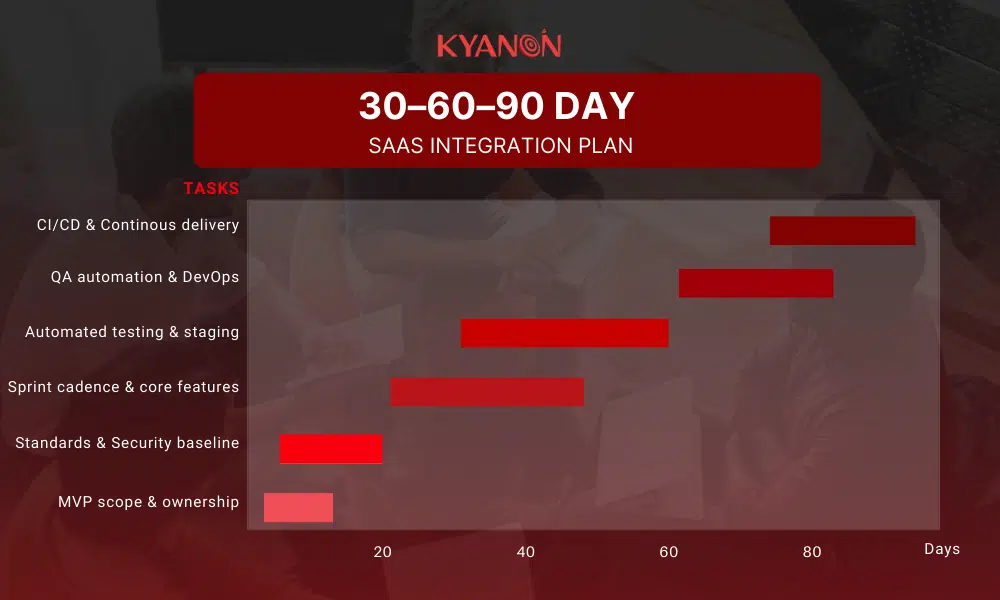
- Days 1 to 30 – Align
- Define MVP scope and non-goals
- Establish coding standards, DoD, security baseline
- Days 31 to 60 – Build rhythm
- Sprint cadence, demos, retrospectives
- Introduce automated testing and staging
- Days 61 to 90 – Scale
- Add QA automation / DevOps
- Move toward continuous delivery
Step 5: Measure what matters (make speed visible)
Use delivery metrics, not effort metrics:
|
Metric |
Why it matters to leaders |
|
Lead time |
Predictability of releases |
|
Deployment frequency |
Ability to iterate fast |
|
Change failure rate |
Quality and stability |
| Time to restore |
Operational resilience |
If delivery metrics improve, your offshore model is working, regardless of location.
Step 6: Control risk without slowing down
To keep speed and trust:
- Contractual IP ownership and confidentiality
- Least-privilege access to code and cloud
- Embedded QA from sprint one (not at the end)
Build SaaS faster with Vietnam by aligning ownership, designing async workflows, measuring delivery speed, and scaling teams only after validation.
Risks & challenges when building SaaS offshore
Building SaaS offshore helps companies move faster and reduce costs, but it also introduces risks around ownership, communication, quality, and long-term control if not managed correctly.
When product ownership is unclear, priorities shift slowly, and decisions stall, especially across distributed teams.
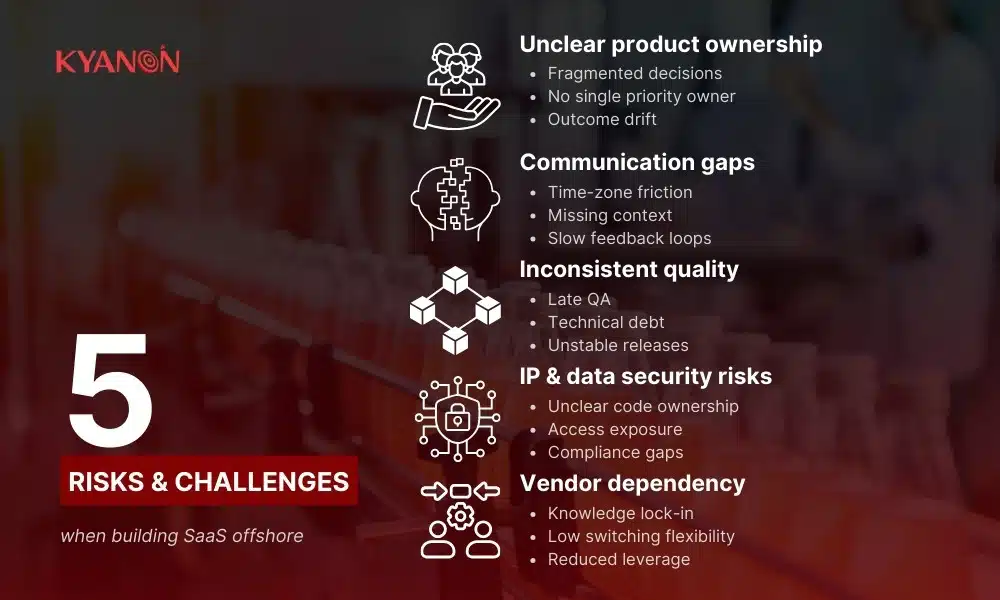
A quick table identifies key risks and controls in offshore SaaS delivery
|
Risk |
Business impact | Control leaders should apply |
|
Unclear product ownership |
Features shipped without clear value, slow decision-making |
Assign one product owner and maintain a single prioritized backlog |
|
Communication gaps |
Rework, delays, misaligned expectations |
Use clear written requirements and scheduled overlap for key decisions |
|
Inconsistent quality |
Technical debt, slower releases, higher long-term cost |
Apply shared standards, embedded QA, and automated testing |
|
IP & data security risks |
Legal exposure, compliance issues, loss of trust |
Enforce IP clauses, limit system access, run regular security reviews |
| Vendor dependency | Loss of control, difficult partner transitions |
Keep product vision, architecture, and roadmap ownership in-house |
How Kyanon Digital delivers SaaS value
Kyanon Digital delivers SaaS value through end-to-end development, cloud-native architecture, built-in security, API-first integrations, performance optimization, and agile delivery models, helping enterprises launch scalable, secure, and user-centric SaaS products efficiently.
- Full-cycle SaaS development from concept to launch and ongoing support, not just code delivery but strategic product execution.
- Cloud-native and multi-tenant architecture that supports growth, efficient resource use, and resilient performance for diverse user bases.
- Security and compliance by design, including robust authentication, data encryption, and adherence to relevant standards, protecting both user data and regulatory interests.
- API-first and integration-ready platforms that work seamlessly with third-party services and evolving enterprise ecosystems.
- Performance optimization and reliability engineering, including load balancing and proactive monitoring to maintain high availability.
- Agile delivery and CI/CD pipelines that enable rapid feature releases, iterative improvement, and predictable project cadence.
- User-centric design and customization, ensuring intuitive interfaces and tailored user experiences that boost adoption and retention.
- Flexible engagement models (fixed price, time & material, and dedicated teams) tailored to your business objectives and risk profile.
In conclusion
As SaaS markets become more competitive, the ability to move quickly without creating long-term complexity has become a defining advantage.
Vietnam product teams have emerged as a practical solution for leaders who need to scale delivery while maintaining control. When integrated into a strong product operating model, these teams enable faster iteration, flexible capacity, and predictable execution without the fixed-cost burden of traditional onshore teams.
For organizations navigating growth, modernization, or new product launches, leveraging a Vietnam-based product team is not a shortcut but a strategic choice to balance speed, quality, and sustainability over the long term.
For leaders seeking speed without compromise, Vietnam product teams represent a strategic lever, not a tactical shortcut.
Learn how Kyanon Digital helps SaaS leaders turn speed into sustainable advantage. Contact us now!