
Custom ecommerce systems are moving from edge cases to a practical requirement in retail environments where order flows, inventory logic, fulfillment rules, and cross-channel data have become too complex for standard platform extensions alone. Global retail leaders are still growing digital revenue, but the operational pressure behind that growth is rising: Deloitte reports the Top 250 retailers generated US$6.03 trillion in aggregate revenue with 3.6% YoY growth, while digital capability remains a major differentiator.
For businesses with complex retail ops, the real issue is not having an online store. It is whether the commerce stack can support real-time inventory truth, advanced routing, policy-heavy returns, cross-border fulfillment, and multi-channel consistency without creating brittle workarounds. In 2025, NRF projects $849.9 billion in retail returns and estimates 19.3% of online sales will be returned, while DHL reports 81% of shoppers abandon carts if their preferred delivery option is missing. Those numbers explain why operational design now matters as much as storefront design.
In this blog, Kyanon Digital examines when custom ecommerce systems become the right fit for complex retail operations, which architecture models make sense, and how enterprises can reduce delivery and migration risk.
Key takeaways
- Custom ecommerce systems become necessary when retail operations outgrow SaaS limits, plugin workarounds, and fragile integrations.
- Operational complexity usually appears first in inventory sync, order routing, returns, pricing logic, fulfillment rules, and multi-market execution.
- Composable, headless, and unified core models solve different problems; none is universally best.
- The strongest business case is operational fit, not a better-looking frontend.
- Regional patterns differ: Southeast Asia is growing fast through platform and video commerce, while Europe is larger but more mature and fragmented by market behavior and infrastructure.
- A design system matters because multi-frontend retail becomes expensive fast without shared components, accessibility rules, and governance.
- The right decision is measurable: latency, integration debt, rule complexity, governance needs, and change frequency should decide whether to build, customize, or re-platform.
Further reading:
- Why Retailers Build Custom Software Platforms
- Enterprise Digital Commerce Transformation in Singapore
- Building an Enterprise Data Warehouse for Commerce
What complex retail ops mean in ecommerce
A retail operation usually becomes complex when several operational layers must run together in real time without creating inconsistency.
|
Complexity trigger |
Why it becomes difficult | What breaks first | What businesses usually worry about |
|
Multi-warehouse inventory |
Stock changes by location, timing, and reservation state | Overselling, delayed fulfillment |
Inventory accuracy, margin leakage |
|
Multi-market commerce |
Local rules differ across tax, payment, shipping, and policy | Pricing errors, policy gaps |
Expansion speed, compliance risk |
|
Mixed B2B/B2C flows |
Different commercial logic runs in one environment | Workflow conflicts |
Platform fit, process control |
|
Omnichannel fulfillment |
One order may touch many systems and nodes | Routing failures |
Delivery reliability, cost control |
|
High-return categories |
Returns affect stock, finance, and fraud controls | Manual reconciliation |
Reverse logistics cost, refund accuracy |
| Policy-heavy products | Extra rules and approvals are required | Compliance issues |
Auditability, exception handling |
When off-the-shelf platforms become a constraint
Off-the-shelf platforms usually work well until complexity starts being handled through too many plugins, patches, and manual workarounds.
At that point, the issue is not just a feature shortage. It is integration debt.
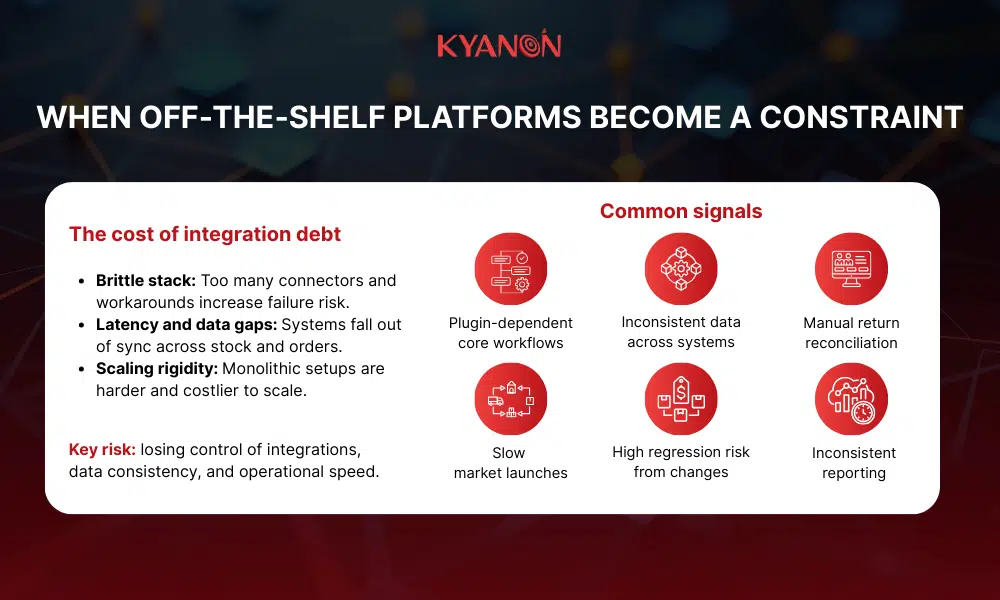
- Core workflows depend on plugins from multiple vendors
- Inventory and order status differ across storefronts, OMS, ERP, WMS, and POS
- Returns require manual reconciliation
- New market launches take too long
- Changes in routing or catalog logic create regression risk
- Reporting is inconsistent because systems define the same event differently
When commerce complexity rises, the biggest risk is often not missing features but losing control over integrations, data consistency, and operational speed.
|
Feature |
Off-the-shelf platform |
Custom ecommerce system |
|
Logic alignment |
Businesses must adapt to software |
Software is built around business logic |
|
Fulfillment |
Basic shipping rules |
Cost-aware, multi-warehouse routing |
|
Data integrity |
Periodic sync (Potential Latency) |
Real-time system of record |
|
Growth path |
High “Integration Debt” over time | Scalable central nervous system |
What custom ecommerce systems are and what they replace
A custom ecommerce system is best understood as an operating layer for retail execution, not just a custom storefront.
Custom ecommerce systems are the central nervous system
These systems act as the orchestration layer. Instead of just displaying products, they manage the flow of data between inventory, order management (OMS), and customer relationship management (CRM) systems in real time.
In complex environments, a custom system often orchestrates:
- Product and catalog logic
- Inventory visibility
- Order capture and splitting
- Fulfillment routing
- Customer state and entitlements
- Refund and return workflows
- Event flows between commerce, ERP, OMS, WMS, POS, and CRM
That operating layer gives businesses one place to enforce business rules, instead of scattering them across apps and manual procedures.
The typical monolith problems custom systems solve
|
Feature |
Monolithic platform |
Custom ecommerce system |
|
Flexibility |
Rigid, predefined workflows |
Built around specific business logic |
|
Scaling |
Scaled as a single unit (expensive) |
Independent scaling of high-load components |
|
Risk |
Great change risk due to coupled code |
Low risk through isolated services |
Custom ecommerce systems often replace or reduce dependence on:
- Heavily customized monoliths that are slow to change
- SaaS stacks overloaded with plugins
- Channel-specific logic duplicated across web, app, and store systems
- Middleware that has grown without clear ownership
Typical monolith problems include:
- Release cycles are tied to the whole application
- Scaling bottlenecks in checkout, catalog, or search
- Hard coupling between customer experience and operational logic
- Higher risk when changing one workflow
- Limited visibility into failure states and data lineage
The 3 architecture patterns used in custom ecommerce systems
Many businesses choose architecture based on market trends. A better approach is to identify the main business constraint first.
- Headless commerce fits when the priority is faster frontend delivery across channels.
- Composable commerce fits when the priority is replacing or scaling services independently.
- Unified core platforms fit when inventory, routing, fulfillment, and returns must work as one coordinated system.
|
Pattern |
Best for | Main advantage | Main risk |
Best question to ask |
|
Composable commerce |
Service-level flexibility | Replace parts independently | Integration burden |
Do we have the governance maturity to run a modular stack well? |
|
Headless commerce |
Multi-frontend experience delivery | Faster UX iteration | Backend complexity remains |
Is experience speed the real bottleneck, or is ops the bigger issue? |
|
Unified core commerce and operations |
Ops-heavy retail execution | Process consistency | Risk of over-centralization |
Do inventory, routing, and fulfillment need one tightly controlled core? |
Composable commerce
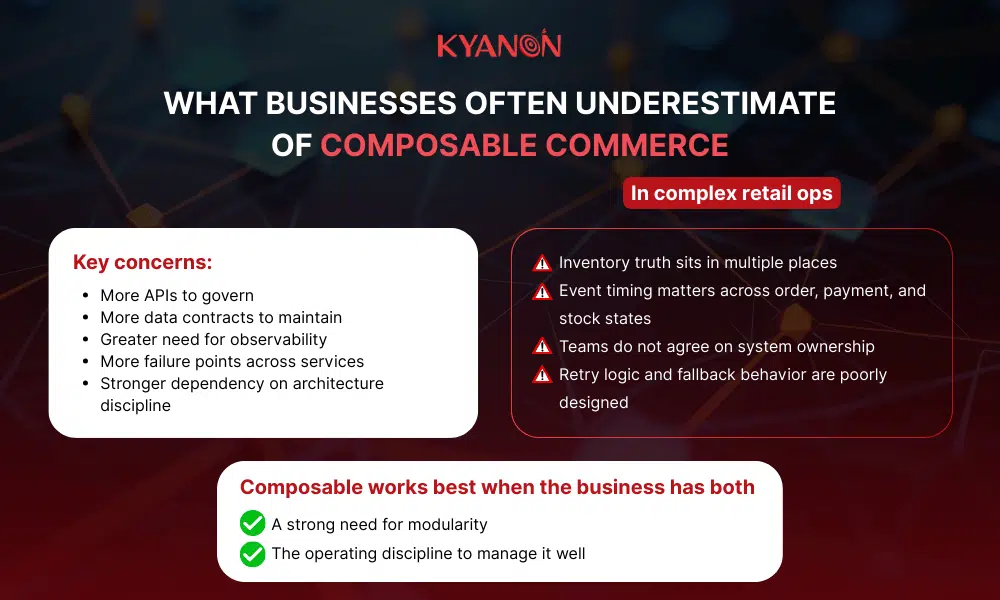
Composable commerce uses separate services connected by APIs and events, allowing businesses to build a custom stack from specialized components.
Best fit for
- Businesses with strong architecture governance
- Environments where functions evolve at different speeds
- Organizations that want to replace parts of the stack over time instead of replacing everything at once
- Teams that already operate well with APIs, event-driven systems, and cross-vendor integration
Headless commerce
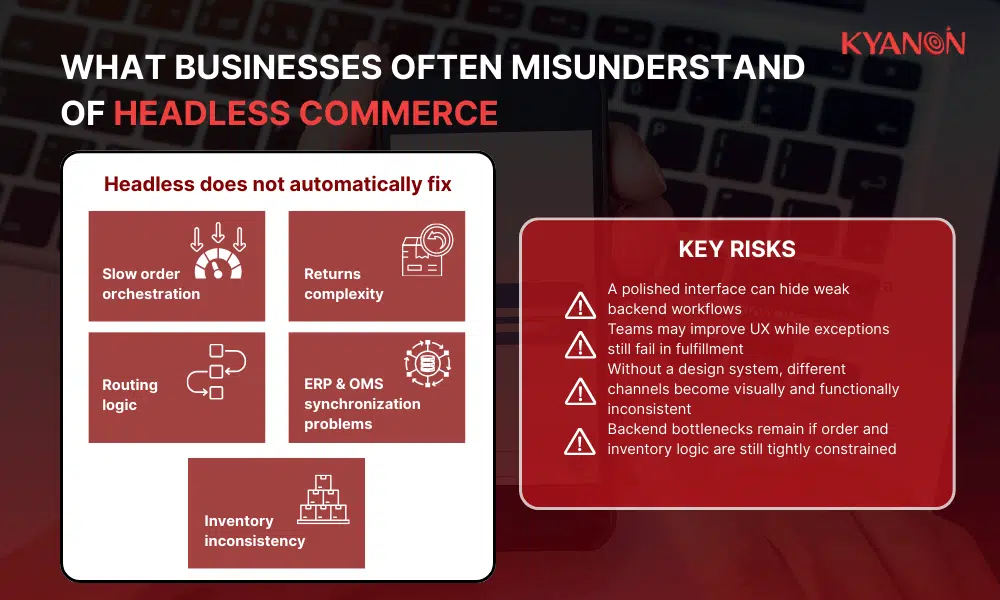
Headless commerce separates the frontend experience layer from backend commerce services.
Best fit for
- Multi-touchpoint retail environments
- Businesses prioritizing frontend speed and content flexibility
- Teams that want separate release cycles for experience and backend logic
- Organizations investing in design systems and omnichannel consistency
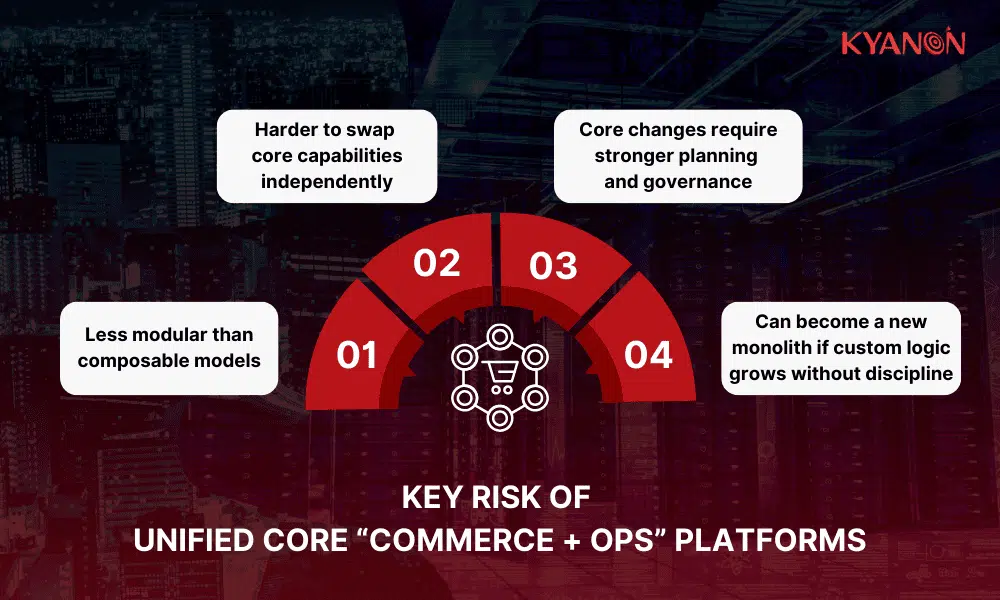
Unified core “commerce + Ops” platforms
A unified core commerce-plus-operations platform combines commerce logic with inventory, routing, fulfillment, and operational orchestration in one tightly governed layer.
This model is less discussed in trend-driven ecommerce conversations but is often more relevant for complex retail operations.
Best fit for
- Businesses with high operational interdependence between sales, stock, routing, and fulfillment
- Environments where process consistency matters more than swapping vendors frequently
- Businesses where ecommerce success depends on operational accuracy, not only customer-facing agility
- Retail models with heavy store fulfillment, distributed inventory, complex returns, or policy-heavy workflows
How businesses should choose the right architecture
The right architecture should be chosen by operational bottleneck, not by market popularity.
Choose composable commerce when
- Different capabilities need to evolve independently
- Vendor replacement flexibility matters
- Internal architecture governance is already strong
- Integration maturity is high enough to manage many services cleanly
Choose headless commerce when
- Frontend speed is the main issue
- Many customer touchpoints need a unified experience layer
- Design system maturity is strong
- Backend operational complexity is already stable or separately addressed
Choose a unified core when
- Order, stock, routing, and fulfillment are tightly linked
- Stores, warehouses, and suppliers act as one network
- Operational consistency matters more than service swapping
- Reverse logistics, substitutions, or policy-heavy flows are business-critical
Operational capabilities that drive the case for custom
The strongest case for custom comes from workflows that standard commerce setups handle poorly.
Advanced order routing and splitting
Examples:
- Route by SLA, geography, stock freshness, margin, or shipping cost
- Split one order across the warehouse, store, and supplier
- Hold or reroute based on fraud checks, restricted SKUs, or service levels
Why it matters:
- Routing quality directly affects fulfillment cost, delivery reliability, and stock utilization
- DHL’s 2025 data shows delivery options strongly influence conversion, which makes routing logic commercially important, not just operationally important.
Omnichannel synchronization in real time
Complex retail fails when channels disagree.
Critical sync points:
- Stock updates
- Reservations
- Returns received
- Refund status
- Store pickup state
- Customer order history
Why this matters: Online returns are still high, and return handling now affects margin, trust, and fraud exposure.
Complex product and catalog logic
Custom systems are often justified by catalog complexity such as:
- Bundles and kits
- Configurable products
- Hierarchical assortments
- Market-specific attributes
- Shared inventory across multiple sellable products
- B2B contract catalogs alongside public assortments
Regulated or policy-heavy workflows
Certain retail categories need mandatory workflow steps:
- Approval chains
- Age or identity verification
- Restricted product handling
- Region-specific compliance checks
- Audit trails for refunds and order overrides
These are usually poor fits for plugin-based workarounds because the risk sits in the exceptions, not the happy path.
Integration landscape for complex retail ecommerce
Integration strategy usually decides whether the build succeeds.
ERP, POS, CRM, OMS, WMS as core dependencies
In complex retail, commerce rarely acts alone. A typical system map includes:
|
System |
What it usually owns |
Why the integration matters |
|
ERP |
Finance, master data, procurement |
Commercial truth and reconciliation |
|
POS |
In-store sales and local inventory events |
Omnichannel stock and returns |
|
CRM/CDP |
Customer identity and engagement state |
Personalization and service continuity |
|
OMS |
Order lifecycle and orchestration |
Routing, split orders, exceptions |
|
WMS |
Warehouse execution |
Pick-pack-ship accuracy |
Custom ecommerce software development often starts here because architecture choices that ignore system dependencies usually fail in production.
Data consistency and the system of record problem
Most retail incidents are not caused by missing features. They are caused by inconsistent ownership.
Questions businesses need answered early:
- Which system is the source of truth for price?
- Which system owns sellable inventory?
- Which system defines the return state?
- What is the acceptable latency for stock updates?
- What event schema is canonical?
Without this, businesses get:
- Duplicate records
- Delayed stock truth
- Broken refunds
- Reporting mismatches
- Manual reconciliation at scale
Ecommerce design system as a growth multiplier
An ecommerce design system is not only a UX asset. In headless and omnichannel retail, it becomes a control mechanism for speed and consistency.
What an ecommerce design system includes
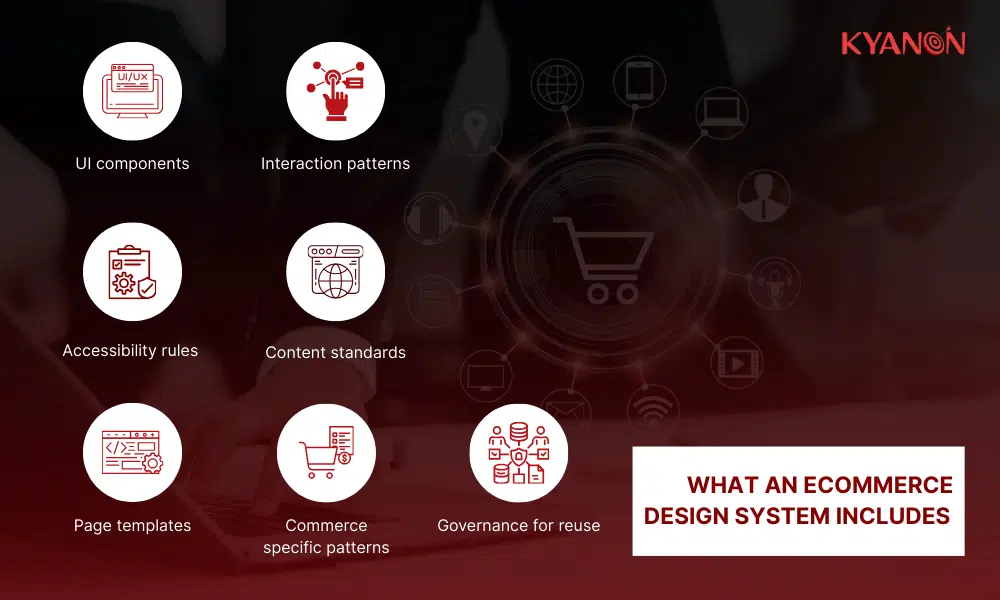
- UI components
- Interaction patterns
- Accessibility rules
- Content standards
- Page templates
- Commerce-specific patterns such as product cards, filters, checkout states, error states, and account flows
- Governance rules for updates and reuse
Why design systems matter in headless and omnichannel
When web, mobile, in-store, and campaign touchpoints evolve separately, design debt grows quickly.
Benefits:
- Faster launches across channels
- More consistent customer journeys
- Lower frontend maintenance cost
- Easier governance in multi-team environments
- Better accessibility and content quality control
This matters more as AI-driven personalization and multi-touchpoint shopping expand. PwC’s 2025 consumer markets outlook points to AI-first experiences that blend online and in-store journeys with real-time product customization and predictive merchandising. That kind of execution is hard to scale without a common design and content model.
Build vs customize vs re-platform
This decision should be made through constraint analysis, not ideology.
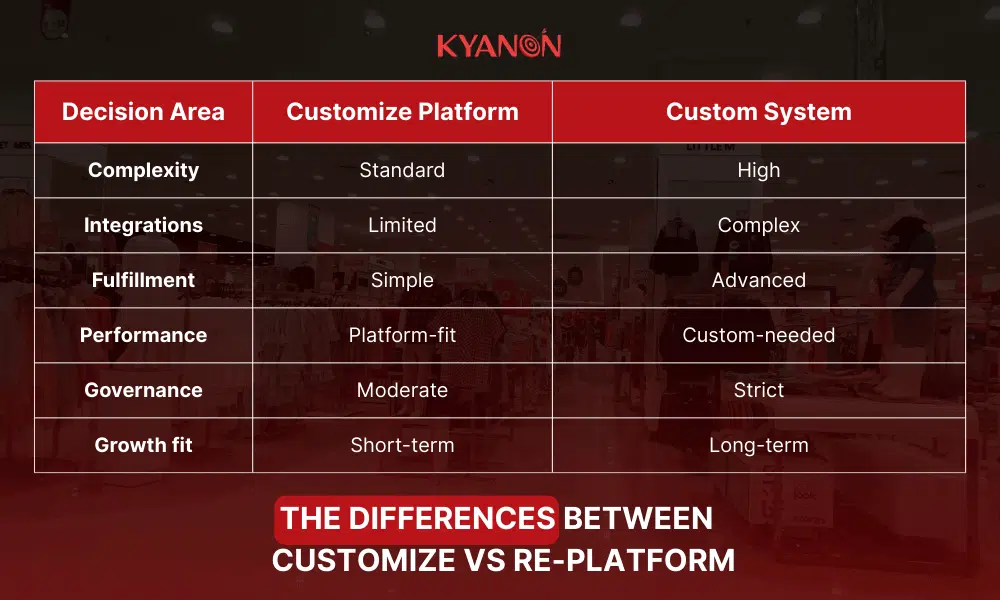
When customizing a platform is enough
Platform customization is often necessary when:
- Catalog logic is moderate
- One main channel drives revenue
- Integrations are limited and stable
- Fulfillment rules are simple
- Returns and refund workflows are manageable
- Performance targets are realistic within platform limits
This is usually the lower-risk option for businesses still proving demand or simplifying operations.
When a custom ecommerce platform is justified
A custom ecommerce platform is more defensible when several thresholds are crossed:
- Rule complexity is rising faster than platform flexibility
- Integration debt is slowing delivery
- Cross-channel consistency requires stronger orchestration
- Latency targets cannot tolerate middleware-heavy flows
- Governance or compliance requirements need tighter control
- New market or channel launches are repeatedly blocked by platform constraints
|
Question |
Customize platform |
Custom system |
|
Are workflows mostly standard? |
Yes |
No |
|
Is plugin sprawl still manageable? |
Yes |
No |
|
Are integrations few and stable? |
Yes |
No |
|
Are order/stock rules becoming a competitive capability? |
No |
Yes |
|
Is governance or compliance strict? |
Sometimes |
Often |
|
Is long-term roadmap control important? |
Moderate |
High |
Migration strategy and risk containment
The safest migration pattern is usually phased.
Common methods:
- Strangler pattern by domain
- Start with orchestration before storefront rebuild
- Migrate selected markets first
- Keep legacy checkout or legacy catalog temporarily, where needed
- Run dual-write or event-based transition carefully, with audit controls
The goal is not big-bang modernization. It is controlled risk reduction.
Cost, timeline, and total cost of ownership (TCO)
Upfront build cost matters, but an incomplete TCO analysis leads to poor decisions.
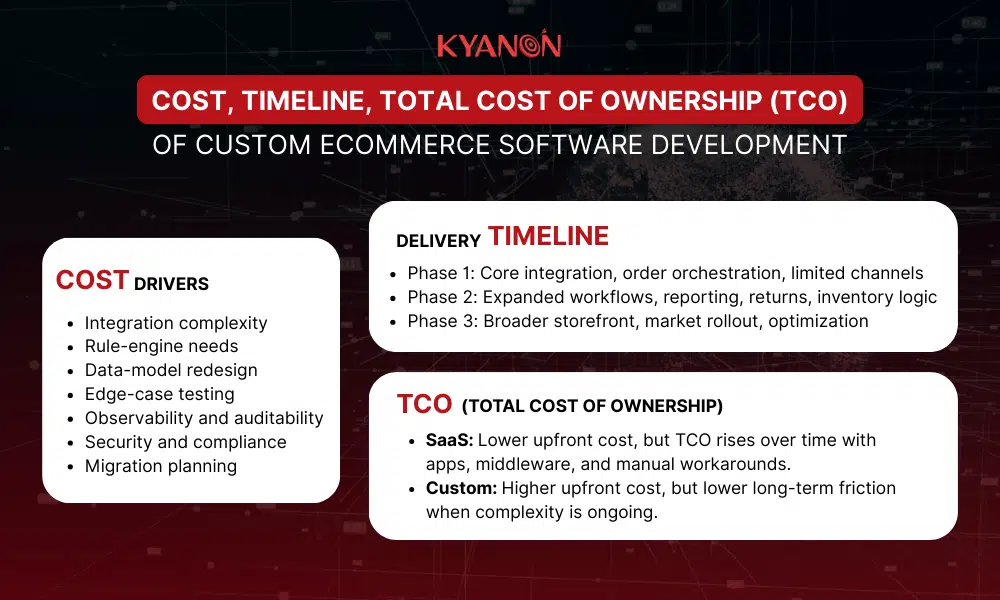
Cost drivers in custom ecommerce software development
The biggest cost drivers are usually:
- Number and complexity of integrations
- Rule-engine requirements
- Data-model redesign
- Testing for edge cases
- Observability and auditability requirements
- Security and compliance controls
- Migration and coexistence planning
TCO vs SaaS fees and plugin sprawl
SaaS often looks cheaper early, but TCO changes when businesses add:
- Many paid apps
- Middleware layers
- Manual operational workarounds
- Repeated reimplementation of business rules
- Vendor-driven roadmap compromises
Custom systems cost more to build, but they can lower long-run friction when complexity is structural, not temporary.
Delivery timeline and phased go-lives
Typical timeframes depend on scope, not category labels.
|
Scope |
Typical focus |
Indicative timeline |
|
Phase 1 |
Core integration, order orchestration, limited channels |
3–6 months |
|
Phase 2 |
Expanded workflows, reporting, returns, inventory logic |
6–12 months |
|
Phase 3 |
Broader storefront, market rollout, optimization |
12+ months |
A common mistake is rebuilding everything at once. In many cases, the better sequence is:
- Fix operational core
- Stabilize data flows
- Expand customer-facing experiences
Common failure modes in custom ecommerce systems
Most failures are predictable.
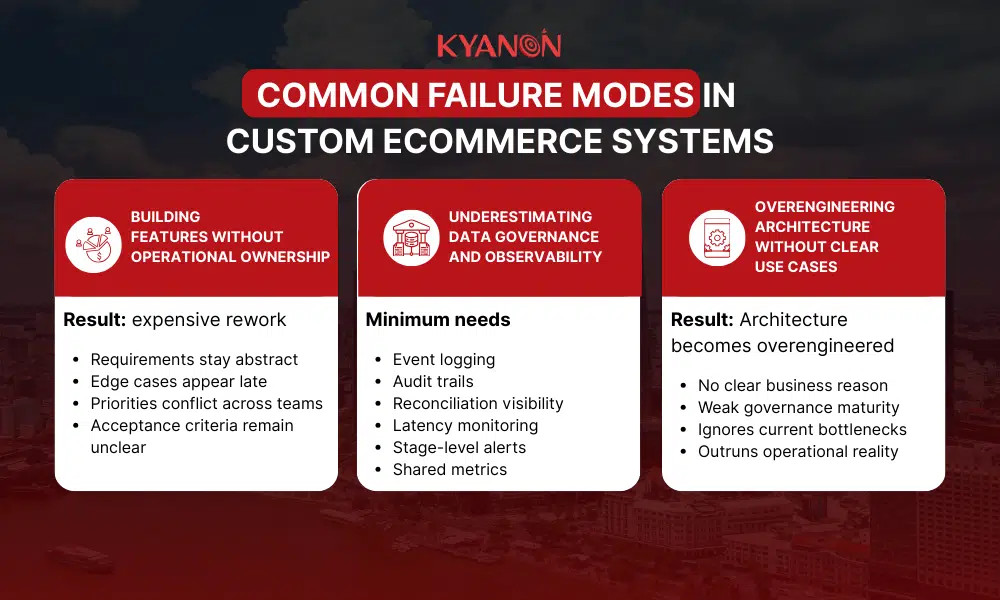
Building features without operational ownership
When workflows do not have business owners:
- Requirements stay abstract
- Edge cases appear late
- Priorities conflict across teams
- Acceptance criteria remain unclear
Result: expensive rework.
Underestimating data governance and observability
In complex retail, monitoring is not optional.
Minimum needs:
- Event logging
- Audit trails
- Inventory reconciliation visibility
- Latency monitoring
- Failure alerts by workflow stage
- Shared metric definitions
IBM’s 2025 research also points to a wider shift: retail organizations are investing more heavily in AI and ecosystem platforms, which increases the importance of governed data and trusted process signals.
Overengineering architecture without clear use cases
Composable and headless are not goals on their own.
Architecture becomes overengineered when:
- Services are split without business reason
- Teams do not have the governance maturity to run modular systems
- The design assumes future scale but ignores present bottlenecks
- Modern stack choices outrun operational reality
Evaluation checklist for custom ecommerce systems
|
Area |
What to test |
Why it matters |
|
Workflow coverage |
Edge cases, exceptions, approvals |
Prevent rework |
|
Integration readiness |
API/event maturity |
Reduce sync failures |
|
Performance |
Peak and degraded modes |
Protect revenue |
|
Governance |
Ownership, audit, monitoring |
Support long-term control |
|
Security/compliance |
Payments, PII, logs |
Reduce business risk |
How Kyanon Digital builds custom ecommerce systems for complex Ops
Kyanon Digital helped a large multi-format retailer solve fragmented fulfillment, weak system integration, and limited real-time visibility by building an integrated omnichannel platform that connected commerce, inventory, transportation, and customer delivery tracking into one scalable operating model.
Challenges
- Fragmented delivery operations reduced visibility and coordination across channels.
- Fulfillment processes were inefficient, causing delays and higher error rates.
- Transportation management increased cost and weakened customer experience.
- ERP, POS, ecommerce, and logistics systems were not well integrated.
- Limited real-time tracking led to more service inquiries and lower satisfaction.
Solutions
- Kyanon Digital delivered an integrated omnichannel fulfillment and transportation management solution.
- The platform included smart fulfillment with pick-and-pack optimization, barcode scanning, and real-time warehouse task management.
- It added transportation management with AI-powered route optimization, dynamic load planning, vehicle tracking, and delivery fee automation.
- It improved customer experience with real-time order tracking, automated notifications, and digital proof of delivery.
- It connected ERP, POS, ecommerce, and third-party logistics through a cloud-native, API-first, event-driven architecture.
Results & impact
- Faster order processing and improved delivery performance strengthened operational efficiency.
- Automation reduced manual work and human error.
- Real-time visibility and proactive communication improved customer satisfaction and reduced service inquiries.
- Route optimization and better resource use lowered transportation and operating costs.
- The modular cloud architecture created a scalable foundation for new channels, locations, and partners.
In conclusion
Custom ecommerce systems make sense when retail complexity is ongoing, operationally critical, and too costly to manage through extensions alone. For businesses handling multiple channels, markets, inventory nodes, and complex fulfillment rules, the right choice is the one that improves operational control, scalability, and long-term flexibility.
The right next step is not a redesign brief. It is a structured discovery on workflows, data ownership, architecture options, and migration risk.
Contact Kyanon Digital today to explore a custom ecommerce system built for complex retail operations, with the architecture, integration strategy, and scalability needed for long-term growth!