
Custom retail platforms have moved from a niche engineering choice to a core strategic asset for enterprises operating at scale. As retail complexity expands across channels, regions, and fulfillment models, the gap between what generic platforms deliver and what enterprise operations actually require has never been wider.
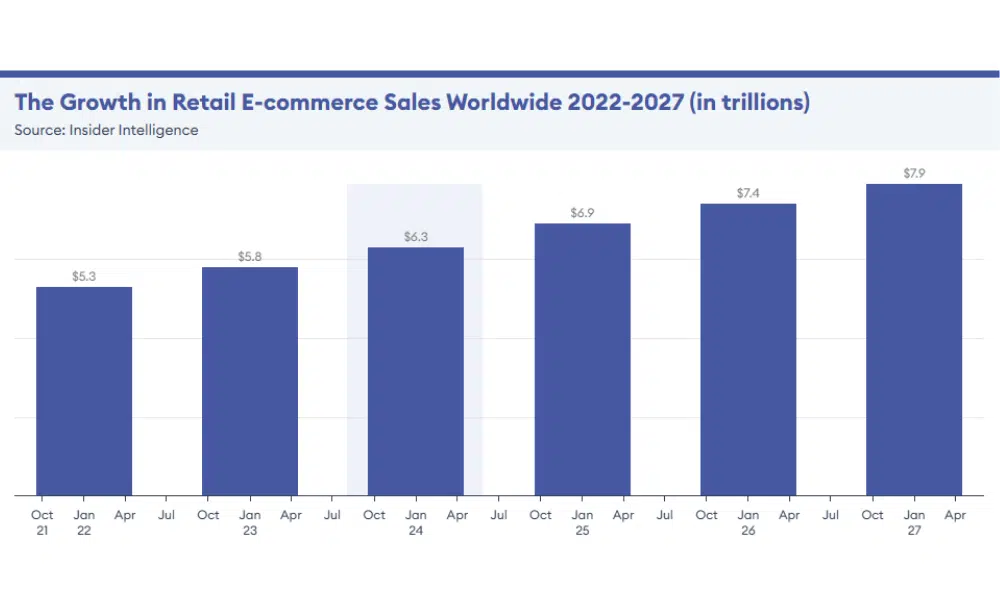
The numbers confirm the urgency. According to Statista, global retail e-commerce revenue is expected to surpass $8 trillion by 2027, with multi-channel fulfillment and unified inventory management cited as the top two operational bottlenecks for enterprises scaling internationally.
For enterprises running hundreds of stores, multiple brands, or cross-border logistics, off-the-shelf retail software increasingly breaks under operational weight. Workflows become workarounds. Integrations become liabilities. Data becomes fragmented.
In this blog, Kyanon Digital explores how enterprises can strategically assess, design, and implement these systems to achieve true operational efficiency and long-term agility.
Key takeaways
- Custom retail platforms function as the operational core of enterprise retail, not simply as a storefront but as the system unifying commerce, supply chain, CRM, and ERP.
- Standard platforms usually break at complexity, not at launch. The common failure point is fragmented workflows across stores, regions, brands, and channels.
- Customization becomes a strategic necessity, not a preference, when competitive logic, proprietary fulfillment, or legacy constraints cannot be solved through configuration alone.
- API-first and headless architectures provide the best long-term flexibility by decoupling the frontend from backend logic, enabling faster iteration without full rewrites.
- Build vs. buy is rarely binary. Many enterprises succeed with a hybrid model: a stable core platform plus custom operational layers.
- Implementation risk is high without a phased approach; diagnostics, architecture design, piloting, and staged rollout are not optional steps.
- Over-customization, recreated data silos, and change management failures are the top three reasons enterprise retail platform programs fail, even when the technology works.
Further reading:
- Why Retailers Build Custom Software Platforms
- Custom ECommerce Systems for Complex Retail Ops
- Building AI-Driven Pricing Systems for Retail
Why enterprise retail outgrows standard retail platforms
Standard retail platforms are built for the majority of mid-market businesses with predictable workflows, moderate transaction volumes, and a manageable number of integrations.
Enterprise retail, by contrast, operates in a different dimension of complexity. The breaking points are structural, not incidental.
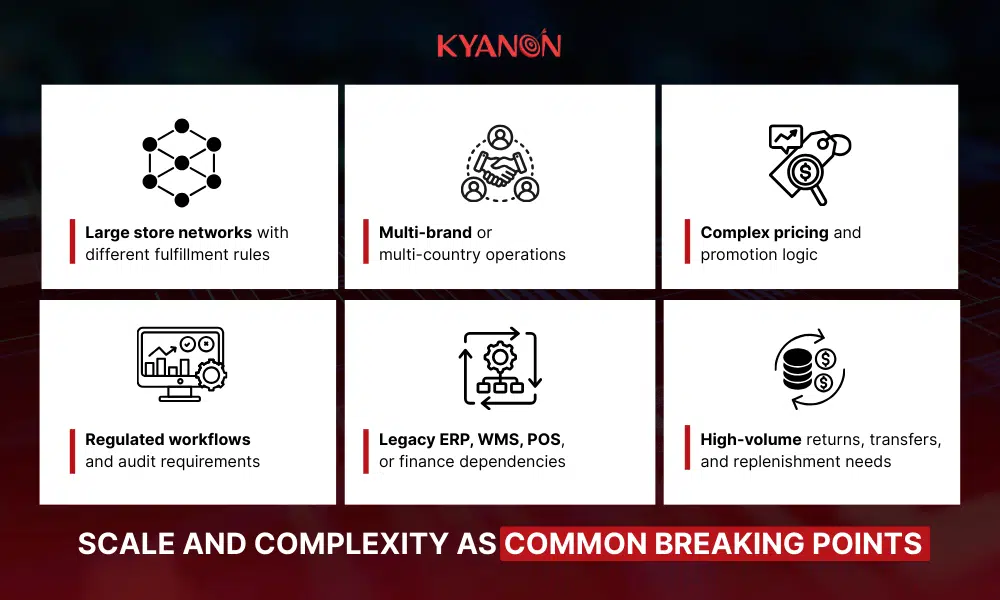
Scale and complexity as breaking points
Volume alone can surface the limits of generic platforms. IDC’s 2025 Retail Technology Report notes that enterprise retailers running more than 200 stores or processing over 500,000 daily transactions report a 3x higher rate of platform-related operational incidents compared to mid-market peers.
- Peak-load failures during high-traffic events (promotional campaigns, holiday seasons) are disproportionately common on shared-infrastructure SaaS platforms.
- Multi-currency, multi-tax, and multi-regulatory requirements across geographies expose hard-coded assumptions in off-the-shelf systems.
- Enterprise product catalogs, often in the millions of SKUs, exceed the indexed query performance of platforms not designed for that data scale.
Target’s sortation centers helped raise next-day delivered orders by over 150%, showing that retail platforms must improve fulfillment operations, not just e-commerce experience.
Fragmented systems across stores, regions, and channels
Enterprise retail typically evolves through acquisition, organic expansion, and channel diversification. The result is a technology landscape assembled over time, not designed from first principles.
- POS systems vary by market or brand, creating inconsistent transaction records.
- E-commerce, mobile, and in-store inventory are tracked in separate systems, leading to overselling, stock discrepancies, and customer experience failures.
- CRM data lives in one system, loyalty data in another, and purchase history in a third, making unified customer profiles operationally difficult.
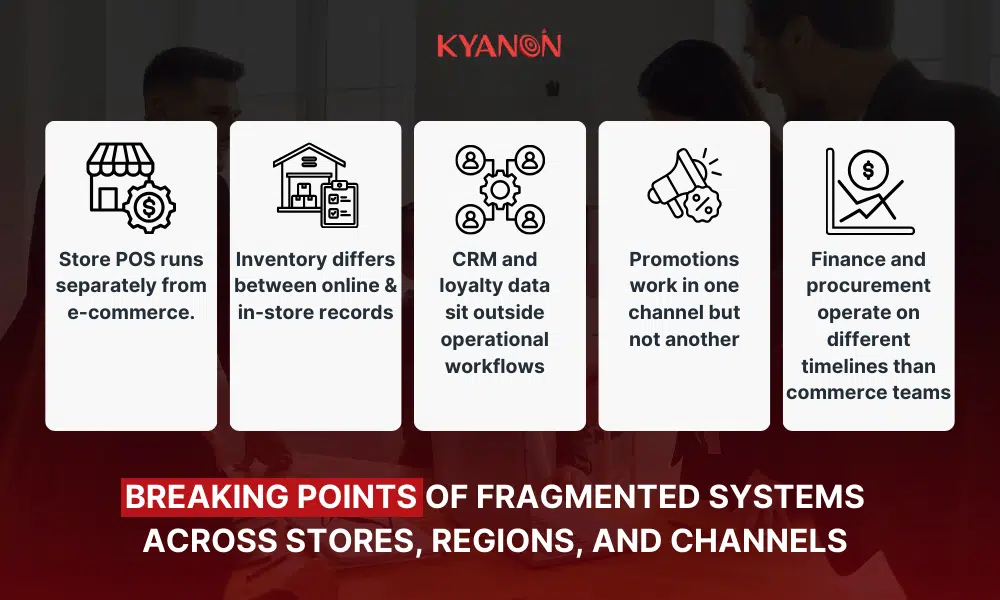
The survey found that 43% of enterprise retailers operate five or more disconnected back-end systems, with data reconciliation consuming an average of 18 staff-hours per week per region (Deloitte, 2025).
Operational bottlenecks caused by rigid workflows
Off-the-shelf platforms are designed around standard retail workflows. When enterprise operations diverge from those standards, and they inevitably do, the result is workarounds, not solutions.
- Custom fulfillment logic (e.g., ship-from-store with complex routing rules) requires code-level changes that most platforms do not support.
- Proprietary pricing models, loyalty tier calculations, and B2B discount structures cannot be configured into systems built for B2C simplicity.
- Compliance requirements in regulated markets (GDPR, local data residency laws, tax authority reporting) require platform modifications that vendor roadmaps do not prioritize.
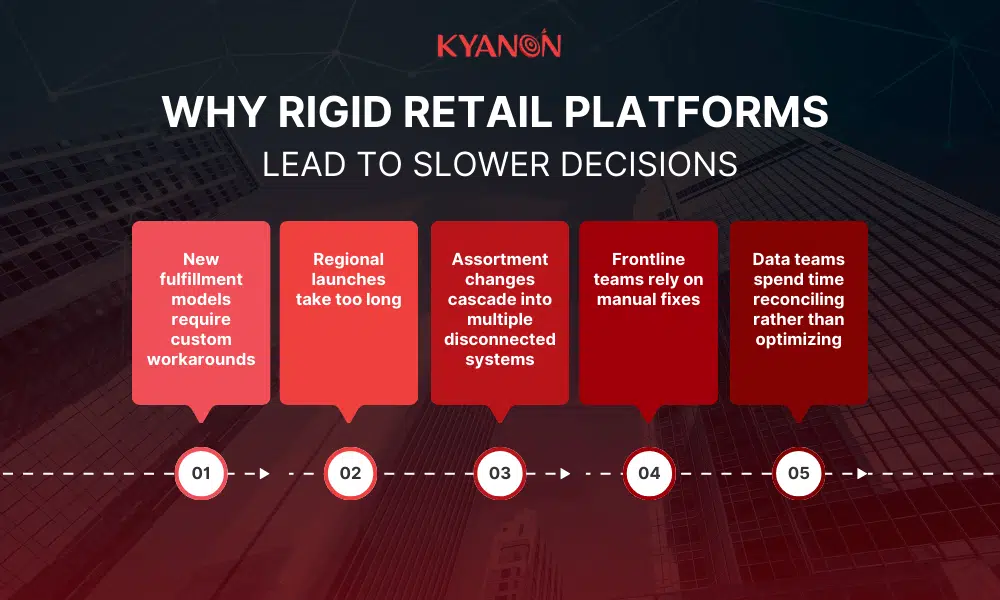
McKinsey highlights the same operational problem in supply chain transformation: fragmented data and outdated infrastructure make visibility, speed, and agility difficult to achieve at scale.
Why standard retail platforms fail at enterprise scale
|
Pressure area |
Typical limitation in standard platforms |
Enterprise impact |
|
Multi-channel inventory |
Partial synchronization |
Stock inaccuracies, missed sales |
|
Regional operations |
Rigid workflows |
Slow rollout across markets |
|
Legacy integration |
Limited interoperability |
High middleware cost |
|
Store operations |
Generic checkout and task flows |
Low frontline efficiency |
|
Data architecture |
Siloed records |
Weak decision visibility |
|
Innovation speed |
Vendor release dependency |
Slower business model changes |
What are custom retail platforms
Definition and scope of custom retail platforms
Custom retail platforms are enterprise operating systems designed around the specific workflows, integration needs, governance rules, and scalability requirements of a retail business.
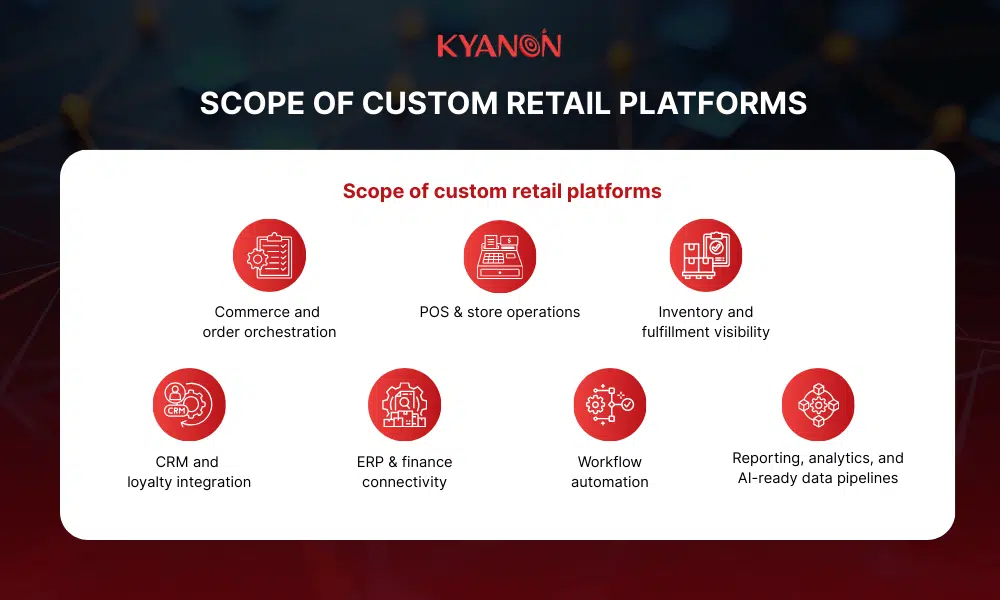
Difference between custom retail platforms and packaged retail software
|
Dimension |
Off-the-shelf platform |
Custom retail platform |
|
Transaction volume |
Optimized for mid-market scale |
Engineered for millions of daily TXs |
|
Integration depth |
Pre-built connectors, limited depth |
Full API ownership, deep ERP/CRM tie-ins |
|
Workflow customization |
Configuration only |
Purpose-built logic for operations |
|
Data ownership |
Vendor-controlled data model |
Enterprise-owned schema |
|
Scalability path |
Upgrade tiers or migrate |
Horizontal scaling by design |
|
Vendor lock-in risk |
High |
Low-to-Medium (if designed correctly) |
|
TCO |
Predictable short-term; high long-term |
Higher upfront; lower long-term marginal cost |
- Packaged platforms are strongest when processes are relatively standard.
- Custom retail platforms become relevant when process complexity is part of the business model itself.
When customization becomes a strategic necessity, not a preference
Customization becomes strategic when:
- Operational complexity creates measurable revenue leakage or cost drag
- Data inconsistency blocks enterprise-wide visibility
- Legacy replacement is not feasible in one step
- Channel expansion depends on new workflow logic
- Store and fulfillment operations need differentiated rules
- Vendor release cycles are too slow for business priorities
The point is not to customize because it is possible. It is to customize when standard software creates operational friction that compounds across the enterprise.
Core capabilities of custom retail platforms for enterprise operations
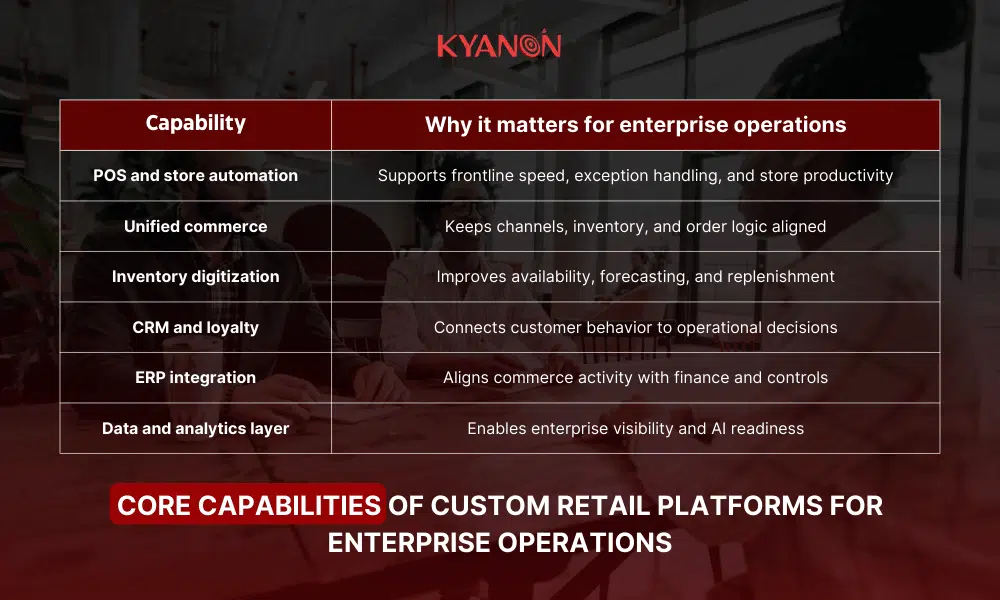
Intelligent POS and in-store automation
- Designed to support high-volume, concurrent transactions across hundreds or thousands of physical locations simultaneously.
- Enables specialized checkout flows: self-checkout kiosks, mobile POS, assisted selling stations, and click-and-collect counters, all feeding a unified transaction ledger.
- Supports complex in-store logic: partial payments, multi-tender transactions, returns-to-stock routing, and real-time loyalty point application at the point of sale.
- Integrates natively with in-store automation hardware: barcode scanners, electronic shelf labels (ESL), RFID readers, and cash management systems.
At enterprise scale, POS is no longer just checkout software.
PwC’s NRF 2025 review shows how physical and digital retail are converging in-store, with growing use of self-checkout, store apps, and digital convenience tools. That trend raises the bar for POS from transaction capture to operational coordination.
Unified omnichannel commerce layer
- A single pricing engine, inventory pool, and customer identity layer serve all channels, such as web, mobile app, in-store, social commerce, and marketplace, simultaneously.
- Eliminates channel-specific pricing inconsistencies that erode customer trust and create reconciliation overhead.
- Real-time inventory availability is surfaced across all touchpoints, preventing overselling and enabling accurate fulfillment promises.
- Order orchestration logic determines the optimal fulfillment path (warehouse, store, or supplier direct) based on cost, speed, and stock availability.
Target shows how omnichannel capability becomes operational, not just customer-facing. The company says its $20 billion first-party digital business continues to grow alongside same-day services such as Drive Up and same-day delivery, which proves that unified commerce depends on linking digital demand with store and fulfillment execution.
Supply chain and inventory digitization
- Real-time inventory visibility across distribution centres, stores, and in-transit stock eliminates the blind spots that cause both stockouts and overstock situations.
- Demand forecasting modules use historical sales data, promotional calendars, and external signals (weather, events) to generate automated replenishment recommendations.
- Supplier integration via EDI or API enables purchase order automation, delivery confirmation, and invoice reconciliation without manual intervention.
- Shrinkage tracking, expiry management (for perishables), and serial number tracing are supported at the individual SKU level.
Walmart says same-day delivery now reaches 93% of U.S. households, which only works when store, inventory, and fulfillment systems are tightly integrated.
CRM, loyalty, and personalized engagement
- A unified customer data platform (CDP) consolidates transaction history, browsing behavior, support interactions, and loyalty activity into a single, actionable profile.
- Loyalty program logic, including tier management, point calculation, reward redemption, and expiry rules, is built into the platform rather than managed in a disconnected third-party tool.
- Segmentation and campaign targeting are powered by first-party behavioral data, enabling personalized promotions without third-party data dependency.
- Lifecycle management capabilities trigger automated engagement at key customer milestones: re-engagement campaigns, post-purchase sequences, and churn prediction alerts.
IDC expects growing retail investment in AI-driven loyalty and contextual engagement, reflecting the need to connect customer signals with operating systems rather than only campaign tools.
Retail ERP and operational management
Retail operations break when commerce scales faster than enterprise controls.
ERP-linked capabilities typically include:
- Procurement and supplier workflows
- Financial reconciliation
- Tax and compliance handling
- Workforce scheduling
- Store-level operating controls
- Margin and cost reporting
A custom platform matters when these flows need to work together in near-real time rather than through delayed batch integrations.
Architecture models for custom retail platforms
Enterprise decision-makers should evaluate these models based on operational requirements, not technology trends alone.
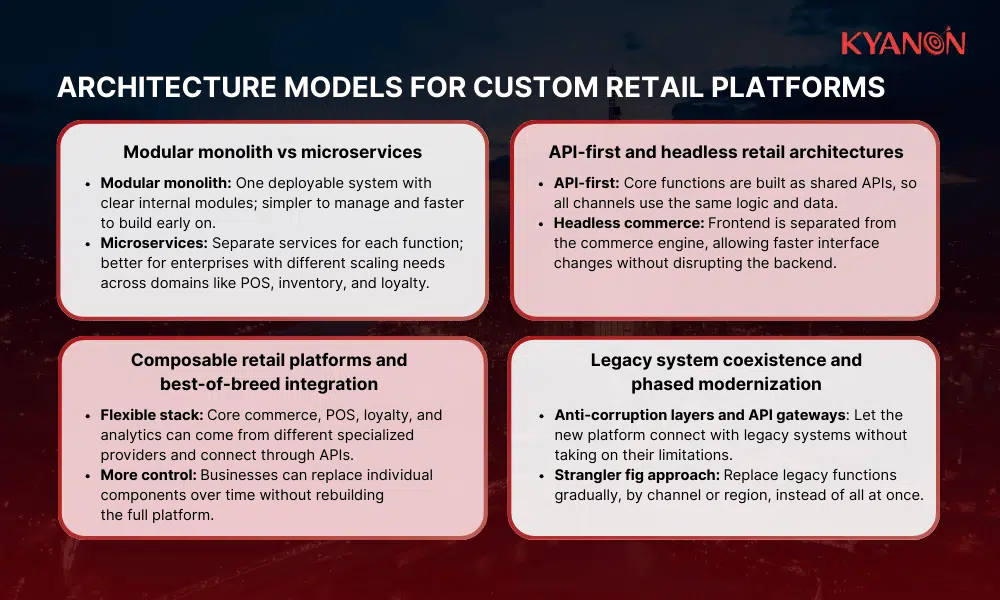
Modular monolith vs microservices at enterprise scale
- Modular monolith architecture organizes the platform into well-defined internal modules that are deployed as a single unit. It is operationally simpler and faster to develop initially, but it can create scaling constraints as individual components grow at different rates.
- Microservices architecture decomposes the platform into independently deployable services, each owning its own data store and business logic. It is the correct choice for enterprises where different capability domains (e.g., POS, inventory, loyalty) have fundamentally different scaling requirements.
API-first and headless retail architectures
This model is particularly valuable for enterprises running multiple branded storefronts on a shared commerce backbone or experimenting with emerging channels (voice commerce, in-car retail, AR try-on).
According to the 2025 MACH Alliance Enterprise Adoption Report, 58% of enterprise retailers implementing new platforms in the past two years chose API-first or headless architectures, up from 34% in 2022.
Composable retail platforms and best-of-breed integration
Composable architecture follows the MACH principles (Microservices, API-first, Cloud-native, Headless), assembling the platform from best-of-breed components rather than a single vendor’s suite.
- Trade-off: Composable approaches require strong API governance, clear data ownership rules, and ongoing integration maintenance that monolithic suites handle internally.
Legacy system coexistence and phased modernization
Most enterprise retail modernization programs cannot replace legacy systems in a single cutover. A phased approach, where new platform capabilities are introduced alongside existing systems, reduces operational risk.
A data migration strategy must be designed before development begins, not as an afterthought, with clear ownership of the canonical data source during transition periods.
Custom retail software development vs platform customization
|
Scenario |
Recommended path |
Rationale |
|
Standard workflows, limited budget |
Buy (platform) |
Faster TTM, lower risk |
|
Complex ops, proprietary logic |
Build (custom) |
Protects competitive IP |
|
Existing platform + unique gaps |
Hybrid |
Preserves investment, adds differentiation |
|
Multi-brand, multi-region enterprise |
Composable + Custom layers |
Agility + governance at scale |
When full custom development is justified
Full custom retail software development is justified when:
- Core operating workflows are differentiators
- Existing platforms cannot support the required logic cleanly
- Integration constraints are severe
- Long-term control matters more than vendor dependency
- Security, compliance, or workflow auditability requires deeper control
This is usually an operations decision before it is a software decision.
- When deep customization of enterprise platforms is sufficient
Deep customization is often sufficient when:
- The platform already covers 70–80% of core needs
- The remaining gaps are workflow-specific, not structural
- Vendor ecosystem strength matters
- Faster time-to-value is more important than full control
Hybrid approaches combining platforms with custom operational layers
For many enterprises, hybrid is the most realistic model.
Typical pattern:
- Use a stable commercial core for standard commerce functions
- Build custom layers for orchestration, store workflows, data, or regional logic
- Keep ERP and critical records in existing enterprise systems
- Add APIs and event flows to unify the operating model
This approach reduces rewrite risk while preserving room for operational differentiation.
Operational benefits of custom retail platforms
Operational efficiency and automation
A better retail platform can reduce:
- Manual inventory checks
- Reconciliation work
- Store-level process inconsistencies
- Fulfillment errors
- Duplicate data handling
- Delays in launching offers, assortments, or services
Scalability across markets, brands, and channels
Scalability is not just traffic capacity.
It includes:
- Faster rollout to new stores or countries
- Shared services across brands
- Configurable local rules
- Common data definitions
- Reusable integrations and workflows
Data consistency and enterprise-wide visibility
This is one of the highest-value outcomes.
- A strong custom platform can create:
- Consistent product and inventory records
- Better profitability analysis
- Cleaner demand planning inputs
- More reliable performance reporting
- Stronger auditability across functions
Faster execution of new business models and initiatives
Enterprises increasingly need to test and scale:
- Marketplace participation
- Dark stores or micro-fulfillment
- Subscription models
- Cross-border selling
- Retail media
- Social and live commerce
- New service bundles
In Southeast Asia, this pace is especially visible. Bain, Google, and Temasek report that video commerce already accounts for 25% of total e-commerce GMV in the region, showing how quickly operating models can shift when new channels gain real scale.
Implementation considerations and trade-offs
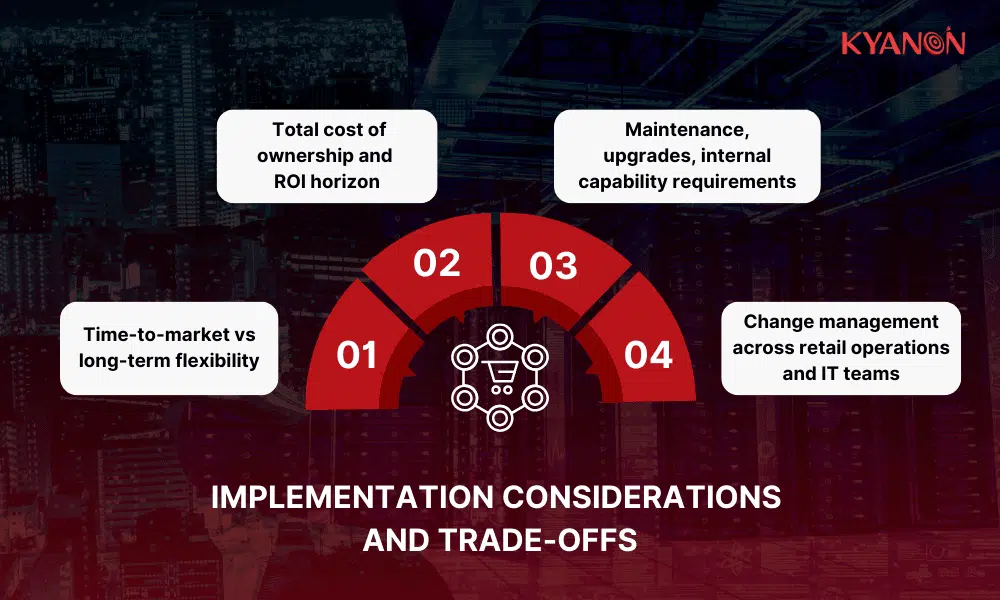
Time-to-market vs long-term flexibility
The fastest option is rarely the most adaptable. The most flexible option is rarely the fastest.
A practical decision rule:
Choose speed when the operating model is still stabilizing
Choose flexibility when workflow complexity is already proven
Avoid long custom programs that solve uncertain future scenarios
Total cost of ownership and ROI horizon
The right cost question is not “What does the platform cost?”, It is “What does fragmentation cost today, and what does adaptability cost tomorrow?”
Cost components to assess:
Direct costs: development, infrastructure, integration, testing, and training.
Indirect costs: internal product ownership, ongoing engineering capacity, and change management programs.
ROI horizon: most enterprise custom platform programs achieve positive ROI within 3-5 years, with the timeline dependent on the operational efficiency gains realized and the degree of operational change managed alongside the technology.
Maintenance, upgrades, and internal capability requirements
Every custom decision creates future obligations.
Enterprises should assess:
- Architecture governance maturity
- Release management discipline
- Product ownership strength
- Internal engineering capacity
- Data platform readiness
- Vendor support depth
Change management across retail operations and IT teams
Large retail transformations fail when teams treat them as software deployment rather than operating model change.
The hard part often includes:
- Store training
- New KPI definitions
- Revised escalation paths
- Role changes in merchandising or supply chain
- New data ownership rules
- Cross-functional governance
A practical implementation roadmap
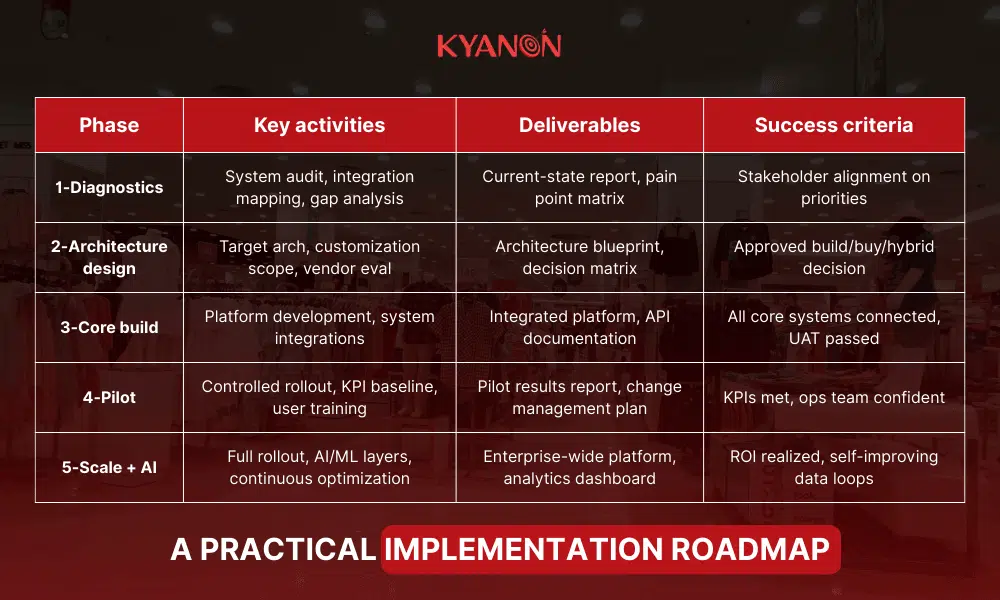
Phase 1: Enterprise retail diagnostics and system mapping
Start with:
- Current-state architecture
- Process pain points
- Integration dependencies
- Data ownership map
- Cost and friction hotspots
- Regional or brand-level complexity differences
Output:
- Clear complexity baseline
- Business case grounded in operational pain, not generic modernization language
Phase 2: Architecture and customization strategy design
Decide:
- What remains standard
- What must be customized
- What should be decoupled by APIs
- Which legacy systems stay in place
- Which domains need phased replacement
Output:
- Target architecture
- Phased roadmap
- Governance model
- Build vs buy principles
Phase 3: Core platform build and system integration
Priority usually goes to:
- Identity and master data
- Product and inventory flow
- Order orchestration
- Store and fulfillment integration
- ERP linkage
Output:
Minimum viable operating platform, not just a minimum viable storefront
Phase 4: Pilot rollout and operational validation
Test in a controlled environment:
- One region, one format, or one brand
- Real users and real process exceptions
- Baseline KPIs before scale
Validation metrics:
- Order accuracy
- Inventory visibility
- Fulfillment lead time
- Store process cycle time
- Return handling quality
- Data reconciliation effort
Phase 5: Scale, optimize, and extend with data and AI
Once the core is stable:
- Expand channels and locations
- Optimize demand and replenishment
- Add AI copilots or agents carefully
- Improve forecasting and service automation
- Strengthen planning and scenario visibility
Common failure modes in enterprise retail customization
Understanding why enterprise retail platform programs fail is as important as understanding why they succeed. The following failure modes account for the majority of platform program setbacks observed across the industry.
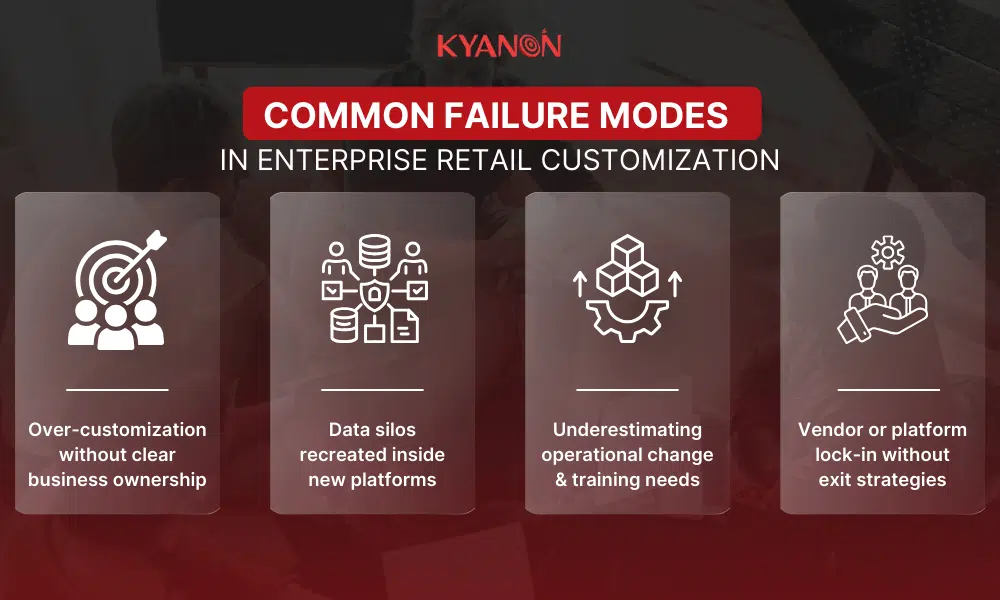
Over-customization without clear business ownership
Risk: Teams customize for preference, not measurable value
Prevention:
- Require business ownership for every major customization
- Tie the scope to specific operational outcomes
Data silos recreated inside new platforms
Risk: The enterprise replaces old silos with newer, cleaner-looking silos
Prevention:
- Define master data and integration rules early
- Govern customer, product, inventory, and order records centrally
Underestimating operational change and training needs
Risk: The software works, but stores and functions do not adopt it well
Prevention:
- Treat rollout as operational redesign
- Build training and process validation into every phase
Vendor or platform lock-in without exit strategies
Risk: The enterprise gains speed now but loses negotiating power and technical control later
Prevention:
- Favor API portability
- Protect data access
- Document exit pathways
- Avoid embedding critical business logic in opaque vendor layers
Decision framework for enterprise leaders
Complexity threshold assessment
A custom retail platform is usually worth serious evaluation when several of these are true:
- Multiple brands, business units, or geographies
- Hybrid store and digital fulfillment complexity
- A legacy system dependency that cannot be removed quickly
- High cost from data inconsistency
- Slow response to new business initiatives
- Need for differentiated store or supply chain workflows
Build vs buy vs hybrid decision matrix
Use the framework below to structure the decision for each major capability domain independently. Not all capabilities require the same approach.
|
Decision path |
Best when |
Watch out for |
|
Buy standard |
Complexity is manageable and speed matters most |
Workflow mismatch later |
|
Customize platform |
Core platform fit is strong but not complete |
Upgrade and governance burden |
|
Build custom |
Operations are highly differentiated |
Delivery time and internal capability risk |
|
Hybrid |
Need a balance between speed and control |
Integration and ownership complexity |
Internal capability and partner dependency evaluation
- Assess the internal engineering team’s capacity to own, maintain, and evolve a custom platform over a 5-10 year horizon. Be realistic: platform ownership is a sustained commitment, not a project.
- If internal capability is limited, the partner selection decision becomes as important as the technology decision. Evaluate partners on their enterprise retail implementation track record, not their technology stack preferences.
- Define the governance model for the ongoing relationship with any technology partner: IP ownership, knowledge transfer obligations, and transition support are as important as development capability.
Why choose Kyanon Digital as your partner?
Kyanon Digital is a strong partner for building custom retail platforms for enterprise operations because it combines deep engineering experience, enterprise integration capability, retail transformation expertise, and delivery governance needed to modernize complex operations at scale.
- 14+ years of engineering experience in agile software development and enterprise-grade digital platform delivery.
- End-to-end custom platform capabilities spanning consulting, architecture, software development, cloud-native applications, microservices, and modernization.
- Strong enterprise integration expertise across ERP, CRM, cloud platforms, legacy systems, third-party applications, and data environments to create connected retail operations.
- Retail and commerce transformation experience across AI, data, automation, e-commerce, and operational visibility use cases relevant to enterprise retail.
- Scalable delivery capacity with 500+ consultants and engineers and experience serving 100+ clients, including Fortune 500 companies.
- Global delivery presence with 5 offices, supporting regional and international transformation programs.
- Proven governance and quality standards backed by ISO 9001 and ISO 27001 certifications for structured delivery, quality management, and information security.
Case study: How Kyanon Digital builds custom retail platforms for enterprise operations
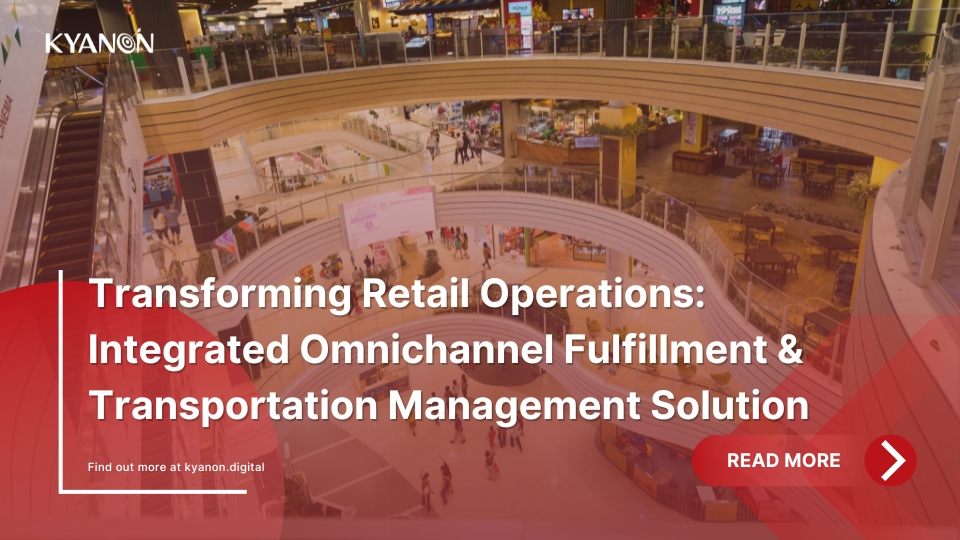
Kyanon Digital helped a large multi-format retailer overcome fragmented fulfillment, weak system integration, and limited real-time visibility by building a custom omnichannel platform that unified commerce, inventory, transportation, and customer delivery tracking into one scalable operating model.
Challenges
- Fragmented delivery operations reduced visibility and coordination across sales and fulfillment channels.
- Inefficient fulfillment processes caused delays, manual work, and higher error rates.
- Transportation complexity increased operating costs and weakened customer experience.
- ERP, POS, e-commerce, and logistics systems were not well integrated.
- Limited real-time tracking led to more service inquiries and lower customer satisfaction.
Solutions
Kyanon Digital delivered a custom omnichannel fulfillment and transportation management platform.
- The solution unified commerce, inventory, warehouse operations, transportation, and delivery tracking in one system.
- Smart fulfillment capabilities included pick-and-pack optimization, barcode scanning, and real-time warehouse task management.
- Transportation features included AI-powered route optimization, dynamic load planning, vehicle tracking, and delivery fee automation.
- Customer experience was improved through real-time order tracking, automated notifications, and digital proof of delivery.
- Core systems were connected through a cloud-native, API-first, event-driven architecture.
Results & impact
- Faster order processing improved fulfillment speed and delivery performance.
- Automation reduced manual work and human error across operations.
- Real-time visibility improved coordination and reduced service inquiries.
- Better route planning and transportation management lowered operating costs.
- Improved tracking and communication enhanced customer satisfaction.
The modular platform created a scalable foundation for expansion across new channels, locations, and partners.
In conclusion
Custom retail platforms represent a fundamental architectural decision for enterprises that have outgrown the capabilities of packaged retail software. They are not a default choice, and they are not appropriate for every stage of retail growth. But for enterprises operating at a scale where generic platforms create measurable operational friction, fragmented data, rigid workflows, and integration failures, the question is not whether to invest in a custom platform, but when and how.
The architectural choices made today, modular monolith or microservices, headless or traditional, composable or integrated, will determine operational flexibility for the next decade. Those decisions deserve the same rigor applied to any major capital investment.
Ready to evaluate your retail platform architecture?
Kyanon Digital works with enterprise retailers to design and deliver custom retail platform programs that align with operational requirements, not vendor roadmaps. Contact our team to begin with an enterprise retail platform readiness assessment.