

The landscape of fulfilment is evolving from manual, reactive workflows to automated, predictive, data-driven operations. From robots picking orders to AI forecasting demand, the key is efficiency, speed, visibility, and customer experience.
At the same time, the demands of customers are shifting: they expect faster delivery, full visibility, personalisation, sustainable operations, and seamless omnichannel experiences. These expectations drive a set of core E-commerce fulfilment trends companies must consider.
Key takeaways
- Fulfillment is a strategic differentiator, not just an operational function
- Automation, AI, machine learning, and real-time data empower businesses to optimize workflows, forecast demand accurately, and reduce errors and costs.
- Personalization, flexible delivery options, seamless omnichannel experiences, and streamlined returns are critical to retain customers and increase lifetime value.
- Supply chain resilience is critical in a volatile environment.
A quick summary of the E-commerce fulfillment trends companies should consider:
|
E-commerce fulfillment trends |
Key Applications |
Benefits |
|
Automation & AI |
Robotic systems (AMRs, robotic arms) for picking, packing, sorting; AI-driven demand forecasting & inventory management; Zero-touch fulfillment; Integration of WMS, conveyor/sortation, cloud platforms |
Reduced errors, faster processing, lower labor costs, improved order accuracy, scalable operations |
| Augmented & Virtual Reality (AR/VR) | Product visualization for customers (e.g., trying clothes, placing furniture) |
Reduced returns, increased customer confidence, enhanced shopping experience |
|
Voice & Social Commerce |
Voice-enabled search; direct purchasing via social media platforms | Improved customer engagement, higher conversion rates, convenience for mobile-first shoppers |
| Flexible Payment Options | Digital wallets, biometric authentication, Buy Now Pay Later (BNPL) solutions |
Reduced cart abandonment, improved checkout experience, higher sales |
|
Hyper-local & Micro-Fulfillment Centers |
Small warehouses closer to customers; same-day & next-day delivery; multi-center network planning; strategic inventory placement | Faster delivery, improved customer satisfaction, lower last-mile shipping costs, competitive advantage |
| Omnichannel Integration & Digital Visibility | Unified Order Management Systems (OMS) for online & offline inventory visibility; BOPIS, curbside pickup, ship-from-store; real-time order tracking; blockchain for supply chain transparency |
Seamless customer experience across channels, increased trust, higher conversion, efficient operations |
|
Customer Experience & Personalization |
Branded packaging, marketing inserts, tailored delivery windows & notifications; improved returns management via label-free/box-free options and reverse logistics | Higher customer loyalty, repeat purchases, reduced return friction, brand differentiation |
| Supply Chain Resilience & Diversification | Multi-region sourcing, diversified suppliers, contingency plans for disruptions, buffer strategies for peak seasons |
Reduced disruption risk, business continuity, optimized inventory, ability to scale globally |
|
Sustainability |
Eco-friendly packaging, optimized delivery routing, electric vehicle carriers, inventory optimization to reduce waste, carbon footprint reduction | Enhanced brand reputation, customer trust, compliance with regulations, reduced environmental impact |
| Data-Driven Decision Making | Predictive analytics for demand forecasting, inventory placement, picking productivity; dashboards & KPI tracking; AI/ML integration |
Optimized operations, accurate forecasting, cost reduction, continuous improvement, smarter business decisions |
Further reading:
- The Best 5 Ecommerce Fulfillment Companies For Your Business
- eCommerce Fulfillment: What Is It & Its Scope
Technology and Efficiency
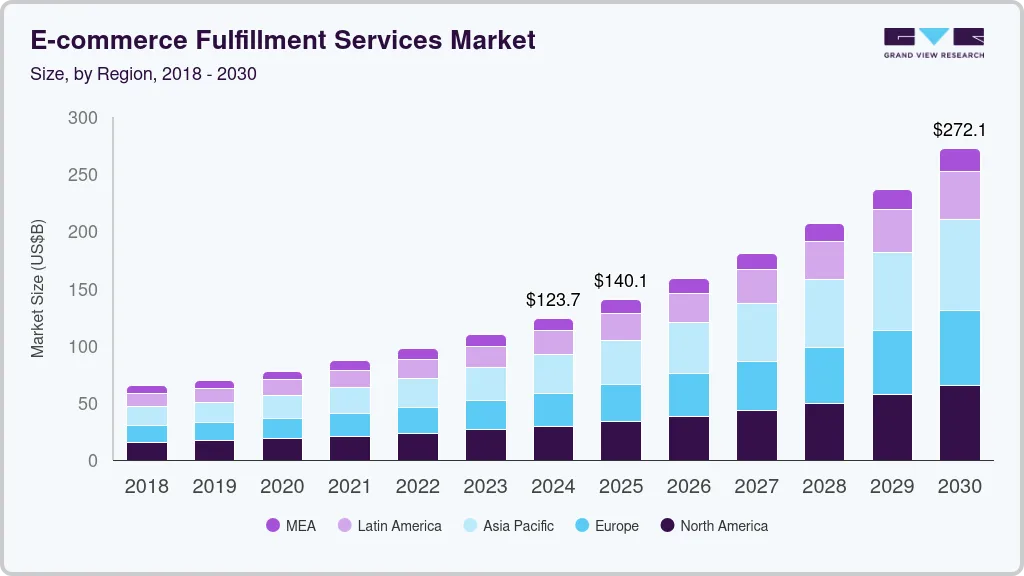
The global e-commerce fulfillment services market size was estimated at USD 123.68 billion in 2024 and is projected to reach USD 272.14 billion by 2030, growing at a CAGR of 14.2% from 2025 to 2030. (Grand View Research)
1. Automation and AI
One of the most powerful fulfillment trends is the adoption of automation and AI systems. According to one report, 73% of global organisations are already using automated technologies, and in ecommerce fulfillment settings, adoption of picking machines, guided vehicles and goods-to-person systems can reduce error rates by up to 67%. (Global Banking and Finance)
This implies that companies must invest in smart systems now if they’re to compete in the future. For example, in October 2024, Amazon opened a next-generation fulfillment center that features innovative technologies like AI and robotics. The company estimated that this next-gen fulfillment center, with advanced technology, eases tasks for employees and improves operational safety.
Key applications:
- Robotic systems (AMRs, robotic arms) for picking/packing/sorting
- AI-driven demand forecasting and inventory management
- Zero-touch fulfilment (end-to-end automation)
- Integration of warehouse management systems, conveyor/sortation, cloud platforms
Innovations now extend beyond the warehouse to directly enhance the customer interface.
- Augmented & Virtual Reality (AR/VR): Allows customers to visualize products, such as trying on clothes or placing furniture in their homes, reducing return rates.
- Voice and Social Commerce: Optimizing platforms for voice-enabled search and integrating direct purchasing via social media are becoming essential engagement channels.
- Flexible Payment Options: Digital wallets, biometric authentication, and “Buy Now, Pay Later” (BNPL) solutions provide convenience and reduce cart abandonment.
2. Hyper-local & Micro-Fulfillment Centres
Speed matters. The faster you can fulfil, the better your customer experience and competitive edge. The trend of micro-fulfilment centres, small, strategically located warehouses closer to the customer is on the rise. One source predicts that same-d ay and next-day delivery will capture significant market share by 2025.
Moreover, the 2025 report from ShipBob found 38% of brands plan to increase the number of fulfilment centres they ship from in 2025.
For companies, this means evaluating network design: how many centres, where located, how inventory is placed across them.
3. Omnichannel Integration and Digital Visibility
Visibility into the fulfilment process from order placed, to picked, packed, shipped, and delivered is no longer optional. According to the DHL E-Commerce Trends Report 2025, 81% of shoppers say delivery remains a key conversion killer when their preferred options are missing.
Customers expect a seamless experience across all shopping channels.
- Unified Systems: Integrated Order Management Systems (OMS) provide a single view of inventory across online and offline channels, enabling flexible options such as Buy Online, Pick Up In-Store (BOPIS) or ship-from-store.
- Real-Time Order Tracking: End-to-end live tracking builds trust and improves the overall customer experience.
- Blockchain for Transparency: Blockchain ensures traceability and transparency across the supply chain, giving customers confidence in product authenticity and ethical sourcing.
Retail customers don’t shop only online or only in-store, they expect flexibility. For companies engaging in both digital and physical channels, the need to support Buy-Online-Pick-Up-In-Store (BOPIS), curbside pickup, ship-from-store, and marketplace fulfilment is growing. The ShipBob report shows that over 56% of brands sell on 3 or more channels today.
Supporting multiple fulfilment options makes the operation more complex, but these are rapidly becoming benchmarks of good customer experience.
Customer Experience and Personalisation
4. Personalisation
In a world of choice, the fulfilment experience becomes part of the brand experience. According to ShipBob’s report, 64% of brands leverage some form of customisation (branded packaging, marketing inserts, etc.).
Tailoring fulfilment elements, packaging, delivery windows, notifications based on customer data can deepen satisfaction and loyalty.
5. Improved Returns Management
Returns are part of the new reality of retail-fulfilment. According to DHL’s 2025 study: globally, 66% of shoppers returned unwanted items via parcel lockers or parcel shops.
Streamlining returns through label-free, box-free options, optimised reverse logistics, and integration with the fulfilment strategy is a key competitive edge.
Supply-Chain and Strategy
6. Supply Chain Resilience and Diversification
The global fulfilment ecosystem is under pressure, from labour challenges to geopolitical constraints, inflation, and changing consumer behaviour. Diversifying supplier bases, regional sourcing, and designing more agile fulfilment networks is critical. For example, ShipBob found 36% of brands plan or are planning international expansion in 2025.
Companies should consider multi-region inventory placement, buffer strategies for peak seasons, and contingency plans for disruptions.
7. Sustainability
Today’s consumer expects brands to show environmental responsibility. One article from Global Banking & Finance notes that 80% of consumers consider sustainability when choosing a retailer.
The DHL report highlights that 1 in 3 shoppers drop out due to sustainability concerns in delivery.
Sustainable fulfilment strategies include eco-friendly packaging, optimised delivery routing (to reduce carbon emissions), partnering with carriers using electric vehicles, and leveraging inventory systems to reduce waste.
8. Data-Driven Decisions
With vast amounts of fulfilment, inventory, shipping and returns data flowing through systems, companies must use analytics to optimise decisions. Whether it’s demand forecasting, inventory placement, picking productivity, or delivery performance, a data-driven approach is non-negotiable. Reports on e-fulfilment emphasise that real-time data and analytics are key enablers of advanced fulfilment operations.
Organisations should build or partner (to advanced tech partner like Kyanon Digital) to acquire dashboards, KPI-tracking, and machine-learning capabilities to continuously improve.
In summary, the overarching goal of ecommerce fulfillment trends is for businesses to deliver faster, smarter, more transparent, personalised and sustainable fulfilment experiences. For companies exploring fulfilment solutions, the message is clear: don’t just optimise for cost.
Optimise for customer experience, flexibility, resilience and future readiness.
How to activate these E-commerce fulfillment trends
Here are direct actions and questions you should ask as you evaluate E-commerce fulfilment solutions:
- Audit your current fulfilment network – how many centres? Where are they located relative to your major customer clusters?
- Evaluate your automation maturity – are you still largely manual in picking, packing, sorting? What’s the error rate and labour cost per order?
- Invest in fulfilment visibility – do you provide end-to-end tracking? Can you integrate carrier APIs, inventory systems and customer notifications?
- Map for omnichannel flexibility – can orders flow freely between online, mobile, physical store, marketplace? Do you support BOPIS, ship-from-store?
- Design for returns excellence – how easy is it for customers to return items? What’s your reverse logistics cost and time?
- Embed sustainability – what packaging are you using? How many delivery miles are you adding per order? What’s your carbon footprint and how could logistics optimisation reduce it?
- Use predictive analytics – do you forecast demand by SKU, region and channel? Are you using AI/ML demand-forecasting tools to optimise inventory placement and reduce stockouts or excess stock?
- Build resilience – are you dependent on a single region, channel or supplier? What is your backup strategy?

Why choose Kyanon Digital as your partner for E-commerce fulfillment services
At Kyanon Digital, we specialise in helping companies transform not just their marketing or software, but their full digital operations, including fulfilment-oriented systems. We’ve supported clients in:
- Designing fulfilment-centric e-commerce architectures (OMS, WMS, inventory systems)
- Integrating AI and analytics into fulfilment strategy
- Building omnichannel fulfilment flows and digital dashboards for supply-chain visibility
- Embedding sustainability metrics and operations into fulfilment workflows
Case study of Kyanon Digital: Transforming Retail Operations – Integrated Omnichannel Fulfillment & Transportation Management Solution
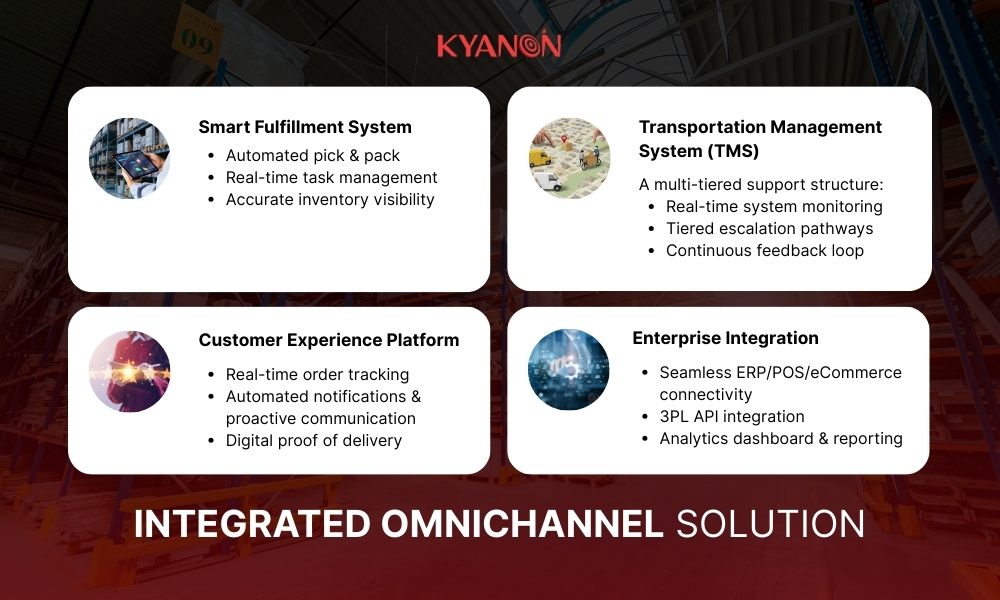
The client is a leading multi-format retail corporation operating across fashion, electronics, food, and lifestyle sectors. With an extensive network of shopping malls, supermarkets, and specialty stores, the client serves millions of consumers across multiple markets and sought to modernize their fulfillment and logistics operations to meet growing omnichannel demands.
Kyanon Digital implemented an integrated omnichannel solution: a smart fulfilment system with automation, a Transportation Management System (TMS) with AI route‑/load‑optimization, and a customer‑experience platform with real‑time tracking and proof of delivery.
Results in 12 months: faster order processing, lower errors, cost reductions in transport/inventory/labour, improved customer satisfaction, and a scalable foundation for growth.
Read the full case study HERE.
Get ready for the future of E-commerce fulfillment
The era of “just ship the order” is over. The future belongs to companies that build fulfilment as a strategic asset, not a cost centre. By focusing on automation & AI, hyper-local fulfilment, personalisation, omnichannel flexibility, sustainability, and data-driven operations, businesses can meet both current demands and future expectations.
As you consider your fulfilment strategy, ask not only “can we fulfil?” but “can we fulfil in a way that delights, differentiates and scales?” That’s the real promise of ecommerce fulfilment trends.
Contact Kyanon Digital if you’d like to dive deeper into any of these areas, be it AI-forecasting for fulfilment, micro-fulfilment centre strategy, or sustainability in supply-chain operations.