
Education app development in Hong Kong in 2026 requires AI integration, PDPO compliance, and mobile-first architecture to meet Education Bureau standards. Investment ranges from USD 40,000 for MVP validation to USD 300,000+ for AI-driven learning ecosystems, with hybrid Vietnam-based engineering models delivering 30–50% cost efficiency over local teams.
The education app development market in Hong Kong has reached a mature and highly competitive stage. Demand is driven by both local and international school systems that require scalable, digital-first learning environments.
Educational app development in Hong Kong is currently focused on AI integration and STEM-centric curricula, supported by significant government funding for 2026. Schools are actively seeking interactive, AI-powered solutions to meet new Education Bureau (EDB) standards and exam transitions.
Key takeaways
- Hong Kong’s EdTech market is mature and highly competitive, requiring AI-driven, mobile-first education app development.
- Education apps are strategic assets that drive revenue, efficiency, and brand positioning.
- AI features like personalized learning and automation are now essential, not optional.
- Hybrid models deliver faster time-to-market with 30 to 50 percent cost efficiency.
- The right partner must offer product strategy, AI capability, and scalable architecture.
- Early adopters gain a strong competitive advantage.
Further reading:
- Top Dedicated Development Teams for Hong Kong
- Top AI Consulting Firms for Hong Kong Enterprises
- Partnering with Singapore agencies for Hong Kong IT Support
Why traditional education models in Hong Kong are losing competitive edge?
Traditional education models in Hong Kong are facing a decline in competitive edge as they struggle to adapt to a global economy that increasingly values innovation, agility, and specialized technical skills over the rote memorization historically emphasized in the region. (eCampusNews)
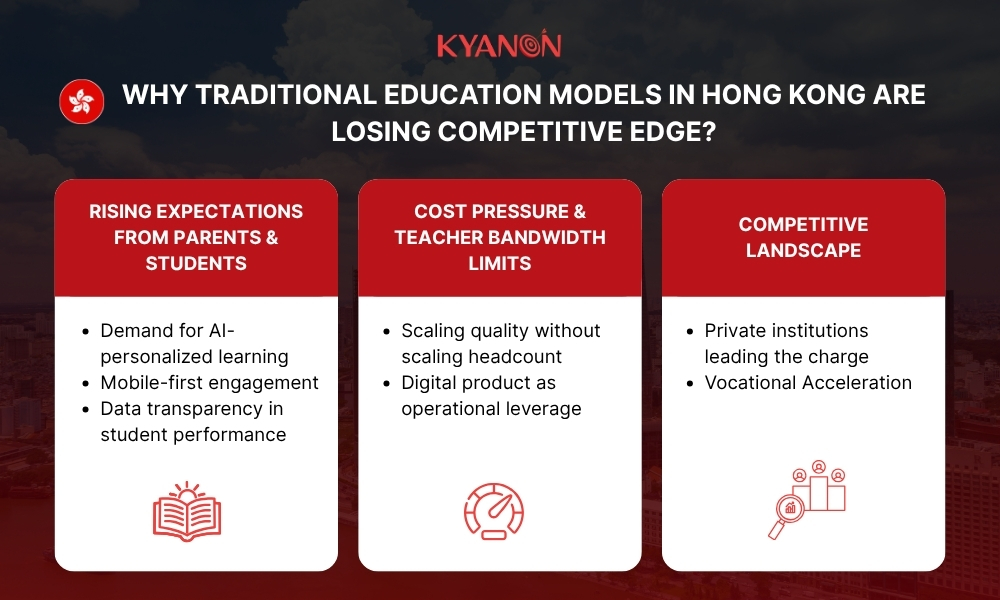
Rising expectations from parents & students
The modern Hong Kong parent is no longer satisfied with just “good grades”; they want efficient, data-driven progress.
- Demand for AI-personalized learning: In a city known for high-pressure exams (DSE, IB), parents want precision. AI can identify a student’s specific weak points in math or English and provide targeted drills, replacing the “one-size-fits-all” homework packet.
- Mobile-first engagement: Students today are “digital natives.” If learning materials aren’t accessible on a tablet or smartphone during a MTR commute, they aren’t being used. Traditional models that rely on physical textbooks feel clunky and disconnected from a student’s lifestyle.
- Data transparency in student performance: Parents want real-time dashboards, not just a mid-term report card. They expect to see “time spent on task,” “accuracy rates,” and “learning curves” instantly through an app.
Cost pressure & teacher bandwidth limits
The “human-only” teaching model is becoming financially and operationally unsustainable.
- Scaling quality without scaling headcount: Hiring top-tier educators in Hong Kong is expensive. Digital platforms allow institutions to deliver high-quality content to 1,000 students as easily as 10, without needing to hire 50 more teachers.
- Digital product as operational leverage: Much of a teacher’s time is wasted on administrative “drudge work”, grading multiple-choice tests, tracking attendance, and distributing handouts. By automating these via an app, teachers can focus on high-value mentoring and emotional support.
Competitive landscape
The gap between the “digital haves” and “have-nots” is widening.
- Private institutions leading the charge: International schools and elite tutoring centers are investing heavily in custom LMS (Learning Management Systems). These platforms create a “sticky” ecosystem that makes it harder for parents to leave.
- Vocational Acceleration (e.g., VTC): Organizations like the Vocational Training Council (職業訓練局) are aggressively adopting VR, AR, and mobile simulations to train the next generation of technical talent. Traditional schools that stick to theory-only models are falling behind in career readiness.
If you are not investing in education app development now, you are competing with outdated infrastructure.
What education app development should deliver for a Hong Kong Institution
To position an education app as a high-value asset for a Hong Kong institution, the focus must shift from “technical features” to Return on Investment (ROI). In a city with high operational costs and a saturated tutoring market, a digital product must either make money or save money.
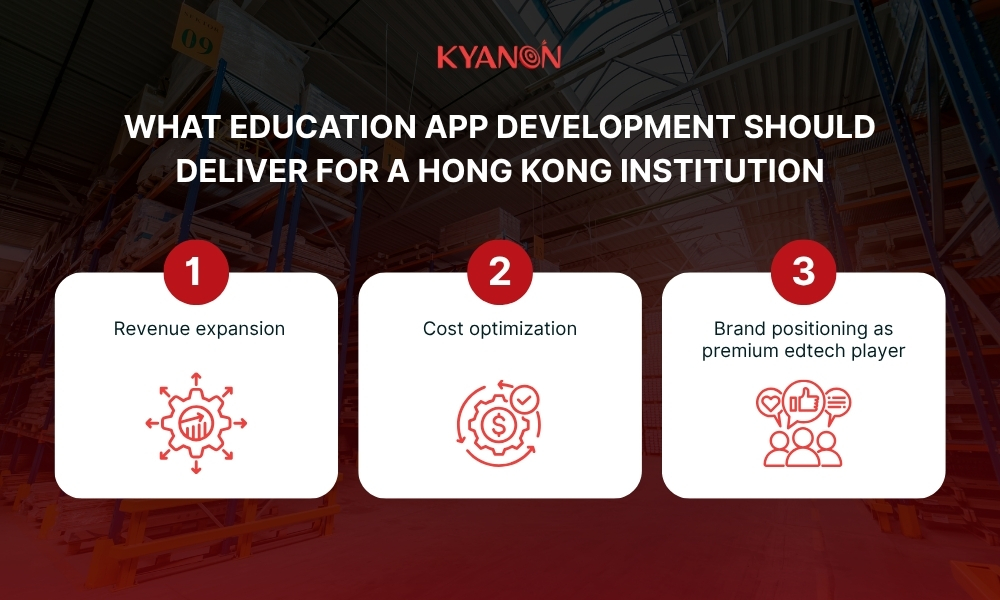
Revenue expansion
An app should not just be a digital textbook; it should be a new revenue stream.
- Subscription-based learning model: Move away from one-off term fees. A mobile app allows for “low-friction” monthly recurring revenue (MRR) through tiered access to premium content, mock exams (DSE/IB), or AI-tutor bots.
- Hybrid offline–online model: Maximize physical space by moving “theory” lessons to the app (asynchronous learning) and reserving expensive HK classroom real estate for high-value “practicals” or interactive workshops.
- Licensing curriculum digitally: If an institution has a proprietary teaching methodology, a polished app allows them to “franchise” or license that curriculum to other schools or learning centers across the Greater Bay Area (GBA) without sending physical staff.
Cost optimization
Efficiency is the only way to survive Hong Kong’s rising labor costs.
- AI-Assisted Assessment: Automate the grading of objective tests and provide AI-generated feedback for open-ended essays. This reduces the hundreds of “marking hours” teachers face during peak exam seasons.
- Automated Progress Tracking: Instead of manual report cards, the app generates real-time analytics. This keeps parents informed automatically, reducing the need for constant phone calls and admin follow-ups.
- Reduced Administrative Workload: Features like digital attendance (via QR or Geo-fencing), automated scheduling, and in-app tuition payments remove the need for a large front-desk administrative team.
In the HK market, “looking modern” is a signal of quality.
- Modern UX as competitive differentiator: A clunky, slow website feels “cheap.” A sleek, intuitive mobile UX (User Experience) signals that the institution is prestigious, forward-thinking, and worth a premium tuition fee.
- AI-driven adaptive learning as USP: “Personalized learning” is the biggest buzzword in HK education. By delivering an algorithm that adapts difficulty based on student performance, the institution gains a Unique Selling Proposition (USP) that traditional “lecturer-on-a-stage” models cannot match.
2026 investment benchmarks: What serious players are spending
In the 2026 Hong Kong education market, price is no longer just a “vendor quote” – it is a strategic capital allocation. Serious players have moved away from looking for the “cheapest developer” and are instead investing based on the specific business outcome they want to achieve.
Here are the 2026 Investment Benchmarks for education app development in Hong Kong:
| Level | Investment Range (USD) | Strategic Intent |
| MVP Validation | $40k – $70k | Ideal for boutique tutoring centers or niche K-12 programs looking to digitize a specific proprietary method and gather user data before a full rollout. |
| Growth Platform | $80k – $150k | Designed for established institutions ready to support 5,000+ concurrent users with robust LMS integration, automated billing, and cross-platform (iOS/Android/Web) parity. |
| AI-Driven Ecosystem | $180k – $300k+ | For top-tier schools or vocational bodies (like VTC) building a “Digital Twin” of their campus. Includes AI-tutors, predictive analytics for student retention, and deep integration with HK EdCity. |
When discussing these figures with stakeholders, it is critical to shift the language:
- This is not “App Development HK Cost”: That is a commodity mindset that leads to “technical debt” and broken systems within 18 months.
- This is Capital Allocation toward Long-Term Digital Infrastructure: Just as an institution would invest in a new physical campus or a high-end laboratory, these benchmarks represent the foundational infrastructure required to remain solvent and competitive in a post-AI education economy.
Build in-house vs outsource: What makes financial sense in Hong Kong?
For Hong Kong educational institutions, the “In-House vs. Outsource” debate is no longer about preference, it’s about fiscal survival. In a city where prime office space and specialized talent carry a massive premium, the traditional in-house model is becoming a strategic liability.
Here is why forward-thinking HK players are shifting toward a sophisticated Hybrid Model.
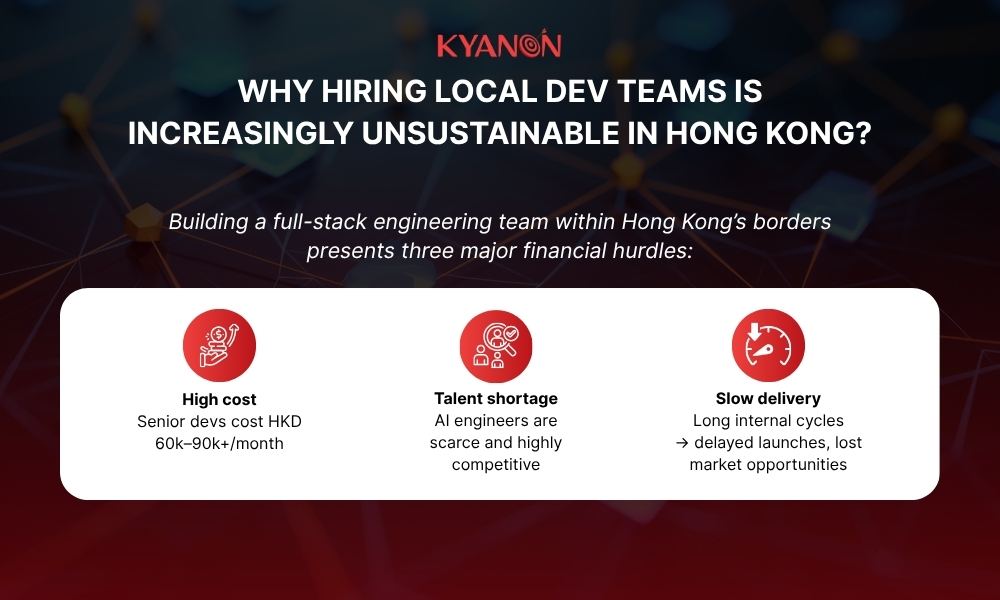
Why hiring local dev teams is increasingly unsustainable
Building a full-stack engineering team within Hong Kong’s borders presents three major financial hurdles:
- Senior Dev Salaries in HK: A senior developer in Hong Kong now commands HKD 60k–90k+ per month. When you factor in MPF, office overhead, and recruitment fees, the “fully loaded” cost of a 5-person team can easily exceed HKD 5M annually, before a single line of code is written.
- AI Engineer Scarcity: There is a massive talent gap for engineers who actually understand LLM orchestration and vector databases. Competition from the fintech and banking sectors makes it nearly impossible for schools or tutoring centers to outbid for top-tier AI talent.
- Slow Iteration Cycles: In-house teams often get bogged down in internal meetings and legacy IT support. In the fast-moving EdTech space, a “slow” 12-month launch window means your competitors have already captured the market.
The hybrid model (Regional strategy, Vietnam-based engineering)
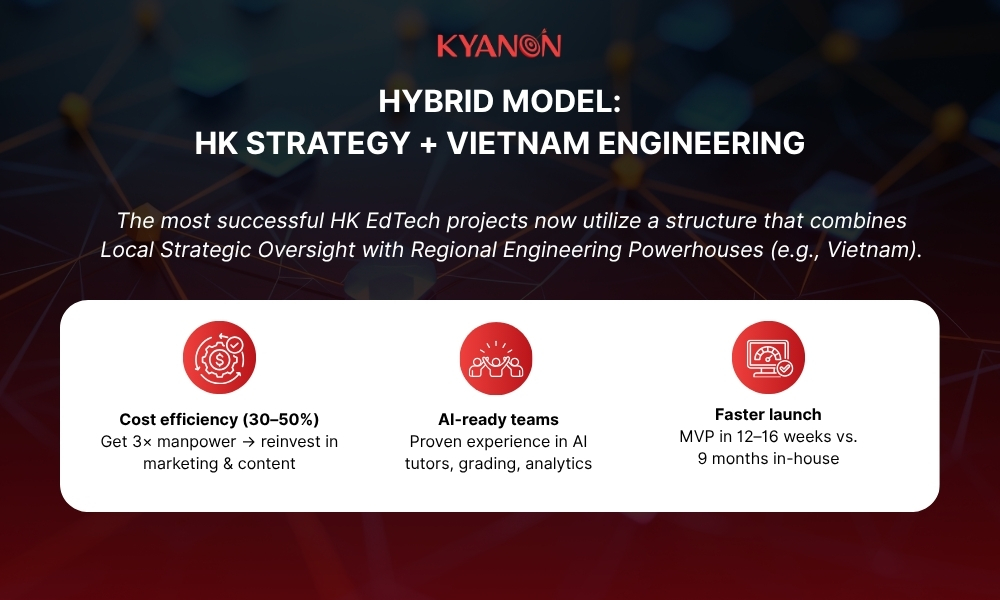
The most successful HK EdTech projects now utilize a structure that combines Local Strategic Oversight with Regional Engineering Powerhouses (e.g., Vietnam).
- Cost efficiency (30–50% optimization): By leveraging high-quality engineering hubs in Vietnam, institutions can access 3x the manpower for the same budget. This allows you to reallocate saved capital toward marketing, content creation, and teacher training.
- AI-native teams from day one: Regional hubs (like Vietnam’s burgeoning tech scene) have pivoted faster to AI-native development. You aren’t just hiring “coders”; you are hiring teams already experienced in building AI tutors, automated grading, and predictive analytics.
- Faster time-to-market: Specialized regional partners operate on “sprint-based” delivery models. What takes an in-house team 9 months can often be delivered as a robust MVP in 12–16 weeks.
Strategic positioning: Not “cheap labor,” but “optimized architecture”
This is not about “cutting corners”, it is about Strategic Structure. Keep your Product Owners and Subject Matter Experts (SMEs) in Hong Kong to ensure cultural and pedagogical alignment. Outsource the Heavy Engineering and AI Infrastructure to regional experts who live and breathe high-scale deployment.
In 2026, a “Hong Kong-only” dev team is a luxury few can afford and even fewer can justify. The hybrid model is the only way to achieve institutional transformation without bankrupting the operational budget.
What a reliable education app development partner must provide
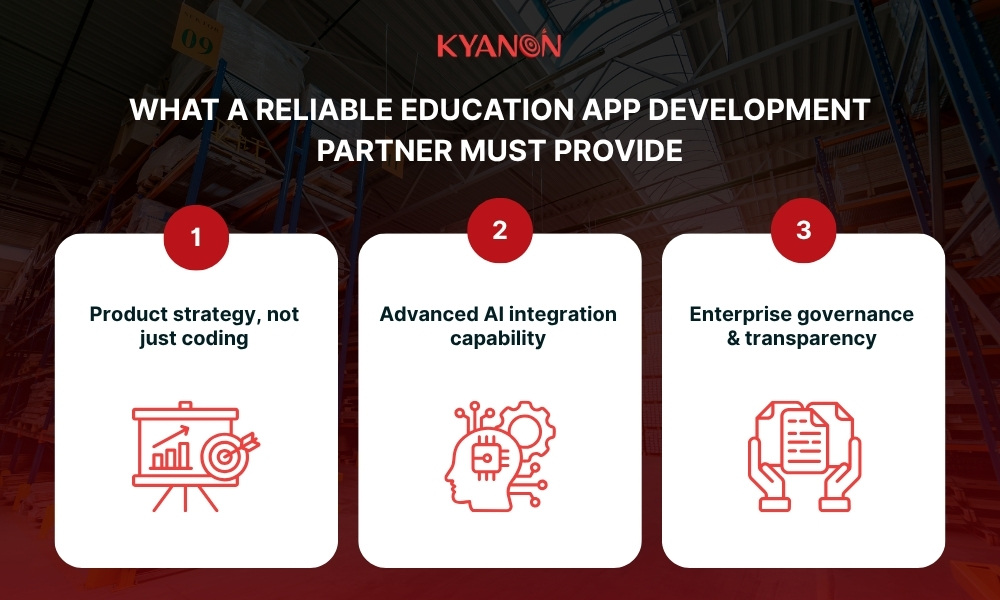
A reliable education app development partner in Hong Kong must act as a strategic consultant, not just a software vendor. In the high-stakes HK education market, “building an app” is easy; building a sustainable digital institution is where most vendors fail.
To be truly reliable, a partner must deliver across these four critical pillars.
Product strategy, not just coding
A vendor that only asks for “features” is a liability. A partner should provide:
- Curriculum mapping: Ensuring your digital pedagogy aligns with Hong Kong’s educational standards (e.g., DSE or IB frameworks) so the app actually improves learning outcomes.
- Learning flow & engagement design: Applying gamification and UI/UX principles specifically for students to ensure they don’t just download the app, but use it daily.
- Monetization architecture: Designing the “plumbing” for recurring revenue, integrating local payment gateways like FPS (Faster Payment System), Octopus, or Stripe for subscription models.
Advanced AI integration capability
In 2026, “standard” apps are obsolete. A reliable partner must offer:
- AI tutor modules: Building 24/7 guided learning bots that can answer student queries in Cantonese and English, reducing the burden on human teachers.
- Adaptive recommendation engines: Algorithms that analyze a student’s performance in real-time to suggest the “Next Best Action” or specific remedial exercises.
- Secure data architecture: Full compliance with the PDPO (Personal Data Privacy Ordinance) and international standards like GDPR to protect sensitive student records.
Enterprise governance & transparency
Institutional projects fail when communication breaks down. A partner must provide:
- Agile sprint transparency: Real-time access to project management tools (like Jira or ClickUp) so you see progress every week, not just at the end of the month.
- SLA and long-term maintenance: A clear Service Level Agreement ensuring 99.9% uptime and rapid response times (e.g., 4-hour critical bug fixes) during exam seasons.
- Scalable system architecture: Building on cloud infrastructure (AWS/Azure/GCP) that can handle 500 users today and 50,000 users next year without a total rewrite.
Most app development vendors in Hong Kong fall short because they build features, not platforms. A “feature-builder” gives you a button; a “platform-partner” gives you a scalable digital asset that grows your revenue and protects your brand reputation.
Why forward-thinking institutions choose a regional partner
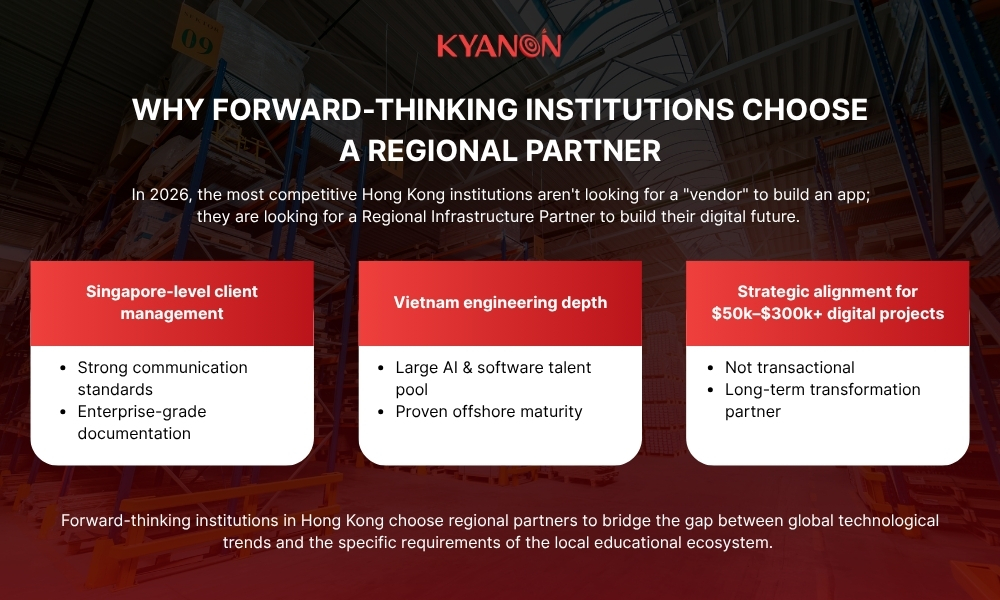
Forward-thinking institutions in Hong Kong choose regional partners to bridge the gap between global technological trends and the specific requirements of the local educational ecosystem. (HKTDC Research). In 2026, the most competitive Hong Kong institutions aren’t looking for a “vendor” to build an app; they are looking for a Regional Infrastructure Partner to build their digital future.
Singapore-level client management
For a Hong Kong institution, communication and reliability are non-negotiable. A regional partner with Singaporean management standards provides:
- Strong communication standards: Professional English and Chinese fluency combined with a “no-surprises” management style. They understand the high-stakes nature of HK academic calendars and enrollment cycles.
- Enterprise-grade documentation: Comprehensive technical specs, security audits, and compliance mapping (PDPO/GDPR). This ensures that if your IT head or Board of Directors asks for a “system architecture diagram,” it is delivered to a global professional standard.
Vietnam engineering depth
While Hong Kong faces a severe developer shortage, Vietnam has evolved into a global powerhouse for specialized EdTech engineering.
- Large AI & software talent pool: Vietnam produces over 50,000 tech graduates annually. Regional partners tap into this pool to find engineers who specialize specifically in LLM orchestration (AI Tutors) and Data Science, which are nearly impossible to source affordably in HK.
- Proven offshore maturity: Unlike “raw” outsourcing, these teams have spent a decade building complex systems for global markets. They don’t just “write code” – they understand Scalable System Architecture and Auto-scaling Cloud Infrastructure (AWS/Azure).
Strategic alignment for $50k–$300k+ digital projects
At this investment level, the relationship must be consultative, not transactional.
- Not transactional: A regional partner doesn’t just “finish the project and leave.” They act as a fractional CTO, advising on how to integrate the app with your existing School Information Systems (SIS).
- Long-term transformation partner: They focus on Product Roadmap (Year 1: MVP; Year 2: AI Personalization; Year 3: GBA Expansion). This ensures your $150k investment is a foundation, not a dead-end “one-off” app.
Implementation roadmap for Hong Kong education leaders
To transition from a traditional model to a digital-first institution, Hong Kong leaders need a structured timeline that balances speed-to-market with regulatory safety.
Here is the 5-phase roadmap for a successful 2026 deployment.
| Phase | Focus | Key Deliverables | Timeline |
| 1. Digital Capability Audit | Discovery & Compliance | SIS/LMS integration audit, PDPO privacy review, & stakeholder pain-point mapping. | Weeks 1–3 |
| 2. AI-Driven Blueprint | Strategic Design | High-fidelity UX/UI prototypes, AI tutor logic, & local payment (FPS/Octopus) architecture. | Weeks 4–6 |
| 3. MVP Build | Core Engineering | Development of “must-have” features via Agile sprints and security hardening (encryption). | Months 3–5 |
| 4. Pilot & Optimization | Local Validation | Beta launch with a select student group, Cantonese AI-tutor accuracy tuning, & bug patching. | Weeks 16–22 |
| 5. Regional Scaling | Expansion | Full enrollment rollout, GBA (Greater Bay Area) infrastructure prep, & advanced predictive analytics. | Month 6+ |
In the Hong Kong market, skipping Phase 1 (Audit) usually leads to expensive “integration debt” later, while rushing Phase 4 (Pilot) risks permanent brand damage among a vocal parent community.
Top education app development partners for Hong Kong
Finding the right education app development partner in Hong Kong requires a balance of local compliance expertise (PDPO), pedagogical understanding, and technical depth. As of early 2026, the following agencies are recognized for their work in the Hong Kong EdTech and mobile development sectors.
Kyanon Digital
Kyanon Digital is a Vietnam-based leading Digital & Technology Company empowering businesses to achieve Growth and Impact through Completed Technology Solutions in the Asia-Pacific region, specializing in high-performance EdTech and AI solutions. Kyanon Digital helps Hong Kong institutions build scalable learning ecosystems by combining Singapore-grade strategic management with Vietnam’s deep engineering talent.
- Website: https://kyanon.digital/
- Founded: 2012
- Team size: 500+ (Vietnam, Singapore, Thailand)
- Pricing tier: $25–$49/hr
- Key clients: Regional educational providers, international schools, and fast-growing EdTech startups.
Strengths:
- AI-Native Engineering: Expertise in building AI tutors, automated grading engines, and adaptive learning pathways.
- Regional Hybrid Model: Provides Hong Kong institutions with high-muscle engineering depth at an optimized cost-to-quality ratio.
- Scalable Architecture: Specializes in cloud-native platforms capable of handling massive concurrent student users during peak exam periods.
- End-to-End Delivery: From pedagogical UX design to complex LMS/SIS integrations and PDPA-compliant data security.
Case study: Building An AI-Powered English Learning Solution With Kyanon Digital
Challenges
- Limited access to quality English education, especially in underserved areas
- One-size-fits-all learning causes low engagement and high dropout
- No real-time feedback on pronunciation and grammar
- Payment barriers due to local wallet-based ecosystem
- Need for a scalable, personalized, mobile-first solution
Solutions
- Built an AI-powered mobile learning app with adaptive placement tests and personalized learning paths
- Integrated speech recognition & NLP for real-time pronunciation and grammar feedback
- Applied gamification (streaks, badges, leaderboards) to boost engagement
- Developed microservices architecture for scalability
- Enabled localized payments (Wave Pay, KBZ Pay)
- Implemented a CMS for content management & localization
Impact
- MVP launched in about 6 months, enabling fast go-to-market
- Improved learner engagement and progression through AI personalization
- Enabled scalable learning without increasing operational cost
- Achieved seamless monetization via local payment integration
- Validated product-market fit and established a foundation for expansion
Explore the full case study here: Building An AI-Powered English Learning Solution With Kyanon Digital
Note: While this project was deployed in Southeast Asia, the AI architecture and scalability principles apply directly to Hong Kong’s education market.
keysoc Limited
A leading home-grown Hong Kong mobile app developer recognized for creating award-winning digital experiences that blend education with local lifestyle. keysoc is a go-to partner for institutions looking to engage the local HK community through creative and functional mobile solutions.
- Website: www.keysoc.com
- Founded: 2013
- Team size: 50–100 (Hong Kong)
- Pricing tier: $50–$99/hr
- Key clients: D‧PARK, local HK schools, and major regional corporate training departments.
Strengths:
- Hyper-Local Expertise: Deep understanding of the Hong Kong educational landscape, Cantonese linguistic nuances, and local user behavior.
- Creative Engagement: Strong focus on “Gamified Learning” and Multiple Intelligence (M.I.) frameworks to drive student retention.
- Award-Winning UX: Consistently recognized for high-quality interface designs that resonate with both parents and students in HK.
- Local Support: Offers immediate, same-timezone technical support and on-site consultation for HK-based stakeholders.
Hyperlink InfoSystem

A global software development giant with a significant presence in Hong Kong, specializing in large-scale e-learning platforms and AI-driven automation. They offer extensive resources for institutions requiring rapid scaling and high-volume data processing.
- Website: www.hyperlinkinfosystem.com
- Founded: 2011
- Team size: 1,200+ (Global, with HK office)
- Pricing tier: < $25/hr
- Key clients: Global educational bodies, large-scale vocational training providers, and enterprise-level corporations.
Strengths:
- Massive Resource Pool: Ability to deploy large dedicated teams quickly to meet aggressive “Growth Platform” launch deadlines.
- Cost-Efficient Scaling: Highly competitive pricing for complex features like AI chatbots, video streaming, and virtual classrooms.
- Broad Tech Stack: Proficiency across all major mobile and web frameworks, ensuring compatibility with any existing school infrastructure.
App Maisters
An innovative US-based developer with a strong Hong Kong footprint, focusing on “Intelligent Transformation” for the education sector. App Maisters specializes in integrating advanced technologies like IoT and AI into the learning experience.
- Website: www.appmaisters.com
- Founded: 2014
- Team size: 50–249 (US, HK, Pakistan)
- Pricing tier: $50–$99/hr
- Key clients: Research institutions, e-learning startups, and specialized technical schools.
Strengths:
- Intelligent Features: Market leader in AI-enhanced learning tools, including voice-command assessments and automated feedback loops.
- Data-Centric Design: Strong focus on predictive analytics to help institutions track student progress and intervention needs.
- Modernization Expertise: Skilled at transforming “Legacy” school systems into modern, mobile-first cloud environments.
Apptisan
A boutique Hong Kong digital agency that excels at the intersection of high-end design and robust mobile engineering. Apptisan is a strategic choice for HK institutions that view their digital platform as a core part of their “Premium” brand identity.
- Website: www.apptisan.com
- Founded: 2014
- Team size: 10–50 (Hong Kong)
- Pricing tier: $100–$149/hr
- Key clients: Premium private tutoring centers, boutique schools, and luxury brands.
Strengths:
- Premium Visual Identity: Specializes in creating “white-glove” digital experiences that justify higher tuition or subscription fees.
- Strategic Consulting: Acts as a product partner, helping leaders define their USP before moving into the development phase.
- Agile and Personal: Offers a high-touch boutique experience where senior leadership remains involved in every project phase.
Legato Technologies

A reliable and technically grounded Hong Kong developer known for delivering stable, functional enterprise-level mobile applications. Legato focuses on the “plumbing” of education apps, ensuring they are secure, scalable, and easy to maintain.
- Website: www.legato.co
- Founded: 2011
- Team size: 10–50 (Hong Kong)
- Pricing tier: $50–$99/hr
- Key clients: Government-linked projects, NGOs, and traditional HK educational institutions.
Strengths:
- Operational Stability: Excellence in back-end engineering, ensuring apps perform reliably during high-traffic enrollment periods.
- Government Compliance: Deep experience navigating the strict procurement and security standards of HK public-sector projects.
- Maintenance Mastery: Offers robust long-term support packages (SLAs) to ensure apps remain functional through OS updates.
The blueprint for digital leadership in Hong Kong education
In 2026, the divide between Hong Kong’s educational leaders and laggards will be defined by their digital infrastructure. Traditional models are no longer just competing with each other; they are competing against AI-personalized, mobile-first ecosystems that offer superior transparency and efficiency.
Kyanon Digital offers the perfect strategic balance: Singapore-grade project management for total reliability and transparency, powered by Vietnam’s elite engineering depth to ensure your project remains cost-optimized and cutting-edge. Contact Kyanon Digital today to schedule a digital strategy consultation and see how we can turn your curriculum into a scalable, revenue-generating digital asset.