
Hong Kong businesses build offshore teams by combining Singapore-based governance with Vietnam engineering capacity, a model that reduces hiring risk, improves delivery speed, and lowers total cost by 40–60% compared to local-only teams. The most effective structure uses a dedicated managed model with embedded Delivery Manager oversight, not ad hoc staff augmentation.
In 2025, Hays reported that Hong Kong employers were still dealing with skill shortages linked to AI and automation, while ManpowerGroup found that 77% of employers across APAC struggled to find skilled talent, with IT the hardest-hit industry at 81%. That combination makes local-only hiring slower, more expensive, and less reliable for enterprises that need steady product delivery.
For many Hong Kong businesses, the issue is no longer whether offshore delivery is acceptable. The real question is how to structure it correctly: which model reduces execution risk, which region aligns best with governance needs, and how to scale without losing product control.
This blog presents that decision framework, with a focus on how regional enterprises are using Singapore governance and Vietnam engineering capacity to build offshore teams more safely and effectively.
Key takeaways
- Build offshore teams for capability, not only cost. The strongest offshore models are now used to access scarce AI, cloud, and product engineering skills, not just to cut payroll.
- Hong Kong local hiring is still constrained. Skill shortages, pay pressure, and retention challenges make single-market hiring less scalable for digital roadmaps.
- Dedicated offshore teams usually outperform ad hoc augmentation when the goal is long-term ownership, security, and predictable delivery.
- The Singapore-Vietnam model is attractive because it separates governance from execution. Singapore supports contract clarity and legal familiarity, while Vietnam provides engineering depth and better cost-to-seniority balance.
- Vietnam is often preferred over larger offshore markets when enterprises prioritize timezone overlap, communication quality, and lower geopolitical friction in regional delivery. This is partly an inference from regional legal, talent, and operating conditions.
- The right offshore setup depends on governance maturity. Businesses that lack strong delivery management, access control, KPI discipline, and onboarding standards usually struggle offshore regardless of location.
The HongKong talent gap: Why local-only hiring is slowing scalable businesses
A local-only hiring strategy works best when skill supply is deep, hiring cycles are short, and retention is stable. That is not the current reality for many digital businesses in Hong Kong.
Hays’ 2025 Asia Salary Guide says employers across Hong Kong and the region are still managing shortages tied to AI and automation, while KPMG’s 2025 Hong Kong Employment Outlook highlights continuing pressure on retention and compensation.
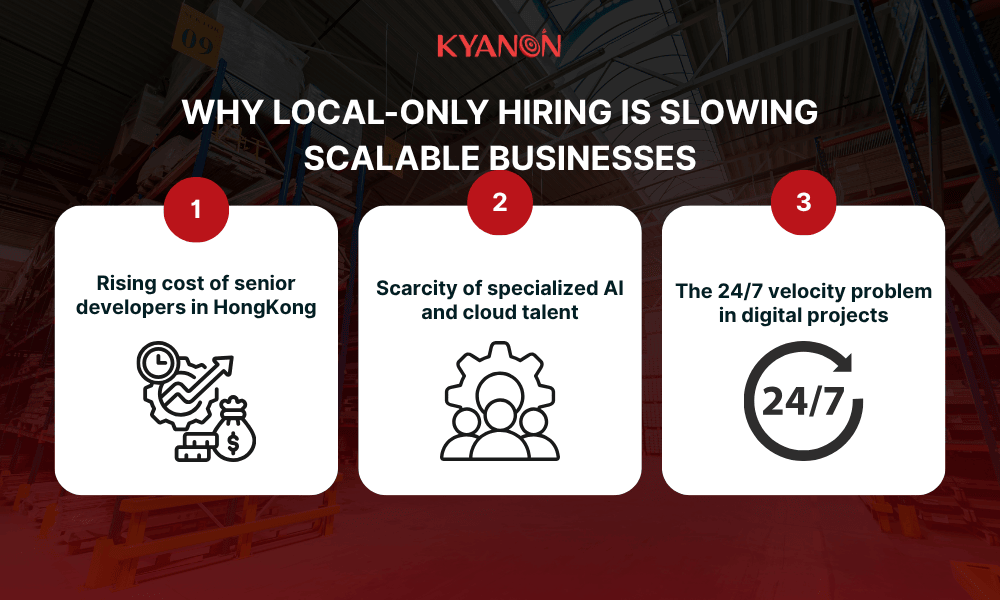
Rising cost of senior developers in HongKong
Hiring senior technical talent in Hong Kong has become one of the most expensive propositions in the Asia Pacific. Three dynamics are converging simultaneously:
- Premium salaries for Node.js, Python, and AI/ML engineers are being pushed upward by demand from global financial institutions, regional tech giants, and well-funded fintech startups, all competing for the same shallow pool of senior engineers.
- Extended hiring cycles averaging 60–120 days mean that by the time a role is filled, product timelines have already slipped.
- Competitive pressure: Local enterprises must compete with global tech giants and the finance sector for a limited pool of experts, such as Goldman Sachs, JPMorgan, Alibaba, and Google.
2026 salary benchmarks: Hong Kong software developers
|
Experience level |
Annual salary (USD) |
|
Junior / Entry Level (1–3 years) |
64,251 |
|
Average |
91,580 |
|
Senior Level (8+ years) |
104,644 |
Source: Salary Expert.
Scarcity of specialized AI and cloud talent
Demand for AI-native engineering talent in Hong Kong has significantly outpaced supply.
- AI-native product development requires niche skillsets: LLM integration, MLOps, vector database architecture that did not exist as standard roles three years ago.
- Fintech regulatory complexity (SFC compliance, HKMA requirements) adds a screening layer that further narrows the qualified candidate pool.
- Cloud specialization (AWS, GCP, Azure) combined with data engineering expertise commands salaries that most non-enterprise organizations cannot competitively offer.
The 24/7 velocity problem in digital projects
When product roadmaps depend on a small local team, execution speed becomes fragile.
- Hiring delays create release delays.
- One or two unfilled specialist roles can block architecture, QA, security review, or deployment.
- Growth-stage businesses lose time twice: first in recruitment, then in lost market response.
- For businesses operating on tight burn rates, the opportunity cost of delayed hiring often exceeds the cost of the offshore model itself.
Offshore as a growth engine, not just cost reduction
The offshore discussion has changed. Mature enterprises do not use offshore delivery only to lower headcount costs. They use it to expand capability, reduce dependency on one labor market, and increase execution resilience.
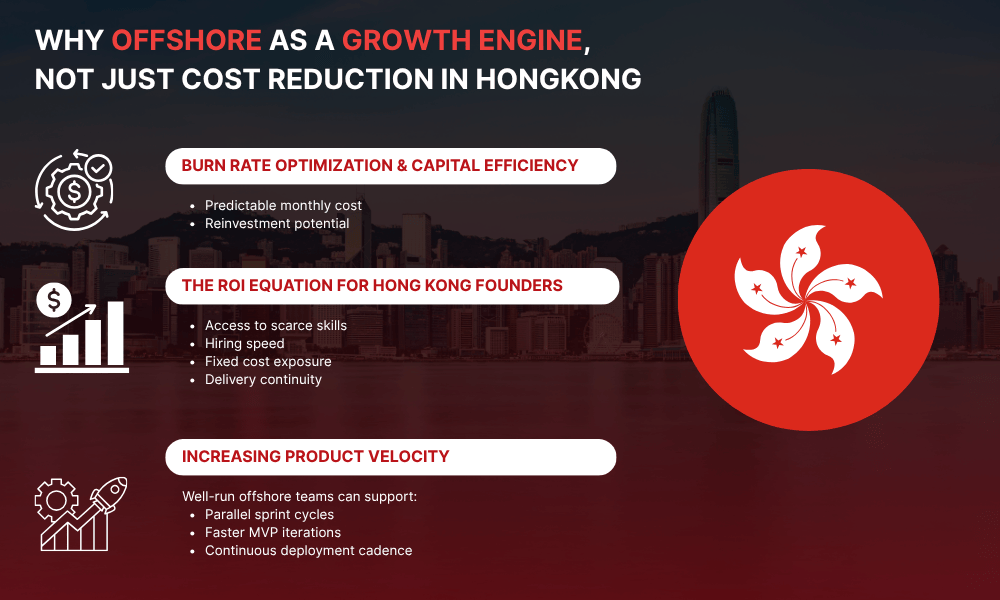
The ROI equation for Hong Kong founders
|
Decision factor |
Local-only model |
Offshore team model |
|
Access to scarce skills |
Narrower pool |
Broader regional pool |
|
Hiring speed |
Often slower |
Can be faster with pre-built recruitment channels |
|
Fixed cost exposure |
Higher |
More flexible monthly structure |
|
Delivery continuity |
Dependent on one market |
More diversified talent base |
Burn rate optimization and capital efficiency
For businesses operating with 12–24 month runways, the offshore model offers a structural advantage:
- Predictable monthly cost: No variable recruitment fees, no probation surprises, no sudden counter-offer attrition.
- Reinvestment potential: Capital saved on engineering costs can be redirected to growth channels: go-to-market, customer acquisition, product marketing.
Increasing product velocity with offshore collaboration
BCG’s 2025 GCC research found a sharp maturity divide and showed that only a small minority of capability centers had advanced strongly in innovation, differentiation, and efficiency.
The lesson is important: offshore works best when it is treated as a managed operating model with clear ownership and governance, not as overflow labor.
In practice, well-run offshore teams can support:
- Parallel sprint cycles allow product and engineering workstreams to run simultaneously across geographies.
- Faster MVP iterations with a dedicated team that owns delivery accountability, not just task execution.
- Continuous deployment cadence is achievable when the offshore team operates on shared tooling, sprint rituals, and communication standards from Day 1.
Offshore dedicated team vs staff augmentation: Choosing the right model
|
Dimension |
Staff augmentation |
Offshore dedicated team |
|
Governance depth |
Low, relies on client’s internal structure |
High, delivery manager embedded |
|
Cost predictability |
Variable |
Fixed monthly structure |
|
Scalability |
Moderate |
High, structured ramp-up |
|
Technical leadership |
Client-dependent |
Included in managed model |
|
Strategic ownership |
Limited |
Full team ownership of outcomes |
|
Risk profile |
Higher (no accountability layer) |
Lower (governance-first approach) |
|
Best for |
Short-term gap filling (< 6 months) | Long-term product development (12–24+ months) |
Staff augmentation
Use staff augmentation when:
- A business already has strong internal engineering management
- The need is temporary or role-specific
- Governance, architecture, QA, and sprint control already exist in-house
Risks:
- Fragmented accountability
- Higher coordination burden
- Knowledge loss when contractors rotate out
Offshore dedicated team (managed model)
Use a dedicated offshore team when:
- The roadmap is multi-quarter or multi-year
- The business needs a repeatable delivery engine
- The priority is not just staffing but operational continuity
Advantages:
- Clearer KPI structure
- More stable team formation
- Better cultural integration over time
- Easier planning for scaling up or down
The managed offshore model, where the partner provides delivery manager oversight, HR, infrastructure, and performance reporting, is the structure most aligned with enterprise-grade accountability.
Strategic decision matrix for HK businesses
|
Decision criterion |
Staff augmentation |
Offshore dedicated team |
|
Governance depth |
Lower |
Higher |
|
Cost predictability |
Medium |
Higher |
|
Scalability |
Medium |
Higher |
|
Technical leadership continuity |
Lower |
Higher |
|
Risk profile |
Higher if internal processes are weak |
Lower when governance is defined clearly |
Why Hong Kong leaders prefer the Singapore–Vietnam offshore model
Many Hong Kong businesses want two things at the same time: legal and commercial confidence, and strong engineering output. The Singapore-Vietnam model is attractive because it can separate those needs.
The Singapore governance advantage
Singapore remains credible for regional contracting because of its legal familiarity, judicial clarity, and business-friendly reputation.
Chambers notes that Singapore operates under a common law system with judicial power vested in its courts, while the 2025 World Justice Project said Singapore ranked 16th globally and performed strongly in regulatory enforcement and civil justice.
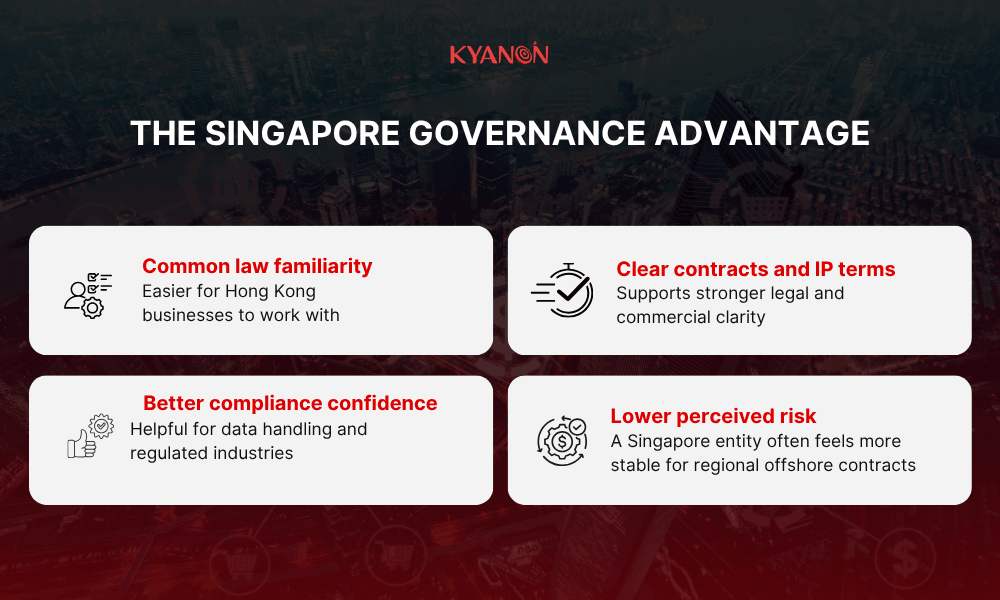
Singapore delivers:
- Strong legal framework aligned with common law principles familiar to HK businesses.
- Contract clarity, enforceable agreements, clear IP ownership language, and PDPA-aligned data handling.
- Financial compliance familiarity, Singapore’s MAS-regulated environment is well-understood by HK finance-adjacent businesses.
- Perceived regional stability, signing with a Singapore-registered entity, reduces perceived risk compared to contracting directly with a purely offshore vendor in a less familiar jurisdiction.
Vietnam is the engineering powerhouse
Vietnam’s emergence as a top-tier engineering destination in Southeast Asia is not accidental; it is the result of a decade-long STEM investment cycle now producing measurable output:
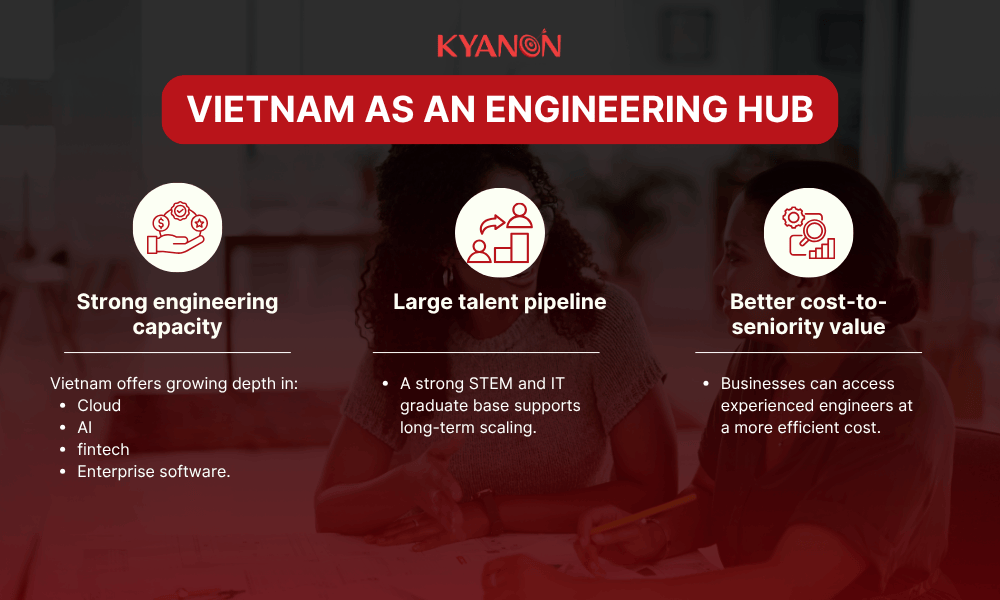
- Deep cloud, AI, and fintech expertise: Vietnamese engineering teams are increasingly operating at a senior level in cloud-native architectures, AI integration, and enterprise commerce platforms.
- Strong STEM pipeline: Vietnam produces approximately 55,000 IT graduates annually (Vietnam Ministry of Education and Training, 2024), with a growing proportion specializing in data science, AI, and cloud engineering.
- Competitive cost-to-seniority ratio: senior engineers in Vietnam deliver at a quality tier that matches or exceeds regional alternatives at a significantly lower total cost of ownership.
Time zone & operational synergy (HK–SG–VN triangle)
One of the most underappreciated advantages of this model is operational proximity:
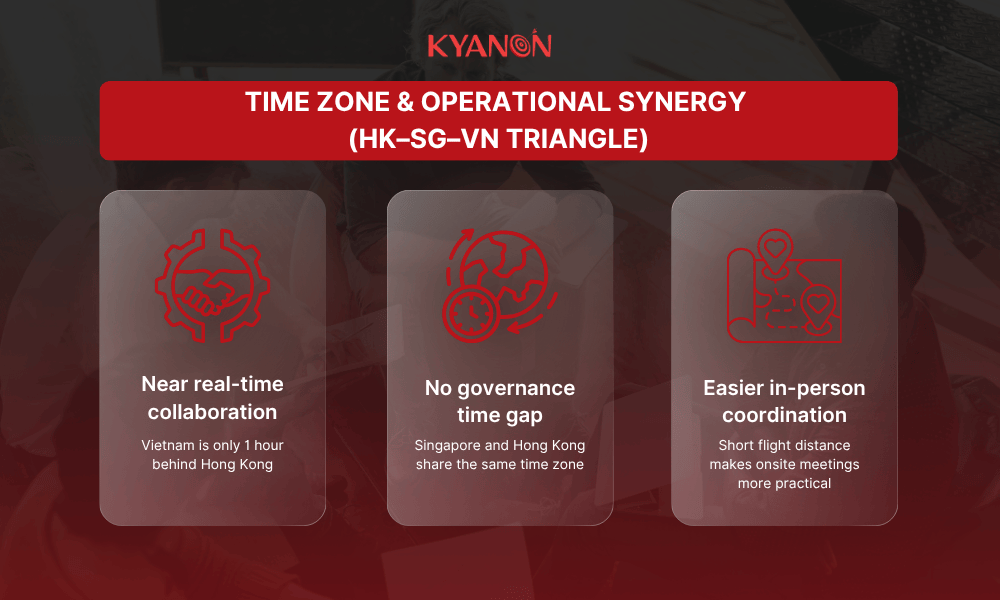
- Vietnam (GMT+7) sits within 1 hour of Hong Kong time, enabling real-time collaboration, same-day decision cycles, and executive alignment without the time zone friction that plagues India or Eastern Europe, offshore models.
- Singapore (GMT+8) is aligned directly with Hong Kong, with a zero time zone gap for governance and executive communication.
- A 2-hour direct flight between Hong Kong and Ho Chi Minh City or Hanoi makes quarterly onsite sessions practical, not aspirational.
For enterprises concerned about offshore “distance,” this regional proximity lowers a meaningful execution risk.
Why this hybrid model is lower risk than pure offshore
|
Risk area |
Pure offshore vendor model |
Singapore-Vietnam hybrid model |
|
Contract confidence |
Depends on vendor jurisdiction |
Stronger when governed through Singapore |
|
Delivery capability |
Depends on market depth |
Strong with Vietnam engineering base |
|
Leadership visibility |
Often indirect |
Easier with regional proximity |
|
Compliance comfort |
Varies widely |
Usually stronger for regional enterprises |
|
Operating rhythm |
Can be fragmented |
Better real-time collaboration |
Why Vietnam over India or mainland China for Hong Kong companies
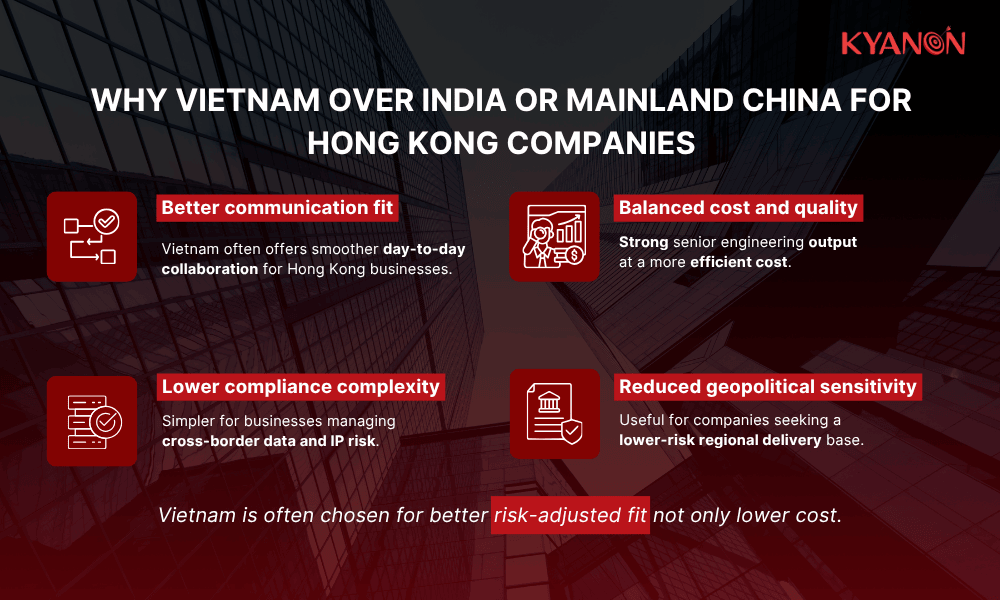
This is a question that every enterprise evaluating offshore options in 2026 faces directly. The answer is not simply about cost, it is about risk-adjusted fit.
Communication clarity and cultural compatibility
Vietnamese engineering teams have consistently demonstrated stronger written and verbal English communication than non-tier-1 Indian engineering pools, and significantly stronger cultural alignment with Hong Kong’s business norms than with mainland China-based teams.
For Hong Kong enterprises navigating cross-border product delivery, communication friction compounds daily.
Balanced cost-to-quality ratio
India offers a broader talent pool, but the premium-quality segment (senior engineers at a global standard) increasingly commands salaries that narrow the cost advantage.
Vietnam’s senior engineering tier delivers comparable output at a lower total cost, with less internal quality variance than the broad India market.
IP and compliance alignment
Mainland China’s data regulations, including PIPL (Personal Information Protection Law) and cross-border data transfer restrictions, introduce compliance complexity that most HK enterprises prefer to avoid, particularly those operating in fintech, healthtech, or SaaS with international data flows.
Reduced geopolitical sensitivity
For some Hong Kong businesses, vendor-country risk is now part of sourcing strategy. Regional diversification, data sensitivity, and internal risk policy can all influence the market choice. This is company-specific, but it is one reason Vietnam is increasingly considered in regional delivery design.
Key strategies used by Hong Kong leaders
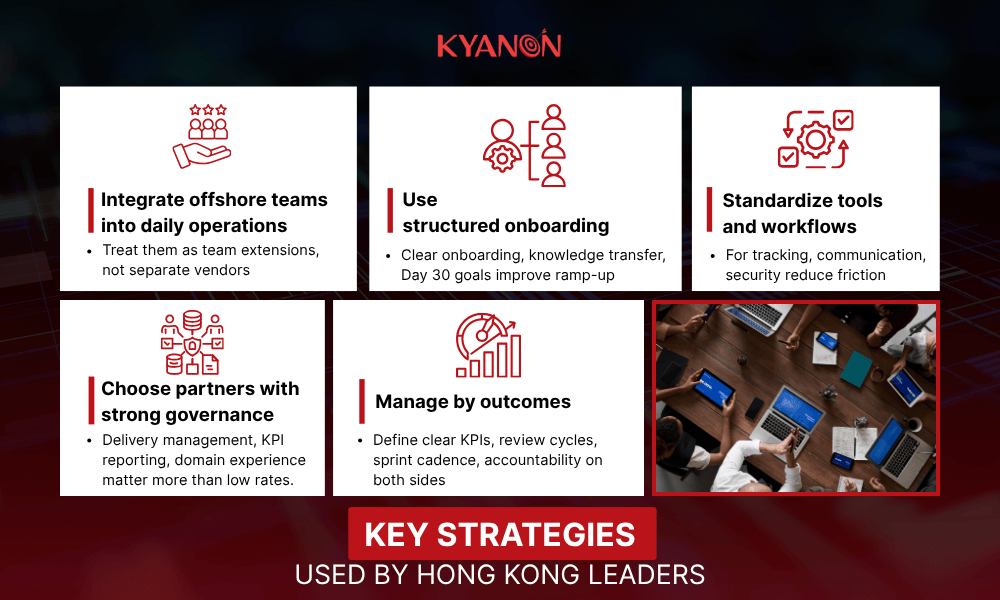
The difference between offshore teams that become strategic assets and those that become expensive headaches is almost always execution discipline, not geography.
Cultural integration
High-performing offshore teams are not managed as vendors; they are integrated as team extensions.
Practical execution:
- Offshore team members are included in company-wide communications, town halls, and recognition programs.
- HQ staff travel to offshore locations during onboarding to establish cultural norms directly.
- Shared team rituals, sprint ceremonies, retrospectives, and all-hands run across both locations.
Structured onboarding & training
The first 30 days determine the trajectory of the engagement.
Leading practices:
- Documented onboarding playbooks covering technical standards, communication protocols, and escalation paths.
- Direct knowledge transfer from HQ to the offshore team, not just documentation handoff.
- Defined “Day 30” success criteria agreed upon before engagement begins.
Leveraging technology & tools
- Project visibility: Jira, Linear, or Asana for sprint tracking and accountability.
- Communication: Slack or Teams with defined channel structures (no open-ended messaging chaos).
- Documentation: Confluence or Notion for living technical documentation.
- Security: Role-based access controls from Day 1, not retrofitted after an incident.
Strategic partnerships
The selection of an offshore partner determines the governance quality of the entire engagement.
Key evaluation criteria:
- Does the partner provide a dedicated Delivery Manager (not just account management)?
- Is there a structured KPI and reporting cadence, or are updates ad hoc?
- Does the partner have a demonstrated track record in the specific technical domain (AI, cloud, fintech)?
Focus on performance & support
Leading enterprises define success at the outcome level, not the activity level.
Offshore teams perform better when businesses define:
- output KPIs
- quality KPIs
- sprint cadence
- review cycle
- accountability owner on both sides
Commonly offshored functions
Not every function should move offshore first. The best starting point is usually where work is measurable, collaborative, and skill-constrained locally.
|
Function |
Common roles offshored |
Offshore suitability |
|
IT & engineering |
Software development, DevOps, QA, cloud infrastructure, AI/ML |
Very high |
|
Data & analytics |
Data engineering, BI development, analytics |
Very high |
|
Back-office support |
Finance operations, data entry, admin |
High |
|
Customer service |
L1/L2 support, lead qualification |
Moderate–high |
|
Product management support |
BA, product documentation, UX research |
Moderate |
The 5-step roadmap to building a high-performance offshore team
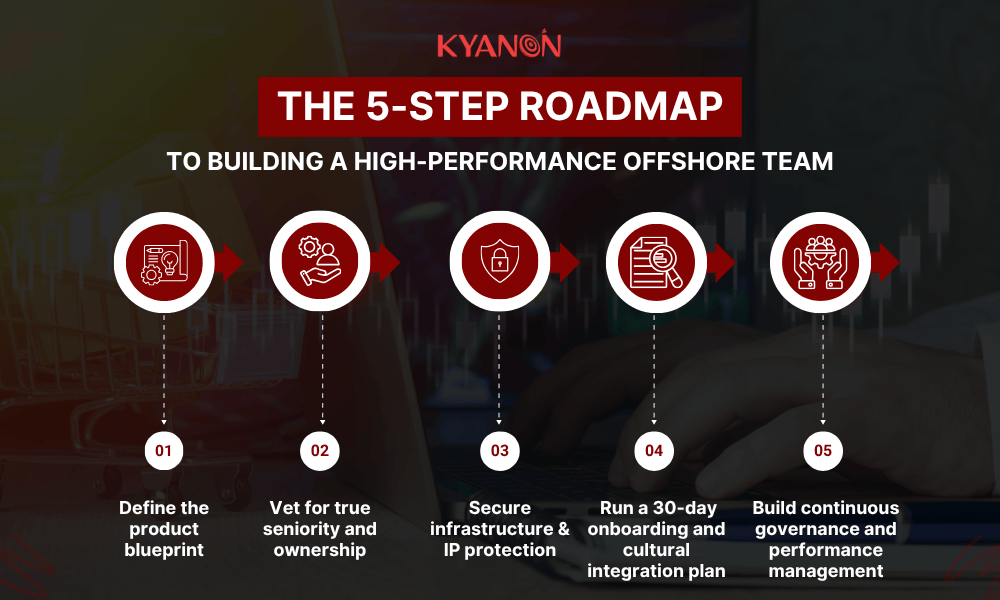
Step 1: Define the product blueprint
Start with outcomes, not headcount.
Set:
- business goals
- product milestones
- architecture boundaries
- delivery KPIs
- budget tolerance
Step 2: Vet for true seniority and ownership
A useful screening model checks four layers:
- Technical depth
- Problem-solving quality
- Communication clarity
- Ownership behavior
Do not hire only for tool familiarity. Hire for judgment, especially in offshore roles with less direct supervision.
Step 3: Secure infrastructure and IP protection
Minimum requirements:
- Role-based access,
- secure repositories,
- device and credential policies,
- NDAs and contract controls,
- clear data handling rules
Step 4: Run a 30-day onboarding and cultural integration plan
Include:
- Team introductions
- Sprint rituals
- Technical walkthroughs
- Business context sessions
- Feedback checkpoints
Step 5: Build continuous governance and performance management
The offshore model needs a stable management system:
- Monthly KPI review,
- quarterly roadmap review,
- defined escalation path,
- visible sprint metrics,
- clear delivery owner
BCG’s 2025 GCC research is useful here: the difference between average and high-value capability models is not access to talent alone, but how well the enterprise builds maturity, governance, and AI-enabled execution into the model.
Managing offshore transformation risks
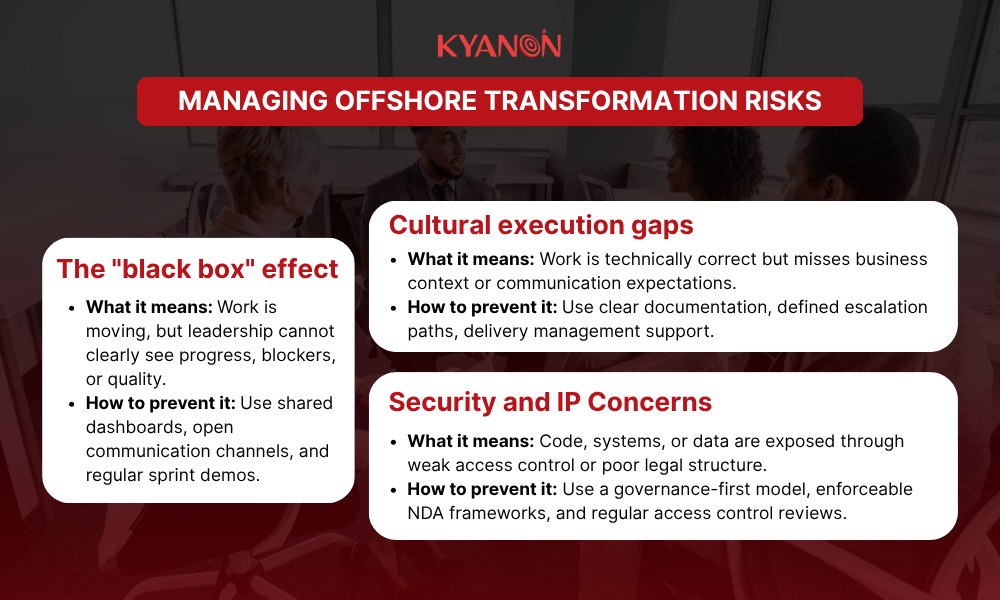
Risk 1: The “black box” effect
What it looks like: Work is happening, but leadership has no real-time visibility into progress, blockers, or quality.
How to prevent it:
- Transparent Jira/Linear dashboards accessible to HK leadership.
- Open Slack channels (no closed-loop offshore communication silos).
- Shared sprint demos at the end of every cycle, not just written reports.
Risk 2: Cultural execution gaps
What it looks like: The offshore team delivers technically correct work, but misaligns on business context, priorities, or communication norms.
How to prevent it:
- Documentation standards that make context explicit, not assumed.
- Clear escalation paths so the offshore team knows when and how to flag issues.
- An embedded Delivery Manager who bridges cultural and operational gaps proactively.
Risk 3: Security and IP concerns
What it looks like: Code, architecture, or client data exposed through access control failures or inadequate legal frameworks.
How to prevent it:
- In a governance-first offshore model, security is a structural feature, not an afterthought.
- NDA frameworks with enforceable jurisdiction (Singapore for the SG–VN model).
- Structured access control with regular access audits.
Case snapshot: How Hong Kong companies scale with offshore teams
Example 1: HSBC

Challenges
- A large Hong Kong-rooted financial institution needs delivery capacity that can support global banking platforms, software ecosystems, and complex operations at scale.
- The challenge is not only hiring more people, but structuring technology and operations so they can support global business lines in a consistent way.
Solutions
- HSBC built India-based capability centres as part of its core operating model, including Global Service Centres with more than 24,000 employees supporting global businesses.
- While HSBC’s model uses India-based centers at enterprise scale, the governance principles embedded in delivery, DevOps pods, and dedicated capability apply directly to the Singapore-Vietnam model at mid-market scale.
- HSBC states that its India technology centres now include more than 23,000 professionals across Pune, Hyderabad, and Bengaluru, delivering technology solutions for businesses worldwide (HSBC).
Results
- HSBC’s offshore model is no longer a side function. It operates as a large-scale delivery engine tied to global technology and operations.
- The structure shows that offshore teams can be embedded into software delivery, DevOps, fintech services, and global resourcing rather than used only for support tasks.
Example 2: FWD Group
Challenges
- A Hong Kong-headquartered insurer operating across multiple Asian markets needs specialised regional support across technology, innovation, finance, actuarial, and product-related functions.
- In regulated sectors, the challenge is often broader than staffing. Businesses need regional capability that can support transformation and specialised business functions across markets.
Solutions
- FWD Group established its Technology and Innovation Malaysia (TIM) Hub in Greater Kuala Lumpur in 2019.
- According to InvestKL, the hub focuses on highly specialised services, including innovation, actuarial, product proposition, finance, and investment operations.
- InvestKL also notes that FWD expanded its centre-of-excellence services to include internal audits, investments, and IFRS 17 in 2023.
Results
- FWD uses the Malaysia hub to deliver technology and support innovation across its regional businesses.
- The hub evolved beyond a narrow delivery role into a broader regional support structure covering multiple high-value business functions.
When should a Hong Kong founder build an offshore team?
Use this checklist.
- Local hiring cycles are consistently too slow
- The roadmap extends beyond 12 months
- AI, cloud, or data skills are hard to hire locally
- Burn-rate discipline matters
- Regional expansion requires scalable delivery capacity
- Product execution is blocked by talent gaps, not by lack of demand
If several of these are true, the issue is likely structural. In that case, an offshore team may be a strategy decision, not a staffing experiment.
Partnering with a managed offshore development team
Enterprises usually choose a managed offshore model when they need more than recruitment support. They need an operating structure.
A strong managed model should provide:
- governance-first delivery
- executive-level reporting
- long-term team stability
- documented security controls
- regional structure that supports both contract confidence and engineering output
This is where the Singapore-governed, Vietnam-executed structure often stands out for Hong Kong businesses: it aligns regional trust, delivery practicality, and operating efficiency in one model.
Why choose Kyanon Digital as your partner?
- Regional operating model: Singapore-based consulting and delivery coordination are combined with Vietnam-based engineering capacity, which supports both stakeholder alignment and scalable execution.
- Security and compliance controls: Public materials highlight security, compliance, and certified management systems that support safer delivery at scale.
- Managed delivery, not only team sourcing: The model covers dedicated team setup plus ongoing support across delivery, quality control, and operational management, which is more suitable for businesses that need structure rather than only recruitment help.
- Built for long-term product work: The dedicated team approach is positioned for continuous development and ongoing support, which helps preserve product knowledge and delivery continuity over time.
- Clear reporting and collaboration: The delivery model emphasizes regular stakeholder alignment, defined roles, KPI monitoring, and structured communication, which makes progress easier to track at the management level.
- Depth across strategy and execution: The service portfolio spans strategy, enterprise architecture, data, AI, software engineering, deployment, and ongoing support, which fits businesses that need both planning and implementation in one partner.
- Scaled engineering bench: Public company materials describe 500+ consultants and engineers, multiple global offices, and experience serving enterprise clients, which indicates broader capacity than a small offshore vendor model.
Explore more: Offshore Developer for Hire
Case study: Managed offshore support for a global coffee chain in Hong Kong by Kyanon Digital
A Hong Kong coffee chain used a managed offshore team to stabilize a complex digital ecosystem, improve delivery governance, and continue platform enhancement without disrupting business operations.

Challenges
- Limited handover documentation made the architecture and workflows hard to understand.
- Existing systems had unresolved issues and frequent service disruptions.
- Clear governance and standard operating processes were missing.
Solutions from Kyanon Digital
- Cross-functional offshore team setup: A 9-member team was assembled across development, testing, DevOps, and project management to support maintenance and enhancement in parallel.
- 24/7 support coverage: The team provided round-the-clock support to reduce downtime and respond faster to ongoing issues.
- System stabilization first: Work started with system review, bug fixing, and structured incident management to restore reliability before scaling enhancements.
- Governance and documentation layer: Industry-standard processes, agile practices, incident management protocols, and a centralized document repository were introduced to improve long-term maintainability.
- Continuous enhancement after takeover: New features were added for loyalty programs and third-party integrations while maintenance continued.
Results & impacts
- System stability improved and service disruptions were reduced.
- Issue resolution and operational workflows became more efficient.
- New features were delivered alongside ongoing maintenance.
Read more: Maintenance and Enhancement of a Global Coffee Chain’s Digital Ecosystem in Hong Kong
In conclusion
To build offshore teams well, Hong Kong businesses need to move beyond the old outsourcing mindset. The decision is no longer just about lowering cost. It is about securing scarce talent, improving delivery speed, reducing dependence on one labor market, and setting up governance that can scale with the business.
The Singapore-Vietnam model has emerged as the dominant configuration for Hong Kong enterprises for clear structural reasons: legal confidence, engineering depth, time zone alignment, and cultural compatibility.
Ready to evaluate your offshore readiness?
Kyanon Digital operates a governance-first offshore delivery model, a Singapore-based entity structure, a Vietnam engineering center, with dedicated delivery manager oversight and structured KPI reporting built into every engagement.
If your business is evaluating how to build offshore teams that deliver at enterprise standard, contact Kyanon Digital for an offshore readiness assessment.