

A robust mobile app development strategy for omnichannel retail in Singapore is no longer optional for enterprises aiming to unify physical and digital storefronts while maintaining consistent customer experiences across channels. Industry forecasts expect Singapore’s e-commerce market to reach USD 24.8 billion by 2028, driven by mobile-first shopping behavior, increasing cross-border demand, and continued SME digitalization, according to Retail Asia. Singapore consumers are also among the region’s most confident cross-border shoppers, with 98% comfortable purchasing from overseas merchants (FedEx), significantly higher than the global average of 89%, signaling both expansion opportunities and intensified competitive pressure.
As 68.3% of shoppers now rely on both digital and physical retail channels when making purchasing decisions, businesses must deliver seamless journeys across mobile apps, e-commerce platforms, and physical stores.
However, many organizations still struggle with disconnected systems, fragmented customer data, and inconsistent fulfillment operations, issues that directly impact conversion rates, delivery reliability, and long-term customer retention.
To address these operational gaps and support scalable omnichannel retail experiences, Kyanon Digital presents this comprehensive guide to help enterprises design, build, and scale mobile retail applications aligned with Singapore’s evolving commerce landscape.
Key takeaways
- Mobile-first is mandatory: Mobile apps are the operational control plane in Singapore; design accordingly.
- Integrate before you build: Prioritize CDP, OMS, POS, and payment integrations over feature bloat.
- Fulfillment wins customers: Real-time inventory + store-based fulfillment (BOPIS/ship-from-store) reduces cost and speeds delivery.
- Speed > bells: Target sub-second core flows and <200 ms perceived responsiveness for checkout to protect conversion.
- Compliance is business critical: Embed PDPA-aligned consent and tokenised payments from Day 1.
- Start small, scale fast: Run a 60–90 day pilot (1–3 stores) with clear KPIs (Inventory ≥99%, Pickup SLA ≥95%, Pricing parity ≥99%).
Further reading:
- Omnichannel eCommerce Solutions for Business Growth
- B2B Guide: Top 10 Omni Channel Retail Strategies That Shine!
- Mobile App Engineering Trusted by Singapore Brands
Why mobile apps are central to omnichannel retail in Singapore
Mobile apps are the core engagement and fulfillment control plane for omnichannel retail in Singapore. Functioning as the central nervous system of modern commerce, they own identity, payments, fulfillment triggers, and in-store phygital flows. For enterprise leaders, the mobile app is no longer just another sales channel; it is the primary architecture that binds the physical and digital retail experience together.
Mobile apps are the core engagement and fulfillment control plane for omnichannel retail in Singapore; they own identity, payments, fulfillment triggers, and in-store phygital flows.
Singapore is a mobile-first retail market
Singapore’s near-universal connectivity and digital payment adoption make mobile the primary operational interface between businesses and customers.
Enterprises operating in Singapore must design for a market shaped by extremely high connectivity, advanced digital infrastructure, and mature payment ecosystems. Mobile platforms are the default interaction layer through which customers browse, compare, purchase, and collect orders.
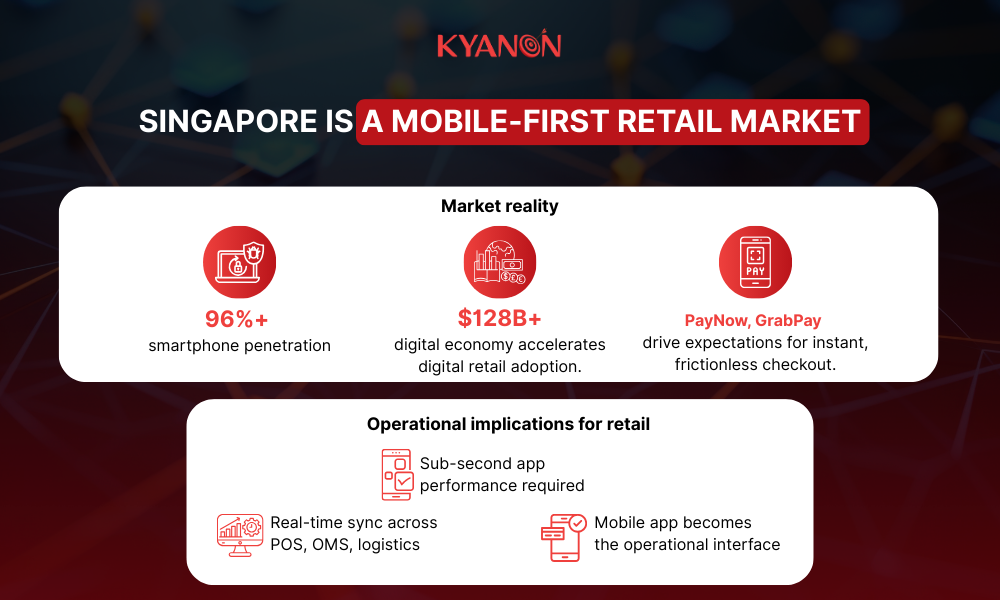
- Smartphone penetration exceeded 96% in 2025, reinforcing mobile as the dominant commerce device (Statista).
- Singapore’s digital economy reached USD 128B+, contributing nearly 19% of GDP, supported by nationwide connectivity and digital adoption initiatives (IMDA).
- Real-time payment adoption continues rising through local systems such as PayNow and GrabPay, shaping expectations for instant checkout experiences.
What this means operationally
- Customers expect sub-second app response times and uninterrupted checkout flows.
- Retail apps must support high-frequency data exchange between POS, OMS, and logistics systems.
- Architecture priorities shift toward:
- Edge caching and API optimization
- High availability infrastructure
- PDPA-aligned security and consent governance.
The shift from multichannel to omnichannel
Omnichannel retail succeeds when mobile apps unify customer data, inventory logic, and fulfillment decisions into a single operational system.
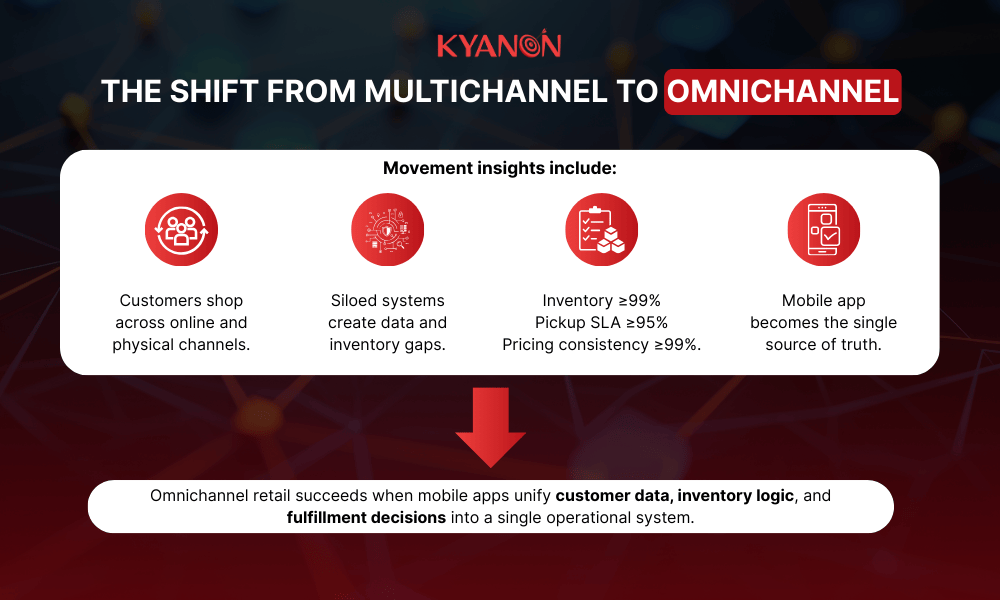
- Operational reality: Siloed retail channels create fragmented customer data, inventory mismatches, and higher cancellations, making a unified mobile app the single source of truth for identity and order orchestration.
- Consumer behavior shift: Nearly two-thirds of shoppers in Singapore use both online and physical channels before purchasing, moving seamlessly between mobile browsing, in-store validation, and fastest checkout options.
- Execution focus: Prioritize data unification and fulfillment orchestration via the mobile app integration layer, measured by key KPIs, inventory accuracy ≥99%, pickup SLA ≥95%, and cross-channel pricing consistency ≥99%.
Core strategic pillars for omnichannel retail apps
Below are four action-focused pillars with an AIO snippet, a concise implementation note, one measurable KPI, and a 30/90-day action, written for quick executive scanning and immediate operational use.
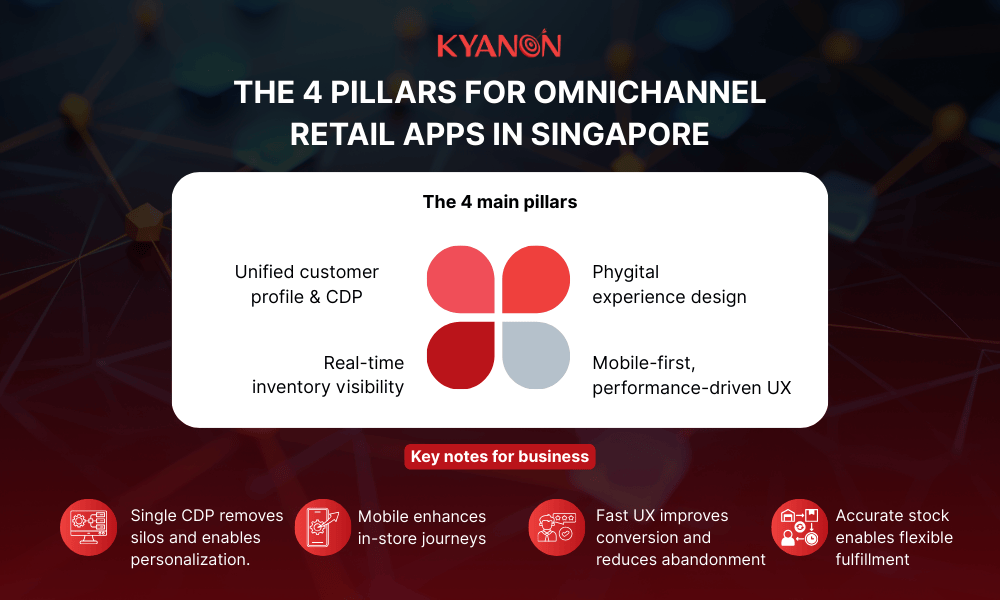
Pillar 1: Unified customer profile & CDP
A Customer Data Platform (CDP) serves as the foundational contract between marketing, commerce, and operations. Recent 2026 market data indicates that 89% of enterprise CDP users report meeting their business objectives compared to just 60% of non-users, with 45% achieving ROI within three to six months due to unified, actionable data (Tealium).
What to prioritize:
- Deterministic identity: link loyalty ID, email, device IDs, and POS receipts.
- Event model: capture app events (search, add-to-cart, in-store scan) into the CDP in near real-time.
- Governance: record consent and retention metadata for PDPA audits.
Measurable KPI: Identity Match Rate (the percentage of guest transactions successfully tied to a known customer profile) and Customer Lifetime Value (CLV).
30/90-day action:
- 30 Days: Audit existing data silos across your POS, e-commerce site, and mobile app to define a unified customer schema.
- 90 Days: Deploy a core CDP integration capable of capturing real-time events across at least two major sales channels.
Pillar 2: Phygital experience design
Mobile apps should extend, not replace, the physical store. A comprehensive 2025/2026 consumer behavior study by Minsait reveals that 75% of shoppers use three or more channels during a single purchase, and that digital interactions directly influence over 70% of all physical retail sales.
Tactical patterns:
- In-store QR/beacon flows for product info and assisted checkout.
- Appointment and reservation integration (for F&B and premium retail).
- Offline-first caching for store-assisted transactions.
Measurable KPI: In-store app engagement rate (percentage of store foot traffic opening the app) and BOPIS conversion rate
30/90-day action:
- 30 days: Map the physical in-store journey to identify friction points (e.g., checkout lines, fitting room waits) that digital flows can alleviate.
- 90 days: Launch a pilot “Scan & Go” or in-app inventory lookup feature within 1–3 flagship stores in Singapore.
Pillar 3: Real-time inventory visibility
Inventory accuracy is the engine that powers BOPIS, ship-from-store, and automated next-best-fulfillment decisions.
Implementation notes:
- Event-driven sync from POS/warehouse into an OMS with optimistic reconciliation.
- Expose “available to promise” and hold windows for reservations.
- Latency SLAs: sub-second reads for customer-facing inventory; eventual consistency for analytics.
Measurable KPI: Order Defect Rate (orders canceled due to stockouts) and Inventory Accuracy Percentage.
30/90-day action:
- 30 days: Conduct a latency assessment between your current warehouse/POS systems and your digital storefront.
- 90 days: Implement an OMS middleware layer to enable accurate “available to promise” data buffers for your top 20% highest-velocity SKUs.
Pillar 4: Mobile-first, performance-driven UX
In high-density retail environments, speed and reliability consistently trump feature count. With 2026 Statista projections showing that 72% of all e-commerce transactions now occur on mobile devices, a frictionless and lightning-fast user experience is a non-negotiable business driver.
UX rules:
- <200 ms perceived responsiveness for core flows where possible.
- Progressive enhancement starts with critical flows (search, buy, pay, pickup).
- Accessibility and localization for a multilingual customer base.
Measurable KPI: Time to Interactive (TTI) and Cart Abandonment Rate on mobile.
30/90-day action:
- 30 days: Execute a technical performance audit on your current mobile experience to identify API bottlenecks slowing down the checkout flow.
- 90 days: Refactor the critical purchasing path to hit the <200 ms latency target, stripping out non-essential third-party tracking scripts.
Essential features for a retail mobile app in Singapore
In Singapore’s omnichannel retail market, mobile apps must prioritize personalization, unified loyalty, local payments, and location-aware engagement to drive measurable conversion and retention outcomes.
|
Feature category |
Key capability |
Business impact |
|
Personalization |
AI-driven recommendations |
Higher conversion and average order value |
|
Loyalty |
Unified cross-channel rewards |
Increased retention across physical and digital |
|
Payments |
PayNow, GrabPay, Apple/Google Pay |
Reduced checkout friction in the local market |
| Engagement | Geofencing and proximity marketing |
Increased foot traffic to physical locations |
Hyper-personalization and recommendations
Personalization turns mobile apps into decision engines by adapting content, offers, and journeys in real time.
Modern retail apps analyze behavioral signals, browsing history, purchase patterns, location context, and in-store interactions to deliver dynamic product recommendations and promotions.
What businesses should implement?
- Real-time recommendation models using session behavior (search, views, and cart actions).
- Contextual offers triggered by lifecycle stage (new customer, repeat buyer, or dormant user).
- Privacy-by-design personalization aligned with PDPA consent and purpose limitation.
Business outcome
- Higher basket size through relevant suggestions.
- Reduced decision friction during checkout journeys.
Unified loyalty and rewards programs
Loyalty succeeds when customers earn and redeem rewards seamlessly across online and physical stores.
Singapore consumers expect loyalty benefits to follow them across channels, mobile apps, e-commerce sites, and physical POS.
Key capabilities
- A single loyalty wallet is visible inside the app.
- Real-time point accrual from POS and online purchases.
- Instant redemption during checkout or in-store payment.
Operational insight
- Loyalty data becomes a behavioral dataset powering segmentation and personalization.
- Unified rewards reduce channel-switching friction and increase repeat purchases.
Business outcome
- Improved customer lifetime value (CLV).
- Stronger omnichannel engagement consistency.
Local payment integration
Supporting local payment ecosystems directly improves checkout completion rates in Singapore. Retail apps must align with regional payment behavior where digital wallets and instant bank transfers are widely adopted.
Essential integrations
- PayNow for instant bank transfers.
- GrabPay for everyday mobile payments.
- Apple Pay and Google Pay for frictionless biometric checkout.
Implementation considerations
- Tokenized payments to minimize PCI scope.
- Fast retry logic for payment failures.
- Unified reconciliation between PSP and POS systems.
Business outcome
- Lower checkout abandonment.
- Faster payment confirmation enables quicker fulfillment.
Location-based engagement
Location intelligence bridges online intent with physical store traffic. Mobile apps can trigger contextual engagement when customers are near or inside stores, connecting digital browsing with real-world experiences.
Tactical approaches
- Geofencing notifications when customers approach a store.
- In-store prompts for promotions or loyalty redemption.
- Proximity-based recommendations using QR or beacon signals.
Best practice
- Use behavioral triggers instead of frequent notifications to avoid fatigue.
- Combine location signals with purchase history for relevance.
Business outcome
- Increased foot traffic and store conversion.
- Better alignment between marketing campaigns and store performance.
Omnichannel fulfillment capabilities
Modern retail fulfillment is no longer warehouse-centric. Mobile apps enable flexible fulfillment by showing real-time inventory, letting customers choose delivery or pickup options, and automatically coordinating execution across stores, warehouses, and logistics partners, turning fulfillment into a customer-driven experience rather than a back-office process.
Business value
- Reduces last-mile costs through store-based fulfillment.
- Improves delivery speed and reliability.
- Converts nearby inventory into immediate revenue opportunities.
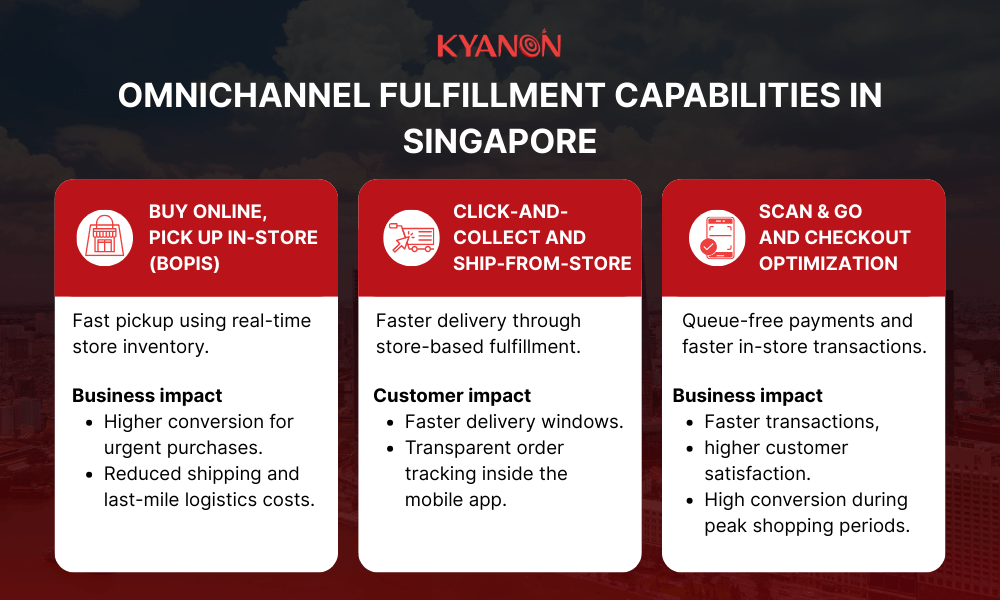
Buy online, pick up in-store (BOPIS)
BOPIS combines digital convenience with instant physical fulfillment, turning stores into micro-fulfillment hubs.
Mobile apps allow customers to purchase online and collect items at a nearby store, supported by real-time inventory visibility and reservation logic.
Operational benefits
- Uses existing store inventory to fulfill orders faster.
- Eliminates delivery fees for customers.
- Drives additional in-store purchases during pickup visits.
Implementation essentials
- Real-time “available to promise” inventory display.
- Automated reservation holds after checkout.
- Staff pickup dashboard with readiness notifications.
Business impact
- Higher conversion for urgent purchases.
- Reduced shipping and last-mile logistics costs.
Click-and-collect and ship-from-store
Click-and-collect expands BOPIS by allowing flexible pickup scheduling, while ship-from-store transforms retail locations into distributed fulfillment nodes.
Why it matters
- Stores closer to customers reduce delivery time and cost.
- Prevents lost sales when the central warehouse stock is unavailable.
- Balances inventory across locations automatically.
Operational requirements
- Order Management System (OMS) with routing logic.
- Store workload balancing rules.
- Integrated courier APIs for real-time shipment tracking.
Customer experience impact
- Faster delivery windows.
- Transparent order tracking inside the mobile app.
Scan & go and checkout optimization
Mobile apps enable customers to scan products, review carts, and pay directly without waiting in line, particularly valuable in high-density retail environments like Singapore.
Key capabilities
- Barcode or QR scanning is linked to the product catalog.
- In-app payment via local wallets (e.g., PayNow or GrabPay).
- Digital receipt synchronized with the loyalty profile.
Operational advantages
- Reduces checkout congestion and staffing pressure.
- Improves store throughput during peak hours.
- Captures richer behavioral data from in-store journeys.
Business outcome
- Faster transactions, higher customer satisfaction.
- Increased conversion during peak shopping periods.
Mobile app development strategy and process
|
Strategy area |
Key focus | Business value |
|
Agile development |
Ship features in small iterations and optimize using real user data. |
Faster launch, lower risk, continuous improvement. |
|
System integration |
Connect the app with ERP, CRM, OMS, and CDP for real-time data flow. |
Unified operations and accurate omnichannel visibility. |
| Native vs PWA | Native for performance; PWA for reach and cost-efficiency; hybrid for scaling. |
Smarter investment aligned with growth and customer behavior. |
Security, privacy, and compliance in Singapore
Retail mobile apps in Singapore must embed PDPA-compliant data governance and secure authentication into core system architecture to protect customer data, enable trusted personalization, and support frictionless digital payments across omnichannel retail.
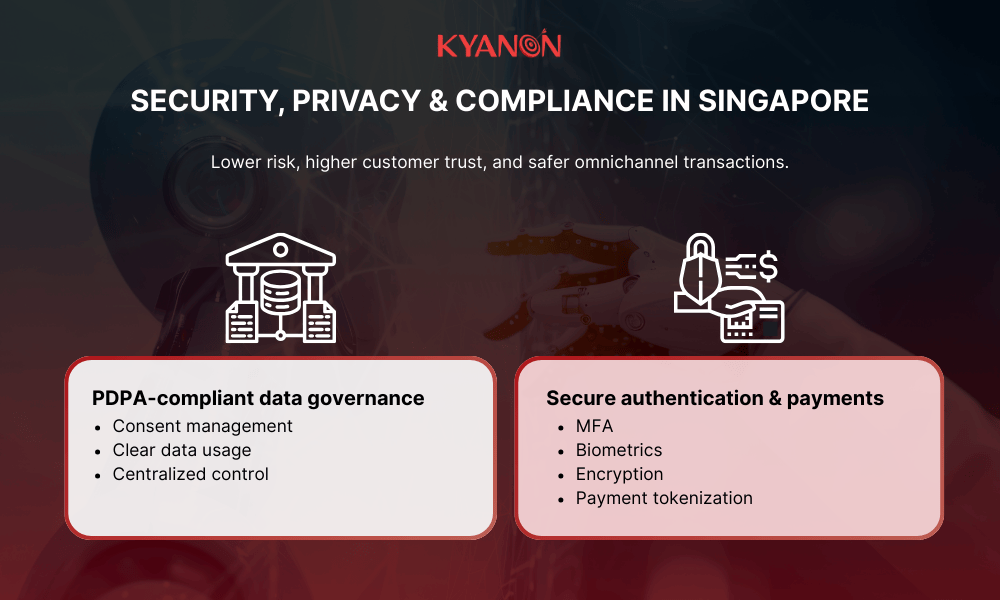
PDPA compliance and data governance
Retailers must manage customer data responsibly under Singapore’s Personal Data Protection Act (PDPA).
Key focus for businesses
- Capture explicit customer consent for data collection and marketing usage
- Maintain clear data purpose, retention, and access controls
- Centralize governance through CDP or data platforms for audit readiness
Business impact
- Reduced regulatory risk
- Higher customer trust and data-sharing willingness
- Sustainable personalization at scale
- Secure authentication and payments
Security should function as a built-in experience layer, not a backend feature.
Key focus for businesses
- Multi-factor authentication (MFA) and biometric login
- End-to-end encryption and payment tokenization
- Fraud monitoring integrated into checkout flows
Business impact
- Lower fraud and chargebacks
- Increased checkout confidence and conversion rates
- Stronger brand credibility in digital commerce environments
Cost considerations for mobile app development in Singapore
Retail mobile app investment in Singapore depends primarily on integration complexity, omnichannel capabilities, and AI functionality. Businesses should budget based on long-term operational impact rather than feature quantity, treating the app as core retail infrastructure.
Cost drivers in retail app development in Singapore
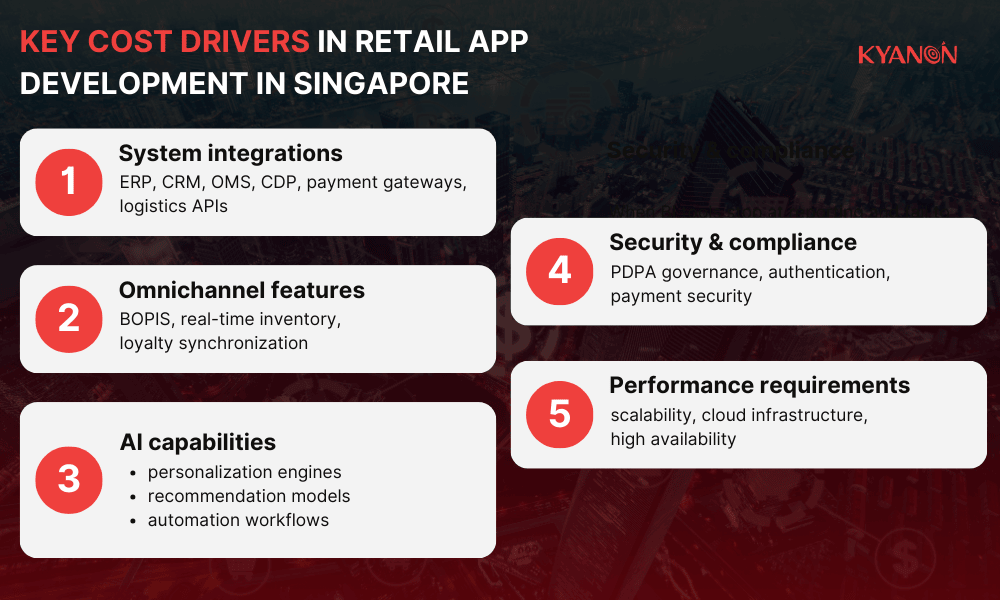
Key factors influencing cost
- System integrations: ERP, CRM, OMS, CDP, payment gateways, logistics APIs
- Omnichannel features: BOPIS, real-time inventory, loyalty synchronization
- AI capabilities: personalization engines, recommendation models, automation workflows
- Security & compliance: PDPA governance, authentication, payment security
- Performance requirements: scalability, cloud infrastructure, high availability
Typical cost ranges by complexity
|
App complexity |
Scope | Typical investment |
Business use case |
|
Basic commerce app |
Catalog, checkout, payments, loyalty | $80K–$150K |
Digital channel launch |
|
Omnichannel app |
Store integration, BOPIS, unified profile | $150K–$400K |
Mid–large retailers scaling operations |
|
Advanced intelligent app |
AI personalization, automation, real-time orchestration | $400K–$900K+ |
Enterprise omnichannel transformation |
Future trends in retail mobile app development
Retail apps are evolving into AI-driven operational platforms, combining automation, predictive engagement, and new interaction interfaces beyond traditional mobile screens.
AI-powered customer service and automation
What’s changing
- AI chatbots handling order tracking, returns, and product discovery
- Predictive support based on customer behavior signals
- Automated workflows connecting support → fulfillment → logistics
Business value
- Reduced support costs
- Faster resolution times
- 24/7 scalable customer engagement
Voice, IoT, and wearable integration
Emerging interaction channels
- Voice commerce for search and reorder actions
- Smart store IoT triggering contextual offers
- Wearables enabling notifications, loyalty validation, or queue-free pickup
Common mistakes in retail mobile app strategies
Most retail apps fail not because of technology limitations but due to misaligned strategy and weak operational integration between digital platforms and physical retail execution.
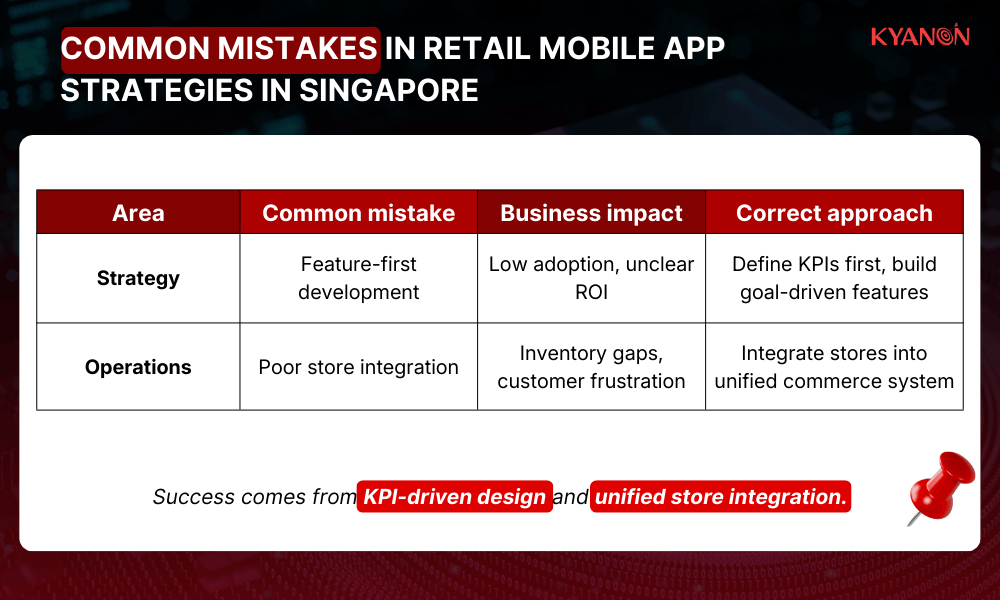
Feature-first instead of strategy-first
Typical problem
- Building apps based on trends rather than measurable business outcomes
- Excess features without clear ROI or adoption plan
Correct approach
- Define success metrics first (conversion, retention, fulfillment speed)
- Design features that directly support operational goals
Poor integration with store operations
Typical problem
- Apps disconnected from store inventory or staff workflows
- Promotions or availability inconsistent across channels
Business consequence
Customer frustration and lost trust
Execution principle
Treat stores as fulfillment nodes integrated into the same system architecture as e-commerce.
Building the right mobile app strategy
When a mobile app accelerates omnichannel growth
Retail readiness indicators
- Multiple sales channels are operating, but lacking unified customer data
- Increasing fulfillment complexity (BOPIS, ship-from-store, cross-border orders)
- Rising customer acquisition costs require stronger retention strategies
- Store networks need digital integration rather than expansion
Business signal: A mobile app creates the most value when operational scale already exists, but coordination efficiency is low.
What retailers should clarify before development?
Strategic alignment questions
- Data: Is customer identity unified across ecommerce, POS, and loyalty systems?
- Operations: Are stores prepared to act as fulfillment nodes?
- Technology: Can existing ERP/OMS systems support real-time synchronization?
- Scalability: Will the architecture support regional expansion or new channels?
Execution insight: Most delays occur from unclear internal ownership, not technical limitations.
How Kyanon Digital supports omnichannel retail apps
Kyanon Digital helps businesses build mobile apps as the central integration layer connecting customer experience, store operations, and fulfillment execution.
- Strategy-led development: Mobile roadmap aligned with business KPIs (conversion, fulfillment speed, retention).
- Product-aligned delivery teams: Dedicated engineers and experts supporting scalable mobile platforms.
- Enterprise system integration: Connect mobile apps with POS, OMS, CRM, and CDP for real-time operations.
- Phygital & fulfillment enablement: Support BOPIS, ship-from-store, and in-store mobile experiences.
- Performance, security & optimization: PDPA-ready architecture, fast UX, and continuous improvement post-launch.
Case study: How Kyanon Digital rebuilt an iconic retailer’s mobile-first omnichannel platform
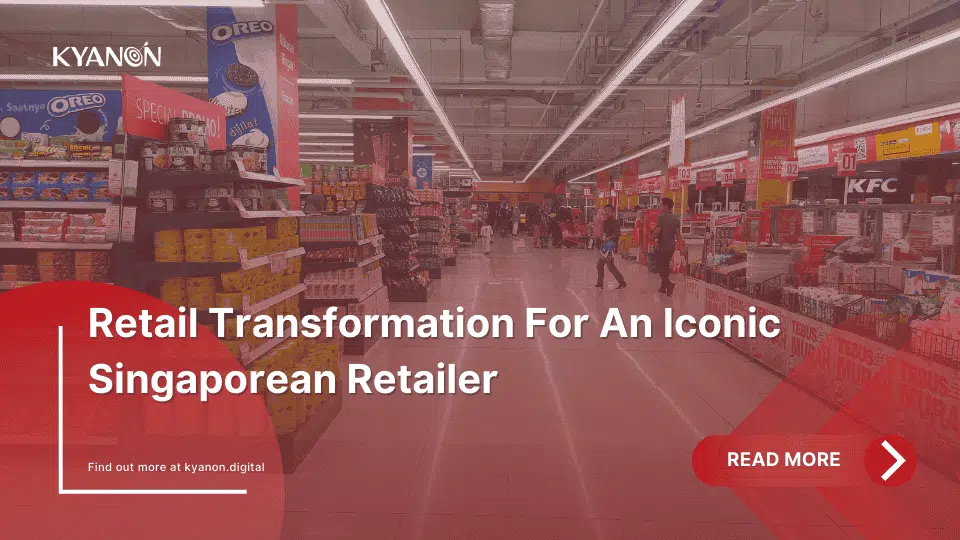
A leading Singapore retailer partnered with Kyanon Digital to modernize its mobile app and commerce ecosystem, integrating customer data, inventory, and fulfillment systems to enable real-time omnichannel retail operations.
Challenge
A well-established Singapore retail brand faced limitations common in legacy omnichannel environments:
- An outdated eCommerce platform is slowing innovation and integrations
- The mobile app and website are unable to meet modern UX expectations
- Disconnected store and digital systems are causing friction in O2O journeys
- Lack of unified CRM and inventory visibility for personalization and fulfillment accuracy
Solution
The transformation positioned the mobile app as the operational bridge between online and physical retail:
- Revamped mobile commerce app with improved navigation and personalized journeys
- Migration to an enterprise eCommerce platform for scalability
- Deployment of mobile fulfillment and mobile POS tools for store staff
- Integration of CRM, PIM, OMS, and WMS into one connected ecosystem
Omnichannel capabilities enabled
- Buy online, pick up or return in store (BOPIS & BORIS)
- Real-time inventory visibility across channels
- Store-based fulfillment and assisted checkout
- Personalized marketing powered by unified customer data
Results & business impact
- Enabled BOPIS, in-store returns, and ship-from-store workflows.
- Improved customer engagement and conversions via refreshed mobile UX.
- Faster order processing and accurate fulfillment from unified backend systems
Read more: Retail Transformation For An Iconic Singaporean Retailer
In conclusion
A pragmatic mobile app development strategy for omnichannel retail in Singapore turns the app into the single source of truth that unifies identity, inventory, and fulfillment, reducing cancellations, speeding delivery, and improving lifetime value.
For a tailored pilot, architecture review, or a phased roadmap aligned to your KPIs, contact Kyanon Digital to start a focused 90-day program that moves you from pilot to operations & scale.