
Hong Kong restaurant chains evaluating mobile app partners are entering a market where digital demand is already high, but margin pressure and partner risk are rising. In early 2025, Hong Kong had 17.4 million mobile connections and an internet penetration of 96.0% (Data Reportal, 2025), while official Hong Kong data showed restaurant receipts were uneven through 2025 rather than uniformly strong, which means businesses need mobile investments that improve retention, data ownership, and branch efficiency, not just online reach.
For many restaurant groups, the problem is no longer whether mobile matters. The problem is that delivery apps, booking apps, loyalty tools, POS systems, and payment tools often sit in separate stacks. That results in disconnected customer data, limited repeat-purchase visibility, and inconsistent execution across outlets. Deloitte’s 2025 restaurant trend coverage also points to automation and AI as priorities tied to cost control and reliability, which raises the bar for partner selection.
This is where the conversation shifts from “which app should we join?” to “which mobile app partner model gives the business control, integration, and room to scale?”
This guide maps the full landscape of mobile app partners available to Hong Kong restaurant chains, compares their use cases, outlines the critical risks to avoid, and provides a decision framework for selecting the right partner mix.
Key takeaways
- The mobile app partner landscape in Hong Kong spans five distinct categories: custom app development, food delivery platforms, discovery & booking, loyalty & rewards, and POS/operations, each serving a different business need.
- With Deliveroo’s full exit from Hong Kong in April 2025, the delivery market has consolidated into a two-platform duopoly between Keeta and Foodpanda, raising new commission and dependency risks for restaurant chains.
- Commission fees charged by third-party delivery platforms sit at 25–28% per order, a high structural cost that compounds the case for building direct ordering capabilities.
- Businesses that rely exclusively on third-party platforms have no access to first-party customer data, making personalized retention and loyalty programs nearly impossible.
- Gartner projects that by 2027, 85% of customer data will be generated from automated or AI-driven interactions, making data infrastructure decisions made today directly impact long-term competitive positioning.
- The right mobile app partner strategy is not a single-vendor decision. It requires a connected ecosystem: a branded app at the core, integrated with delivery, loyalty, POS, and payment systems.
- Kyanon Digital provides end-to-end custom mobile app ecosystem development, built for direct ordering, loyalty, CRM, and multi-branch scalability, purpose-built for restaurant chains operating in the Hong Kong and Asia-Pacific markets.
Further reading:
- Mobile App Development Services
- Mobile App Partners for Hong Kong Consumer Brands
- Partnering with Singapore Agencies for HongKong IT Support
Why mobile app partners matter for Hong Kong restaurant chains
What do “mobile app partners” mean in the restaurant industry
With mobile internet usage already mainstream in Hong Kong, the real question is how businesses structure mobile partnerships without losing control of data or economics.
In this market, mobile app partners usually fall into five groups:
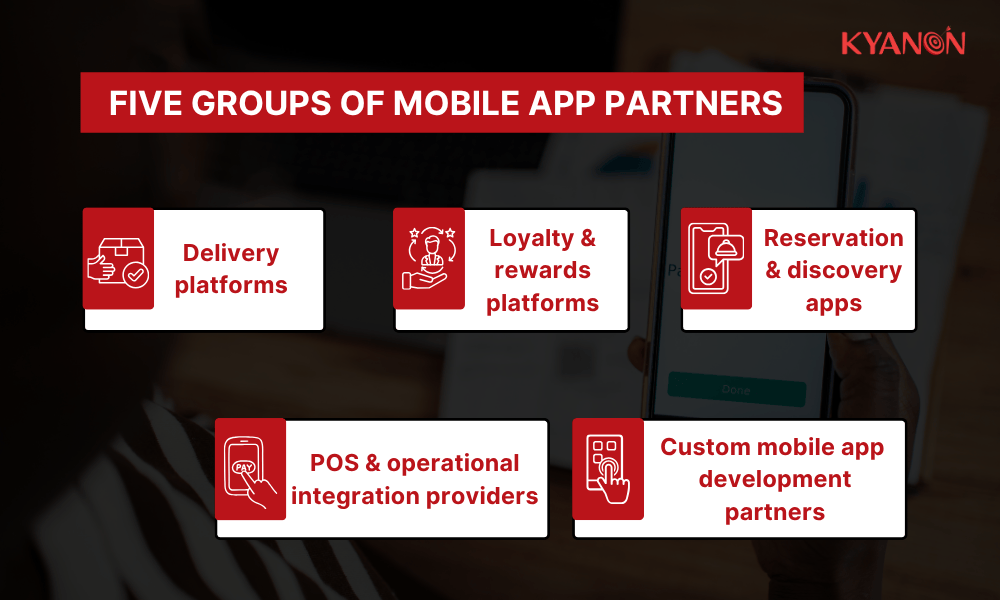
- Delivery platforms: third-party apps that aggregate demand and handle logistics
- Loyalty and rewards platforms: apps that manage points, tiers, and repeat visit incentives
- Reservation and discovery apps: platforms for table booking and local visibility
- POS and operational integration providers: systems that connect ordering, payment, and branch management
- Custom mobile app development partners: technology firms that build branded, proprietary apps integrating all of the above into a single, owned digital channel
Why restaurant chains in Hong Kong need the right mobile app ecosystem
Hong Kong restaurant groups typically face a concentrated set of problems:
- Disconnected customer data across delivery, walk-in, booking, and loyalty channels
- Over-reliance on third-party delivery platforms for demand generation
- Low repeat purchase rates because there is limited owned retention infrastructure
- Inefficient branch operations when outlets run different workflows or tool combinations
- Weak integration with POS and payment tools, which reduces reporting quality and slows campaigns
These issues matter more in a market where revenue is present, but growth is not effortless. Official Hong Kong statistics show restaurant receipts in 2025 were mixed across quarters and restaurant types, which increases the importance of retention, operational discipline, and smarter mobile investment.
What business leaders are really looking for in a mobile app partner
The evaluation criteria differ by function but converge on the same outcomes:
|
Stakeholder |
Primary goal |
What they are evaluating |
|
Business owners / Founders |
Revenue growth and ROI |
Direct ordering uplift, commission reduction |
|
Marketing leadership |
Customer retention and CRM data |
First-party data access, loyalty integration |
|
Operations management |
Efficiency across branches |
POS sync, order centralization, reporting |
Restaurant chains in Hong Kong choose mobile app partners to improve direct ordering, loyalty, customer retention, and multi-branch operations, while reducing dependence on platform commissions and building first-party data infrastructure.
Types of mobile app partners that restaurant chains in Hong Kong use
The Hong Kong market works best when businesses distinguish between “reach partners” and “control partners.”
- Reach partners help acquire demand.
- Control partners help retain customers, unify data, and improve economics.
Custom mobile app ecosystem partners like Kyanon Digital
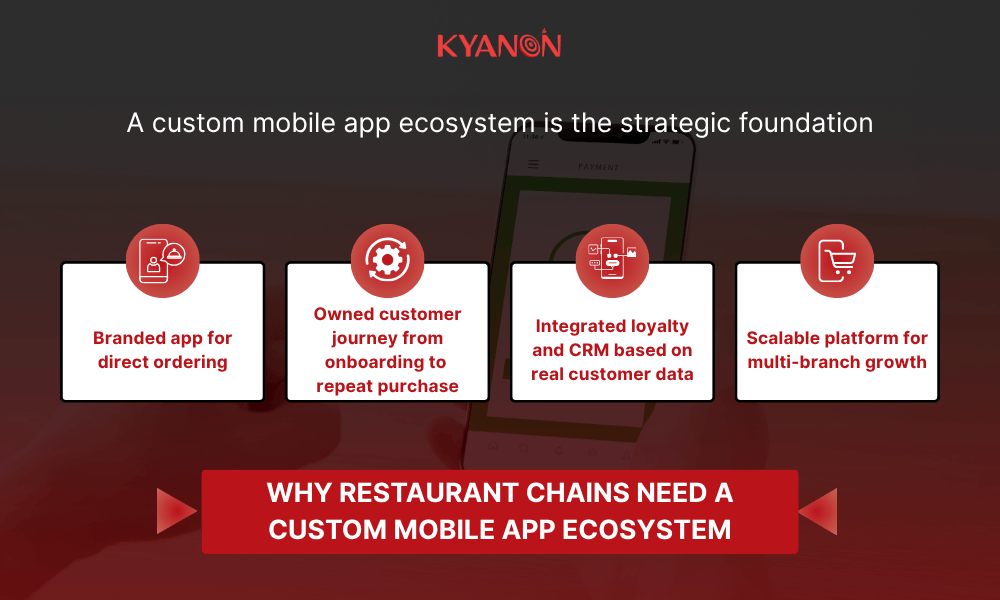
For restaurant chains that want to own the full customer relationship, from first order to repeat loyalty, a custom mobile app ecosystem is the strategic foundation.
What this category delivers:
- Why restaurant chains need a custom mobile app ecosystem.
- A branded app for direct ordering, separate from third-party delivery platforms
- Brand-owned customer journeys: onboarding, discovery, purchase, re-engagement
- Integrated loyalty programs and CRM connected to real customer behavior data
Scalable mobile infrastructure built to support multi-branch expansion
Why this matters in 2026:
- By the end of 2024, Hong Kong had 5.78 million e-payment users, with annual transaction value exceeding USD 4.09 billion, up 14.2% year-on-year, according to the Digital 2025 Hong Kong Report (KPay Group).
- Gartner predicts that by 2027, 85% of customer data will be collected from automated interactions or those led by AI agents.
Food delivery app partners
Delivery platforms remain relevant for customer acquisition and extending delivery reach, but they should be evaluated as acquisition tools, not retention or data infrastructure.
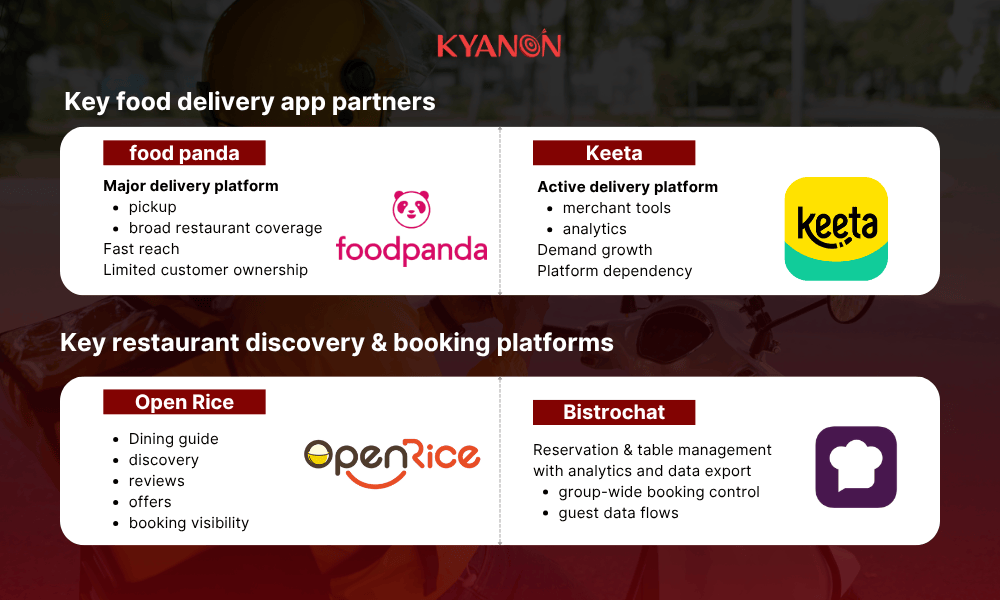
Key platforms active in Hong Kong
|
Partner |
Current role in Hong Kong | Best use case |
Main limitation |
|
foodpanda |
Large delivery marketplace with pickup and broad restaurant coverage | Fast market access and delivery reach |
Limited ownership of the customer relationship |
|
KeeTa |
Active food delivery platform with merchant tools and analytics | Reach, delivery demand, merchant-side performance visibility |
Platform dependency and regulatory watchpoints |
- foodpanda remains a major channel for on-demand reach and pickup.
- KeeTa is active and merchant-facing, but businesses should factor in the November 2025 Competition Commission resolution around restaurant agreement terms.
Restaurant discovery and booking platforms
|
Partner |
What it is best known for |
Best use case |
|
OpenRice |
Dining guide, discovery, reviews, offers, and booking visibility in Hong Kong |
Local visibility, booking demand, discovery |
|
Bistrochat |
Reservation and table management with analytics and data export | Reservations, group-wide booking control, guest data flows |
Use case: These platforms drive awareness and trial visits, particularly for fine dining and destination restaurants. They are effective for top-of-funnel discovery but do not provide the customer data or retention mechanics that chains need at scale.
Risk to manage: Like delivery platforms, discovery apps own the customer relationship at the point of search. Restaurants appear as listings, not brands. Chains with high discovery-platform dependencies should prioritize building direct booking and repeat visit flows through their own channels.
Loyalty and rewards app partners
Key platforms:
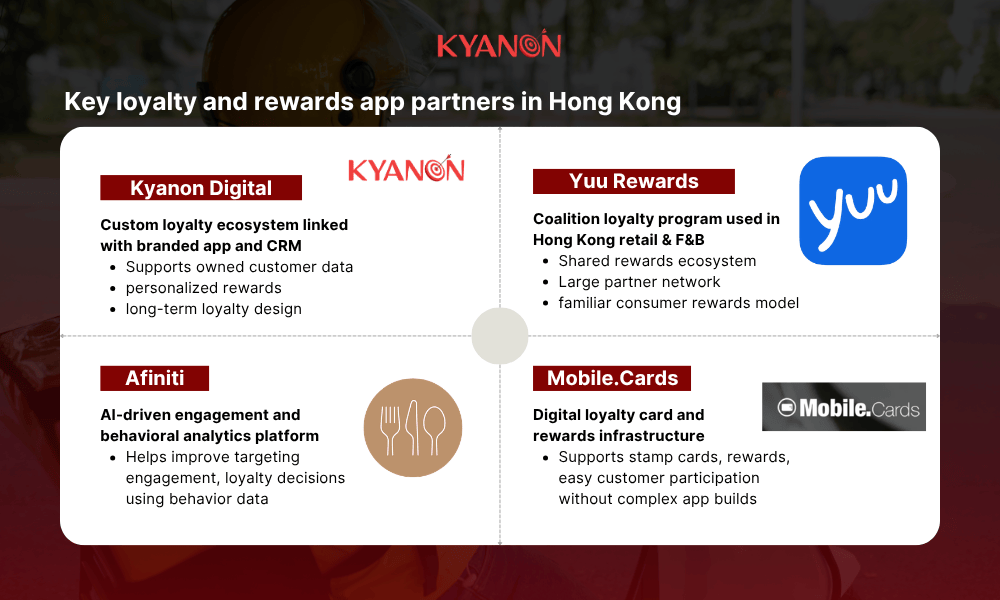
- Kyanon Digital: Custom loyalty ecosystem tied to branded app and CRM, best fit when the business wants owned logic and custom retention design
- Yuu Rewards: coalition loyalty program popular across Hong Kong retail and F&B; allows brands to participate in a shared rewards ecosystem
- Afiniti: AI-driven engagement and behavioral analytics platform used in loyalty contexts
- Mobile.Cards: digital loyalty card infrastructure for mobile-first stamp and reward programs
Use case: These platforms accelerate loyalty program deployment without requiring full custom development. They are effective for smaller chains or brands in early-stage digital adoption.
Trade-off to evaluate: Coalition platforms like Yuu Rewards build cross-brand loyalty, which means the customer’s relationship is with the program, not the restaurant brand. Chains seeking deep brand loyalty and proprietary customer data often outgrow coalition models and require a standalone loyalty infrastructure integrated with their own app.
POS, queuing, and operations partners
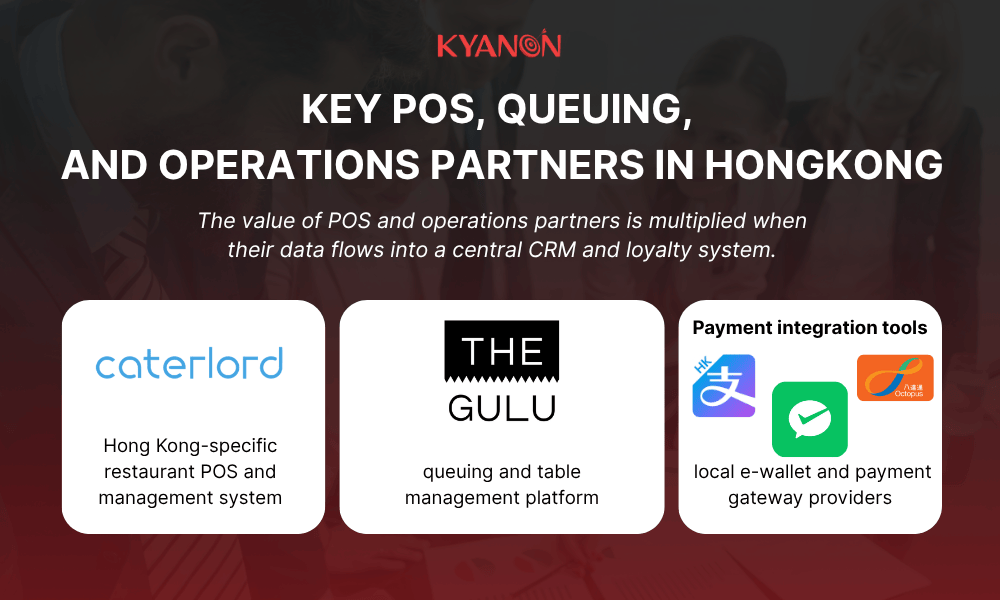
Key platforms:
- Caterlord: Hong Kong-specific restaurant POS and management system
- Foodgulu: queuing and table management platform
- Payment integration tools: local e-wallet and payment gateway providers supporting Octopus, AlipayHK, WeChat Pay HK, and credit card processing
Use case: These tools improve branch-level operational efficiency, reducing wait times, connecting ordering data to kitchen management, and enabling faster payment. They become strategically important when integrated with the wider mobile app ecosystem rather than operating as isolated point solutions.
Critical integration point: The value of POS and operations partners is multiplied when their data flows into a central CRM and loyalty system. Without integration, operational efficiency gains remain siloed from customer experience improvements.
Best mobile app partners for Hong Kong restaurant chains by business need
The right partner depends on the business objective. The table below is the fastest way to shortlist by need rather than by brand familiarity.
|
Business need |
Best-fit partner type | Strong options in Hong Kong |
Why |
|
Build a branded restaurant app |
Custom mobile app ecosystem partner | Kyanon Digital |
Best for direct ordering, owned data, loyalty, and cross-branch app design |
|
Fast delivery reach |
Delivery marketplace | foodpanda, KeeTa |
Best for acquisition, convenience, and logistics reach |
|
Discovery and booking |
Discovery/reservation platform | OpenRice, Bistrochat |
Best for visibility, reservations, and local demand capture |
|
Loyalty and repeat business |
Custom loyalty or rewards partner | Kyanon Digital, yuu Rewards, Mobile.Cards |
Best for retention, offers, and customer engagement |
|
Branch efficiency and operations |
POS/queueing/payment operations partner | Caterlord, THE GULU, payment integration providers |
Best for execution consistency and reporting |
Best partner for building a branded restaurant app
A branded app is the most commercially durable digital asset a restaurant chain can own. The core advantages:
- Full data ownership: every order, preference, and behavioral signal belongs to the business, not the platform
- Direct customer access: push notifications, in-app promotions, and re-engagement campaigns without platform intermediaries
- Long-term retention value: loyalty programs, personalized offers, and member-exclusive content that build habit and repeat visit frequency
Gartner’s CX research confirms that product experience and interaction experience account for over 66% of the change in customer loyalty, meaning the quality of the digital experience delivered through a branded app directly determines retention outcomes.
Kyanon Digital leads this category with custom mobile app ecosystems purpose-built for restaurant chains, integrating direct ordering, loyalty, CRM, multi-branch management, and payment in a single owned platform.
Explore more: Turn Your Loyalty Platform Into a Revenue-Driving Engine
Best partners for delivery reach
- Keeta: dominant reach platform post-Deliveroo exit; highest order volume in Hong Kong
- Foodpanda: strengthened after absorbing Deliveroo assets; strong in grocery and pickup
Best partners for discovery and booking
- OpenRice: primary discovery platform in Hong Kong; essential for visibility with local diners
- Bistrochat: useful for table management and reservation flow; limited CRM depth
Best partners for loyalty and repeat business
- Kyanon Digital: for chains that need a fully integrated, brand-owned loyalty ecosystem with CRM and data analytics
- Yuu Rewards: for chains seeking coalition reach and easier onboarding without custom development
- Mobile.Cards: for lightweight digital stamp-card loyalty programs
Best partners for operations and branch efficiency
- Caterlord: strong local POS capability with Hong Kong-specific configurability
- Foodgulu: queuing and table management; reduces front-of-house friction
- Payment/POS integrators: essential for Octopus, AlipayHK, and WeChat Pay HK acceptance
When Hong Kong restaurant chains need a strategic partner
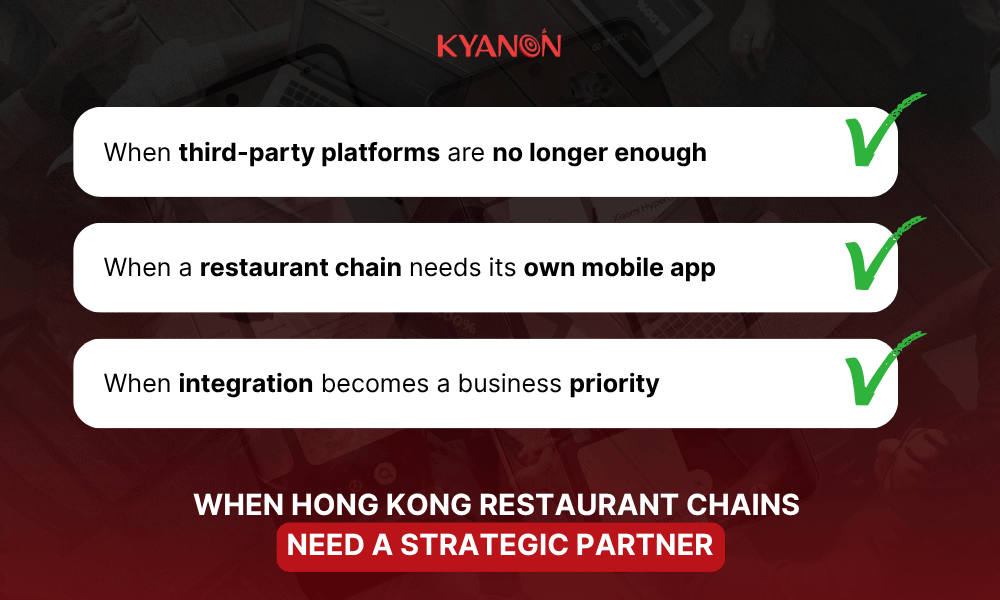
When third-party platforms are no longer enough
The signs are usually clear:
- High commission dependency
- No real ownership of customer data
- Difficulty building loyalty
- Inconsistent brand experience
This is the point where a marketplace channel may still be useful but no longer sufficient as the center of the mobile strategy.
When a restaurant chain needs its own mobile app
A chain typically needs its own app when it wants to
- Enable direct ordering
- Run personalized promotions
- Capture first-party customer data
- Operate one app across multiple branches
This is increasingly relevant because mobile optimization is now tied directly to visit-driving activity. Deloitte Digital reports that 48% of surveyed restaurants said optimizing owned platforms for mobile experiences is one of the most effective ways to drive visits.
When integration becomes a business priority
Integration becomes urgent when the business needs to:
- Connect POS
- Sync loyalty
- Enable local payment methods
- Centralize reporting and campaign management
Without that, AI, personalization, and CRM usually fail to produce enterprise value because the data inputs are fragmented. Gartner’s 2025 data and analytics trend framing reinforces the same point: the quality and usability of data products matter before advanced analytics can deliver reliable outcomes.
Key features restaurant chains should expect from mobile app partners
The real value sits in orchestration, data, and operational fit.
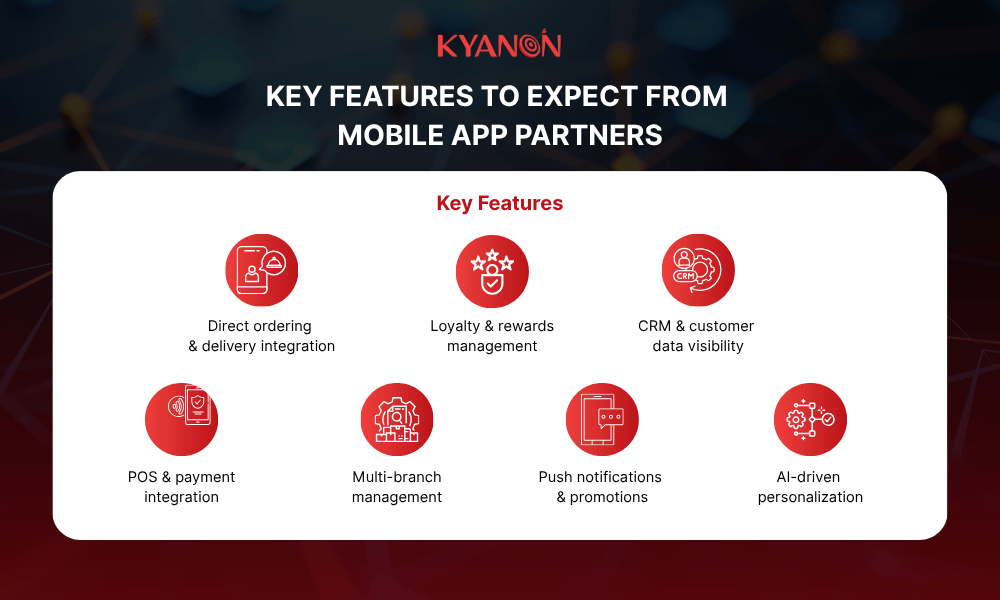
Direct ordering and delivery integration
Support branded ordering journeys
Connect with delivery or pickup flows
Avoid forcing customers into too many handoffs
Loyalty and rewards management
Points, tiers, vouchers, and rule logic
Campaign-level control across outlets
Clear redemption reporting
CRM and customer data visibility
First-party profiles
Purchase history
Segmentation and lifecycle tracking
Consent-aware data capture
POS and payment integration
Real-time sync with transaction systems
Local payment support
Lower reconciliation friction
Multi-branch operational management
Outlet-level menus and pricing
Central campaign control
Role-based reporting by branch or concept
Push notifications and promotional campaigns
Triggered offers
Geo and behavior-based messages
Branch-specific promotion support
AI-driven personalization and recommendations
Product recommendations
Promotion targeting
Reorder prompts and behavior-led messaging
But businesses should evaluate AI carefully. Gartner reported in 2025 that poorly handled personalization can create regret and reduce future purchase intent, so AI should be judged on data quality, controls, and measurable uplift rather than on headline claims alone.
Reservation, queue, and table management support
Queueing and waitlist visibility
Reservation flow
Demand smoothing during peak periods
5 challenges Hong Kong restaurant chains face when choosing app partners
|
Challenge |
Why it matters |
Solution |
|
Relying too heavily on third-party delivery apps |
Creates dependency, high commission costs, and weak control over customer relationships. |
Keep delivery apps for reach, but build owned channels for direct ordering and retention. |
|
Losing ownership of customer relationships |
Prevents the business from building CRM, loyalty, and re-engagement strategies. |
Work with partners that enable first-party data capture and customer lifecycle management. |
|
Managing disconnected systems across branches |
Makes operations harder to control and reporting harder to trust. |
Select partners that unify POS, payments, loyalty, and branch-level reporting. |
|
Struggling to unify loyalty, CRM, and promotions |
Reduces personalization and weakens campaign performance. |
Connect loyalty, CRM, and promotions through one integrated platform or ecosystem. |
|
Choosing a partner that cannot scale with the business |
Small-scale solutions often fail at enterprise growth stages. |
Choose a partner with scalable architecture, strong integration support, and multi-branch readiness. |
5 factors to consider when evaluating mobile app partners
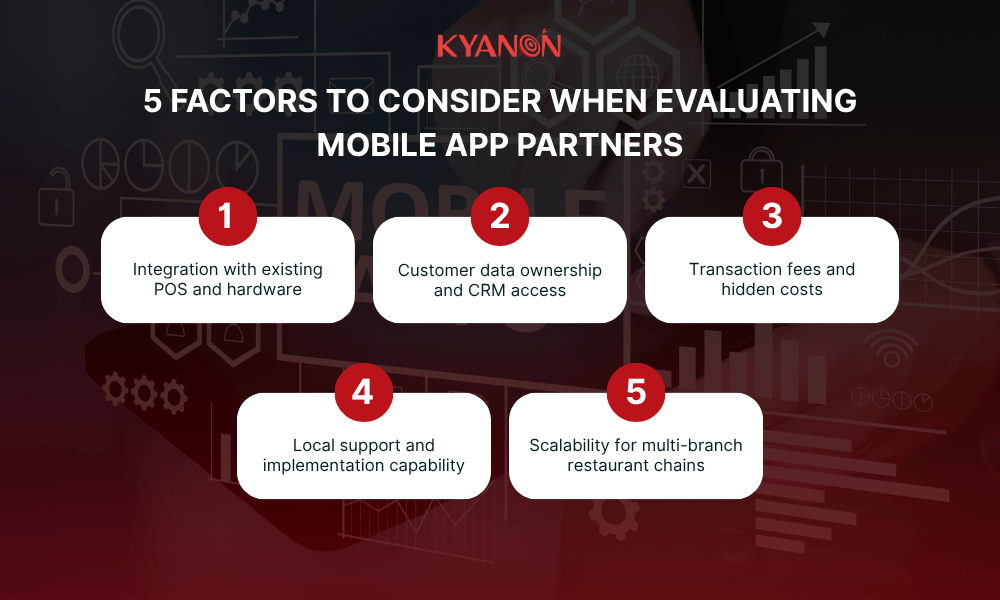
Integration with existing POS and hardware
Ask:
- Does it connect to current POS, kiosks, printers, and payment flows?
- How much custom work is required?
- Who owns support when integration breaks?
Customer data ownership and CRM access
Ask:
- Who owns the customer data?
- Can the business export and use it freely?
- Is the data granular enough for a retention strategy?
Ask:
- What are the commission, subscription, and implementation costs?
- Are there extra charges for support, campaigns, or outlets?
- What is the real cost at scale?
Local support and implementation capability
Ask:
- Is there local implementation experience in Hong Kong?
- Can the partner support local payment methods and operational realities?
- Is rollout support available during peak trading periods?
Scalability for multi-branch restaurant chains
Ask:
- Can the system handle multiple outlets, concepts, and promotions from one control layer?
- Does reporting work by branch and by group?
- Can the business add functions later without rebuilding the core?
A smarter mobile app strategy for Hong Kong restaurant chains
Why relying on one app partner is rarely enough
Each category of mobile app partner solves one problem:
- Delivery platforms solve logistics reach, but not retention or data
- Loyalty platforms solve repeat engagement, but not ordering or operations
- Discovery platforms solve awareness, but not conversion or retention
The result of a single-partner strategy: restaurant chains optimize one dimension of the business while remaining structurally weak across the others.
What an ideal partner ecosystem looks like
|
Layer |
Partner type |
Function |
|
Core (Owned) |
Custom app ecosystem (Kyanon Digital) |
Branded ordering, loyalty, CRM, data |
|
Reach |
Delivery platforms (Keeta, Foodpanda) |
New customer acquisition, logistics |
|
Discovery |
OpenRice, Bistrochat |
Local visibility, dine-in reservations |
|
Operations |
Caterlord, Foodgulu, payment integrators |
Branch efficiency, payment, POS sync |
The strategic logic: Delivery platforms handle acquisition. The owned app handles retention. Operations partners handle efficiency. All three layers connect through a shared customer data infrastructure.
Why integrated ecosystems create better business outcomes
- Better customer retention: personalized loyalty and re-engagement driven by first-party behavioral data
- Stronger data ownership: every touchpoint feeds a unified customer profile that the restaurant owns
- Improved campaign targeting: segment-level marketing replaces blanket promotions, and cost-per-campaign outcome improves
- More consistent operations across branches: centralized management reduces operational variance and reporting lag
How Kyanon Digital supports restaurant chains beyond app development

Kyanon Digital supports restaurant chains beyond app development by helping businesses plan digital strategy, integrate systems, strengthen loyalty, use analytics, and scale operations after launch.
- Supports digital strategy and planning: Kyanon Digital helps businesses define technology goals, architecture, and roadmaps, not just build app features.
- Connects systems and automates workflows: Its services focus on integrating platforms, improving efficiency, and reducing siloed operations across the business.
- Strengthens loyalty and customer engagement: Kyanon Digital highlights loyalty and rewards solutions that support better retention, customer data use, and engagement strategy.
- Uses analytics to improve decisions: Its offering includes data strategy, analytics, forecasting, BI, and AI support to help businesses make smarter decisions over time.
- Provides post-launch support and optimization: Kyanon Digital also positions itself around support, optimization, and scaling after launch, which is important for restaurant chains running live digital operations.
- Helps unify multi-system operations: Its restaurant-related case studies show experience in modernization and integration for large restaurant businesses managing fragmented systems.
Conclusion
Hong Kong’s restaurant market is at an inflection point. Delivery platform consolidation, margin compression, and rising consumer expectations for personalized experiences have made the mobile app strategy question unavoidable, not just for growth, but for operational survival.
The most durable businesses in this market will not be those with the largest delivery platform presence. They will be those who own their customer data, control their loyalty mechanics, and have built a direct digital channel that compounds in value with every transaction.
That requires the right combination of mobile app partners and a strategic technology partner who builds and maintains the ecosystem that connects them.
Kyanon Digital helps restaurant chains across Hong Kong and Asia-Pacific build mobile app ecosystems that deliver direct ordering, loyalty, CRM, POS integration, and multi-branch scalability on a platform the business owns.
If you’re evaluating mobile app partners who are ready to move beyond platform dependency and build a customer relationship that belongs to you, contact us now!