
HongKong IT support has shifted from a local helpdesk function to a cross-border operating requirement as more enterprises run cloud, data, security, and user support across HongKong, Mainland China, and Singapore.
The market reflects this shift. Technavio forecasts that HongKong’s IT market will grow by USD 3.84 billion from 2025 to 2030, at an 8.2% CAGR, driven by government-led digital infrastructure expansion, smart city investment, and rising demand for cloud, cybersecurity, and data platforms.
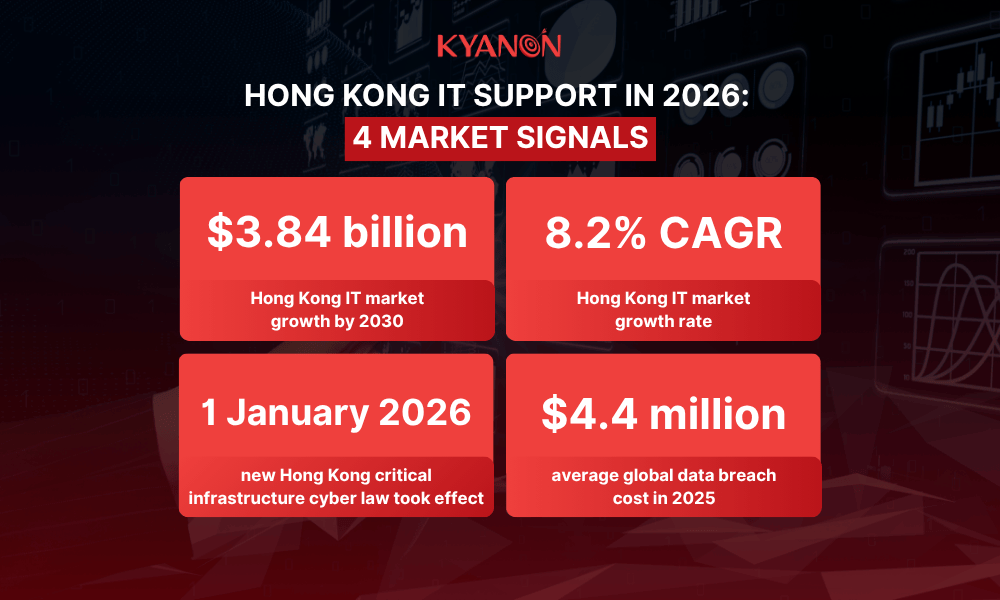
The pressure is not just growth-driven. Hong Kong’s Protection of Critical Infrastructures (Computer Systems) Ordinance came into effect on January 1, 2026, introducing mandatory cybersecurity obligations for designated operators across critical sectors. At the same time, IBM’s 2025 breach research shows the global average cost of a data breach was USD 4.4 million, while secondary summaries of the same report place the financial services average at USD 5.56 million, showing why tolerance for ad hoc IT management is falling fast.
Cross-border complexity is rising as well. Businesses operating across the HongKong–Mainland China–Singapore corridor increasingly need IT support that can work across jurisdictions, governance models, and time zones, not just within a single office.
This is why Singapore-based IT agencies are becoming part of the discussion, offering a centralized delivery model with regional reach. That view is consistent with the market’s growing focus on cross-boundary data integration, cloud adoption, and managed services.
This blog maps the HongKong IT support landscape as it stands in 2026, covering service types, market players, pricing structures, emerging trends, and the specific rationale behind the Singapore cross-border delivery model so enterprises can evaluate options with full context.
Key takeaways
- New cybersecurity legislation (effective Jan 2026) mandates compliance controls across 8 critical sectors: finance, energy, transport, healthcare, and more.
- Financial services data breaches in 2025 cost an average of US$5.56M per incident, the second highest globally (IBM Cost of a Data Breach Report, 2025).
- Singapore-based agencies are increasingly delivering IT support for Hong Kong operations via a centralized SG–HK cross-border model, offering 24/7 coverage and multi-jurisdiction governance.
- Managed IT pricing in Hong Kong ranges from US$50–$150/user/month for SMBs to custom enterprise contracts. Hidden costs often sit in compliance complexity and security depth.
- AI-powered IT support (AIOps), zero-trust security architecture, and cloud-first strategies are now operational requirements, not optional upgrades.
- Choosing the wrong provider costs more than the fee difference. Scalability gaps, poor SLA governance, and compliance misalignment are the most common failure modes.
Further reading:
- A 2026 Guide to Vietnam Software for Hong Kong Enterprises
- Top AI Consulting Firms for Hong Kong Enterprises
- Top Best Choice Offshore Software Partners For Hong Kong
What is HongKong IT support?
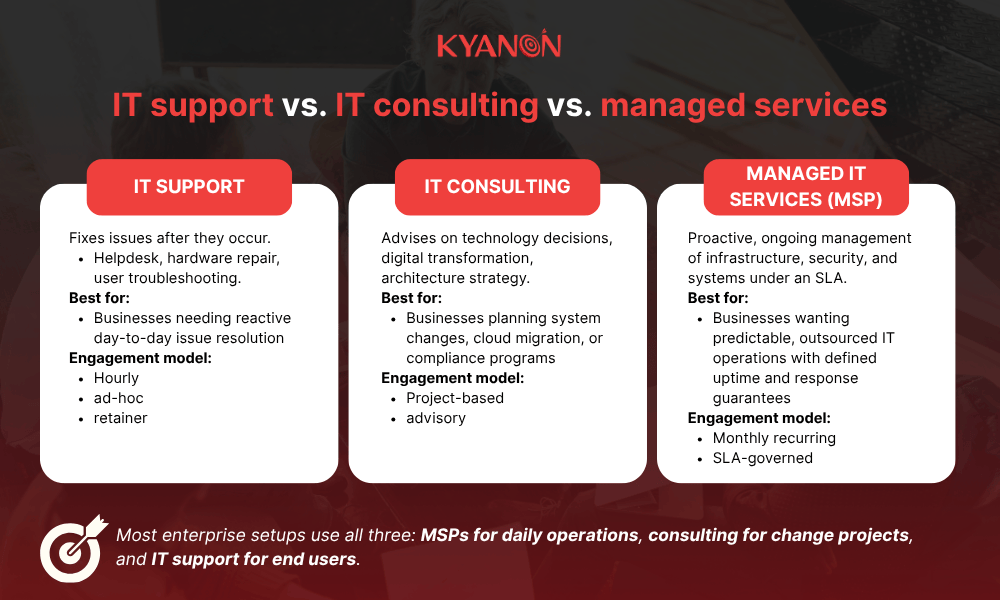
HongKong IT support refers to the range of services that maintain, secure, and optimize an organization’s technology infrastructure within, and increasingly, connected to the Hong Kong operating environment. This includes everything from end-user helpdesk to fully managed infrastructure, cloud operations, and strategic IT consulting.
Understanding the distinctions between service types is the first step to matching the right provider to your actual needs.
Why IT support is critical for Hong Kong
Hong Kong remains a dense, high-speed operating environment where downtime, weak access control, and fragmented vendor management can quickly become business issues, not just technical issues.
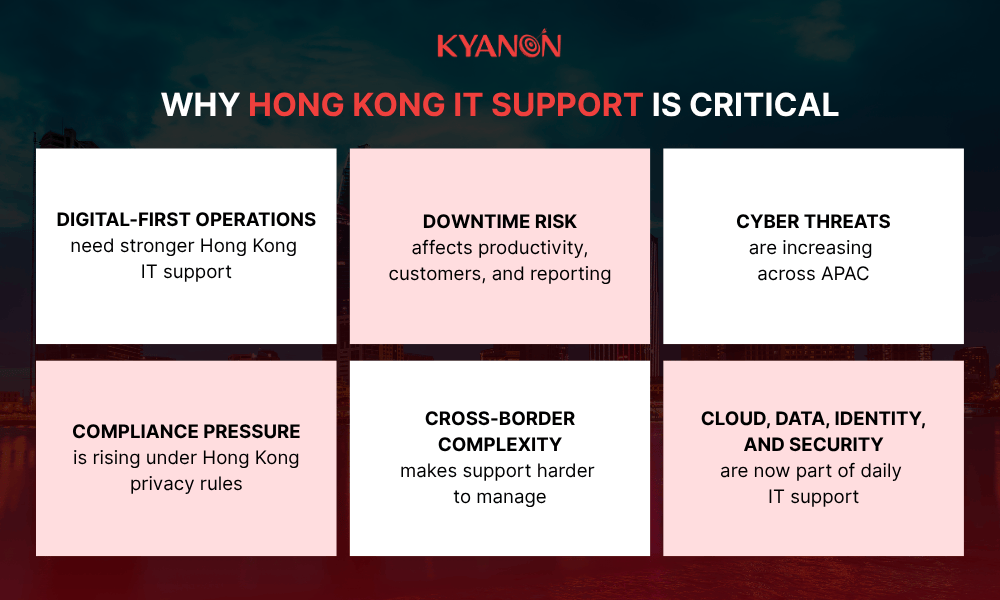
- Digitalization is already mainstream in Hong Kong. HKMA found nearly two-thirds of sampled non-financial corporates are engaged in digitalization, and over half are in more advanced stages. That means support demand now includes cloud, integration, data, identity, and security, not just device repair.
- Operational downtime is more expensive in digitally mature environments. As firms move deeper into digital workflows, support failures affect customer operations, internal productivity, partner connectivity, and regulatory reporting. This is a practical implication of higher digital dependence, even where exact downtime costs vary by sector.
- Cyber threats are increasing in frequency and sophistication. IBM’s 2025 Threat Intelligence Index says APAC saw the largest share of incidents in 2024, while Deloitte’s 2025 cyber reporting highlights the growing use of AI in phishing and attack execution.
- Compliance pressure is active, not theoretical. In Hong Kong, personal data handling sits under the PDPO framework and PCPD guidance, including data breach notification guidance and AI-related privacy resources for organizations.
- Cross-border complexity is increasing. For many businesses, support now spans users in Hong Kong, applications in the cloud, data hosted regionally, and suppliers distributed across multiple jurisdictions. That makes coordination and governance more important than simple proximity.
Types of IT support services in Hong Kong
The term “IT support” covers a wide spectrum. Before evaluating providers, it is important to be clear about which service layers a business actually needs.
|
Service type |
What it covers | Best fit |
Main risk if missing |
|
Managed IT services |
24/7 monitoring, patching, infrastructure management, SLA delivery | Enterprises needing an outsourced operating layer |
Reactive firefighting |
|
IT helpdesk & end-user support |
Ticket handling, remote troubleshooting, device/user support | Distributed teams and multi-office operations |
Low productivity and poor user experience |
|
Infrastructure & cloud support |
Network, servers, cloud platforms, backups, resilience | Cloud-first or hybrid estates |
Outages, weak recovery, cloud misconfiguration |
|
IT consulting |
Roadmaps, architecture, vendor strategy, transformation planning | Businesses changing systems or scaling regionally |
Fragmented investments |
|
Cybersecurity & compliance |
Endpoint, IAM, incident response, policy controls, audit readiness | Regulated or high-risk sectors |
Data loss, control failures, weak incident response |
Managed IT services (MSP Hong Kong)
- Provides proactive, ongoing management of IT infrastructure under a defined SLA
- Includes 24/7 monitoring, patch management, device management, and incident response
- Functions as an outsourced IT department, replacing or augmenting in-house teams
Best fit: Businesses that need predictable costs, guaranteed uptime, and continuous coverage without building large internal IT teams
IT helpdesk & end-user support
Covers remote support, on-site support, ticketing, user onboarding/offboarding, access resets, and hardware/software troubleshooting.
- Automation-assisted triage: AI-driven first-response tools reduce resolution time on common issues
- Bilingual support (English + Cantonese/Mandarin) is a practical requirement in HK enterprise environments
IT infrastructure & cloud support
Includes AWS, Azure, hybrid cloud, server management, networks, backup, recovery, and capacity monitoring.
The Hong Kong data center market is transitioning toward high-density AI/GPU workloads, requiring infrastructure support teams with advanced capabilities beyond traditional server management
A strong provider should be able to support both legacy infrastructure and cloud-native environments during transition periods.
IT consulting services in Hong Kong
Focuses on architecture decisions, transformation roadmaps, operating model design, and vendor rationalization.
Useful when a business is deciding what to modernize first, how to reduce vendor overlap, or whether to centralize support across markets.
- IT architecture design: cloud migration, system integration, ERP/CRM implementations
- Regulatory technology: compliance architecture for PDPO, Critical Infrastructure Ordinance, GBA data rules
Cybersecurity & compliance services
Covers endpoint security, vulnerability management, IAM, email security, SOC coordination, policy enforcement, and compliance support.
- Hong Kong buyers should treat this as the core support scope, not an optional add-on.
- PDPO compliance: data classification, access controls, breach notification processes
- Critical Infrastructure Ordinance compliance: Security Management Unit setup, risk assessments, audit preparation
- Zero Trust architecture implementation: Identity-first security replacing legacy perimeter models
- Endpoint and network security: EDR, SIEM, threat detection, and response (MDR)
Selected IT support providers for Hong Kong enterprises
Automation-assisted triage: AI-driven first-response tools reduce resolution time on common issues
Bilingual support (English + Cantonese/Mandarin) is a practical requirement in HK enterprise environments
|
Provider |
Strengths | Best for |
Regional reach |
|
Kyanon Digital |
Integrated technology solutions for growth and operational impact. R&D team in Vietnam with international delivery. | Enterprises needing end-to-end digital transformation with managed IT capabilities across HK and APAC |
HK, Singapore, APAC |
|
CDW |
Hardware procurement, multi-vendor solutions, enterprise-scale infrastructure | Large enterprises with complex hardware and multi-vendor environments |
Global / APAC |
|
FunctionEight |
SME-focused managed IT, Microsoft 365, local HK support | SMBs and mid-market businesses need local helpdesk and cloud productivity management |
Hong Kong |
|
systems Go |
IT staffing, contract resources, managed services for financial services | BFSI sector, project-based IT resourcing, compliance-sensitive environments |
HK/Singapore |
What differentiates top providers
The strongest providers usually show clearly:
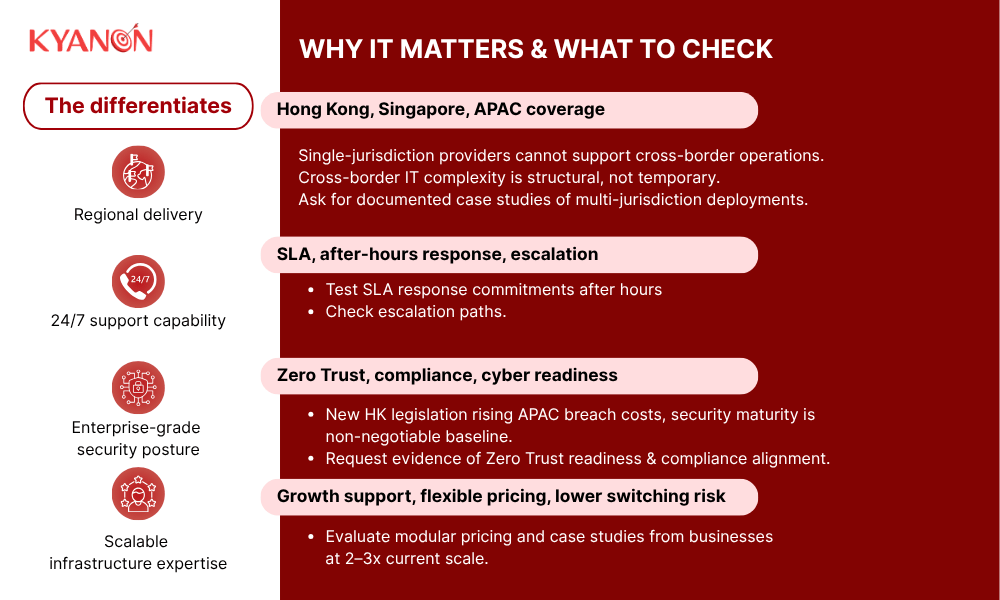
- Regional delivery design, not just local staffing
- 24/7 support capability with clear escalation ownership
- Security maturity embedded in operations
- Cloud and infrastructure depth
- Scalability across additional sites, users, and systems
Explore more: Top AI Consulting Firms for Hong Kong Enterprises
Key advantages of Singapore-HK partnerships
This is the most important strategic section for businesses evaluating a Singapore agency for Hong Kong IT support.
Cross-border IT support model (SG–HK)
A Singapore-led, Hong Kong-executed model can work well when:
- Support operations need regional consistency
- Systems span multiple APAC markets
- The business wants central governance with distributed execution
- Internal teams need one operating partner instead of several local vendors
This is less about geography and more about operating design.
24/7 “follow-the-sun” support
For businesses with customers, teams, or systems across multiple regions, a provider with broader delivery coverage can reduce handoff delays.
The key is not the phrase 24/7 itself. It is whether after-hours incidents have real technical ownership, not just message taking.
Access to high-quality tech talent
Singapore remains one of the region’s strongest digital labor markets. IMDA reports 214,000 tech professionals in 2024, up from 208,300 in 2023, with AI/data and cybersecurity roles among the fastest-growing. This matters because Hong Kong support increasingly requires cloud, data, security, and automation skills, not only desktop support.
Stronger governance and standardization
Singapore’s digital economy indicators point to a market that is both broad and deep in enterprise digital adoption:
95.1% of enterprises adopted at least one digital area in 2024
- Non-SMEs raised AI adoption from 44.0% to 62.5%
- SMEs raised AI adoption from 4.2% to 14.5%
- Tech jobs linked to cloud platforms and scalable infrastructure continued to rise
For buyers, this suggests many Singapore agencies operate in a market where structured digital delivery is already normal. That can translate into stronger runbooks, clearer change control, and better-managed support processes.
Compliance and data security across regions
A Singapore agency can be a strong partner, but only if it can handle Hong Kong requirements in detail:
- PDPO and privacy handling in Hong Kong
- Data location and transfer controls
- Incident reporting responsibilities
- Access control across shared systems
- Audit trails for regulated operations
A cross-border model is only credible when responsibility is explicit. Enterprises should ask who owns the incident, who holds privileged access, where logs sit, and how data is segmented.
Key features to look for in a HongKong IT support provider
Below is a practical shortlist businesses can use during provider evaluation.
|
Evaluation area |
What good looks like |
Warning sign |
|
SLA & response times |
Clear first-response and resolution targets by severity |
Vague “best effort” commitments |
|
Local + regional presence |
Hong Kong response model plus APAC coordination |
Regional story with no local execution detail |
|
Cybersecurity maturity |
IAM, patching, endpoint controls, incident workflow, audit readiness |
Security handled as a separate upsell |
|
Cloud certifications |
Demonstrated AWS/Azure/GCP capability and references |
Only desktop/helpdesk competence |
|
Vendor & asset management |
Clear ownership of lifecycle, warranties, renewals, inventory |
No operating visibility |
|
Bilingual support |
Practical language coverage for users and documentation |
Sales promise without staffing proof |
HongKong IT support pricing (2026 guide)
Pricing in Hong Kong is not standardized. It depends heavily on service depth, support window, security scope, and infrastructure complexity.
Common pricing models
|
Pricing model |
Structure |
Best suited for |
|
Per-user pricing |
Monthly fee per managed user. Scales directly with headcount. |
Businesses with distributed, user-centric environments (professional services, financial operations) |
|
Per-device pricing |
Monthly fee per managed device. Predictable for asset-heavy operations. |
Businesses with high device-to-user ratios: manufacturing, logistics, multi-site retail |
|
Monthly managed services (Flat) |
Fixed monthly contract covering defined scope. Maximizes cost predictability. |
Businesses wanting full-scope coverage without variable billing surprises |
|
Project-based pricing |
One-time or milestone-based fees for defined scope: migrations, implementations, audits. |
Digital transformation projects, compliance readiness programs, cloud migrations |
Average cost in Hong Kong
|
Business segment |
Typical price range |
Typical scope |
|
SMB (around 20 users) |
US$12.8–19.2 / user/month |
Helpdesk, monitoring, M365/Google Workspace, endpoint/admin support |
|
Mid-Market (100–500 users) |
Custom pricing |
Expanded managed services, security, cloud, reporting |
|
Enterprise (500+ users) |
Custom pricing |
Custom SLA, multi-site delivery, advanced security/compliance |
Note: These public prices are for reference only and should not be treated as fixed market benchmarks for all Hong Kong businesses.
How to choose the right IT support company in Hong Kong
Most businesses make provider selection errors at two points: choosing based on price before defining requirements, and failing to test the provider’s actual responsiveness during evaluation.
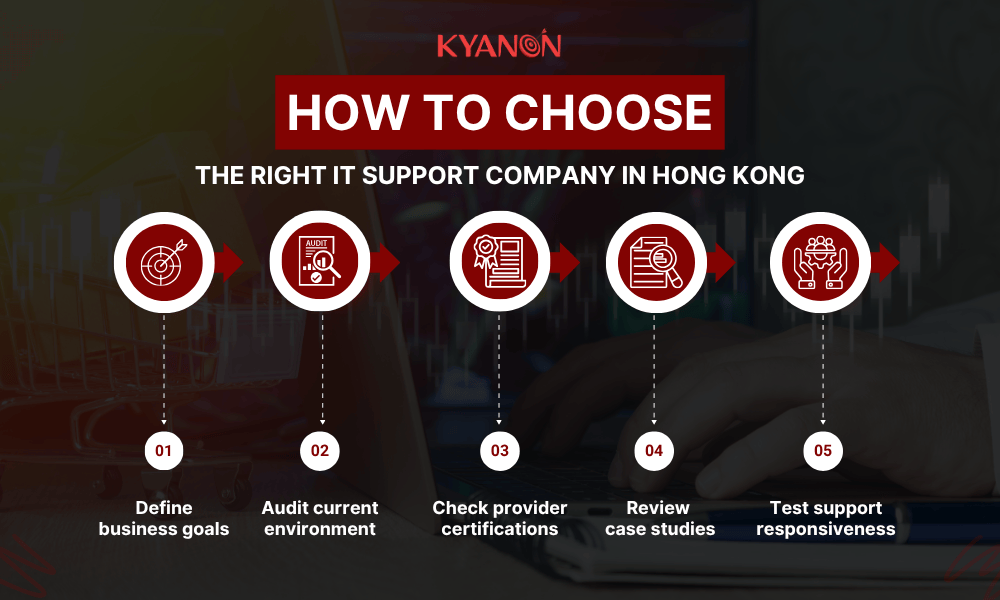
Evaluation framework
|
Step |
Action |
What it reveals |
|
Define business goals |
Articulate what IT support needs to enable: uptime targets, compliance milestones, growth plans across new markets. |
Whether a provider’s capability matches future needs, not just current state. |
|
Audit current environment |
Document existing infrastructure, contracts, security posture, pain points, and escalation history. |
Hidden complexity that should be disclosed to providers for accurate pricing and fit assessment. |
|
Check provider certifications |
Verify cloud certifications (AWS, Azure, GCP), security credentials, and any industry-specific compliance experience. |
Whether technical capability is marketed or demonstrated. |
|
Review case studies |
Request references from clients with comparable size, sector, and cross-border complexity. |
Whether the provider has solved problems similar to yours, not just similar in size. |
|
Test support responsiveness |
Submit a test support ticket or call during evaluation. Measure actual response time against stated SLA. |
The gap between sales promises and operational reality. This is the most revealing test. |
Common mistakes to avoid
- Choosing the cheapest vendor: Low-price IT contracts almost always externalize cost to the business through slower response, scope gaps, or security incidents that a better-resourced provider would have prevented.
- Ignoring scalability: A provider that is a good fit at 100 users may be structurally unable to support 500 users across three cities. Evaluate the provider’s model at 2–3x current business scale.
- Underestimating cybersecurity requirements: With the January 2026 Critical Infrastructure Ordinance now in force, compliance is not optional for designated sectors. Providers without documented compliance frameworks create regulatory exposure, not just operational risk.
- Not defining the cross-border requirement upfront: If operations span HK and Singapore, or HK and the GBA, this must be stated explicitly in the procurement process; it fundamentally changes which providers are qualified.
Explore more: Software development companies in Hong Kong
Latest IT support trends in Hong Kong
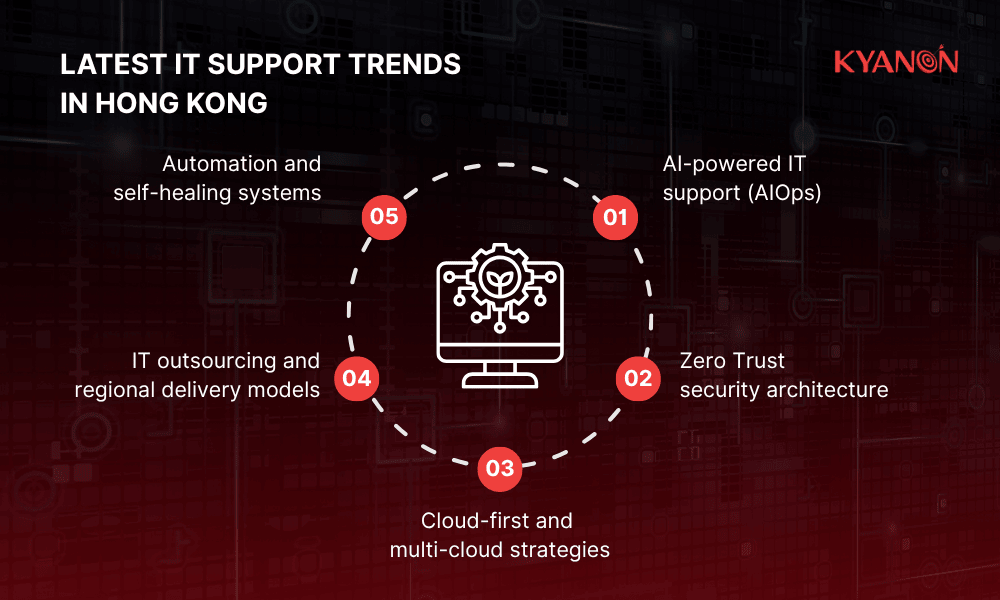
AI-powered IT support (AIOps)
AI is moving into ticket triage, anomaly detection, predictive monitoring, and auto-remediation.
This trend is real, but governance matters. IBM’s 2025 reporting warns that organizations experiencing AI-related incidents often lack proper access controls.
Businesses should ask whether the provider has rules for AI access, logging, human override, and change control.
Zero Trust security architecture
Identity-first security is becoming central to modern support.
Deloitte’s 2025 cyber analysis and PCPD’s organizational guidance both point toward stronger control expectations around access, data handling, and cyber hygiene.
In practice, this means support providers must understand MFA, privileged access, device posture, and segmented access, not just antivirus deployment.
Cloud-first and multi-cloud strategies
More enterprises are operating across hybrid and multi-cloud environments, which increases the value of support teams that understand platform operations, not just end-user devices.
Hong Kong continues to hold strategic weight in cloud and data center infrastructure, while Singapore’s market shows growing digital intensity and AI/cloud uptake (InvestHK).
IT outsourcing and regional delivery models
The rise of SG–HK support partnerships reflects a wider move toward regional operating models with local execution layers.
This is especially relevant where enterprises want common tooling, shared governance, and fewer fragmented country vendors.
Automation and self-healing systems
Automation is reducing manual support work in patching, alert handling, endpoint response, and routine remediation.
- The value for businesses is a lower mean time to resolution and more predictable service levels.
- The risk is over-automation without ownership; providers still need clear human escalation for critical events.
Why choose Kyanon Digital as your IT support
Kyanon Digital delivers cross-border IT support for Hong Kong enterprises through a regional model combining 24/7 coverage, DevOps and governance capability, and a proven track record in HK digital operations. For businesses running complex systems across HK and APAC, this means one partner instead of fragmented local vendors.
- Regional delivery model: Supports businesses across Hong Kong, Singapore, and APAC with cross-border delivery capability.
- Broader support scope: Covers support and maintenance, software enhancement, integration, and enterprise system support.
- Scalable team: Has a large engineering and consulting base to support growing business needs.
- Proactive support approach: Focuses on stabilization, maintenance, and long-term system improvement, not only break-fix support.
- Hong Kong experience: Shows relevant delivery experience in Hong Kong with ongoing support and 24/7 coverage.
Case study: How Kyanon Digital supports Hong Kong F&B IT operations through a regional delivery model

A Hong Kong branch of a leading global coffee chain partnered with Kyanon Digital to take over the maintenance, stabilization, and continuous enhancement of its large-scale digital ecosystem.
Challenges:
- Limited handover documentation made system understanding and transition more difficult.
- Ongoing system instability and unresolved issues affected service reliability.
- No clear governance model or standard operating processes were in place.
- The digital ecosystem covered customer-facing apps, web platforms, and backend systems, increasing delivery complexity.
Kyanon Digital solution:
- Deployed a 9-member cross-functional team across development, testing, DevOps, and project management.
- Provided 24/7 support coverage to reduce downtime and improve issue response.
- Stabilized the platform through system review, bug fixing, and structured incident management.
- Built governance foundations with agile processes, incident protocols, and centralized documentation.
Results & impacts:
- Improved system stability and reduced service disruption.
- Increased operational efficiency through clearer workflows and governance.
- Enabled new features aligned with business growth in the Hong Kong market.
- Demonstrated how a regional support partner can combine ongoing maintenance, governance, and enhancement in one delivery model.
Read more: Maintenance and Enhancement of a Global Coffee Chain’s Digital Ecosystem in Hong Kong
Conclusion
For businesses reviewing Singapore agencies for Hong Kong IT support, the decision should come down to practical factors such as regional delivery capability, local responsiveness, security maturity, cloud expertise, and long-term scalability.
Kyanon Digital can be assessed through the same lens. With delivery experience across Hong Kong, Singapore, and APAC and capabilities spanning data, CX, AI, automation, and commerce, the company is one of the providers businesses may consider when evaluating cross-border IT support models.
For Hong Kong enterprises that need cross-border IT support with real governance, 24/7 coverage, and regional delivery, not just a local helpdesk, Kyanon Digital is built for that model. Contact us to map your current support gaps against a scalable 2026 structure.