
The biggest tech trends shaping enterprise software architecture in 2026 are agentic AI, Cloud 3.0 infrastructure, and identity-centric zero trust security. Organizations are moving from experimental AI adoption to embedding autonomous systems directly into core architecture across data pipelines, security, and software development workflows.
The biggest tech trends shaping enterprise software architecture in 2026 are agentic AI, Cloud 3.0 infrastructure, and identity-centric zero trust security. Organizations are moving from experimental AI adoption to embedding autonomous systems directly into core architecture across data pipelines, security, and software development workflows.
The following latest tech trends outline the roadmap for digital transformation in the coming year.
Key takeaways
- Agentic AI Transition: Enterprise architecture is moving from passive co-pilots to autonomous agents capable of independent cross-system orchestration.
- Cloud 3.0 & Sovereignty: Focus shifts from simple migration to optimization and full-stack control over data and models.
- Proactive Security: AI-powered defense and identity-centric Zero Trust are becoming the standard to combat deepfakes and automated threats.
- Operational Resilience: Real-time analytics and “GreenOps” are mandatory for sustainable, cost-effective scaling.
Further reading:
- Top GenAI Opportunities for Tech Products by Gartner
- Biggest Software Trends in Retail & eCommerce for 2026
- Trends in Business Process Automation 2026
AI-native & agentic architectures: Beyond passive assistants
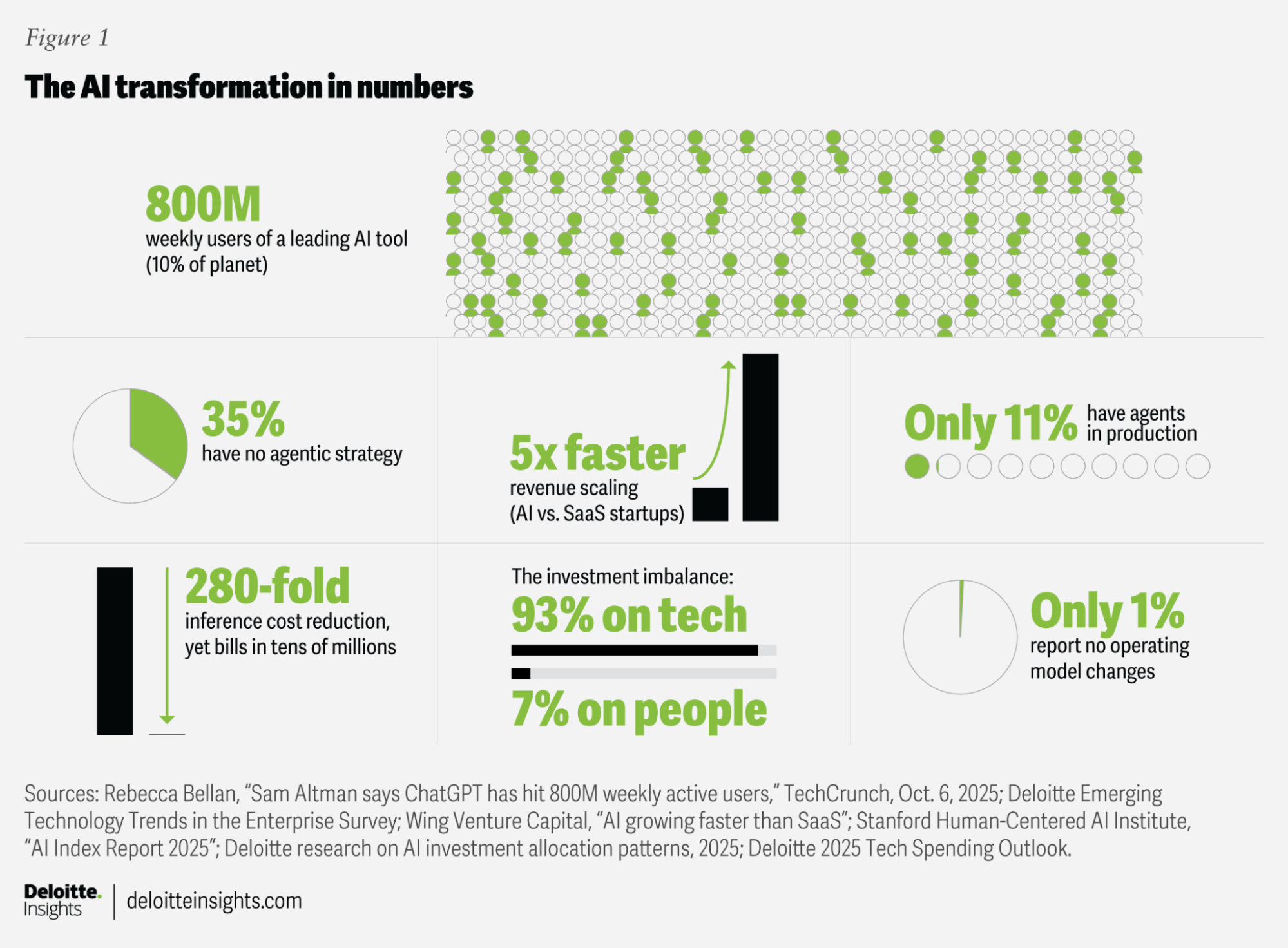
One of the most transformative AI tech trends is the rise of agentic systems. It took the telephone 50 years to reach 50 million users, while the internet achieved the same milestone in just seven years. In contrast, a leading generative AI tool doubled that figure in only two months. Today, it has surpassed 800 million weekly users, representing around 10% of the global population. (Deloitte)
Agentic AI systems
AI is evolving from passive copilots to autonomous agents capable of executing multi-step workflows. These agents can orchestrate across systems such as CRM, ERP, and data platforms without human intervention.
For example, an AI agent in a retail enterprise can:
- Analyze customer demand signals
- Adjust inventory levels
- Trigger logistics workflows
- Optimize pricing in real time
This marks a fundamental shift in current tech trends, where software moves from reactive to proactive execution.
AI-native platforms
Enterprises are redesigning systems with AI embedded at every layer:
- AI-driven data pipelines
- Automated testing and QA
- Self-healing infrastructure
This reduces operational overhead and accelerates innovation cycles. Netflix has built a highly mature AI-native architecture where AI is embedded across multiple layers:
- Data pipelines: AI models process massive streaming data in real time to personalize content recommendations
- Automated testing: Continuous testing and experimentation frameworks validate features at scale
- Self-healing systems: Tools like Chaos Engineering automatically detect and recover from failures
Domain-specific models
Instead of relying on general-purpose LLMs, organizations are investing in smaller, domain-specific AI models:
- Higher accuracy for industry use cases
- Lower inference costs
- Better data control and privacy
This is especially critical in regulated sectors such as finance and healthcare. JPMorgan Chase has made strides in AI through its Contract Intelligence (COiN) platform. By employing AI to interpret and review legal documents, COiN can analyze thousands of contracts within seconds. This capability dramatically reduces the time and resources needed for contract analysis, previously requiring approximately 360,000 labor hours annually (IBM Research). Moreover, the platform has enhanced the accuracy of data extraction, leading to better compliance and risk management processes (Global Banking & Finance Review)
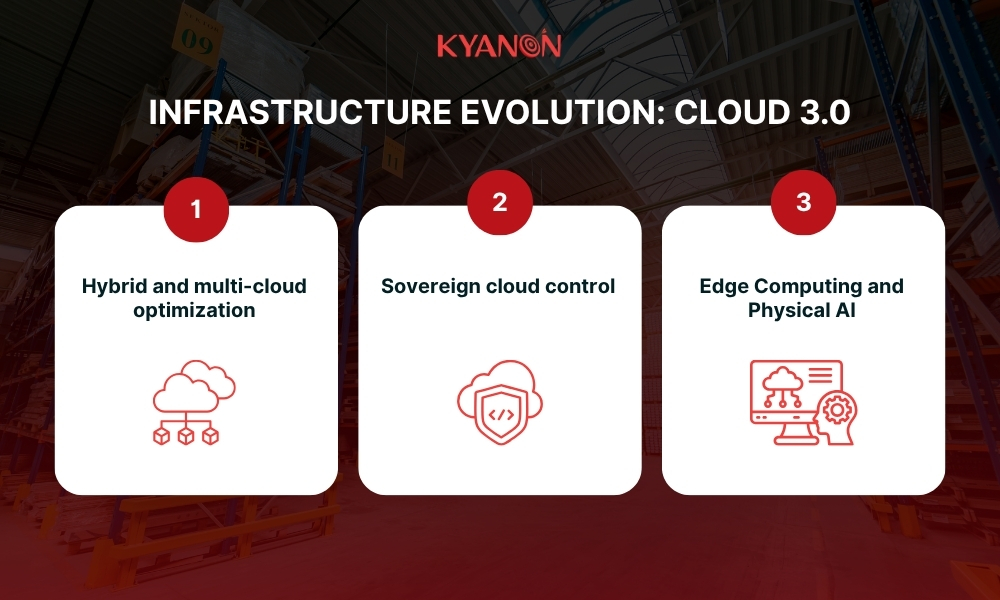
Infrastructure evolution: Cloud 3.0
Another defining pillar of new tech trends is the evolution toward “Cloud 3.0”.
Hybrid and multi-cloud optimization
What makes managing distributed cloud environments sustainable today. The answer lies in the transition from manual oversight to intelligent, AI-driven automation. Modern architectures involving multi-cloud, hybrid cloud, and edge environments have become too complex for human-only management. Therefore, leveraging Cloud 3.0 infrastructure emerges as the only sustainable solution to handle this increasing complexity.
Cloud 3.0 platforms continuously analyze traffic patterns, resource usage, application behavior, and business priorities. Consequently, these intelligent systems automatically scale resources up or down and optimize spending in real time, entirely without human intervention.
Sovereign cloud control
According to Oracle, sovereign cloud control is the strategic deployment of a cloud environment that helps an organization meet strict digital sovereignty requirements while retaining the scalability and performance of modern cloud computing.
As regulatory pressures increase globally, organizations must ensure their infrastructure complies with stringent data residency, privacy, and security laws. For example, a European financial institution might deploy a sovereign cloud to ensure that all personally identifiable information (PII) remains physically within the EU, maintained exclusively by personnel with specific security clearances.
Edge Computing and Physical AI
Edge computing is a distributed computing paradigm that brings data processing, analysis, and storage physically closer to where the data is generated, rather than transmitting raw data to remote, centralized cloud servers. When integrated with modern ai tech trends, this architecture evolves into “edge AI,” enabling artificial intelligence and machine learning models to run directly on local devices.
Because the information is processed right at the source, edge AI delivers real-time inference and autonomous decisions in milliseconds without requiring constant connectivity. This foundational capability is now extending into “physical AI” – a term popularized by NVIDIA, which refers to AI systems embedded in machines that perceive, analyze, and act on information to interact with the real world safely and dynamically.
Physical AI and edge computing combine local intelligence with distributed infrastructure to power mission-critical hardware across multiple industries.
- Autonomous Vehicles: Edge AI processes data from LiDAR, cameras, and radar systems to execute precise, split-second physical movements in cars, drones, and submersibles.
- Industrial IoT (IIoT): Physical AI coordinates perception and decision-making for factory automation systems, heavy machinery controllers, and mobile platforms on production floors.
5G and Telecommunications: Edge computing is deployed directly at base stations, small cells, and telecom units to ensure the real-time responsiveness required for modern distributed networks.
Integrated Security and Governance
Security is becoming deeply embedded into architecture rather than treated as an external layer.
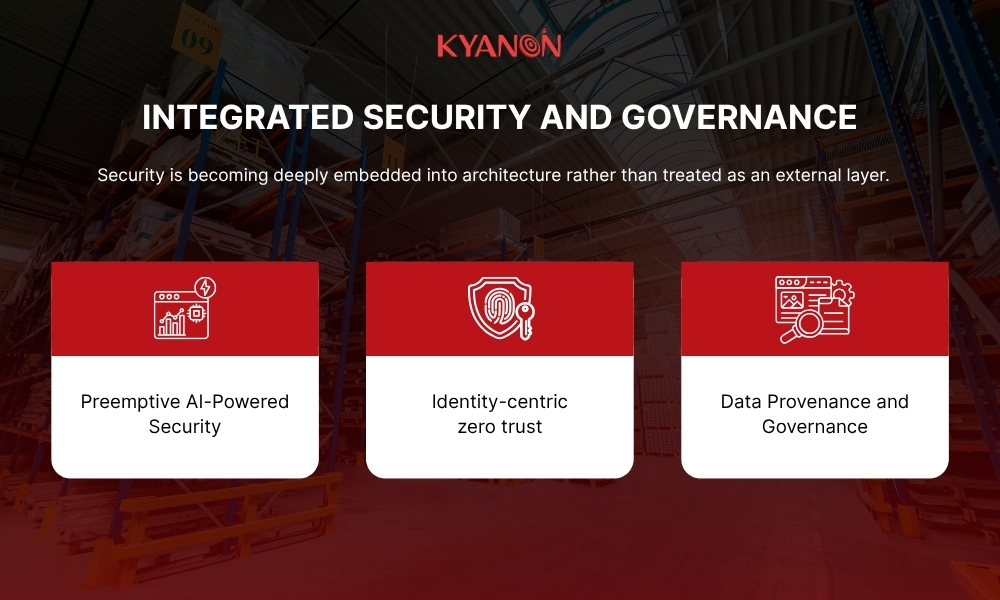
Preemptive AI-Powered Security
As organizations increasingly rely on autonomous systems, cybersecurity is moving away from traditional, reactive defense models toward preemptive, AI-powered security frameworks. This involves deploying artificial intelligence that continuously monitors system behavior, identifies anomalies, and instantly fortifies vulnerabilities without requiring human intervention.
Implementing AI-driven defense mechanisms allows businesses to build resilient systems capable of self-protection and rapid response against emerging threats.
- Adversarial Defense: AI models are specifically trained to recognize and block adversarial inputs designed to trick or manipulate machine learning algorithms and autonomous agents.
- Deepfake Detection: Preemptive security protocols analyze audio and video streams in real time to identify and flag synthetically generated media, preventing sophisticated social engineering fraud.
- Automated Threat Hunting: Intelligent systems continuously scan the network environment to uncover hidden vulnerabilities, isolating compromised endpoints automatically before lateral movement occurs.
Identity-centric zero trust
Identity-centric zero trust is a security model where identity, of users, devices, and applications, replaces the traditional network perimeter as the primary control point for access. Instead of trusting anyone inside a specific network, this approach treats every access request as a potential threat that must be continuously verified.
In 2026, identity-centric zero trust has shifted from a “best practice” to a mandatory baseline for modern digital infrastructure. Its application focuses on replacing static network defenses with dynamic, identity-first verification across several key areas.
Data Provenance and Governance
By 2026, Data Provenance and Governance have evolved from “back-office compliance” to the frontline of cybersecurity. The explosion of Generative AI has made it impossible to trust data without knowing exactly where it came from and who has touched it.
Practical applications:
- Verified Diagnostics: Tracks the exact source of medical data to ensure AI-driven diagnoses are based on reputable clinical records, preventing “garbage in, garbage out” errors in patient care.
- Audit-Ready AI: Banks use immutable audit logs and explainable decision pathways to satisfy regulators that AI-driven lending or trading decisions are unbiased and traceable.
- Sustainability Reporting: Tracks energy use, water consumption, and recycling data across thousands of suppliers to meet over 600 global ESG (Environmental, Social, and Governance) standards.
- Compliance Automation: Law firms use AI-governance platforms to automatically flag data transfers that violate fragmented global privacy laws (like GDPR or new US state laws).
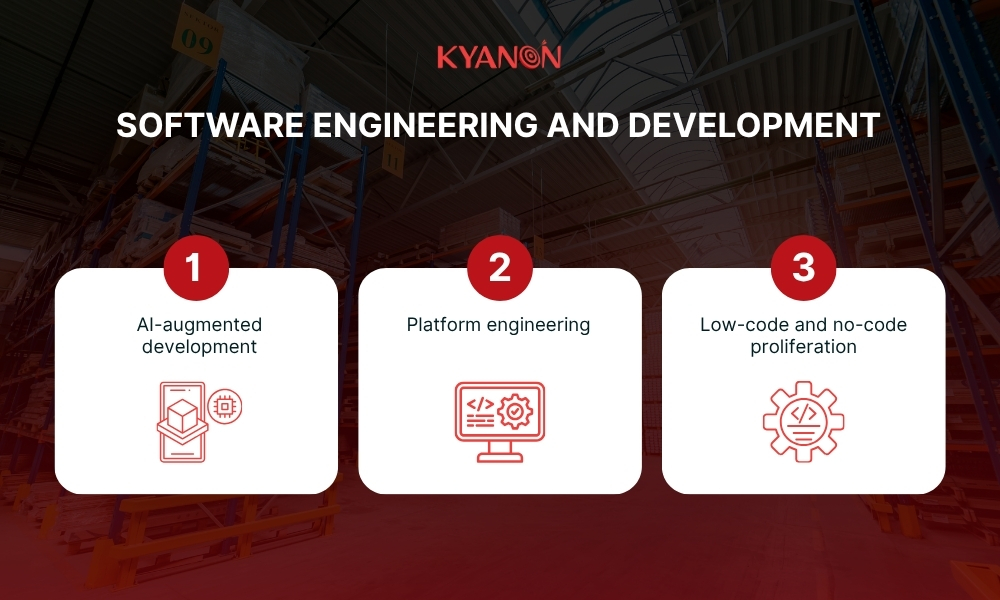
Software engineering and development
Software development itself is being transformed by AI and platform thinking.
AI-augmented development
AI-augmented development has transitioned from “coding assistants” to “AI Teammates.” We are no longer just using autocomplete; we are managing autonomous agents that handle the heavy lifting of the software development lifecycle (SDLC).
The 2026 Shift: From Copilot to Autopilot:
- In 2026, AI agents like Devin or evolved versions of GitHub Copilot can take a Jira ticket, write the feature, create unit tests, debug the CI/CD pipeline, and submit a Pull Request for human review.
- Natural Language as the New Syntax: “Programming” is becoming “System Orchestration.” Senior developers spend more time describing architectural intent and edge cases in high-level language while the AI generates the boilerplate and integration logic.
The “Coder” is becoming the “Code Reviewer.” The primary skill in 2026 is no longer memorizing syntax, but Problem Decomposition and Strategic Oversight.
Platform engineering
Platform Engineering has evolved from a niche DevOps trend into the standard operating model for high-performing tech organizations. It is the practice of building Internal Developer Platforms (IDPs) that provide “golden paths” – standardized, self-service workflows that hide the complexity of infrastructure.
Core applications:
- Rapid Onboarding: A new hire can ship their first line of code on Day 1 because the platform provides a pre-configured development environment (like GitHub Codespaces) with all permissions pre-vetted.
- Standardized Security: Every app deployed through the platform automatically includes logging, monitoring (e.g., Datadog/Grafana), and identity-centric zero trust protocols by default.
- Cost Management (FinOps): Platforms now include “cost transparency” dashboards, showing developers exactly how much their specific microservice costs the company in real-time.
Companies realized that “You build it, you run it” (the original DevOps mantra) was burning out developers. Platform Engineering fixes this by providing the paved road that makes “running it” effortless.
Low-code and no-code proliferation
Low-Code and No-Code (LCNC) has shifted from a tool for “simple apps” to the engine of enterprise agility. It is no longer just for non-coders; it is a collaborative layer where business experts and professional developers build side-by-side.
The biggest driver in 2026 is the integration of Generative AI. You no longer “drag and drop” components manually; you describe the logic, and the platform assembles the architecture.
- Enterprise-Grade Scalability: In the past, LCNC apps were “toys” that couldn’t scale. In 2026, platforms like Microsoft Power Platform, Mendix, and OutSystems generate high-performance, cloud-native code that handles millions of transactions.
- Governance-First Shadow IT: IT departments have embraced LCNC by providing “Sandboxed Environments.” Users can build freely, but the platform automatically enforces security, data provenance, and identity-centric zero trust protocols.
- The Pro-Code/No-Code Hybrid: Professional developers use LCNC to handle 80% of the “boilerplate” (UI, auth, basic CRUD) and only write custom code for the 20% that requires complex, proprietary logic.
The bottleneck in 2026 is no longer technical skill, but logical thinking. If you can map out a process, you can build the software to run it.
Data and operational resilience
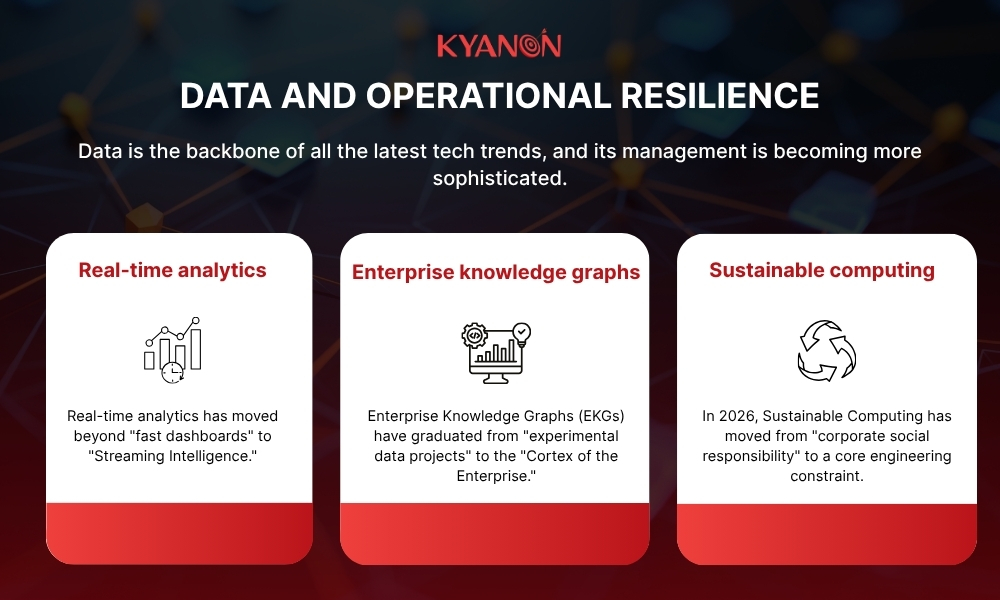
Data is the backbone of all the latest tech trends, and its management is becoming more sophisticated.
Real-time analytics
Real-time analytics has moved beyond “fast dashboards” to “Streaming Intelligence.” The window between a data event occurring and a business action being taken has shrunk from minutes to milliseconds.
Practical applications:
- Hyper-Personalized Retail: As you walk through a store, the app analyzes your pathing and past purchases in real-time to push a one-time discount code to your phone for the exact item you are looking at.
- Instant Fraud Prevention: Credit card networks now analyze thousands of data points, including your current GPS, typing cadence, and biometrics to block a fraudulent transaction before the “Submit” button is even fully processed.
- Smart Grid Management: Utility companies balance renewable energy (solar/wind) against demand in millisecond intervals to prevent blackouts as millions of EVs plug in simultaneously.
- Logistics & Telematics: Shipping giants like FedEx use real-time “Digital Twins” of their entire fleet to predict delays caused by a sudden storm and re-optimize thousands of routes in seconds
In a world of AI-Augmented Development and No-Code, the speed of your data is the only remaining competitive moat. If your competitor knows what happened 2 seconds ago and you only know what happened 2 minutes ago, you’ve already lost.
Enterprise knowledge graphs
Enterprise Knowledge Graphs (EKGs) have graduated from “experimental data projects” to the “Cortex of the Enterprise.” They are no longer just about organizing data; they are the critical infrastructure that allows AI agents to “understand” the business rather than just processing text.
- Context-Aware Customer 360: A bank’s AI doesn’t just see a “Customer”; it sees a “Household.” The graph links a teenager’s checking account application to their parents’ high-value mortgage, prompting the AI to offer a tailored family package instead of a generic rejection.
- Supply Chain Resilience: When a factory shuts down, the graph instantly traces the “Blast Radius” – identifying exactly which downstream products, shipments, and customer contracts are affected across tier 2 and tier 3 suppliers.
- Pharma & Research: Drug discovery teams use graphs to link internal experiment data with public research papers, allowing AI to spot non-obvious connections between a specific gene and a failed trial from five years ago.
Without a Knowledge Graph, your AI is brilliant but amnesiac – it knows language, but it doesn’t know your business. The graph provides the long-term memory and logical structure that makes GenAI safe for mission-critical work.
Sustainable computing
In 2026, Sustainable Computing has moved from “corporate social responsibility” to a core engineering constraint. With the massive energy demands of AI, “Green IT” is no longer optional – it is a survival strategy for companies facing carbon taxes and skyrocketing energy costs.
Core applications:
- Green DevSecOps: CI/CD pipelines now include a “Carbon Budget” alongside a financial budget. If a code update increases the energy footprint of an app beyond a certain threshold, the build is automatically rejected.
- Smart Building Twins: Real-time analytics and knowledge graphs are used to create “Digital Twins” of office buildings, using AI to perfectly balance lighting, HVAC, and server cooling based on real-time occupancy.
- Biodegradable/Recyclable Sensors: For the “Industrial Internet of Things” (IIoT), companies are deploying sensors made from sustainable materials that can be safely left in the environment or easily recycled.
In 2026, efficiency is the ultimate competitive advantage. A company that can run its AI for half the energy cost of its competitor has a massive margin advantage. Sustainability is no longer just about the planet; it’s about the bottom line.
Strategic outlook for enterprise leaders
By 2026, enterprise software architecture is pivoting from experimental AI adoption to agentic, AI-first, and self-optimizing ecosystems. The strategic focus is shifting from simply adding AI features to embedding autonomous agents, domain-specific models, and robust governance directly into the core architectural design to deliver measurable ROI.
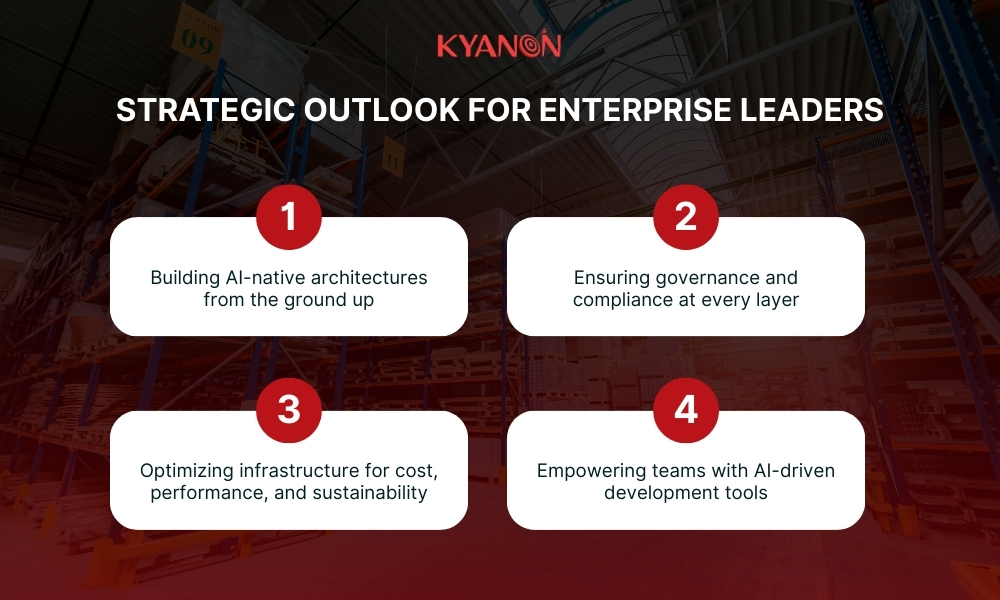
These new tech trends are not optional. They are becoming the foundation for competitive advantage in a digital-first economy. To prepare for 2026, CIOs and enterprise architects should focus on:
- Building AI-native architectures from the ground up
- Ensuring governance and compliance at every layer
- Optimizing infrastructure for cost, performance, and sustainability
- Empowering teams with AI-driven development tools
Turning tech trends into scalable enterprise architecture
At Kyanon Digital, we help enterprises translate AI tech trends and current tech trends into practical, scalable solutions. With global project experience and a strong, high-quality local engineering workforce in Vietnam, we deliver end-to-end capabilities across AI, cloud, data, and enterprise software development.
Whether you are modernizing legacy systems, building AI-native platforms, or optimizing your cloud architecture, Kyanon Digital is ready to support your journey.
Ready to future-proof your enterprise architecture? Contact Kyanon Digital today to explore how we can help you turn strategy into execution and drive real business impact.