


Digital transformation in retail is hindered by legacy system integration, data siloes, and cultural resistance to change. Top challenges include high implementation costs, a lack of specialized talent, and the need for unified omnichannel experiences. Data security, evolving customer expectations, and measuring ROI are critical
However, starting on digital transformation for retailers is not always straight-forward and as a business, you will face several challenges, as listed below.
Key takeaways
- Retail digital transformation fails more from strategy and people issues than from technology itself.
- Connected data is essential for personalization, omnichannel consistency, and smarter decisions.
- True omnichannel retail requires deep system integration, not standalone upgrades.
- Talent gaps and cybersecurity risks must be addressed early to avoid slowing transformation.
- ROI should be measured long-term, focusing on agility, efficiency, and customer experience, not just short-term returns.
Further reading:
- The Next Wave of CX: Context, Memory, Emotion
- Top Key Trends In D2C Industry To Explore
- AI In Marketing: Shaping Marketing Strategies For The Future
What is digital transformation in Retail?
Digital transformation in retail is the integration of technology into all areas of a business to fundamentally change how it operates and delivers value to customers. This shift is no longer a luxury but a necessity for survival in a “phygital” world where physical and digital boundaries blur.
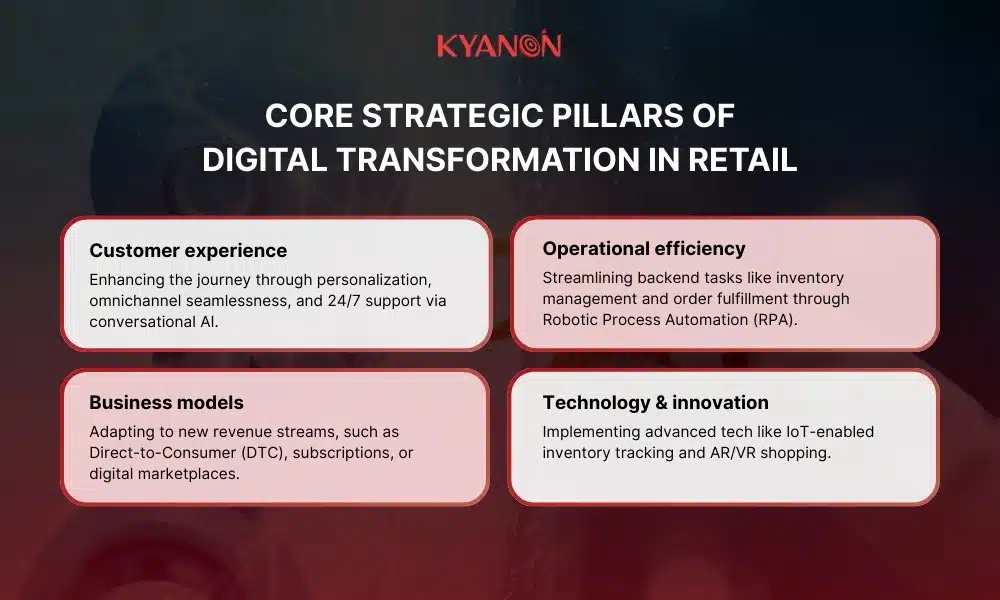
Core strategic pillars of digital transformation in Retail
Retailers focus on four foundational areas to navigate this change:
- Customer experience: Enhancing the journey through personalization, omnichannel seamlessness, and 24/7 support via conversational AI.
- Operational efficiency: Streamlining backend tasks like inventory management and order fulfillment through Robotic Process Automation (RPA).
- Business models: Adapting to new revenue streams, such as Direct-to-Consumer (DTC), subscriptions, or digital marketplaces.
- Technology & innovation: Implementing advanced tech like IoT-enabled inventory tracking and AR/VR shopping.
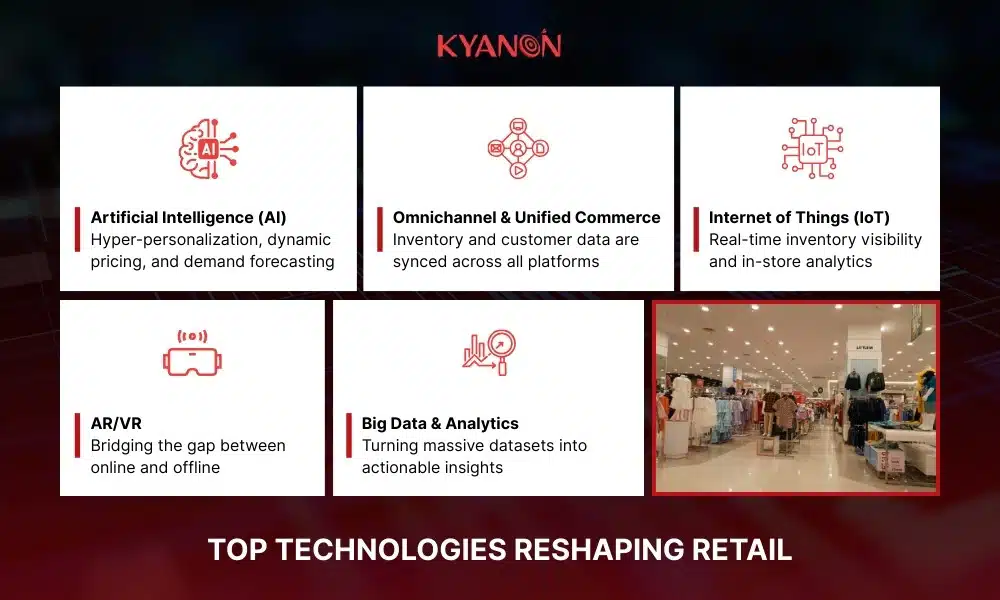
Top technologies reshaping Retail
- Artificial Intelligence (AI): 91% of retail IT leaders prioritize AI for implementation by 2026 (Gartner). It powers hyper-personalization, dynamic pricing, and demand forecasting.
- Omnichannel & Unified Commerce: Moving beyond multi-channel to a unified commerce approach where inventory and customer data are synced across all platforms.
- Internet of Things (IoT): Using smart sensors and RFID tags for real-time inventory visibility and in-store analytics.
- AR/VR: Immersive tech like the IKEA Place app allows customers to virtually place furniture in their homes, bridging the gap between online and offline.
- Big Data & Analytics: Turning massive datasets into actionable insights for trend analysis and sales forecasting.
Implementation challenges
Despite high potential of digital transformation in retail, 53% of professionals find transformation difficult due to insufficient change enablement (Deloitte). Major hurdles include:
- High costs: Complete transformations can cost large companies an average of $17.7 billion. Legacy Systems: Difficulties integrating new digital tools with aging IT infrastructure.
- Skills gap: A lack of internal expertise in data analytics, AI, and digital marketing.
- Cultural resistance: Employees may fear job displacement or resist learning complex new systems.
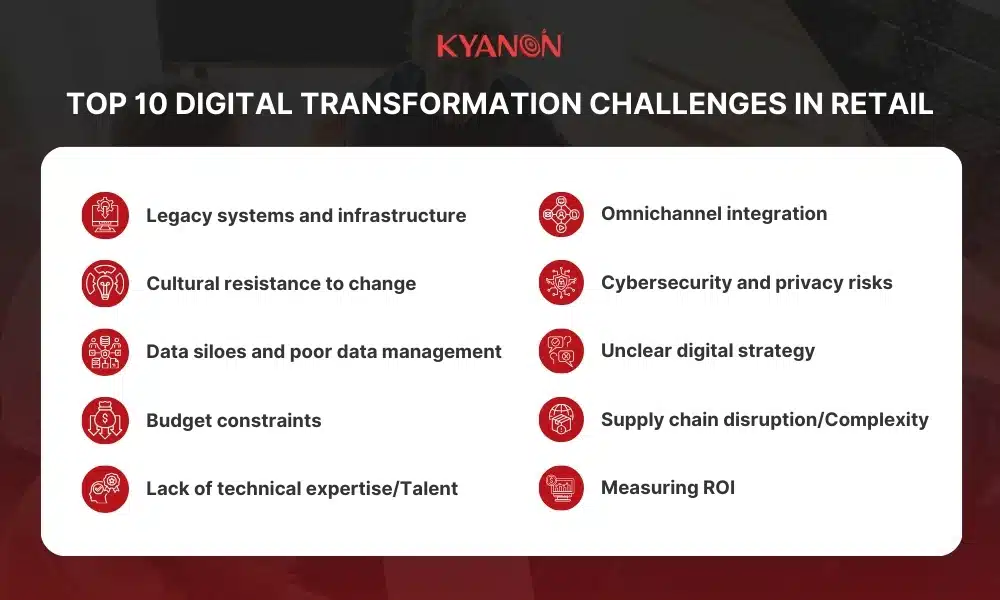
Top 10 Digital Transformation Challenges In Retail
Digital transformation is no longer optional for retailers, it’s essential to stay competitive in an increasingly data-driven, omnichannel world. However, many retail organizations struggle to turn digital ambition into real business impact. Below are the top 10 challenges retailers face when undergoing digital transformation, along with context on why they matter.
Legacy systems and infrastructure
Many retailers still rely on legacy systems built decades ago, such as monolithic POS platforms, outdated ERPs, or on-premise databases. These systems are often rigid, expensive to maintain, and incompatible with modern cloud-native or API-driven technologies.
As a result, integrating advanced solutions like AI-driven personalization, real-time analytics, or headless commerce becomes slow and complex. Legacy infrastructure also limits scalability, making it harder for retailers to respond quickly to market changes, peak seasons, or new digital channels.
Cultural resistance to change
Technology alone does not drive transformation – people do. One of the most common barriers in retail digital transformation is resistance from employees and leadership who are accustomed to traditional processes and workflows.
Store staff may fear automation replacing jobs, while management may hesitate to disrupt existing operations that “still work.” Without strong change management, clear communication, and leadership buy-in, even the best digital initiatives can stall or fail to gain adoption across the organization.
Data siloes and poor data management
Retailers collect massive amounts of data from POS systems, eCommerce platforms, CRM tools, loyalty programs, and supply chain systems. However, this data often lives in silos, managed by different teams using disconnected systems.
These silos prevent retailers from achieving a single, unified view of the customer. As a result, personalization efforts become inconsistent, demand forecasting is less accurate, and decision-making is based on incomplete insights. Poor data governance and quality further compound the issue, reducing trust in analytics outputs.
Budget constraints
Digital transformation requires significant upfront investment in technology, integration, training, and process redesign. For many retailers, especially mid-sized or traditional brick-and-mortar brands, justifying these costs can be challenging.
Advanced capabilities such as AI, machine learning, automation, or real-time analytics often come with high implementation and operating costs. Without a phased investment plan or clear business case, digital initiatives risk being delayed, underfunded, or deprioritized.
Lack of technical expertise/Talent
Retailers frequently face a shortage of skilled professionals capable of designing, implementing, and operating modern digital solutions. Roles such as data engineers, data scientists, AI specialists, cloud architects, and cybersecurity experts are in high demand but short supply.
This talent gap slows down transformation efforts and increases dependency on external vendors. Without the right internal capabilities, retailers struggle to maintain systems, extract value from data, or continuously innovate beyond initial implementation.
Omnichannel integration
Today’s customers expect a seamless experience across physical stores, websites, mobile apps, social commerce, and marketplaces. However, many retailers operate these channels independently, leading to fragmented customer journeys.
Challenges include inconsistent pricing, disconnected inventories, lack of real-time stock visibility, and poor synchronization between online and offline touchpoints. Achieving true omnichannel retail requires deep integration across commerce, marketing, fulfillment, and customer service systems, something many retailers underestimate in complexity.
Cybersecurity and privacy risks
As retailers digitize operations and collect more customer data, they become increasingly vulnerable to cyberattacks and data breaches. Customer payment information, personal data, and loyalty data are highly valuable targets for cybercriminals.
At the same time, retailers must comply with strict data protection regulations and rising consumer expectations around privacy. Weak security architecture, legacy systems, or poorly governed third-party integrations significantly increase risk and potential reputational damage.
Unclear digital strategy
Many retail organizations pursue digital transformation without a clear, cohesive strategy. Initiatives are often launched in silos, such as eCommerce upgrades, CRM implementations, or mobile apps, without alignment to overarching business goals.
This lack of a clear roadmap leads to fragmented technology stacks, duplicated investments, and limited long-term impact. Successful digital transformation requires a well-defined strategy that aligns technology initiatives with customer experience, operational efficiency, and revenue growth.
Supply chain disruption/Complexity
Modern retail supply chains are global, multi-tiered, and highly dynamic. Digital transformation in retail often exposes gaps in supply chain visibility, data accuracy, and responsiveness.
Retailers struggle to implement real-time inventory tracking, demand forecasting, and automated replenishment across suppliers, warehouses, and stores. Addressing this challenge often requires modern data platforms, integration layers, and advanced analytics, areas where experienced digital partners like Kyanon Digital can help retailers modernize supply chains without disrupting ongoing operations.
Measuring ROI
One of the most persistent challenges is measuring the return on investment (ROI) of digital transformation. Unlike short-term campaigns, many digital initiatives deliver value over time through improved efficiency, better customer experience, or increased agility.
Retailers often struggle to link these long-term benefits directly to revenue or cost savings, making it difficult to justify continued investment. Without clear KPIs, baseline metrics, and value-tracking frameworks, digital transformation risks being seen as a cost center rather than a growth driver.
Retail Digital Transformation: What’s Next
Digital transformation in retail is no longer a competitive advantage. It is a survival imperative. From legacy systems and data silos to cultural resistance and budget constraints, these challenges can slow progress and dilute ROI if not addressed strategically. The retailers that succeed are those that take a holistic, phased approach, modernizing technology, unifying data, empowering teams, and continuously adapting to changing customer expectations. Overcoming these challenges is not about adopting more tools. It is about building a resilient, future-ready retail ecosystem that drives measurable business value.
At Kyanon Digital, we help retailers navigate digital transformation with clarity and confidence. With proven experience across commerce, data, and customer experience transformation, we partner with retail leaders to turn complex challenges into scalable, high-impact solutions.
Ready to accelerate your retail transformation? Contact Kyanon Digital to build a digital strategy that delivers real results