
Artificial intelligence (AI) is the ability of machines to perform tasks that are typically associated with human intelligence, such as learning and problem-solving. AI applications use techniques such as expert systems, machine learning, natural language processing, speech recognition, and machine vision to simulate and enhance human-like intelligence.
According to Grand View Research, AI is expected to grow at a compound annual growth rate (CAGR) of 37.3% from 2023 to 2030. This rapid growth highlights the increasing importance of AI technology in the coming years.
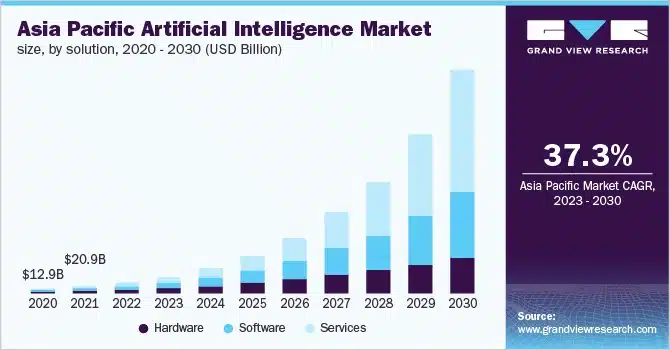
Asia Pacific AI market 2023 – 2030
Source: Grand View Research
AI is also expected to have a significant impact on economic growth. By 2030, AI is projected to contribute a net increase of 21% to US GDP.
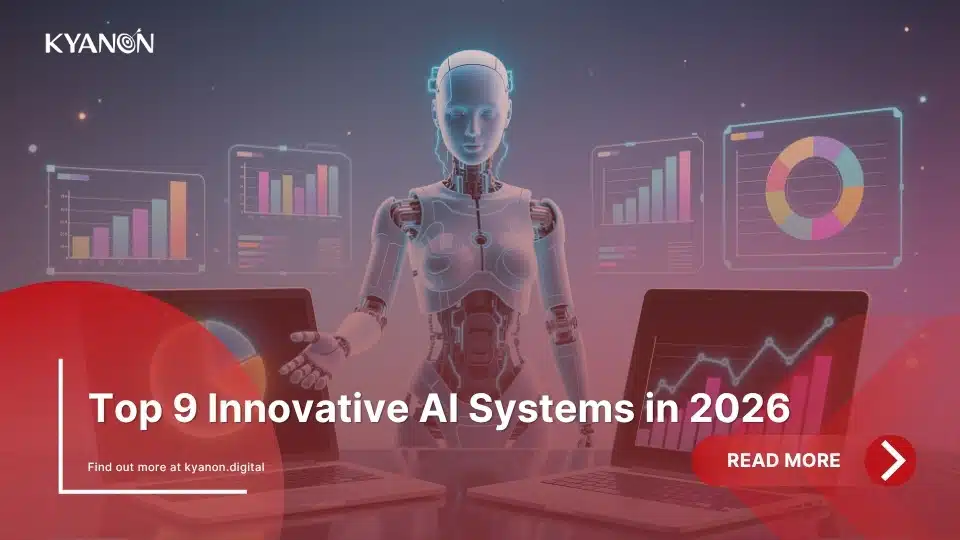
This post examines some of the most sophisticated AI systems in the world. In this blog, Kyanon Digital presents a list of the top 9 innovative AI systems for businesses.
Further reading:
- Top 10 Generative AI Applications: Big Wins Await!
- AI in Business: What It Is, Why It Matters, and How to Use It
- Revolutionizing Industry With Object Detection In AI Technology
- AI in Retail: Revolutionizing Operations & Boosting Experience
Top 9 Innovative AI Systems
Quick comparison table:
|
AI system |
Main focus | Enterprise fit / Use case |
Pricing tier / Access model |
|
GPT‑5 |
Multimodal reasoning & automation | Enterprise-grade decision support, automation | Free → Plus → Pro → Business/Team → Enterprise |
|
Gemini |
Multimodal Google AI ecosystem | Productivity, content creation, insight extraction | Freemium → API/Developer → Premium subscription → Enterprise |
|
Claude 4 |
Ethical reasoning & compliance |
Regulated industries, deep-context workflows |
Free → Pro/Max → Team → Enterprise |
|
DALL‑E |
Text-to-image creativity |
Marketing, design, creative asset generation |
Freemium → API → Subscription |
|
Midjourney |
Stylized generative visuals |
Creative agencies, branding, concept ideation |
Subscription: Basic → Standard → Pro → Mega |
|
Sora |
Video & avatar generation |
Content studios, e-learning, entertainment |
Beta → Studio → Pro → Enterprise |
|
Stable Diffusion |
Open-source image generation |
Custom deployments, privacy-controlled AI |
Community → Credit/API → Pro → Max → Enterprise |
|
AlphaFold |
Protein-structure prediction |
Biotech, pharma, R&D |
Free → Commercial license → Enterprise |
| AlphaGo | Reinforcement learning | Simulation, operations research, strategy AI |
Research only / Licensing for specific enterprise RL frameworks |
1. GPT-5

GPT-5 is the newest flagship large-language model from OpenAI, launched in August 2025, built for expert-level reasoning, multimodal understanding (text + image), and enterprise scalability, for use across domains such as coding, writing, analysis, and tools.
Main features:
- Dual-mode architecture balances fast and deep reasoning.
- Multimodal comprehension (text + image + audio beta).
- 400K-token context for enterprise-scale data and code workflows.
- Seamless integration with productivity ecosystems and APIs.
Core value proposition: GPT-5 delivers an enterprise-grade cognitive layer that augments strategic decision-making, automates cross-functional tasks, and scales innovation across business units.
Market positioning & access model:
|
Tier |
Typical monthly cost | Key features & access highlights |
|
Free |
$0 |
Basic access to GPT-5 in limited capacity; default for new users |
|
Plus |
~ US $20/month |
Higher usage limits, faster responses, priority access to GPT-5 models. |
|
Pro |
~ US $200/month (premium tier) |
Unlimited or near-unlimited GPT-5 usage, advanced features such as GPT-5 Pro, higher performance and deeper reasoning |
|
Business / Team |
~ US $25–30/user/month (annual billing) |
Team-oriented workspace, shared projects, unlimited GPT-5 messages (subject to fair-use), collaborative features |
| Enterprise | Custom pricing |
Enterprise-grade security, large-scale deployment, SLA, analytics, admin controls, long context window with GPT-5 |
Note: Pricing may vary by region, currency, and billing terms (monthly vs. annual).
2. Gemini

Gemini is Google DeepMind’s cutting-edge multimodal AI, combining text, image, and audio comprehension for business intelligence, content creation, and enterprise automation.
Main features:
- Full integration with Google Workspace and Cloud AI Suite.
- Handles multimodal workflows: documents, visuals, audio, and video.
- Deep Research, AI-powered video generation, and NotebookLM for advanced writing and analysis.
Core value proposition: Empowers organizations leveraging Google’s ecosystem to accelerate insight extraction, creativity, and productivity with AI at scale.
Market positioning & access model:
- Embedded in Google Workspace and Cloud AI tools.
- Freemium access for entry-level users with limited credits.
- Premium subscriptions unlock advanced models and high-capacity AI features for enterprise use.
|
Tier / Model |
Usage context | Price tier |
|
Developer/API (Gemini 2.5 Pro) |
Text/Image/Audio tokens |
Free input up to some limit
|
|
Developer/API (Gemini 2.5 Flash) |
Cost-efficient large-scale model |
Input ~$0.30/1M tokens (text/image/video) for paid tier |
|
Consumer Subscription (Google AI Pro) |
Individual use (Gemini-based) |
~$19.99/month/user |
|
Consumer Premium (AI Ultra) |
Power user, advanced features |
~$249.99/month/user (some markets) |
| Enterprise Edition | Large-scale organizational deployment |
From ~$30/user/month (with annual commitment) for “Enterprise Standard” |
Note: Pricing may vary by region, currency, and billing terms (monthly vs. annual).
3. Claude 4

Introduced in May 2025, Claude 4 includes the models Opus 4 and Sonnet 4, engineered for long‑form reasoning, complex coding, and AI‑agent workflows.
Main features:
- Hybrid “fast” and “extended thinking” modes (tool use, memory, local file access).
- Enhanced tool integrations: web search, files API, code execution, and agent capabilities.
- Benchmarked superior performance in coding (SWE‑bench, Terminal‑bench) and reasoning tasks.
Core value proposition: Delivers a high‑fidelity AI reasoning platform for enterprises needing deep‑context, multi‑step workflows and coding intelligence—bridging assistant‑level and agent‑level capabilities.
Market positioning & access model:
- Freemium access: Sonnet 4 is available to free‑tier users.
- Paid tiers: Pro, Max, Team, and Enterprise include both Opus 4 & Sonnet 4 with extended‑thinking capabilities.
- API & platform integration: Available via Anthropic API, Amazon Bedrock, and Google Cloud Vertex AI.
|
Model |
Purpose / Use case |
Price tier |
|
Claude Opus 4 |
Highest‑capacity model for coding, long workflows |
|
|
Claude Sonnet 4 |
Balanced model for general reasoning & coding tasks |
|
Note: Pricing may vary by region, currency, and billing terms (monthly vs. annual).
4. DALL-E

Dall-E is a generative AI system that allows people to generate new images by responding to graphical prompts with words. Dall-E is a neural network that can generate whole new graphics in any number of different styles according to the user’s instructions.
Main features:
- Text‑to‑image rendering at multiple resolutions.
- Style‑consistency, in‑painting, and out‑painting tools for visual refinement.
- Seamless integration with ChatGPT, design platforms, and API endpoints.
Core value proposition: Enables marketing and design teams to generate on‑brand visual content instantly, dramatically reducing creative cycle time and cost.
Market positioning & access model:
- Freemium credit system (initial free image credits).
- Subscription and API pricing tiers for high‑volume enterprise usage.
- Creative‑cloud and platform integrations via the OpenAI API ecosystem.
|
Tier |
Purpose / Use case | Price |
|
Standard API (DALL·E 3 Standard Quality) |
Production image generation (1024 × 1024) |
~$0.04image (≈1024×1024) |
|
HD API (DALL·E 3 HD Quality) |
Premium visuals, high‑resolution marketing |
|
|
Legacy / Draft‑phase (DALL·E 2) |
Prototyping, testing visuals |
~$0.02/image (approx) in earlier models |
Note: Pricing may vary by region, currency, and billing terms (monthly vs. annual).
5. Midjourney

Midjourney is a leading generative‑art AI model offering highly stylized, photorealistic visuals through prompt engineering and creative workflows.
Main features:
- Community‑driven creative engine powered via Discord.
- Fine‑grained aesthetic control for style, mood, detail.
- Support for iterative workflows: variations, remixes, upscaling, and video generation.
Core value proposition: Delivers rapid ideation and design conceptualisation for agencies, brands, and creative studios—reducing time‑to‑market for visual campaigns.
Market positioning & access model:
- Access via Discord bot in real time for image and video generation.
- Subscription‑only plans, tiered by GPU compute time (“Fast” vs “Relax” mode).
- Commercial licensing: including in paid tiers—images can be used commercially once subscribed.
|
Tier |
Use case |
Price |
|
Basic Plan |
Casual users, hobby projects |
|
|
Standard Plan |
Content creators, freelance designers |
|
|
Pro Plan |
Professional designers, studios needing privacy |
|
|
Mega Plan |
Enterprises, agencies with high‑volume usage |
|
Note: Pricing may vary by region, currency, and billing terms (monthly vs. annual).
6. Sora

Sora is OpenAI’s emerging multimodal AI platform designed for real‑time video synthesis and human‑like avatar generation for marketing, entertainment, and enterprise training.
Main features:
- Text‑to‑video generation for instant visual storytelling.
- Lip‑sync and voice cloning for realistic digital avatars.
- Scalable content production pipeline: suitable for studios and media teams.
Core value proposition: Enables organizations to deploy high-quality, human‑like avatars at lower production costs—accelerating content creation for digital marketing campaigns, e-learning simulations, and entertainment projects.
Market positioning & access model:
- Early beta program access for developers and content studios.
- Tiered SaaS subscriptions for small to medium content production teams.
- Enterprise licensing options for large-scale media production and distributed deployments.
|
Tier |
Use case | Price |
|
Beta Access |
Developers and early adopters |
Free / Invitation-only; limited video generation and avatar capacity |
|
Studio Plan |
Small & medium content studios |
Approx. $49–$99/month; includes standard resolution video, limited avatars, and SaaS features |
|
Pro Plan |
Professional creators and agencies |
Approx. $199/month; higher resolution, unlimited avatars, priority support |
|
Enterprise License |
Large studios, marketing teams, media production |
Custom pricing, full scalability, multi-user collaboration, API integration, and commercial rights |
Note: Pricing may vary by region, currency, and billing terms (monthly vs. annual).
7. Stable Diffusion

Stable Diffusion is an open‑source, text‑to‑image diffusion model that enables high‑quality visual generation and full custom deployment.
Main features:
- Fully open‑source model architecture allowing self‑hosting and fine‑tuning.
- Commercial licence model that scales based on annual revenue thresholds, enabling businesses to use it in production.
- API‑based credit system for flexible consumption in cloud or hybrid environments.
Core value proposition: Gives enterprises full flexibility, control, customisation, data privacy, and cost efficiency for building branded or domain‑specific generative image systems in‑house or at scale.
Market positioning & access model:
- Free community licence for individuals or organisations with revenue under USD 1 million.
- Commercial licence or enterprise agreement for organisations above revenue thresholds or with large-scale usage.
- Credit‑based subscription/API access for production image generation, with tiered features (generation volume, resolutions).
|
Tier |
Use case | Price |
|
Community Licence |
Hobbyists, research, non‑commercial use |
Free to use the core models and derivatives, as long as annual revenue < USD 1 million |
|
Credit/API Subscription |
Production usage via API |
Credit‑based: 1 credit = US$0.01 |
|
Pro Plan (Web service) |
Individuals/teams needing higher volume |
~$7‑10/month (billed yearly) for ~2,000 fast image generations per month |
|
Max Plan (Web service) |
Content studios, higher output demand |
~$20/month (billed yearly) for ~4,000 fast image generations/month |
| Enterprise Licence |
Large organisations, embedding model in products |
Custom pricing; required if revenue > USD 1 million or usage is very high |
Note: Pricing may vary by region, currency, and billing terms (monthly vs. annual).
8. AlphaFold
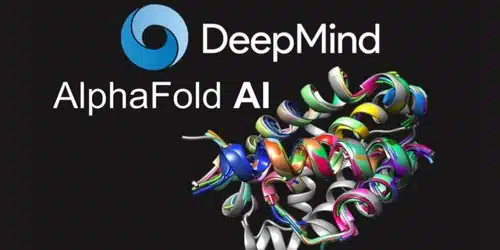
AlphaFold is DeepMind’s breakthrough AI system that predicts three‑dimensional structures of proteins and other biomolecules from their sequences—unlocking precision modelling for life sciences.
Main features:
- High‑accuracy protein‑structure prediction, with performance close to experimental methods.
- Expanded modelling in version 3: predicting complexes of proteins, DNA, RNA, ligands, and molecular interactions.
- Global database of predicted structures (AlphaFold DB) enabling rapid access to millions of models for research and enterprise use.
Core value proposition: Delivers a scientific‑grade AI modelling platform that accelerates R&D, drug discovery, and biotech innovation by converting sequence data into structural insight with unprecedented scale and speed.
Market positioning & access model:
- Public research access via AlphaFold Server for non‑commercial use.
- Licensing or partnership models for commercial use (especially in pharma, biotech, life sciences).
- Integration into enterprise pipelines for drug design, materials science, genomics, and molecular engineering.
|
Tier |
Use cases |
Price |
|
Free‑Research Access |
Academic, non‑commercial research users |
Free access via AlphaFold Server for non‑commercial use |
|
Commercial License / Enterprise Use |
Pharma/biotech companies requiring large‑scale access |
Custom pricing; negotiations required for commercial deployment |
|
API/Embedding for Enterprise Workflows |
Integrating structural predictions into products |
Enterprise negotiations |
9. AlphaGo
AlphaGo is the pioneering reinforcement‑learning system from DeepMind that mastered the ancient board game Go using deep neural networks and advanced search algorithms.
Main features:
- Combines policy and value networks with Monte‑Carlo tree search to evaluate and select moves at a human-champion level.
- Self‑play training loop enabling the system to surpass its initial training from human games.
- Strategic long‑horizon planning and adaptation: uncovering novel moves and strategies previously unseen in human play.
Core value proposition: Demonstrates the potential of strategic AI for logistics, operations research, and autonomous decision frameworks.
Market positioning & access model:
- Research‑grade system: primarily a published research landmark rather than a commercial product.
- The underlying architecture and methods inform enterprise reinforcement‑learning frameworks and internal agent systems.
- No direct commercial subscription offered-usage involves licensing or collaboration for specific RL/optimisation engagements.
Key trends in multimodal AI for 2026
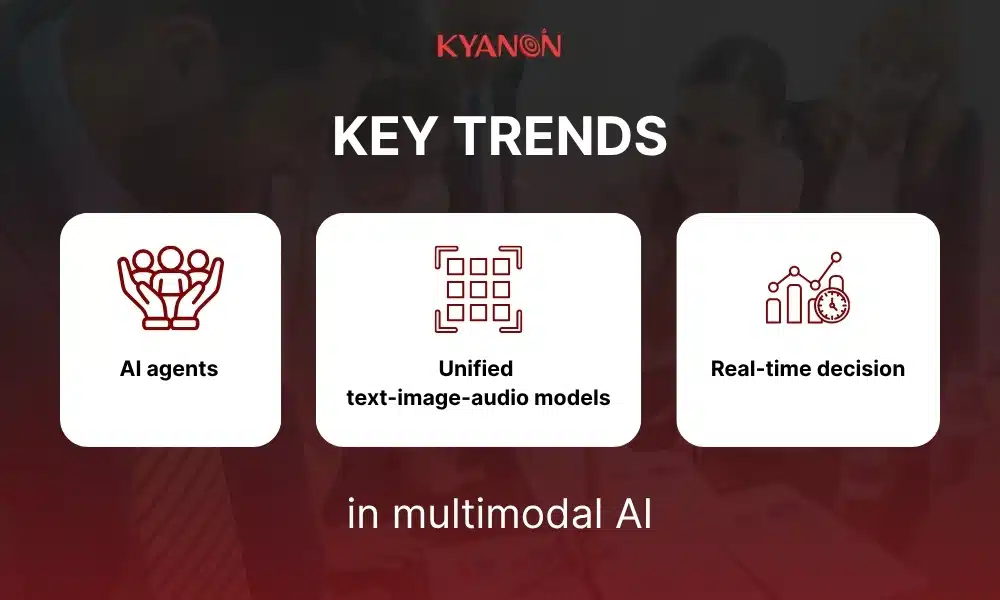
Unified text-image-audio models
- Modern AI systems like GPT-5 and Gemini 2.5 can seamlessly interpret text, images, and audio.
- Benefit: Enables cross-functional workflows, e.g., auto-generating reports with embedded visuals, multimedia marketing content, and real-time translation or transcription.
AI agents for task automation
- Intelligent agents execute multi-step processes autonomously across enterprise systems.
- Benefit: Reduces manual intervention, accelerates decision-making, and supports predictive analytics, inventory optimization, and customer service automation.
Real-time decision support
- AI models process large datasets and provide instant insights for operational and strategic decisions.
- Benefit: C-level executives can make faster, data-driven decisions while reducing risk, particularly in supply chain, finance, or R&D-heavy industries.
Read more: Top 10 Tech Trends 2026 by Gartner.
Actionable strategy for piloting AI in business
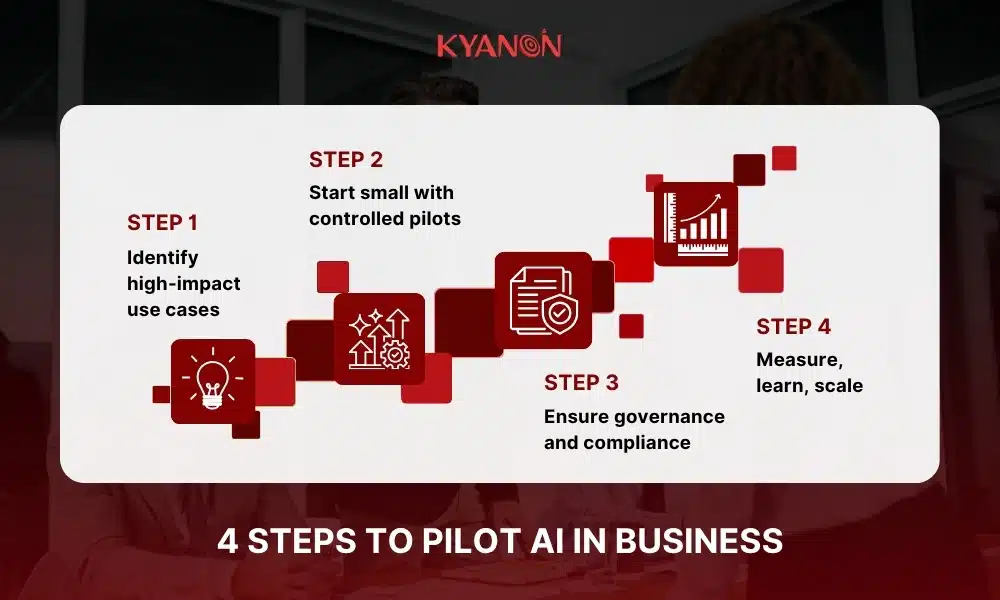
Step 1: Identify high-impact use cases
- Focus on areas with measurable ROI: content generation, predictive maintenance, or decision automation.
- Example: Use GPT-5 for executive report summarization or Sora for marketing video campaigns.
Step 2: Start small with controlled pilots
- Select a department or process for initial deployment.
- Use limited licenses/subscriptions for experimentation.
Step 3: Ensure governance and compliance
- Establish data handling policies, ethics guidelines, and audit mechanisms.
- Integrate human-in-the-loop controls for high-stakes decisions.
Step 4: Measure, learn, and scale
- Track metrics such as efficiency gains, cost savings, and adoption rates.
- Expand deployment to other units after validating ROI and operational fit.
In conclusion
To summarize, the future of AI in business is extremely bright, with endless opportunities for innovation and development. We should expect even more fascinating technological developments beyond 2026.
For business leaders and tech-strategy teams in Vietnam and Asia-Pacific, adopting these AI systems means thinking beyond “can we use it” to “how will it transform business model, operations, and culture.” Select the right AI system aligned to your core use-case, ensure governance around data and ethics, and build incremental pilots that scale.
Kyanon Digital is a Vietnam-based tech powerhouse providing world class solutions to clients across the globe. Our team at the AI and Machine Learning department is striving to bring the best solutions to unleash the power of unlimited processing. Contact us for more information about AI solutions for your business.