

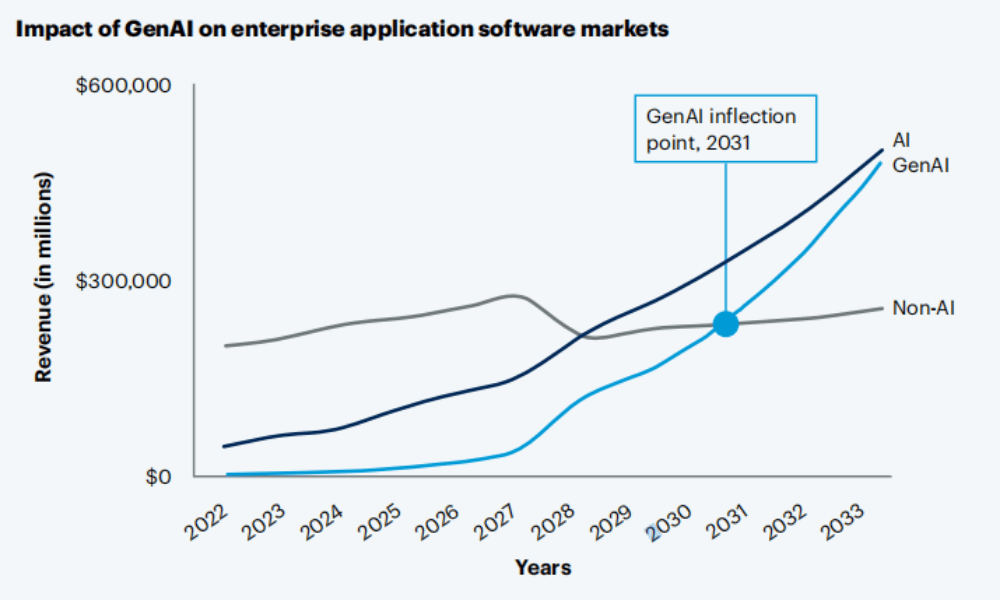
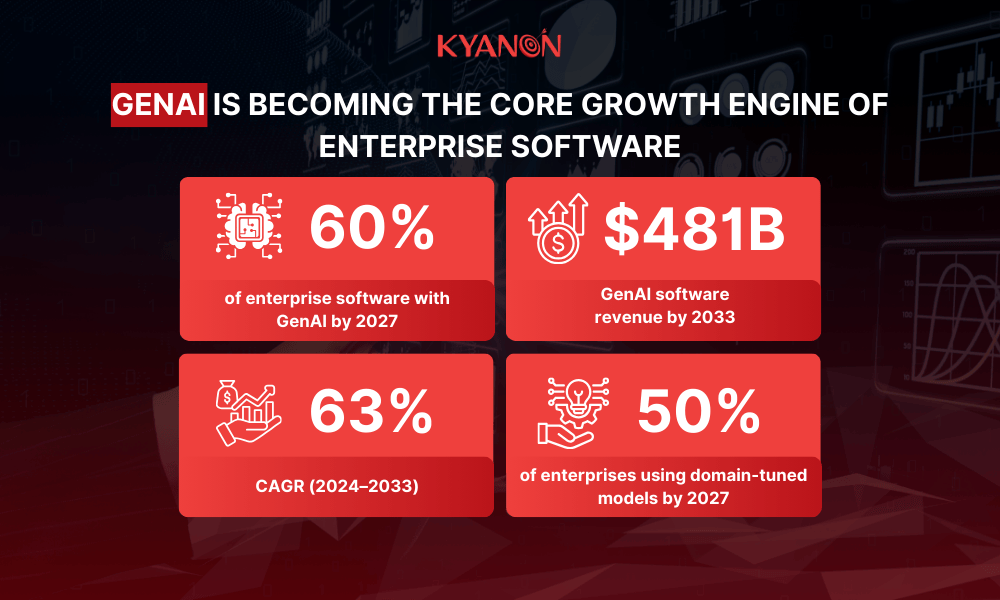
GenAI opportunities are no longer a forward-looking concept; they are the defining line between enterprises that will lead their markets and those that will be displaced by 2031. According to Gartner’s 2025 report, revenue from GenAI-enabled enterprise application software is projected to reach $481 billion by 2033, growing at a CAGR of 63%. It will surpass non-AI software revenue as early as 2031. Meanwhile, 60% of enterprise software offerings will embed GenAI by 2027, up from just 15% in 2024.
The challenge is not awareness; most enterprises already know AI is critical. The challenge is execution: knowing which GenAI capabilities to invest in, when to move, and how to translate technology investment into real business value. Too many organizations are stuck between chasing AI hype and waiting too long to act.
This blog draws directly from Gartner’s top GenAI opportunities for tech products and layers in a strategic practitioner perspective to give enterprises a clear, decision-ready view of the landscape, covering the 4 key GenAI capabilities defining competitive advantage, the strategic timing framework for when to act, and the 4 execution actions that separate winning AI strategies from expensive experiments.
Key takeaways
- Market inflection is real: Gartner projects GenAI revenue in enterprise software will surpass non-AI revenue by 2031; enterprises that delay risk permanent market share loss.
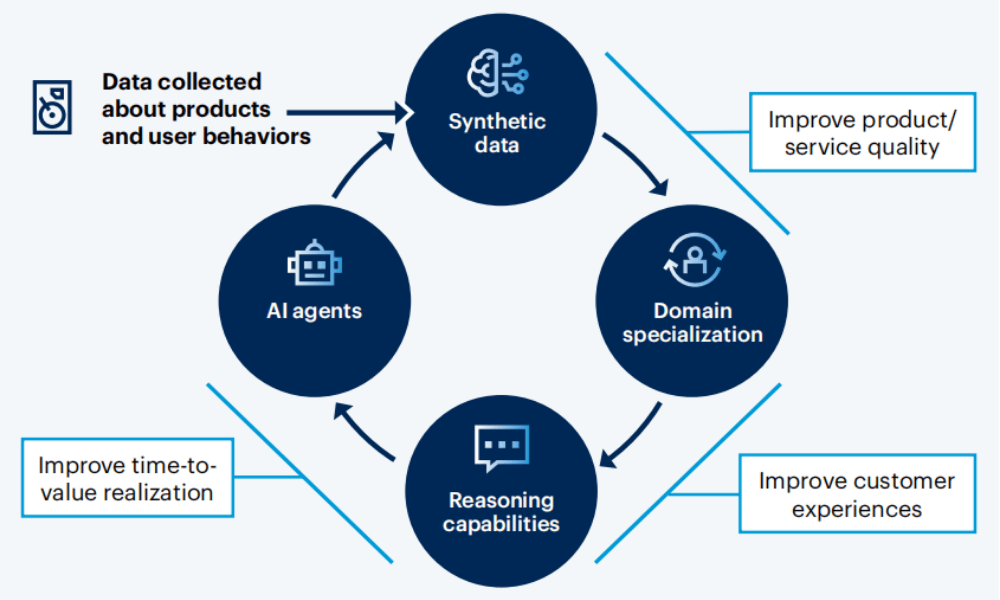
- 4 capabilities define differentiation: The domain-specific language models (DSLMs), AI agents, reasoning capabilities, and synthetic data are the building blocks of a competitive GenAI strategy.
- Timing is strategic, not just technical: Gartner’s Stop/Pause/Go framework maps three market positions, Keep Pace, Early, and Leader, across a 0–6 year window, each requiring different actions now.
- Execution requires 4 disciplines: Understanding user needs, assessing product capabilities, identifying key ecosystem players, and performing market gap analysis.
- The buyer has changed: Enterprises no longer ask, “Do you have AI?” They ask how AI improves productivity, whether it is domain-specific, and whether it supports autonomous workflows.
- Domain fine-tuning is the next frontier: By 2027, over 50% of GenAI models used in enterprises will be domain-specific and fine-tuned, up from 1% in 2024.
Further reading
- Top 10 Tech Trends 2026 by Gartner
- The Future of AI-Native Software in Singapore
- How AI Is Redefining Customer Loyalty in SEA
Market reality 2026: AI is no longer optional
Gartner’s proprietary market risk projection presents one of the clearest data pictures available on GenAI opportunities in enterprise software:
The inflection point of 2031 is not a distant milestone. It represents the tipping point at which enterprises without embedded GenAI capabilities will be structurally disadvantaged in every competitive sales cycle, every RFP, and every customer retention conversation.
2026 context: What changed?
The question enterprises are being asked by their own customers and boards has fundamentally shifted. The market is no longer evaluating whether AI exists in a product; it is evaluating the depth and domain relevance of that AI.
The three questions now driving enterprise buying decisions are:
- How much does this AI improve my team’s productivity? Measurable time-to-value is expected, not optional.
- Is this AI tuned to my industry’s language, compliance needs, and workflows? Generic AI wrappers are losing ground to domain-specific intelligence.
- Can this AI operate autonomously or semi-autonomously? Agentic capability is moving from differentiator to baseline expectation.
Gartner notes that many customers still struggle to separate GenAI hype from actual business value. This creates a critical window for enterprises that can demonstrate measurable outcomes rather than feature lists.
4 GenAI capabilities that will define competitive advantage
Domain-specific models (DSLMs) – The real differentiator
Domain-specific language models are AI models customized to the needs of particular industries, enabling higher accuracy, relevance, and trust for specialized tasks and critical applications (Gartner, 2025).
Why it matters now:
- By 2027, over 50% of GenAI models used by enterprises will be domain-specific and fine-tuned, up from just 1% in 2024 (Gartner, 2025).
- Generic large language models (LLMs) perform poorly on industry-specific terminology, regulatory constraints, and workflow context.
- Domain fine-tuned models reduce hallucination rates, improve compliance alignment, and deliver faster time-to-value in production environments.
Industry priority zones
|
Industry |
Highest-priority GenAI use cases |
|
Banking & securities |
Knowledge management, virtual assistants, compliance automation |
|
Manufacturing |
Synthetic data, simulation, operational analytics |
|
Retail |
Content generation, data analytics, customer experience |
|
Healthcare |
Knowledge search, regulatory compliance, clinical documentation |
|
Communications & media |
Virtual assistants, content generation (very strong signal) |
Kyanon Digital’s approach: RAG-based domain AI
Rather than generic LLM wrappers, Kyanon Digital builds domain-specific AI using RAG (Retrieval-Augmented Generation), grounding every AI response in the business’s own data, with traceable sources and no hallucinated outputs.
|
What RAG solves |
Why it matters |
|
Generic LLMs don’t know your business |
RAG feeds AI only your verified internal content |
|
Hallucination risk in regulated industries |
Every answer is cited, auditable, and source-linked |
|
Data privacy and compliance exposure |
Private LLM endpoints, no data sent to third-party pipelines |
|
Vendor lock-in |
Modular architecture, model-layer swappable |
- Legal & RegTech: Contract query assistant reduced legal research from hours to minutes
- Retail: AI-driven BI and data warehouse for a leading retail corporation
- Banking: AI-powered Digital Rewards & Loyalty Platform
- Education: Adaptive AI English learning solution
Read more: Transform How Your Business Thinks, Works, and Scales – with Generative AI
AI agents – From assistance to autonomy
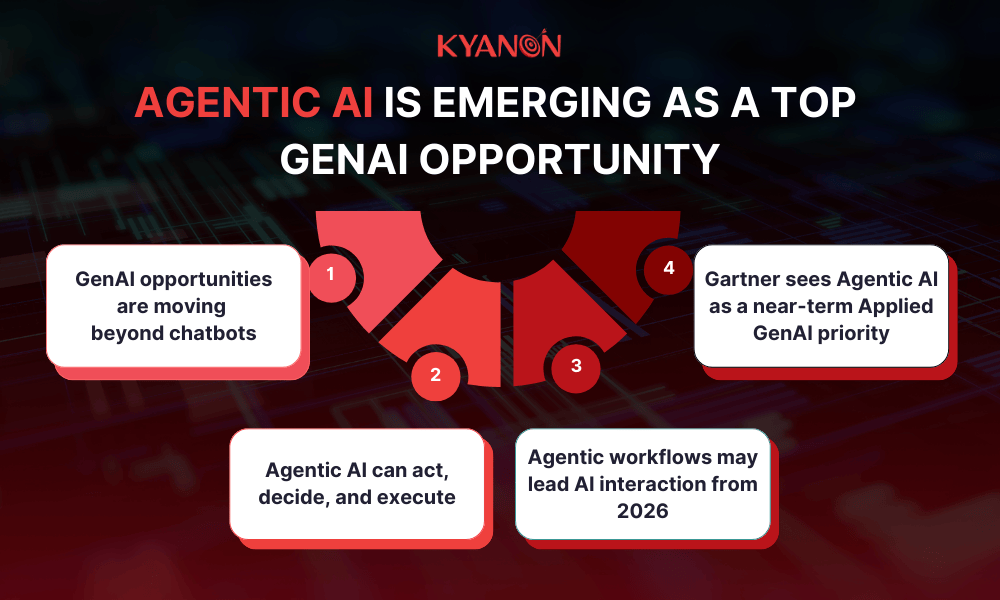
AI agents are autonomous or semi-autonomous software entities that use AI techniques to perceive, make decisions, take actions, and achieve goals in their digital or physical environment
Enterprise use cases with the highest ROI potential:
- Sales intelligence agents: Autonomous lead qualification, outreach sequencing, and CRM enrichment without human intervention at each step.
- Inventory and supply chain planners: Semi-autonomous agents that monitor demand signals, flag anomalies, and generate replenishment recommendations.
- Data intelligence copilots: Agents that traverse internal data sources, generate reports, and surface insights without manual query construction.
Key distinction: The value is not in the AI interface; it is in the orchestration layer that connects AI reasoning to live systems and real-world actions.
How Kyanon Digital builds agentic workflows in practice
Kyanon Digital’s integrate & automate capability is specifically designed to connect AI reasoning to live enterprise systems, eliminating the workflow silos that make standalone AI tools only partially useful.
|
Agent type |
What it connects to |
Real outcome |
|
Inventory & fulfillment agent |
ERP, POS, eCommerce, logistics APIs |
Automated order batching, AI-powered route optimization, real-time stock visibility |
|
Data intelligence copilot |
Data warehouse, BI dashboards, analytics layers |
Auto-generated reports and insights without manual query construction |
|
Customer engagement agent |
CRM, loyalty platforms, communication channels |
Automated notifications, proactive service actions, real-time personalization |
Proven in production:
- Retail: Integrated omnichannel fulfillment + TMS for a leading retail corporation: AI route optimization, automated pick & pack, real-time tracking, and full ERP/POS/eCommerce connectivity.
- Banking: AI-powered loyalty platform connecting customer behavior signals to automated rewards and outreach, with zero manual intervention per action.
Read more: Seamless Integration – Intelligent Automation
Reasoning capabilities – Multi-step logic for complex tasks
Reasoning models are an advanced evolution of AI models, capable of performing logical inference, complex problem solving, and multistep reasoning
Why this is distinct from standard GenAI:
Standard GenAI excels at text generation, summarization, and pattern matching. Reasoning models go further.
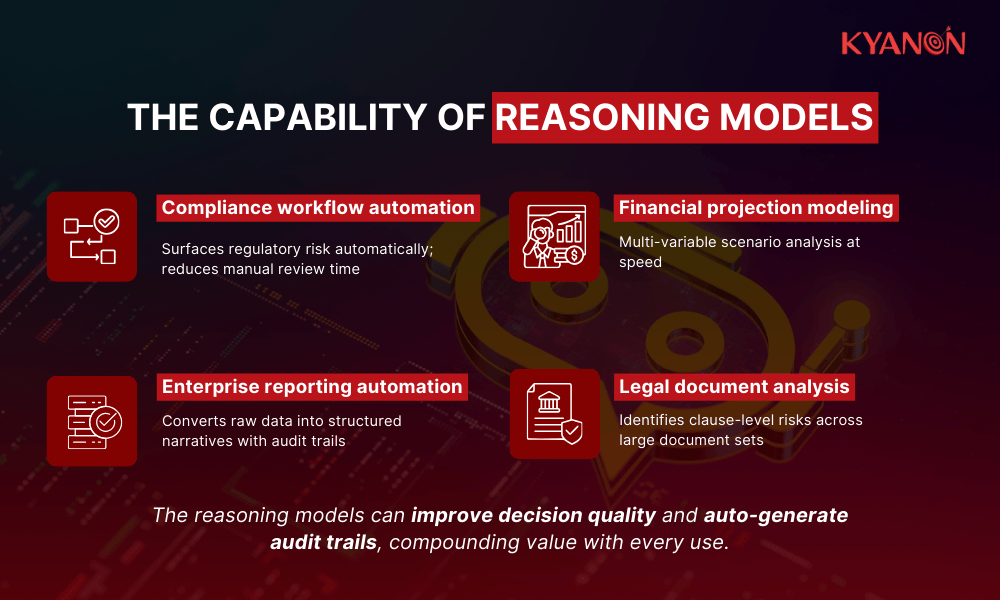
High-value enterprise applications:
|
Use case |
Value delivered |
|
Compliance workflow automation |
Reduces manual review time; surfaces regulatory risk automatically |
|
Financial projection modeling |
Multi-variable scenario analysis at speed |
|
Enterprise reporting automation |
Converts raw data into structured narratives with audit trails |
| Legal document analysis |
Identifies clause-level risks across large document sets |
Where reasoning AI delivers real enterprise value
Most enterprise reporting, compliance checks, and financial analysis involve conditional logic, multiple data sources, and structured output requirements, tasks that standard GenAI handles poorly. Reasoning models close this gap.
Kyanon Digital’s analysis & augment capability applies AI and ML to exactly these workflows: turning raw, fragmented data into automated, auditable intelligence.
Proven in production:
- Retail: AI-driven data warehouse + BI for a 193-store retail corporation: automated reporting, real-time dashboards, zero data fragmentation.
- RegTech: Scalable compliance platform for Cynopsis solutions: structured AI reasoning with fully traceable, auditable outputs.
Synthetic data & data frontier
Synthetic data is an artificially generated class of data used as a proxy for real data, for anonymization, AI, and machine learning development, data sharing, and data monetization
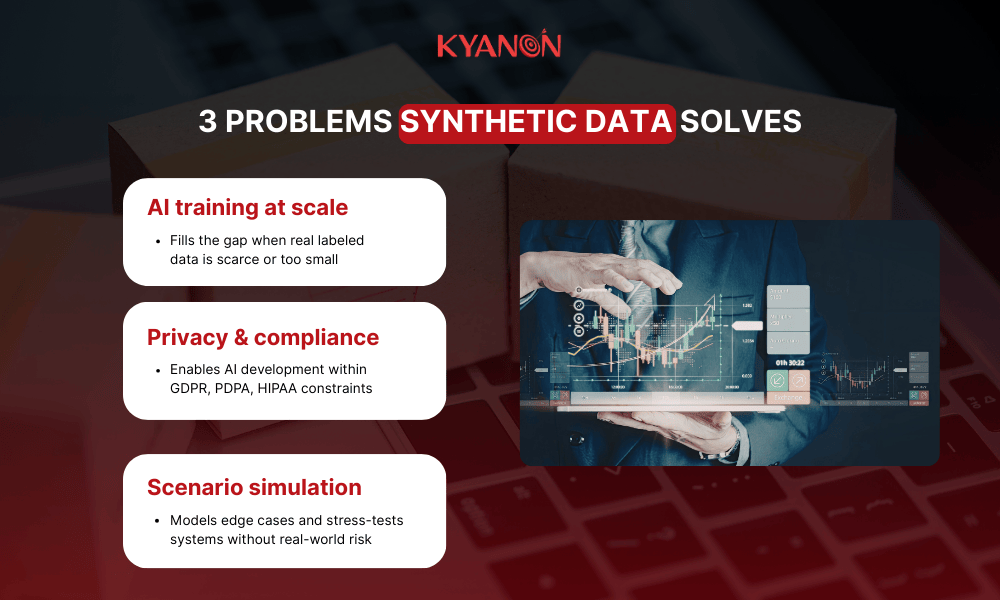
- AI training at scale: Real-world labeled data is scarce, expensive to collect, and often too small to train specialized models. Synthetic data fills the gap.
- Privacy and compliance: GDPR, PDPA (Southeast Asia), HIPAA, and other frameworks restrict the use of real customer data in model training. Synthetic data enables AI development inside these constraints.
- Scenario simulation: Enterprises can model edge cases, stress-test systems, and explore rare scenarios without waiting for those events to occur in the real world.
Why enterprises with strong data engineering foundations have a structural advantage:
- They can build synthetic datasets that mirror real operational behavior.
- They can combine MLOps capabilities with secure enterprise architecture to operationalize synthetic data pipelines at scale.
- They can monetize data assets, and synthetic versions of proprietary datasets become shareable IP.
Where Kyanon Digital’s foundation applies directly
|
Capability |
What it enables |
|
Data engineering + AI integration |
Build synthetic datasets that mirror real operational behavior at scale |
|
Secure enterprise architecture |
GDPR, PDPA, HIPAA-compliant AI development, no real customer data in training pipelines |
|
MLOps pipelines |
Operationalize, monitor, and retrain models built on synthetic data continuously |
Proven in production:
- Port & logistics: Centralized data hub for Vietnam’s largest port operator (50%+ national market share): fragmented logistics data unified into a single, real-time intelligence layer.
- Retail: Data warehouse across 193+ stores: manual inputs replaced with a clean, structured data foundation ready for AI augmentation.
Stop / Pause / Go: Strategic timing framework 2026
One of Gartner’s most actionable contributions in this report is the stop/pause/go calibration model, a framework that maps competitive positioning to time horizons.
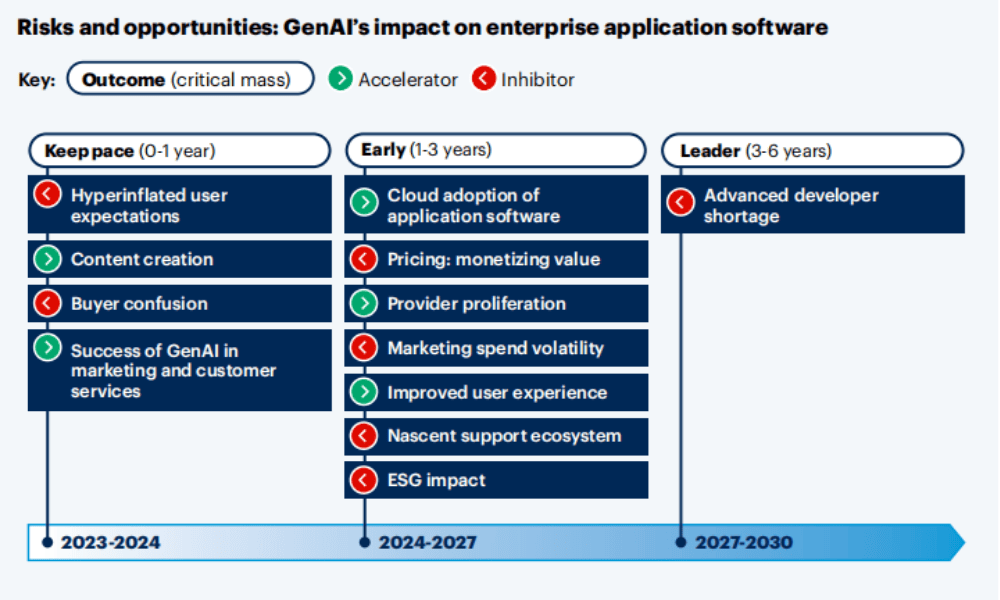
What “Keep pace” actually means right now
Enterprises in the Keep Pace window (0-1 year) are not behind, but they are at the minimum threshold to remain in competitive consideration. This means:
- Embedding GenAI feature parity into core product offerings so they are not eliminated from enterprise RFPs.
- Addressing buyer confusion by clearly articulating what their AI capabilities do, how they are measured, and what outcomes they deliver.
- Capitalizing on the proven early success of GenAI in marketing automation and customer service, the two highest-validated use cases across industries are in Gartner’s data.
What “Early” positioning requires
Moving into the Early zone (1–3 years) means launching AI-differentiated modules that go beyond feature parity and begin to create monetizable AI layers. This requires:
- Selecting the right cloud architecture for GenAI workloads (model serving, vector databases, embedding pipelines).
- Navigating provider proliferation strategically, the DSLM startup ecosystem alone raised $11.9 billion in VC funding from 275 companies between 2023 and 2025 (Gartner, 2025).
- Building pricing models that monetize AI capabilities as distinct product value (outcome-based, usage-based, or capability-tier pricing).
What “Leader” positioning requires
The Leader zone (3–6 years) is where enterprises build AI-native products, products where AI is not a feature but the core architecture. This is a multi-year commitment requiring:
- Deep investment in domain-specific model development or strategic acquisition of DSLMs.
- Building proprietary data moats through synthetic data pipelines and behavioral data capture.
- Developing or retaining advanced AI engineering talent, Gartner flags the advanced developer shortage as the primary inhibitor in this window.
Where Kyanon Digital fits in this framework
Most implementation partners help enterprises Keep Pace. Kyanon Digital designs roadmaps that move businesses into Early and toward Leader.
|
Position |
What’s needed |
Kyanon Digital’s role |
|
Keep pace (0–1 yr) |
GenAI feature parity, clear AI value articulation |
AI integration into existing products and workflows |
|
Early (1–3 yrs) |
Differentiated AI modules, monetizable AI layer, right cloud architecture |
Architecture & Strategy + GenAI development + composable, modular AI stack |
|
Leader (3–6 yrs) |
AI-native product, domain model investment, proprietary data moats |
End-to-End Digital Transformation + DSLMs + MLOps + data engineering foundation |
What makes the difference in practice:
- 14 years of enterprise engineering across Fortune 500 clients in retail, banking, logistics, and technology.
- 500+ consultants and engineers covering the full stack: AI/ML, data engineering, cloud architecture, MLOps, and system integration.
- Enterprise-grade execution at cost structures that make the Early-to-Leader roadmap financially viable for mid-market and growth-stage enterprises.
The 4 strategic actions to execute GenAI correctly
Gartner outlines four key actions that product leaders must execute when deciding where and when to add GenAI capabilities.
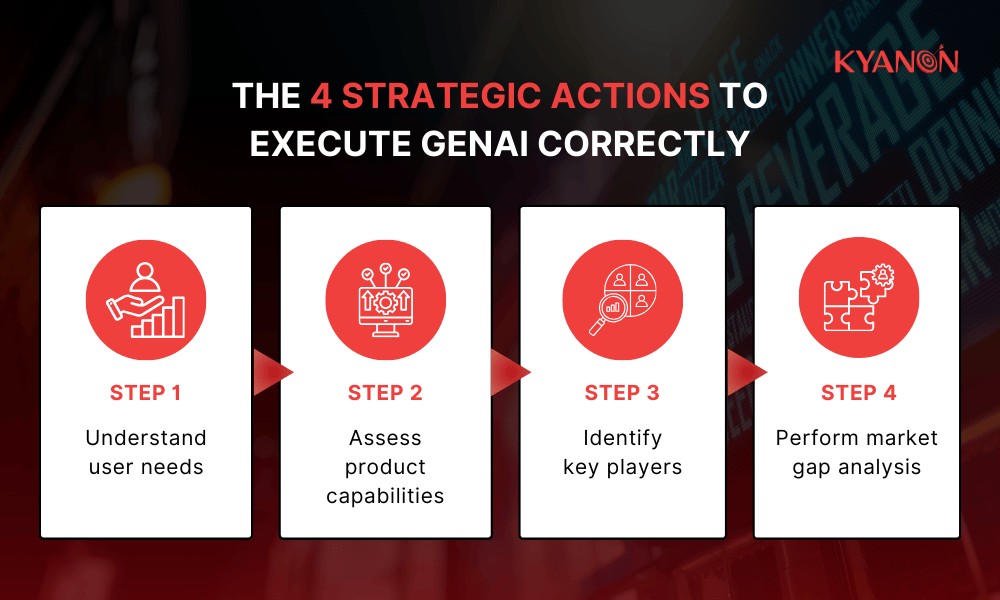
Understand user needs
Before adding any GenAI capability, businesses need to define the real business outcome first. Gartner’s guidance is clear: target GenAI capabilities that solve real problems and feasible use cases, not hype-driven ideas.
What this means in practice:
- Focus on what users need to achieve, not what AI can demo
- Prioritize use cases with measurable value
- Avoid building AI features based on trend pressure alone
Strong signals from Gartner’s use-case view:
- Knowledge management and search
- Virtual assistants
- Text and translation content generation
Assess product capabilities
Gartner says businesses should assess how GenAI-enabled innovation can strengthen the product portfolio and keep it competitive. Its Emerging Tech Impact Radar groups 22 GenAI technologies across four themes: model-centric technologies, model performance, applied GenAI, and data frontier.
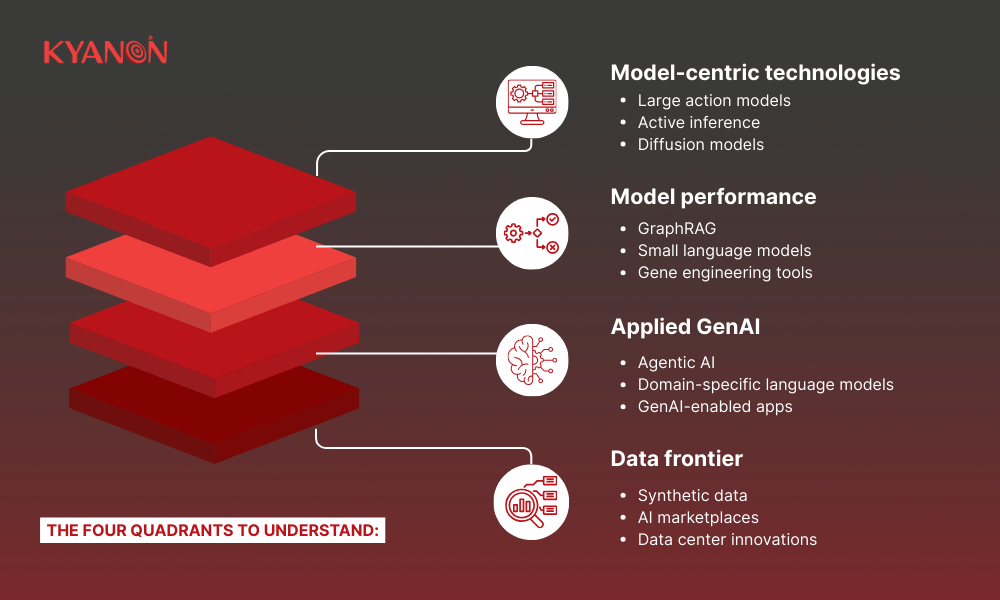
What to focus on now:
- Applied GenAI for near-term product value
- Data frontier for scalable AI infrastructure
- Architecture gaps that block deployment, integration, or governance
For most businesses in 2025–2026, the priority is not every emerging technology. It is the set that can move into production faster and support real adoption.
Identify key players
The GenAI ecosystem is moving fast. Gartner studied 275 startups focused on domain-specialized language models and found they raised more than $11.9 billion in VC funding from 2023 to 2025.
Why this matters:
- The market is still evolving
- Partner choices made too early can create lock-in
- Modular AI stacks are safer than rigid vendor dependence
This is especially important because the largest funding pool in Gartner’s view sits in agent platforms, showing where the architecture is moving: toward orchestration layers, not just chatbot tools.
Perform market gap analysis
The goal is not to copy competitor claims. It is to find the gap between what users value most and what current solutions deliver poorly.
What this should include:
- Competitive capability benchmarking
- Feature heatmapping
- AI monetization strategy
- User importance versus satisfaction analysis
This is where GenAI investment becomes more strategic. The best opportunity is usually not the noisiest feature. It is the capability that matters most to users and still performs weakly across the market.
2026 strategic imperatives for tech companies
Drawing from both the Gartner analysis and practitioner experience in enterprise AI delivery, three imperatives stand out for any enterprise serious about GenAI in 2026.
AI must deliver three measurable outcomes
- Reduced time-to-value for customers using the product.
- Improved customer experience, not just satisfaction scores, but retention, adoption depth, and workflow stickiness.
- Better product and service quality, measurable through error rates, output accuracy, and user productivity metrics.
Balance innovation & real value
Engineering teams should have a structured space to explore GenAI capabilities, but that exploration must be bounded by business ROI alignment.
- The risk is building technically impressive AI features that solve no validated business problem. Gartner explicitly warns against hype-driven AI investment.
Move along the maturity curve deliberately
- AI feature → AI workflow
- AI workflow → AI-native platform
- AI-native platform → AI-powered business model
Each step requires greater architectural commitment and deeper data infrastructure. Enterprises that try to skip steps, jumping from scattered AI features to AI-native claims, consistently underdeliver on both technical performance and business outcomes.
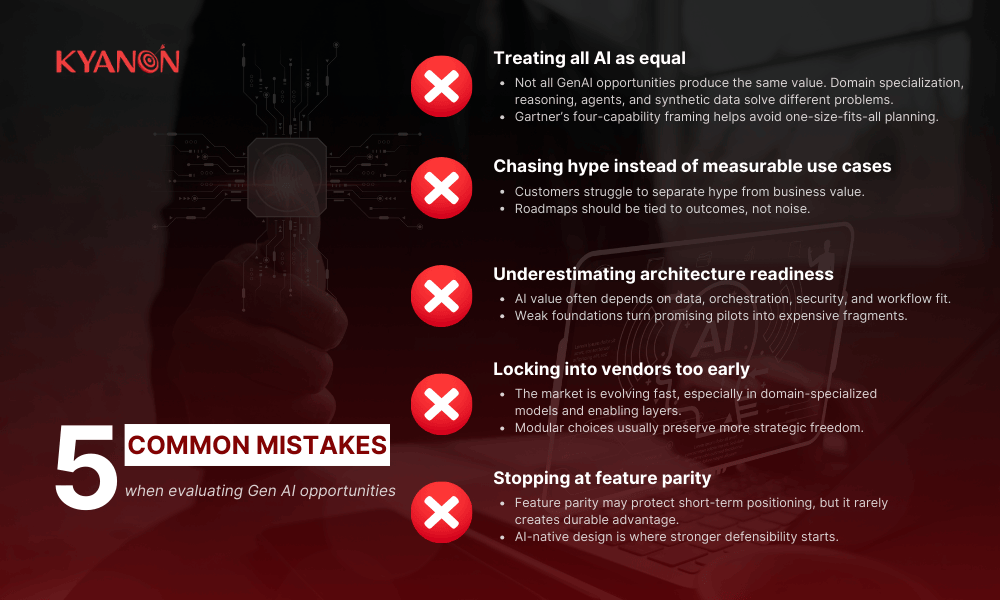
Common mistakes when evaluating GenAI opportunities
A neutral decision-making view should also name the traps.
How to choose correctly: A decision framework for enterprises
Based on Gartner’s research and strategic practitioner input, enterprises evaluating GenAI investments should apply this decision structure.
Step 1: Know your market position
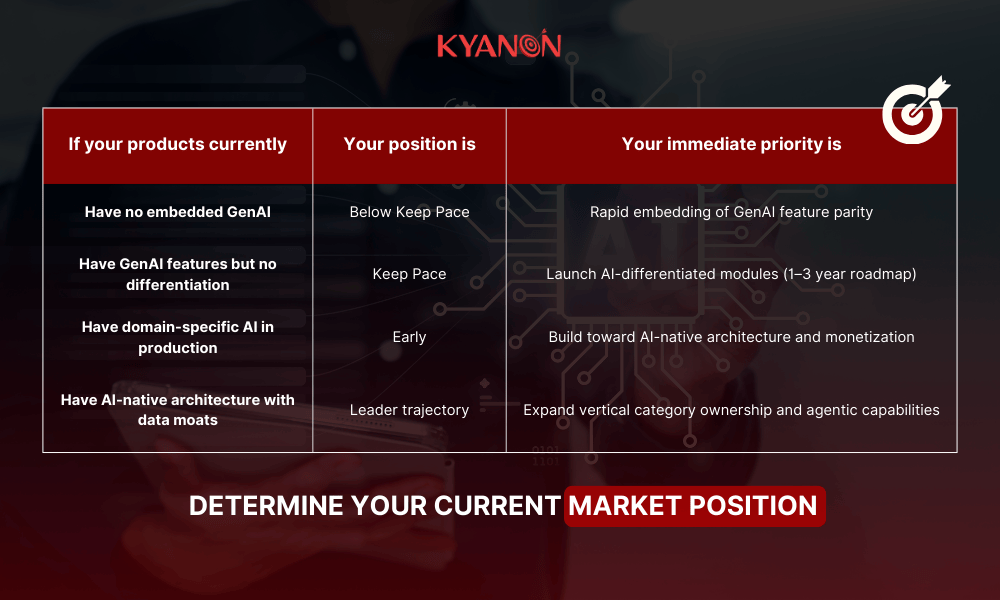
- No GenAI = catch up fast
- Basic GenAI = build differentiation
- Domain AI in production = move toward AI-native
- AI-native foundation = expand category leadership
Step 2: Match capabilities to business value
|
Customer value goal |
Highest-impact GenAI capability |
|
Improve time-to-value |
AI agents, reasoning capabilities |
|
Improve customer experience |
Domain specialization, virtual assistants |
|
Improve product/service quality |
Synthetic data, reasoning models, DSLMs |
Step 3: Evaluate your data readiness
Domain-specific AI and synthetic data capabilities are only as strong as the underlying data architecture. Before committing to DSLM investment or agentic AI builds, audit:
- Data quality and accessibility across core operational systems.
- Compliance posture for AI training data (GDPR, PDPA, HIPAA, depending on market).
- MLOps maturity, the infrastructure to fine-tune, deploy, monitor, and retrain models at scale.
Where Kyanon Digital fits in this landscape

Kyanon Digital operates as an AI-native transformation partner for enterprises across Singapore, Hong Kong, and Southeast Asia, specifically for organizations that need to move beyond Keep Pace into Early and Leader positioning.
The specific capabilities Kyanon Digital brings to the execution of the GenAI framework include:
- AI-ready architecture design: Auditing current technology stacks, identifying AI integration points, and refactoring roadmaps for GenAI readiness.
- Domain-specific AI layer development: Building vertical AI for retail/FMCG, manufacturing, banking, and financial services environments where generic LLMs fall short.
- Agentic workflow implementation: Moving enterprises from chatbot UX to AI orchestration layers that connect reasoning to live enterprise systems (CRM, ERP, data lakes).
- Synthetic data and data engineering: Enabling AI training, compliance-safe model development, and scenario simulation at enterprise scale.
- Modular AI stack architecture: Building AI infrastructure that avoids vendor lock-in and allows model-layer substitution as the DSLM ecosystem continues to evolve.
Kyanon Digital’s delivery model combines Vietnam-based engineering depth with Singapore-facing enterprise delivery, designed for complex digital transformation projects where both cost efficiency and enterprise-grade execution are non-negotiable requirements.
In conclusion
The strongest GenAI opportunities are not the loudest ones. They are the ones that solve real business problems, fit product architecture, and create lasting value through better workflows, better decisions, and better customer outcomes.
The enterprises that will own their vertical categories are not the ones that added the most AI features fastest. They are the ones that made disciplined decisions about which GenAI capabilities to build (domain specialization, agentic workflows, reasoning, synthetic data), when to move (calibrated against Gartner’s Stop/Pause/Go framework), and how to execute (with validated user needs, honest product capability assessment, ecosystem awareness, and competitive gap intelligence).
Ready to move from AI feature to AI-native architecture?
Kyanon Digital works with enterprises across SEA and Singapore to design and implement AI-native product strategies grounded in real business outcomes, not AI hype. Contact our team to start with an AI architecture journey!