
Vietnam’s information and communication technology (ICT) industry is experiencing rapid growth and offers vast potential for further development. As one of the fastest-growing economies in Southeast Asia, the country is poised to become a leading player in digital transformation, driven by increasing demand for advanced ICT infrastructure. With significant investments in sectors such as artificial intelligence, cloud computing, data centers, and blockchain, Vietnam is positioning itself as an attractive destination for both local and international investors. (Vietnam Briefing)
For global enterprises and SMEs exploring Vietnam sourcing, Ho Chi Minh City, Hanoi, and Da Nang each present distinct advantages. Ho Chi Minh City enables rapid scaling and startup agility. Hanoi excels in deep technology research and institutional stability. Da Nang offers optimized operating costs and long-term sustainability.
Selecting the right hub is not simply a geographical decision. It is a strategic alignment between project complexity, talent density, and operational governance. Organizations investing between $20,000 and $200,000 or more in digital initiatives increasingly evaluate these Vietnam IT hubs to maximize both innovation and ROI.
Key takeaways
- Vietnam software hubs such as Ho Chi Minh City, Hanoi, and Da Nang create a strong ecosystem for global Vietnam sourcing and software development.
- Ho Chi Minh City is Vietnam’s largest IT hub and is best suited for rapid product development, fintech platforms, and high-growth projects.
- Hanoi stands out for deep tech capabilities, R&D, and large-scale enterprise systems.
- Da Nang offers lower operational costs, strong engineer retention, and an ideal environment for long-term development teams.
- Choosing the right location among Vietnam software hubs should depend on project complexity, talent specialization, and scalability needs when working with software companies in Vietnam.
Further reading:
- 10 Great Benefits Of Outsourcing Software In Vietnam
- Build Your SaaS Faster With a Vietnam Product Team
- Vietnam’s Advantages for Enterprise AI Outsourcing
The strategic case for Vietnam’s IT ecosystem
Vietnam’s technology sector has evolved into a robust ecosystem that supports large-scale digital transformation and global software development. With a growing pool of highly skilled engineers, strong government support for the digital economy, and an expanding network of technology hubs, the country offers a compelling environment for enterprises seeking reliable, long-term technology partners.
The strategic case for Vietnam’s IT ecosystem
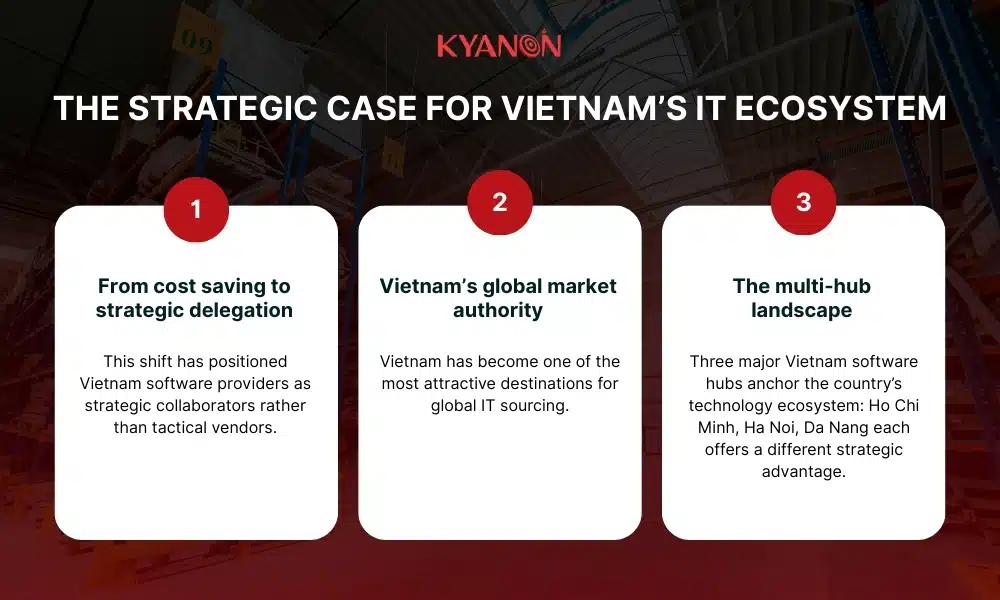
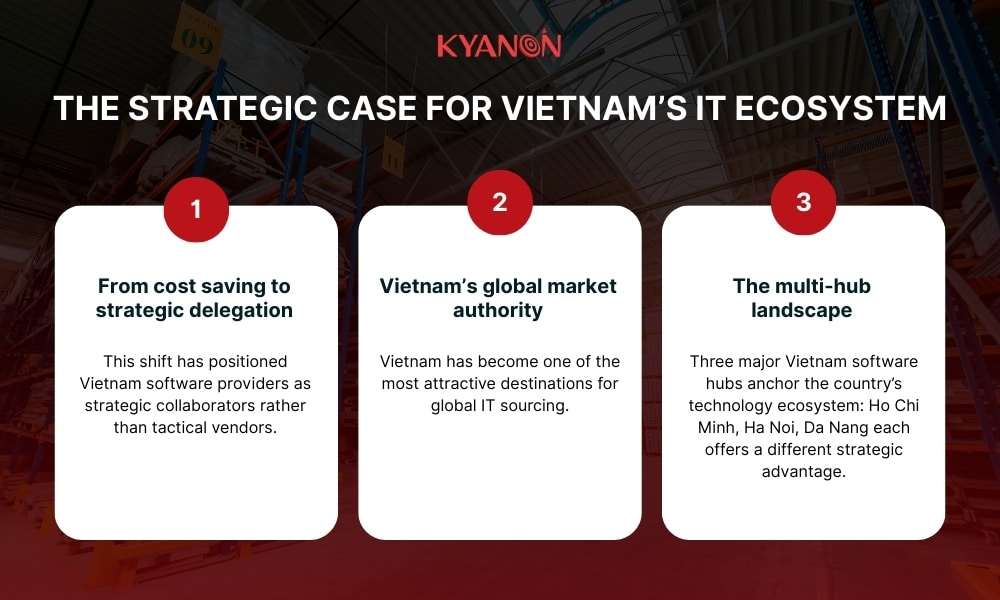
The evolution of outsourcing: From cost saving to strategic delegation
Organizations no longer outsource only to reduce development costs. Instead, they strategically delegate technology initiatives to external partners who can accelerate innovation, expand capacity, and provide specialized expertise.
Today, companies typically outsource projects ranging from $20,000 to more than $200,000, covering:
- Custom software engineering
- Digital platform development
- AI and data analytics initiatives
- Enterprise system modernization
- Cloud migration and integration
This shift has positioned Vietnam software providers as strategic collaborators rather than tactical vendors.
Vietnam has become one of the most attractive destinations for global IT sourcing. According to the Kearney Global Services Location Index, Vietnam consistently ranks among the Top 10 global outsourcing destinations, highlighting its strong competitiveness in software development and digital services.
Several structural factors drive this global recognition:
- Strong cost competitiveness compared to Western markets
- A politically stable business environment
- Government support for the digital economy
- A rapidly expanding technical workforce
Vietnam currently has over 530,000 IT engineers, with the number expected to reach 700,000 by 2028 according to the Vietnam Ministry of Information and Communications. The country is also home to over 70,000 technology companies, including both local startups and multinational development centers.
The multi-hub landscape
Vietnam’s digital economy is not concentrated in a single city. Instead, three major Vietnam software hubs anchor the country’s technology ecosystem:
- Ho Chi Minh City: the largest commercial technology center
- Hanoi: the academic and governmental innovation core
- Da Nang: the fastest growing emerging IT hub
Each city offers a different strategic advantage depending on business objectives, team structure, and long-term scaling plans.
Vietnam has evolved far beyond a low-cost outsourcing destination. Today, it is increasingly recognized as a high-value hub for enterprise digital transformation and AI engineering. The Vietnamese government has invested heavily in building a digital economy. The National Digital Transformation Program aims to make digital technologies contribute 30 percent of GDP by 2030. (Vietnam Governance)
This policy environment has accelerated the growth of software companies in Vietnam across sectors such as:
- Fintech and digital banking
- Retail and omnichannel commerce
- Logistics and smart supply chains
- Healthcare and digital platforms
- Manufacturing Industry 4.0
For organizations planning projects valued between $20,000 and $200,000 or more, choosing the right Vietnam IT hub becomes a strategic decision that impacts:
- Development speed
- Engineering quality
- Operational costs
- Long-term team stability
Strategic alignment for Singapore and Malaysia businesses
Vietnam’s geographic and cultural proximity also strengthens collaboration with Southeast Asian enterprises. For companies in Singapore and Malaysia, Vietnam provides several advantages:
- Only 1 hour zone difference (GMT+7)
- Overlapping working hours for real-time collaboration
- Strong English proficiency in the IT workforce
- Cultural familiarity with regional business practices
This alignment enables seamless remote engineering partnerships without the communication friction often seen in cross-continent outsourcing.
Ho Chi Minh City: The high-velocity ecosystem for rapid scaling
Ho Chi Minh City is widely recognized as the largest Vietnamese IT hub and the commercial center of the country’s technology economy.

Ho Chi Minh City: The high-velocity ecosystem for rapid scaling

The economic engine of Vietnam’s tech sector
Ho Chi Minh City plays a pivotal role as the driving force of Vietnam’s startup ecosystem, accounting for approximately 50% of the country’s startups. The city hosts about 40% of the country’s incubators and startup support facilities, 44% of the total investment capital, and 60% of the investment deals nationwide. According to the Startup Genome Report 2024, HCMC ranks 111th out of 1,000 cities globally in the dynamic startup ecosystem rankings, improving 3 spots from 2023, and is now classified among the emerging startup markets in the 81-90 range. (NSSC)
The startup ecosystem is particularly strong. The Ho Chi Minh City startup ecosystem ranks among the global top 300 cities in the StartupBlink Ecosystem Index. With a global position of #110, the Ho Chi Minh City ecosystem has climbed 1 spot in the most recent rankings. It is currently ranked as the 1st strongest startup ecosystem in Vietnam, having remained stable since 2024. At the regional level, Ho Chi Minh City ranks 5th in South East Asia, having moved up 1 spot since 2024. (StartupBlink)
Talent profile
Engineers in Ho Chi Minh City are known for their:
- Strong commercial awareness
- Experience working with international clients
- Adaptability in fast-paced development cycles
- Expertise in product engineering and agile delivery
The environment encourages experimentation and rapid iteration, making it ideal for high-growth digital products.
Strategic advantage
Ho Chi Minh City is particularly suitable for:
- Fintech platform development
- Omnichannel e-commerce systems
- Mobile application ecosystems
- AI-driven customer experience platforms
- Rapid MVP scaling for startups
Organizations launching high-growth digital initiatives often prefer Ho Chi Minh City because of its speed, talent density, and startup mindset.
Key technology assets
The city also hosts major technology infrastructure, including:
- Quang Trung Software City, one of the largest IT parks in Southeast Asia
- Saigon Hi Tech Park, home to global technology companies such as Intel, Samsung, and Nidec
These innovation clusters strengthen the city’s position as the most dynamic Vietnamese software hub.
Hanoi: The deep tech capital for R&D and systemic stability
Hanoi is positioning itself as Vietnam’s premier deep tech hub, driven by massive public-private investment, the development of the Hoa Lac Hi-tech Park, and a new US$24 million venture capital fund launching in late 2025/2026. Focused on AI, semiconductors, and green technology, the city aims to foster innovation-driven growth through 4% budget allocation for R&D by 2026. (VnEconomy)

Hanoi: The deep tech capital for R&D and systemic stability

The academic and government core
The city hosts many of the country’s most prestigious technical universities, including Hanoi University of Science and Technology and Vietnam National University.
These institutions produce a steady pipeline of highly trained engineers specializing in:
- Artificial intelligence
- Cloud computing
- Cybersecurity
- Enterprise software architecture
This academic foundation makes Hanoi particularly strong in deep technology research and development.
Talent profile
Compared to Ho Chi Minh City, Hanoi engineers often demonstrate the following:
- Strong academic rigor
- Deep expertise in system architecture
- Higher stability and lower job hopping
- Strong focus on long-term engineering quality
Many engineers in Hanoi work on complex enterprise platforms rather than rapid startup products.
Strategic advantage
Hanoi is well suited for:
- Large-scale enterprise system modernization
- AI data platforms and analytics systems
- Industrial technology and manufacturing software
- Government or highly regulated industry systems
Organizations requiring high governance standards and long-term stability frequently choose Hanoi.
Infrastructure and innovation investment
The city hosts several major innovation centers, including:
- Hoa Lac Hi Tech Park, Vietnam’s largest technology research zone
- The $220 million Samsung R&D Center, the company’s largest research facility in Southeast Asia

Hoa Lac Hi Tech Park in Ha Noi
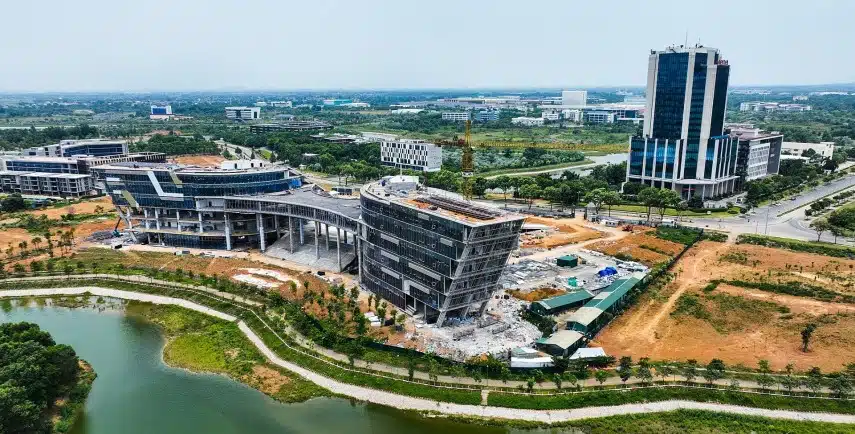
These investments reinforce Hanoi’s position as a critical Vietnam software hub for enterprise innovation.
Da Nang: The emerging strategic hub for quality and efficiency
Da Nang has rapidly emerged as one of the most promising Vietnam IT hubs and is aggressively implementing solutions to achieve economic growth of 11% or more by 2026. (VnEconomy). The city also aims to become an international financial center; a high-tech industrial center; a center for science, technology, innovation and digital transformation; a national and international logistics center; a center for cultural industries, economic and sports activities; a leading tourist destination, a livable city, and a world-class city in Asia.

Da Nang: The emerging strategic hub for quality and efficiency

The coastal technology ecosystem
Often referred to as the “Silicon Valley of Vietnam,” Da Nang combines a high-quality lifestyle with an increasingly mature technology workforce. According to the resolution, by 2030, Da Nang aims to become one of the major socio-economic centers of Vietnam and Southeast Asia; a center for science , technology, entrepreneurship, innovation and digital transformation; tourism, trade, finance, logistics; high-tech industry, digital technology and supporting industries. (Vietnam.vn)
Talent profile
Engineers in Da Nang are often characterized by:
- High technical specialization
- Experience serving Japanese and Western markets
- Lower employee turnover
- Strong loyalty and long-term commitment
The city also benefits from strong training programs at institutions such as the University of Da Nang.
Strategic Advantage
Da Nang is particularly attractive for companies seeking:
- Managed offshore development teams
- Long-term software development centers
- QA and testing operations
- UI/UX design and digital product engineering
The balanced lifestyle and lower living costs contribute to higher workforce stability, which is valuable for long-term projects.
Business environment performance
Da Nang consistently ranks among the top provinces in Vietnam’s Provincial Competitiveness Index (PCI) (VCCI), reflecting:
- Transparent governance
- Strong digital infrastructure
- Business-friendly administrative processes
These factors strengthen its position as a reliable Vietnam sourcing destination.
Comparative decision framework: Which hub fits your transformation roadmap?
Choosing the right technology hub depends on the goals and complexity of your digital transformation roadmap. Ho Chi Minh City, Hanoi, and Da Nang each offer different strengths in terms of talent depth, cost structure, and industry specialization. Understanding these differences allows organizations to align their outsourcing strategy with the specific technical, operational, and scalability requirements of their projects.
| Feature | Ho Chi Minh City | Hanoi | Da Nang |
| Primary Focus | Speed, scale, finance | R&D, governance, industrial systems | Cost efficiency, stability, specialization |
| Talent Pool | Largest and highly competitive | Academic and high-caliber | Focused, young, lower attrition |
| Operational Cost | Higher relative cost | Medium cost | Lowest cost |
| Best For | $100k+ high-growth MVPs | Large enterprise digital transformation | Long-term SDO and QA teams |
Vietnam tech sourcing matrix (2026)
To support strategic sourcing decisions in 2026, enterprises must evaluate not only cost but also the maturity of the technology ecosystem, talent availability, and long-term scalability. The following Vietnam Tech Sourcing Matrix provides a snapshot of key factors that influence Vietnam’s position as a global technology sourcing destination, highlighting its growing engineering workforce, expanding IT services market, and supportive digital transformation policies.
| Evaluation Factor | Vietnam Capability | Strategic Implication |
| Talent Pool | ~560,000 IT professionals with 55,000–60,000 new graduates annually | Strong and continuously expanding engineering workforce supports long-term scaling |
| Market Growth | Vietnam IT services market estimated at $2.63B in 2026, growing at ~10.8% CAGR through 2031 | Indicates a rapidly maturing digital ecosystem with increasing enterprise demand |
| Outsourcing Market Size | IT outsourcing revenue projected to approach $1B by 2026 with double-digit growth | Confirms Vietnam’s rising status as a global outsourcing destination |
| Technology Capabilities | High proficiency in modern stacks such as Java, Python, React, cloud platforms, and AI frameworks | Suitable for full-cycle product engineering and digital transformation projects |
| Government Support | National digital transformation initiatives and strong ICT policy support | Stable policy environment encouraging foreign tech investment |
| Industry Ecosystem | More than 1,500 Vietnamese digital technology companies serving global markets | Growing ecosystem of software vendors, startups, and R&D centers |
Source: Mordor Intelligence, Statista
Critical regulatory updates for 2026
As Vietnam’s digital economy continues to expand, regulatory frameworks are evolving to strengthen data protection, cybersecurity, and cross-border technology operations. The following updates highlight key policy developments in 2026 that organizations should consider when planning technology investments, outsourcing partnerships, or digital transformation initiatives in the country.

Critical regulatory updates for 2026
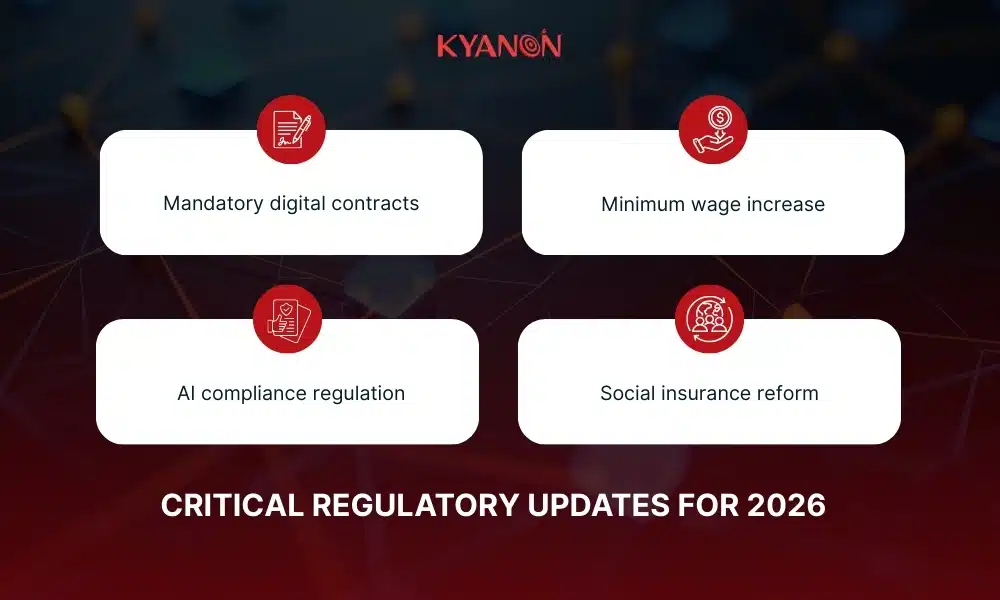
Mandatory digital contracts
From July 1, 2026, Vietnam’s government mandates that all electronic labor contracts (hereinafter, “e-contracts”) must be digitally created, signed, and stored on a centralized platform developed and managed by the Ministry of Home Affairs. This regulation aims to improve transparency and protect both employers and employees. (Vietnam Briefing)
Minimum wage increase
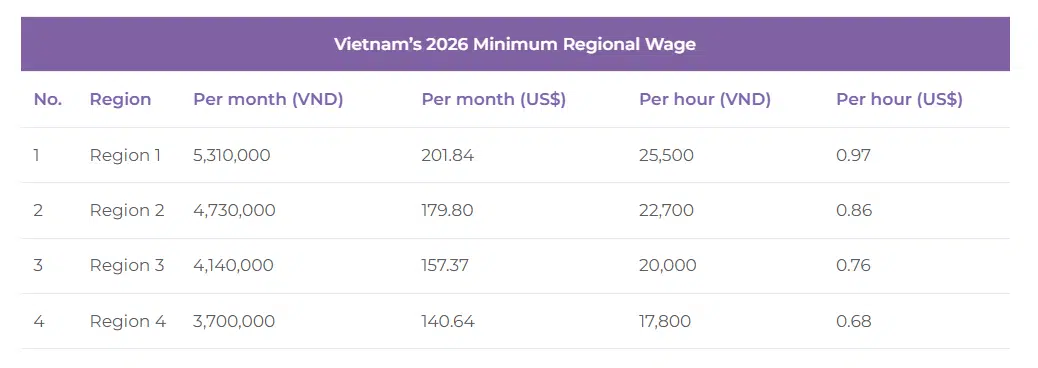
As of January 1, 2026, Vietnam increased regional minimum wages by approximately 7.2 percent. (Vietnam Briefing)
- Region I (Ho Chi Minh City and Hanoi): 5,310,000 VND per month
- Region II (including Da Nang): slightly lower but still competitive

Updates to the Vietnam minimum wage from January 1, 2026 (Source: Vietnam Briefing)
AI compliance regulation
While many countries are still drafting policy blueprints or issuing non-binding guidance, Việt Nam has moved ahead with a standalone Law on Artificial Intelligence (AI), effective from March 1, placing it among a select group of nations to adopt dedicated AI legislation at the parliamentary level. (Vietnam News)
The law introduces a three-tier risk classification system for AI applications – high, medium and low. Providers must assess and categorise their systems before deployment, in line with forthcoming technical guidance.
Social insurance reform
The updated Employment Law (effective 2026) modernizes unemployment insurance systems to better match talent supply and demand in high-tech sectors.
Operational cost insights
Ho Chi Minh City is currently the 6th most expensive city in Asia Pacific for premium office space, though analysts project a 10 to 20 percent rental correction by late 2026 as new supply enters the market. (The Investor)
Da Nang remains a highly cost-efficient alternative. Total operational expenses, including health insurance, housing, and office costs, are significantly lower compared to the two major metros. These cost dynamics reinforce why many organizations adopt a multi-city sourcing strategy across Vietnam software hubs.
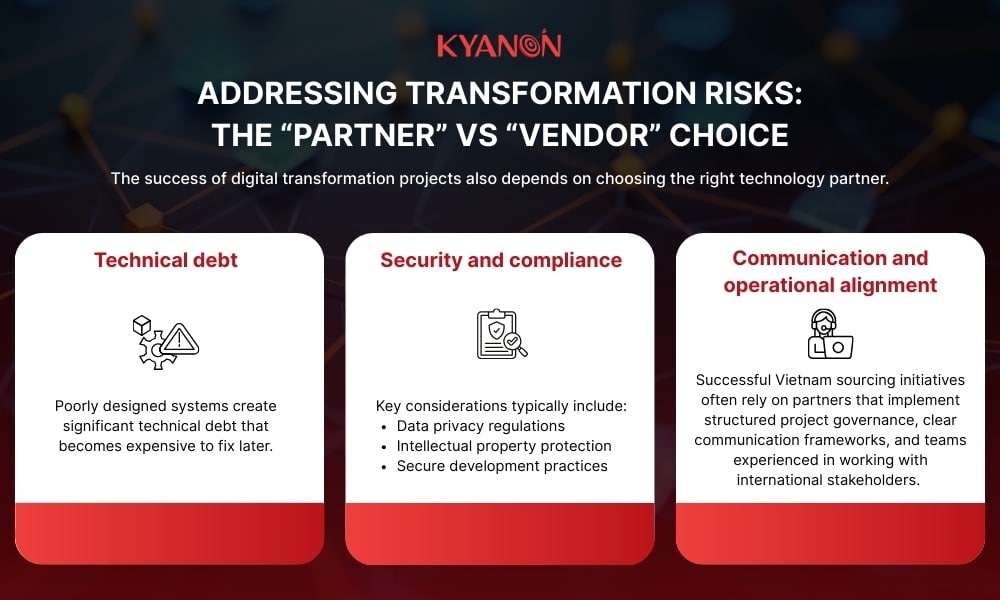
Addressing transformation risks: The “partner” vs “vendor” choice
Selecting a development location is only part of the equation. The success of digital transformation projects also depends on choosing the right technology partner.
Addressing transformation risks: The “partner” vs “vendor” choice
Technical debt
Many companies fail when they prioritize the lowest development cost rather than long-term architecture quality. Poorly designed systems create significant technical debt that becomes expensive to fix later.
Security and compliance
Companies operating across international markets must ensure strict compliance with global technology standards and regulations. This is particularly important for organizations working with software companies in Vietnam while serving clients in regions such as Singapore, Malaysia, or the European Union. Key considerations typically include:
- Data privacy regulations
- Intellectual property protection
- Secure development practices
Established development providers generally follow internationally recognized frameworks such as ISO 27001, secure DevOps pipelines, and standardized data protection protocols to ensure enterprise-level security and compliance.
Communication and operational alignment
Cross-border collaboration can sometimes introduce communication gaps due to differences in language, workflow practices, and business expectations. Successful Vietnam sourcing initiatives often rely on partners that implement structured project governance, clear communication frameworks, and teams experienced in working with international stakeholders. These practices help reduce operational friction and maintain alignment throughout the software development lifecycle.
Kyanon Digital: Your multi-hub enterprise AI and digital transformation partner
Founded in 2012, Kyanon Digital is a leading digital transformation and software engineering partner with delivery centers across Ho Chi Minh City, Hanoi, and Da Nang, enabling enterprises to leverage the full potential of Vietnam’s major software hubs.
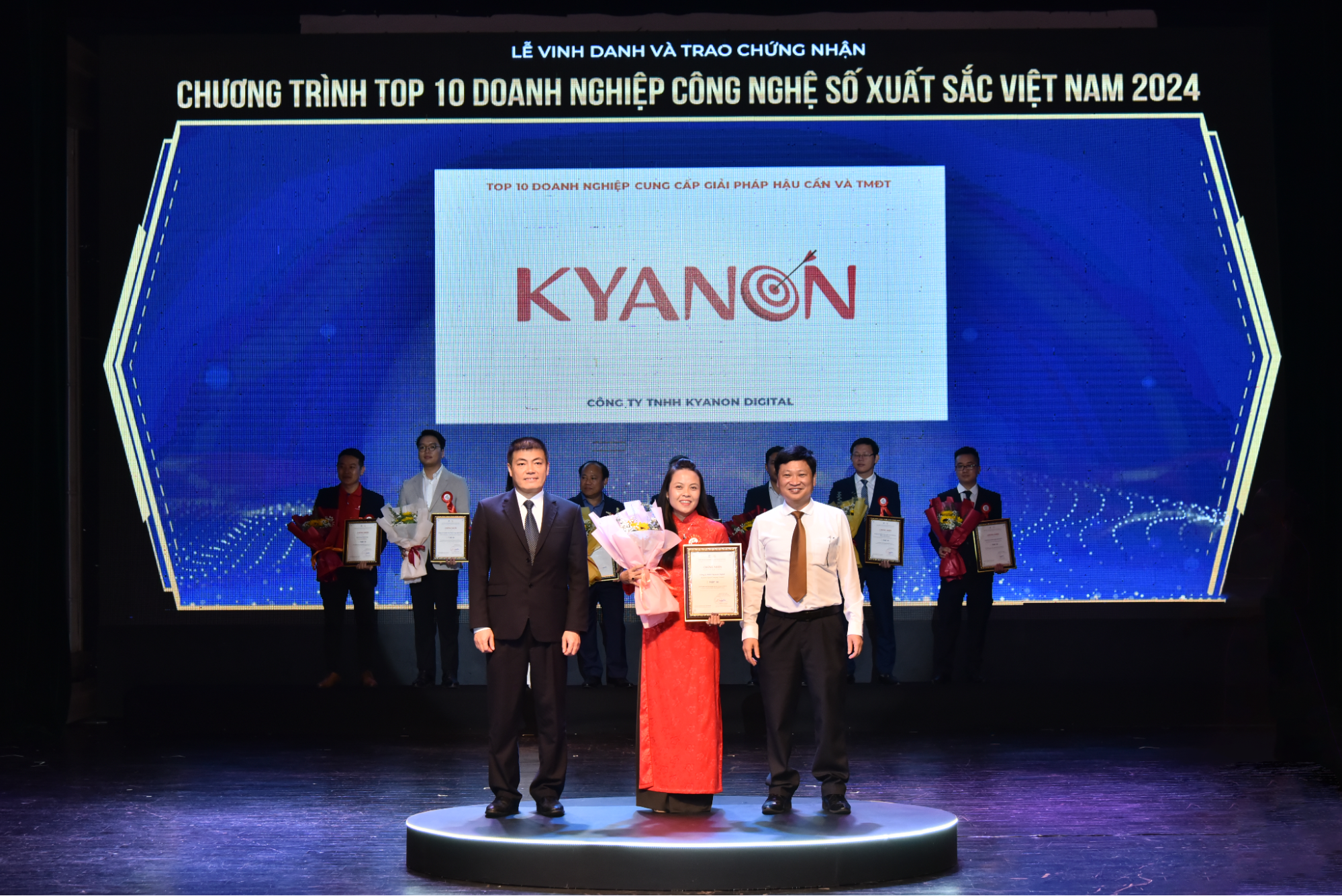
Kyanon Digital recognized as top digital technology companies in Vietnam 2025
With a team of 500+ technology experts, Kyanon Digital combines deep technical expertise with a multi-hub delivery model to provide scalable, resilient, and cost-efficient software outsourcing solutions. This strategic presence across Vietnam allows regional and global enterprises to access diverse talent pools, optimize operational costs, and build high-performing engineering teams that support long-term digital transformation initiatives.
Recognized by VINASA for multiple consecutive years with prestigious digital technology awards, the company helps organizations accelerate innovation, optimize operations, and build future-ready digital ecosystems through strategic consulting and high-quality engineering delivery.
Choosing the right Vietnam software hub
Ho Chi Minh City, Hanoi, and Da Nang each offer distinct strengths for technology development. Ho Chi Minh City provides scale and speed for product innovation, Hanoi stands out for deep R&D capabilities and enterprise system expertise, while Da Nang delivers cost efficiency and long-term team stability. Understanding these differences helps organizations choose the most suitable location when working with software companies in Vietnam.
With offices in all three major technology hubs, Kyanon Digital enables enterprises to access diverse talent pools and build flexible development teams tailored to different project needs. Contact Kyanon Digital to learn how our experts can support your next software development initiative.