
Evaluating white-label vs. IT staff augmentation in Singapore is a critical market landscape decision for enterprises navigating unprecedented digital delivery pressures. According to IDC, the global IT skills crisis is projected to cost organizations $5.5 trillion in delays and revenue losses (Deloitte), highlighting a severe operational bottleneck.
Regionally, demand continues accelerating as Singapore deepens enterprise digitalization; over 100 companies, including Huawei, Accenture, and Amazon Web Services, are collectively hiring for more than 1,000 roles across AI engineering, cloud architecture, cybersecurity, and software development, reflecting sustained structural demand for advanced tech talent despite global tech layoffs (The Straits Times, 2025). To combat these talent deficits, the IT staff augmentation market is expanding rapidly, projected by Verified Market Reports (2025) to reach $200.6 billion by 2033.
In this guide, Kyanon Digital explains the key differences between white-label services and IT staff augmentation, helping businesses protect intellectual property, control costs, and scale technology delivery effectively.
Key takeaways
- White-label services allow non-technical companies to rebrand and resell a provider’s pre-built product as their own, ensuring immediate market entry.
- IT staff augmentation is a model for renting dedicated external technical professionals who integrate directly under your internal management structure.
- The primary differentiator is control: white-labeling is hands-off and vendor-managed, whereas staff augmentation demands active technical leadership but secures intellectual property (IP) ownership.
- As Singapore faces deep tech talent shortages, leveraging local augmentation providers provides enterprises a proven route to bypass lengthy local recruitment cycles.
Further reading:
- IT Staff Augmentation Services
- Top 10 White-Label Software Development Partners in Singapore
- IT Staff Augmentation vs. Outsourcing: Which Model Fits Your Needs?
- Choosing the Right IT Staff Augmentation Partner with Key Criteria
- Case Studies: How IT Staff Augmentation Companies Fueling Business Growth
What is white-label service?
White-label service is the third-party solutions built and maintained by a vendor but delivered to end customers under your brand. The client owns the customer relationship, while the provider remains responsible for product delivery and operations.
How the operating model works
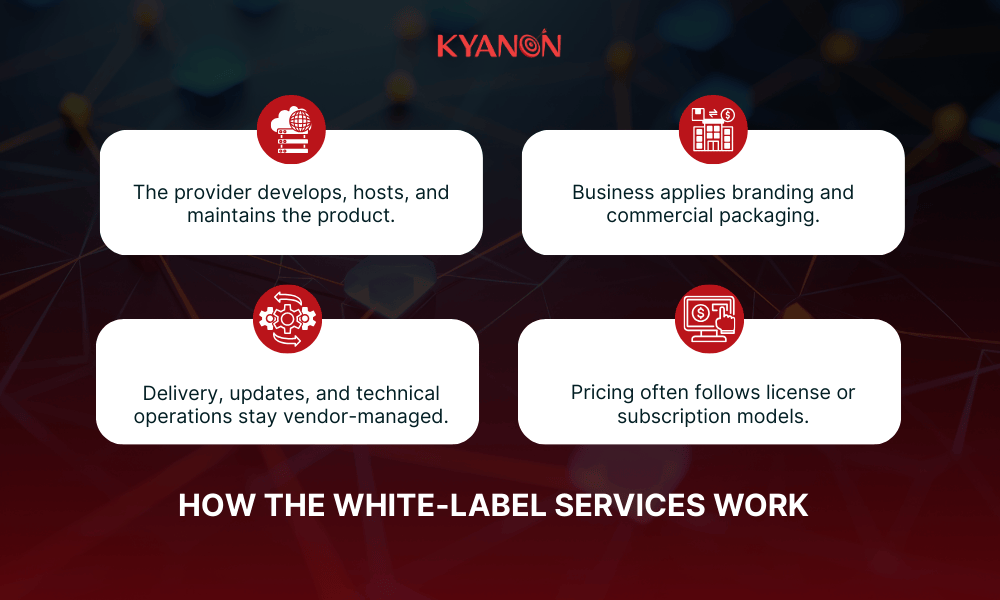
- The vendor develops, hosts, and maintains the product or platform.
- Business applies branding, pricing, and market positioning.
- Delivery, updates, maintenance, and technical operations remain vendor-managed.
- Commercial models typically follow license, subscription, or revenue-share pricing.
- The business focuses on sales and customer growth rather than engineering execution.
Common enterprise use cases
- Launch new digital services without building internal teams.
- Resell SaaS platforms or technology solutions under one brand.
- Test product-market demand before committing engineering investment.
- Expand service portfolios while keeping organizational structure lean.
Strategic advantages
- Faster time-to-market: launch in weeks instead of months.
- Predictable delivery outcomes: through standardized solutions.
- Reduced operational complexity and hiring requirements.
- Lower upfront investment compared to in-house development.
What is IT staff augmentation?
IT staff augmentation is a flexible service model where businesses add external IT specialists to their internal teams on demand, allowing companies to scale technical capacity quickly while maintaining direct management and operational control. (Clutch)
In Singapore’s high-cost hiring environment, this model enables companies to access pre-vetted technical talent without long recruitment cycles or permanent employment liabilities.
Engagement models typically include
- Short-term scaling for product launches.
- Long-term embedded engineers.
- Flexible capacity aligned with project phases.
This structure ensures that businesses retain full control over source code, intellectual property, and technical direction.
How the model works
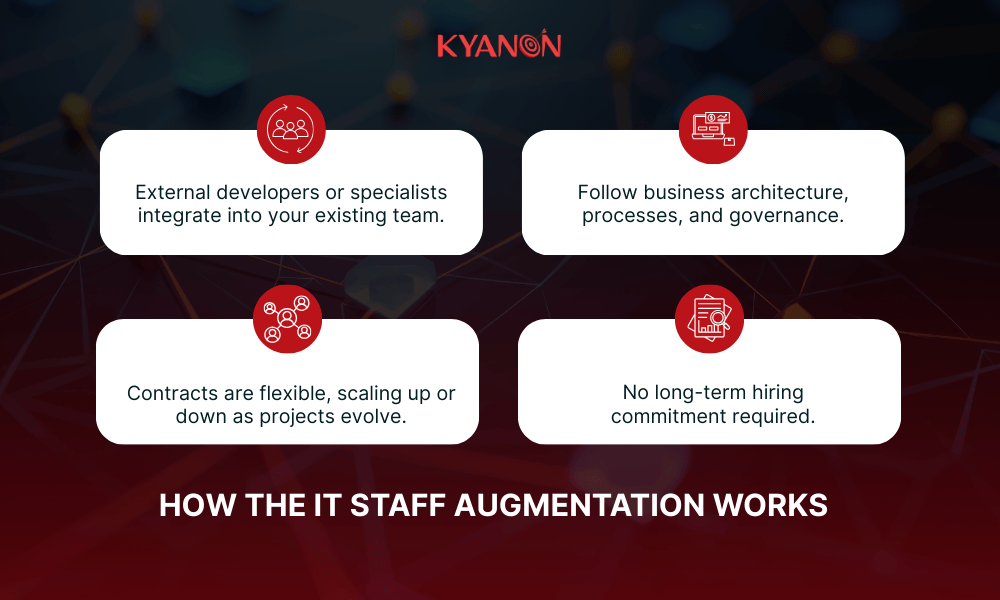
- External developers or IT specialists integrate directly into your existing team.
- Augmented engineers operate under your technical leadership, using your architecture, tools, and governance standards, ensuring full operational control and alignment.
- Companies engage augmentation partners to provide pre-vetted technical talent on demand.
- Teams support ongoing delivery across product development, infrastructure, and core systems.
- Engagement models remain flexible
- Project-based support (short-term scaling)
- Long-term embedded teams
- Workforce capacity can scale up or down based on project phases.
- Unlike traditional hiring, staff augmentation eliminates long recruitment cycles, onboarding overhead, and long-term employment liabilities, enabling faster time-to-value.
IT staff augmentation commonly supports
- Cybersecurity (threat analysis, vulnerability assessment, security implementation).
- Cloud & infrastructure (setup, optimization, maintenance).
- Software development (applications, platforms, enterprise systems).
- Data & analytics (data engineering, BI, insights generation).
- Network operations (performance monitoring and troubleshooting).
How businesses typically use
- Fill specialized skill gaps (AI, cloud, cybersecurity, DevOps).
- Accelerate product launches and digital transformation initiatives.
- Handle temporary delivery spikes without expanding permanent headcount.
- Modernize legacy systems while maintaining internal ownership and continuity.
Key business advantage
- Maintain direct oversight of quality and timelines.
- Keep ownership of source code and technical knowledge.
- Faster access to qualified talent.
- Reduced hiring overhead.
- Full oversight of quality and timelines.
- Complete ownership of intellectual property.
- Operational flexibility aligned with growth phases.
White-label services in Singapore: Moving from basic SaaS to agentic AI
White-label services in Singapore allow B2B tech firms, marketing agencies, and SaaS startups to rebrand and resell ready-made software or digital services as their own.
The shift of white-label services in Singapore.
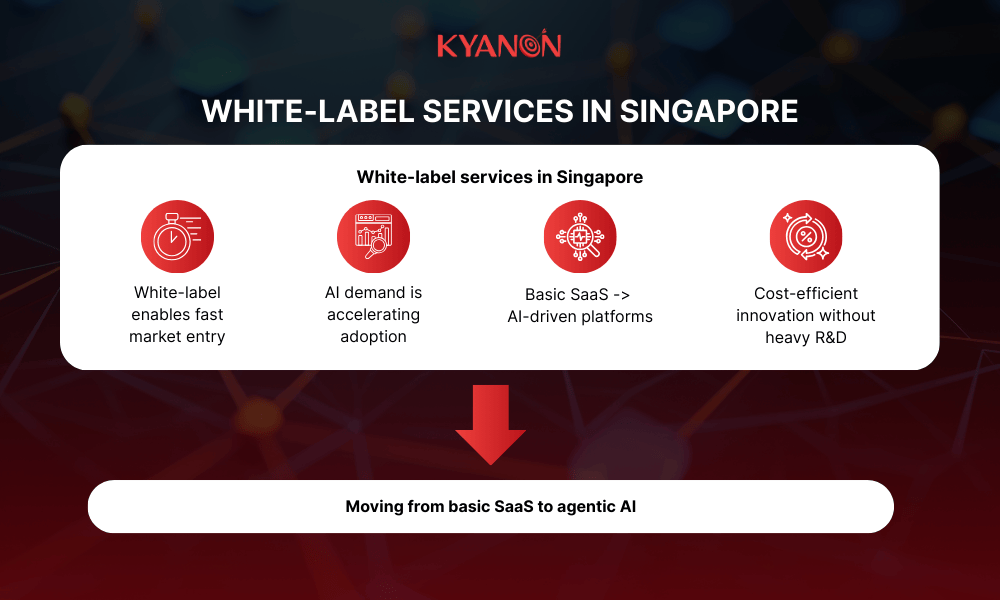
According to IDC, global AI spending is surging at a 29% CAGR. Singaporean startups are using white-labeling to capture this demand without the crippling cost of building proprietary AI models.
The focus has shifted from basic apps to reselling complex GenAI-powered chatbots, custom CRMs, and predictive analytics dashboards, allowing companies to bypass expensive R&D (Deloitte’s 2025 Technology Industry Outlook).
The strategic advantage
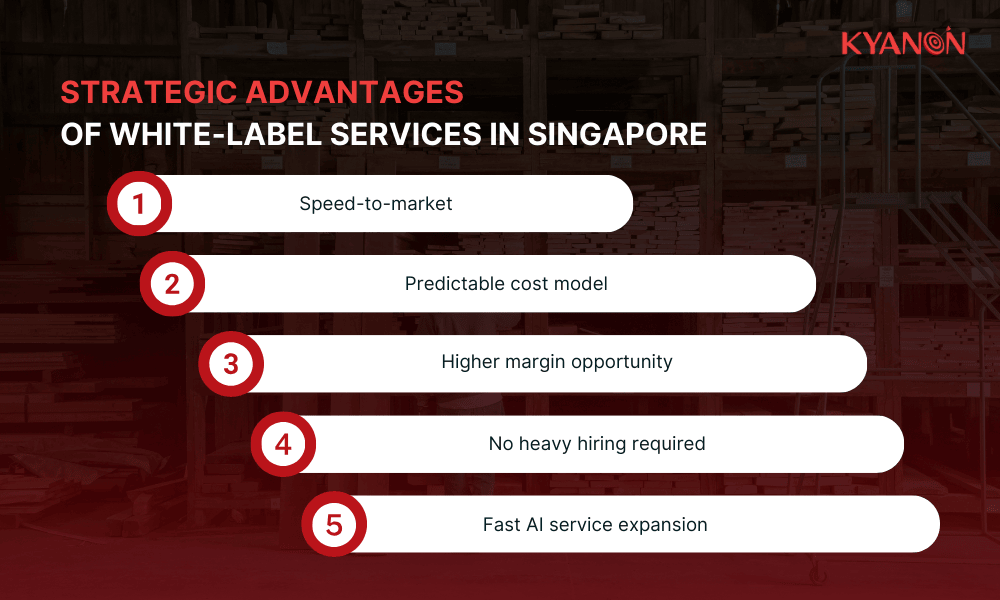
Strategic advantages of white-label services in Singapore.
- Speed to market: Launch enterprise-grade solutions in days, not the 6–12 months required for native development. Perfect for agencies wanting to offer AI-driven marketing to clients instantly.
- Predictable, fixed costs: Replaces volatile R&D burn rates with flat per-license or project-based fees. Protects enterprises’ profit margins in a fluctuating macroeconomic climate.
- Real-life application: Instead of hiring a $150k/year machine learning engineer to build a customer support tool, businesses license a white-label AI agent, brand it with their logo, and upsell it to their local retail clients at a premium.
Real enterprise trade-offs
- Limited technical ownership: vendor controls roadmap, deeper product changes, and many integration paths.
- Vendor dependency risk: upgrades, security posture, and data portability depend on the provider. Demand escrow/exit clauses.
- Differentiation ceiling: branding and packaging are your main levers; deep product differentiation is constrained.
Actionable procurement checklist
- Source-code escrow or migration SLA.
- Clear IP & rebranding rights (what you can modify or resell).
- SLOs (uptime, MTTR), audit rights, and security certifications (SOC2/ISO27001).
- Pricing breakpoints for customization and scale.
Choose white-label when speed and predictable cost outweigh the need for long-term product IP and deep technical differentiation.
IT staff augmentation in Singapore
IT staff augmentation in Singapore is a flexible outsourcing strategy where businesses rent highly specialized global tech talent (like cloud architects or AI prompt engineers) to integrate seamlessly under their internal CTO’s management.
The 2026 talent reality
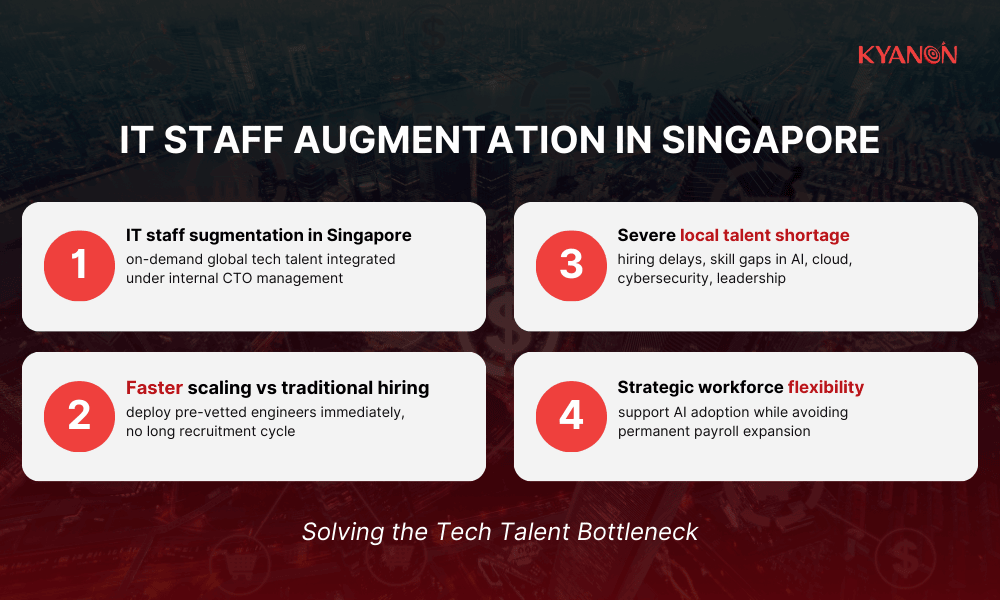
The IT staff augmentation in Singapore helps solve the tech talent bottleneck.
Traditional hiring pipelines in Singapore are currently bottlenecked. According to 2025 data featured in the Singapore Business Review, the local tech market is facing a severe recruitment squeeze:
- High rejection rates: 41% of HR professionals report that less than half of job applicants meet the required qualifications.
- Niche skill shortages: The hardest skills to find locally are technical fluency (36%) and leadership (35%).
- Recruitment gridlock: Companies have become hyper-selective, demanding candidates meet at least 80% of job requirements, which drastically slows down recruitment cycles.
Currently, with 94% of Singaporean business leaders prioritizing AI adoption (Singapore Business Review), staff augmentation allows companies to instantly bypass local talent shortages in technical fluency and leadership without the long-term overhead of permanent hires.
Local demand for advanced tech roles (AI, cloud, cybersecurity) remains strong. Singapore reported more than 1,000 open specialist roles across ~100 firms in 2025 (The Straits Times), making augmentation a practical route to access scarce skills quickly. Verified Market Research shows the global staff-augmentation market growing rapidly over the decade.
Instead of waiting six to twelve months to find the “perfect” local hire, agile tech firms are pivoting to staff augmentation to deploy pre-vetted global talent immediately, offering rapid scaling without long-term payroll commitments.
The strategic advantage of augmentation in 2026
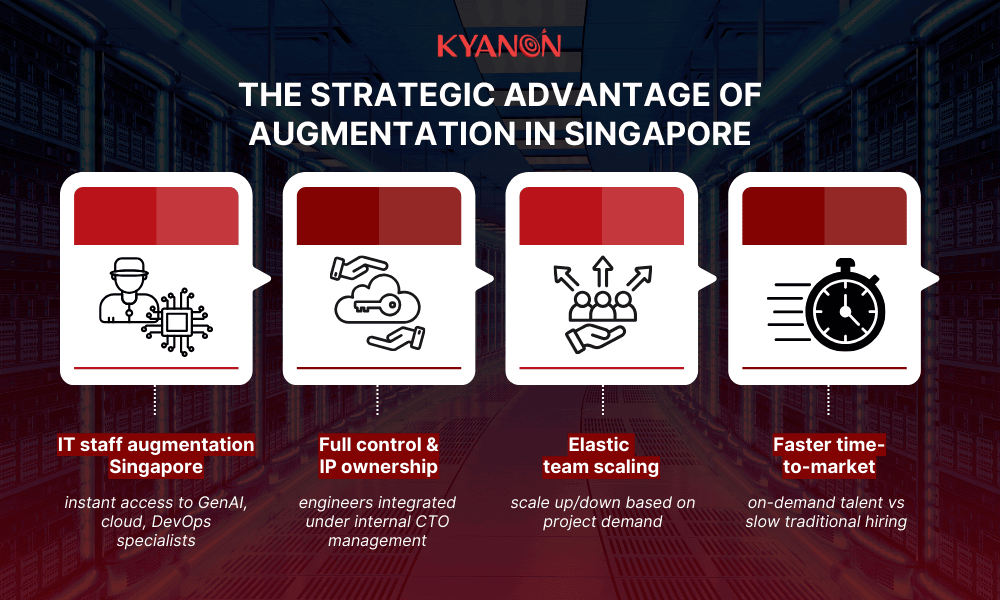
Bridging the technical fluency gap instantly:
- Businesses can immediately onboard niche specialists, such as GenAI developers, LLM prompt engineers, or cloud architects, who already possess the exact technical stack required for your project.
- For example: rather than spending months trying to recruit an AI engineer locally, you rent one for a critical 6-month product integration, ensuring your new software feature hits the market on time.
Direct management & absolute IP control:
- Unlike traditional outsourcing, where the business hands a project over to an external agency, augmented staff act as “plug-and-play” internal employees. They use company emails, follow internal security protocols, and report directly to engineering managers.
- Real-world application: An enterprise maintains 100% oversight over proprietary code quality and data privacy while a rented DevOps expert securely deploys your new enterprise SaaS update.
Bypassing hiring constraints via elastic scalability:
- Augmentation partners (like Kyanon Digital) provide guaranteed experts who meet 100% of technical needs, bypassing the local talent gridlock entirely.
- Real-world application: A business can rapidly scale up a dedicated Python team for a Q4 enterprise software launch and then seamlessly scale back down in Q1 without the legal friction, severance packages, or financial hit of layoffs.
Bottom line for tech leaders:
- With over 73% of APAC companies racing to upskill teams in AI and automation (Singapore Business Review), internal hiring alone is too slow. IT staff augmentation has evolved into a core time-to-market strategy, enabling businesses to scale talent on demand and shift fixed payroll costs into flexible, project-based spending.
Operational realities & competitive advantage
- Requires internal leadership: Augmentation returns are highest when a CTO/tech lead can onboard, assign work, and govern delivery.
- Better ROI on strategic tech: Use augmentation when the product or platform is core to competitive advantage; you keep control while filling skill gaps.
- Hybrid acceleration: Combine augmentation for core systems with selective white-label for customer-facing, commodity features.
Governance & risk controls
- Enforce onboarding SOWs, knowledge-transfer milestones, and shadowing periods.
- Require security vetting, signed NDAs, and well-defined IP assignment clauses.
- Measure performance with engineering KPIs: sprint predictability, defect density, and MTTR.
Pick augmentation when technical ownership, architecture control, and long-term capability building are non-negotiable.
What Singapore enterprises need to know
When Singaporean enterprises choose between white-label software and IT staff augmentation, the decision hinges on four critical pillars:
The 4 pillars of tech outsourcing in Singapore
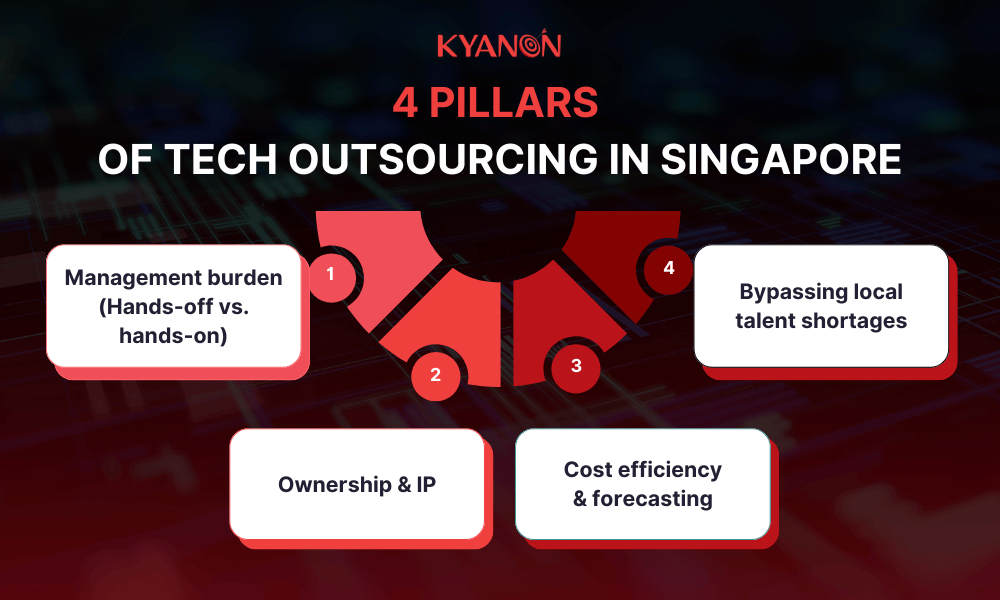
Management burden (Hands-off vs. hands-on)
- White-label: Completely hands-off. The vendor manages the software execution, QA testing, and server maintenance. The enterprise’s internal team focuses purely on client acquisition, marketing, and sales.
- IT staff augmentation: Highly hands-on. Organizations must have an internal technical leader (like a CTO or VP of Engineering) capable of directing the augmented staff, integrating them into internal agile sprints, and reviewing the code.
Ownership & IP
- IT staff augmentation: The enterprise owns the blueprint. Every line of code, database architecture, and AI model developed by the augmented staff belongs 100% to the company.
- White-label: The business rents the blueprint. Companies purchase the license to rebrand and resell the product, but they do not own the underlying technology or source code.
Cost efficiency & forecasting
- White-label: Costs are highly predictable. Vendors charge fixed monthly licenses or milestone-based fees, making it easy for organizations to calculate exact profit margins before making a sale.
- Staff augmentation: Follows a time & materials (T&M) billing model. Enterprises pay hourly or monthly rates for the developers, meaning costs will flex up or down based on the project’s timeline and scope changes.
Bypassing local talent shortages
With Singapore continuing to face severe talent scarcity in specialized tech roles through 2026, both models offer a strategic bypass. Leveraging established regional partners gives enterprises instant access to pre-vetted talent, eliminating the standard 3-to-6-month local recruitment cycle.
Strategic recommendation
Choosing between white-label and IT staff augmentation comes down to your core business objective.
- White-label (when to pick): Use white-label if your priority is speed-to-market and predictable cost, such as agencies, channel partners, or non-tech firms that need a turnkey product quickly. Insist on source-code escrow, SLOs, and clear rebranding/licensing terms before you go to market.
- IT staff augmentation (when to pick): Use augmentation when the technology, IP, or platform is strategic, and you need architectural control. Augmentation buys speed without sacrificing ownership, embeds pre-vetted engineers into your squads, enforces onboarding SOWs, and measures engineering KPIs (sprint predictability, defect density, and MTTR).
- Practical hybrid: Most Singapore enterprises adopt a hybrid: white-label for commoditized, customer-facing features and augmentation for core platform work. This balances speed and long-term value in regional markets like Singapore.
Vendor & governance playbook
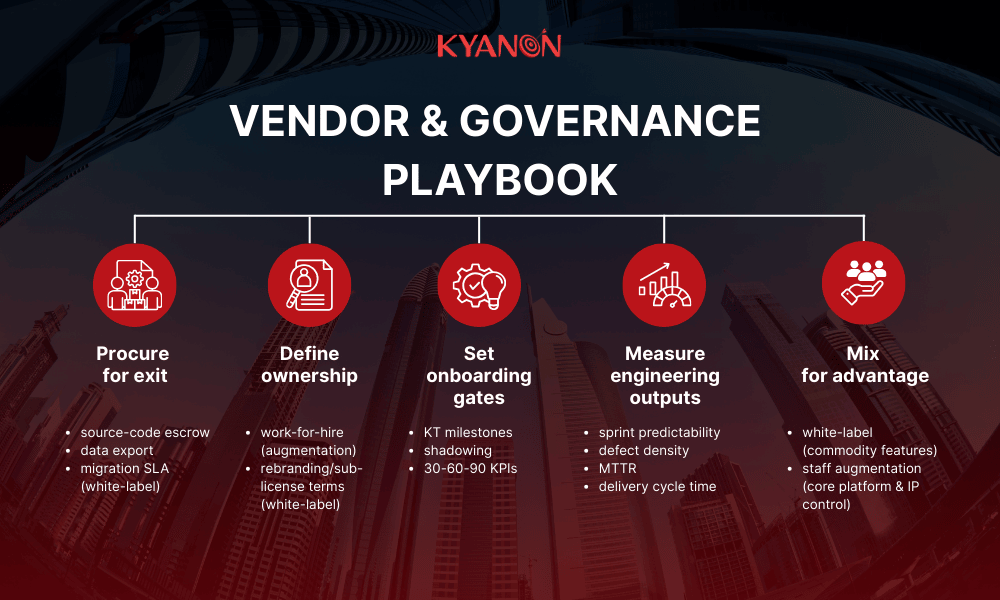
- Procure for exit: require source-code escrow, data export formats, and migration SLAs (non-negotiable for white-label).
- Define ownership: explicit IP and work-for-hire clauses for augmentation and rebranding & sublicensing clauses for white-label.
- Set onboarding gates: shadowing, KT milestones, and first-30/60/90 delivery KPIs.Measure engineering outputs: sprint predictability, defect density, MTTR, and feature-cycle time.
- Mix for advantage: use white-label for commoditized customer features and augmentation for core platform work to balance speed with IP protection
Why partner with Kyanon Digital for IT staff augmentation or white-label?
Kyanon Digital acts as a strategic tech partner, not a recruiter; we align talent to your product roadmap and keep delivery moving while you focus on growth.
- Strategic team design, not CV matching: We staff to your architecture, roadmap, and outcomes, reducing rework and ramp time.
- CoE & upskilling: Continuous training and expert support ensure talent stays current on cloud, AI, and security best practices.
- Massive, multi-layer talent ecosystem: Access a combined pool of enterprise talent at scale: >500 internal professionals, 15,000+ premium candidates, and 1,000+ partners, part of a 50,000+ talent network.
- K-Fresh pipeline (local capacity build): A talent development program across 18 universities in Vietnam to produce ready-to-deploy junior engineers.
- One-stop talent impact solution: End-to-end management from sourcing and HR to payroll and performance, freeing your leaders to run product and GTM.
- Commercial flexibility: Staff augmentation, embedded squads, or white-label licensing to match your time-to-market and budget profile.
- Risk controls built in: SLAs, onboarding gates, KT milestones, and compliance checks to reduce vendor dependency and preserve IP.
- Operational speed & predictability: Shorten hiring cycles, convert fixed payroll into project-aligned Opex, and hit delivery milestones faster.
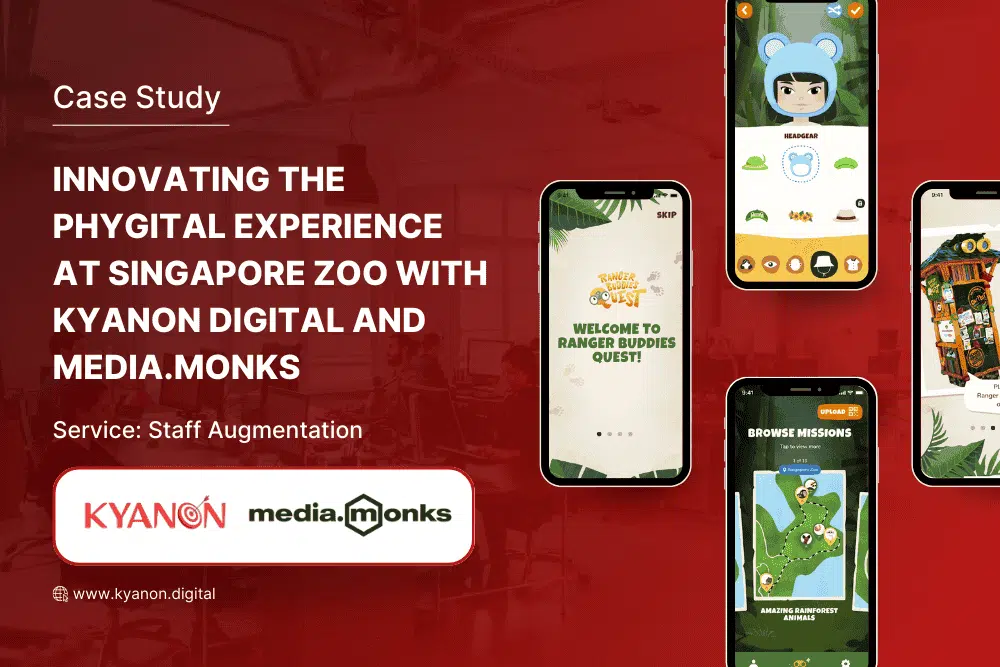
Case study: Kyanon Digital enables Singapore Zoo to deliver a scalable phygital experience through IT Staff Augmentation
Kyanon Digital enhances Singapore Zoo’s phygital initiative with embedded IT staff augmentation teams.
Singapore Zoo, in collaboration with Media. Monks aimed to create an immersive phygital visitor experience combining mobile applications with on-site digital interactions.
Challenges
- Need for specialized engineering skills not available internally
- Tight delivery timeline for interactive digital experience launch
- Complex integration between physical environments and digital platforms
- Avoid long recruitment cycles in Singapore’s competitive tech talent market
Solution from Kyanon Digital
- Provided IT staff augmentation with pre-vetted developers integrated into the client’s delivery team
- Embedded engineers working under client workflows, tools, and agile governance
- Supported cross-platform development (mobile app, backend, interactive systems)
- Enabled flexible scaling aligned with project milestones
Results & business impact
- Accelerated product delivery without permanent hiring expansion
- Seamless integration of physical and digital visitor experiences
- Maintained client ownership over product execution and technical outcomes
Read more: Innovating the Phygital Experience at Singapore Zoo with Kyanon Digital and Media.Monks
Conclusion
Choosing between white-label services and IT staff augmentation in Singapore depends on one core question: Do you prioritize speed or control?
White-label solutions enable rapid market entry with predictable costs and minimal operational burden, while IT staff augmentation provides scalable engineering capacity, full IP ownership, and long-term technology control.
As Singapore enterprises accelerate digital and AI adoption amid ongoing talent shortages, many organizations are adopting a hybrid approach, using white-label for fast deployment and staff augmentation to build strategic platforms sustainably.
Looking to scale your technology delivery with confidence?
Contact Kyanon Digital to design the right augmentation or white-label strategy aligned with your business goals and growth roadmap.