Australian enterprises move development teams to Vietnam to solve a structural talent bottleneck, not just reduce cost. Vietnam offers 40–60% lower engineering costs, a 3–4 hour AEST time overlap for real-time collaboration, 57,000+ annual STEM graduates, and strong Agile adoption across enterprise-grade teams. For ANZ companies scaling digital products beyond local hiring capacity, Vietnam is the most operationally compatible offshore destination in Asia-Pacific.
Key takeaways
Australian enterprises move developer teams to Vietnam primarily to resolve a structural talent bottleneck, not merely to reduce cost. The key drivers are:
- Engineering costs 40–60% lower than Australian market rates.
- A 3–4 hour AEST–ICT time overlap that supports real-time collaboration.
- 57,000+ annual STEM graduates feeding a deepening talent pipeline.
- High Agile maturity across enterprise-grade Vietnamese technology firms.
- Strong adoption of modern stacks including React, Python, and AI/ML tooling.
For ANZ companies scaling digital products beyond local hiring capacity, Vietnam currently represents the most operationally compatible offshore destination in the Asia-Pacific region.
Further reading:
- Build Your Offshore Development Team in Vietnam 2026
- Hire a Dedicated Development Team in Vietnam: The Guide for Australian, US, and EU Clients
- First 90 Days with a Dedicated Team: Milestones & KPIs
The local talent ceiling: Why hiring in Australia Is getting harder
What is the talent bottleneck facing Australian software businesses?
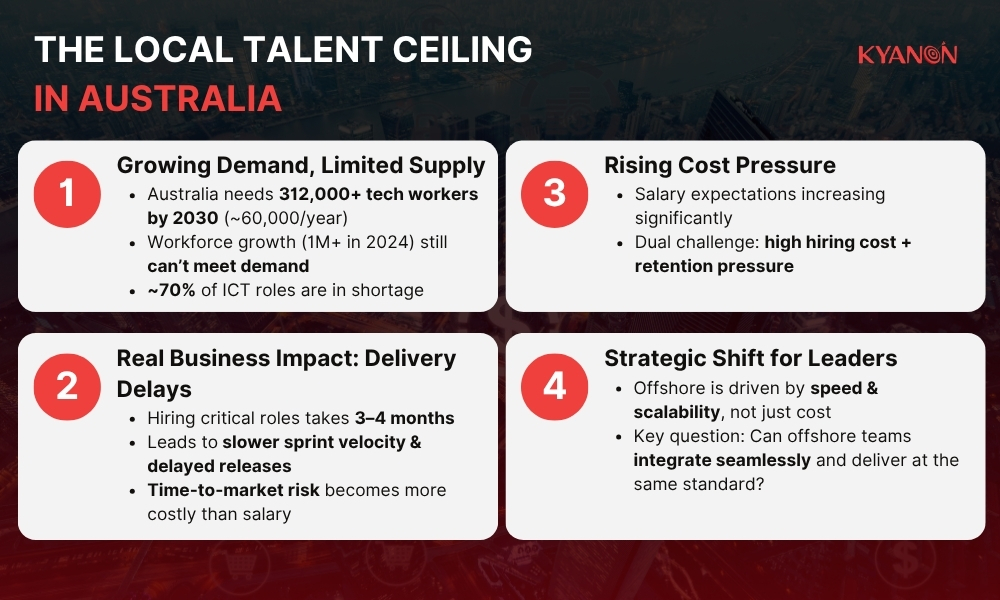
Australia’s technology sector is expanding faster than its domestic pipeline of qualified engineers can support. According to the Australian Computer Society’s Digital Pulse 2024 report, Australia will need 312,000 additional technology workers by 2030 to meet industry demand, equivalent to more than 60,000 new entrants to the technology workforce every year. The technology workforce only surpassed the one million mark in 2024 after a decade of 60% growth, yet that figure still falls short of projected requirements.
The practical consequence for product organisations is not simply a salary increase. It is roadmap delay. When a critical backend role takes three to four months to fill, sprint velocity collapses, feature releases slip, and competitors move faster. The cost of that delay is rarely captured in a salary benchmarking exercise, but it is frequently the decisive factor in whether a product reaches market at the right time.
Why does this matter specifically to CEOs and engineering leaders?
The decision to look offshore is typically triggered not by budget pressure alone, but by the recognition that local hiring can no longer deliver the team scale required to execute a product roadmap within a competitive window. According to the Jobs and Skills Australia report cited by the ACS, nearly 70% of ICT professional occupations are currently in shortage across Australia, a skills challenge described as unlike anything the country has seen since the 1960s.
The Hays Salary Guide FY24/25 documents a significant shift in salary expectations among Australian technology workers, with the proportion of employees expecting salary increases above 3% nearly doubling between 2019 and 2024. This compression affects not only new hires but retention of existing teams, creating dual pressure on engineering cost structures.
The framing that matters: The question is not whether offshore development teams are cheaper. They are. The operationally significant question is whether an offshore developer team can be integrated tightly enough with the parent organisation to deliver at the same standard and whether the time and cultural conditions in a given destination support that integration. That is where Vietnam distinguishes itself.
How does Vietnam compare to other offshore destinations for Australian enterprises
When Australian enterprises evaluate offshore options, the comparison typically involves scaling locally in Australia, engaging developer teams in India or the Philippines, or building a Vietnam-based squad. The table below captures the operationally relevant dimensions.
|
Criterion |
Scale Locally (AU) | India and Philippines | Vietnam |
|
Cost vs. AU market |
Baseline | 50-65% lower | 40-60% lower |
| AEST Time Overlap | Full | 1-3 hours |
3-4 hours |
|
Modern Stack Depth |
High | Variable | High (React, Python, AI/ML) |
| Agile Maturity | High | Mixed |
High |
|
Time-to-Productive |
Immediate | 3-6 months | 2-4 months |
| Business English Communication | Native | Variable |
Strong at senior and mid-senior level |
| Enterprise IP Governance | Strong | Variable |
Strong (with right partner) |
Vietnam is not the cheapest offshore option in absolute terms. India offers marginally lower headline cost in some talent segments. The strategic differentiation is in the combination of time overlap, communication quality, and Agile delivery maturity. A 3-4 hour AEST-ICT working window, typically covering 9:00 AM to 1:00 PM Sydney time, is sufficient to run daily standups, sprint planning sessions, and real-time architecture discussions without scheduling acrobatics.
Teams operating with only a 1-2 hour overlap default to asynchronous communication patterns that introduce compounding review delays, reduced code review velocity, and increased risk of misaligned implementation.
Decision signal for Australian engineering leaders: Vietnam is not the lowest-cost option. It is the highest-leverage option for ANZ teams that require real-time collaboration, modern-stack engineers, and a delivery partner who embeds within the organisation’s engineering culture rather than one that executes tasks in isolation.
How an integrated developer team model works in practice
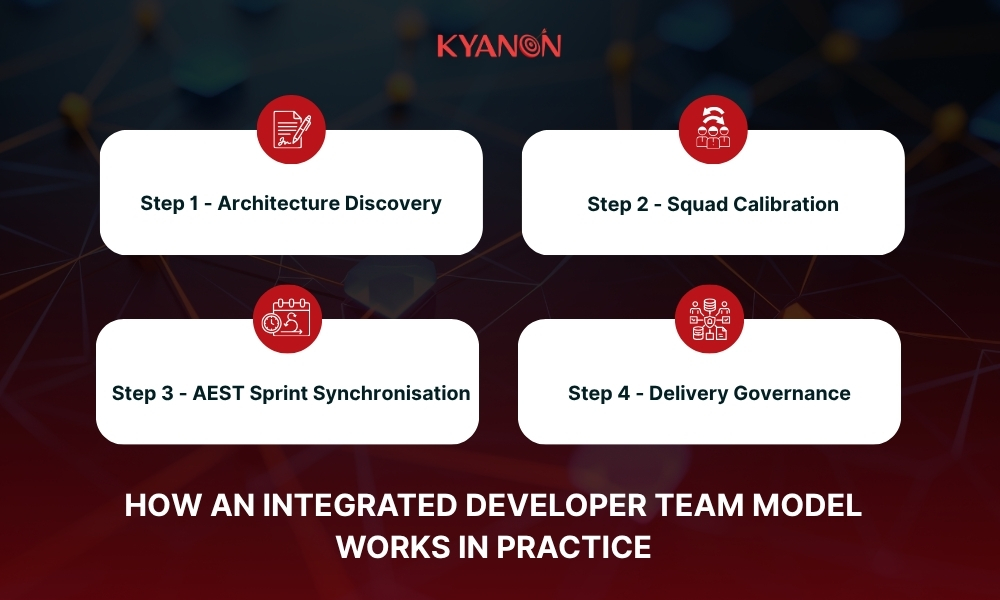
The most common failure mode in offshore engagements is treating the arrangement as a staffing transaction rather than an engineering integration. The following four-step model describes how high-performing ANZ-Vietnam developer team partnerships are structured.
Step 1 – Architecture Discovery
Before any team is assembled, a thorough audit of the client’s current technology stack, technical debt profile, IP ownership requirements, and team topology is conducted. The output is an integration readiness scorecard that identifies where the offshore squad can contribute with the least friction and the fastest ramp.
Step 2 – Squad Calibration
Cross-functional pods are assembled based on the Australian team’s specific toolchain and delivery culture, not from a pool of generic offshore headcount. A squad for a React-native mobile product has a fundamentally different composition than one supporting a Python-based data pipeline. Role alignment at the outset is the primary determinant of ramp speed.
Step 3 – AEST Sprint Synchronisation
All sprint ceremonies, including standups, planning, retrospectives, and review sessions, are scheduled within the AEST-ICT overlap window. This is a structural decision, not a preference. Teams that schedule ceremonies outside the overlap window inevitably drift toward asynchronous-first behaviour, which degrades delivery cohesion within two to three sprints.
Step 4 – Delivery Governance
CI/CD pipelines, automated QA gates, code review standards, and reporting cadence are defined and implemented from day one, not retrofitted after problems emerge. The governance layer is what converts a group of capable engineers into a functioning extension of the client’s engineering floor.
What outcomes have Australian clients achieved?
Clients who follow this model typically report full squad integration within six to ten weeks. The most consistent outcome metrics cited by ANZ technology companies working with Vietnam-based developer teams include a 30-45% reduction in time-to-market for new feature sets, significant improvement in defect rates attributable to automated QA integration, and cost variance against the original projection within +/-8% over the first twelve months.
What most Australian enterprises get wrong about offshoring
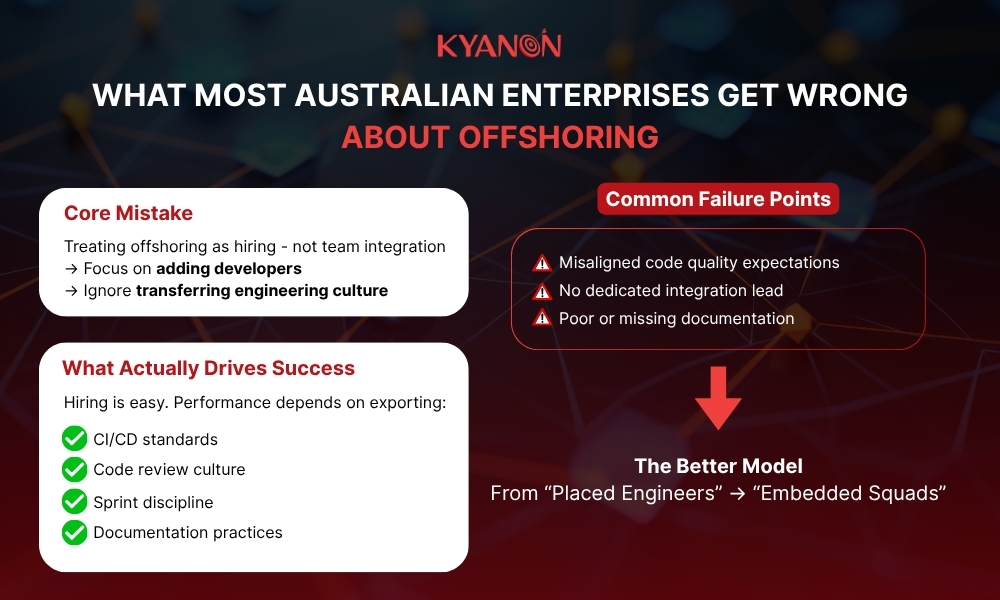
The structural mistake is treating offshoring as an HR exercise rather than an engineering culture export. Most failed offshore engagements share a common pattern: the client organisation invests significant effort in hiring offshore engineers but insufficient effort in transferring the standards and rituals that make their onshore team effective.
Hiring developers is the straightforward part. Exporting CI/CD standards, code review culture, sprint discipline, and documentation practices is what determines whether the offshore developer team performs as an extension of the home team or as a separate, slower-moving unit that requires active management to keep aligned.
What specifically tends to go wrong?
The most common failure points in offshore developer team engagements are:
- Misaligned expectations on code quality standards
- Absence of a dedicated integration lead
- Insufficient documentation of internal workflows
The third point is frequently underestimated: the clarity of handoff materials is directly correlated with ramp speed. Organisations with well-maintained architecture decision records, coding standards, and sprint runbooks integrate offshore teams substantially faster than those relying on tacit knowledge held by individual engineers.
What is the alternative model?
High-performing offshore developer team models are built on the principle of embedded delivery squads rather than placed engineers. The distinction is consequential. Placed engineers receive tasks and return output. Embedded squads participate in architecture decisions, raise blockers in real time, and hold shared accountability for sprint outcomes. The latter model requires more investment at onboarding but produces compounding returns in delivery quality over the engagement lifecycle.
How should Australian enterprises approach IP protection when working with offshore developer teams
IP protection in offshore engagements is governed primarily by the structure of the engagement contract, not by the geography of the development team. The relevant legal and operational safeguards are as follows.
Non-disclosure agreements should be executed at engagement start, not at project close. Retroactive NDAs are legally weaker and create exposure during the onboarding period. IP ownership must be explicitly assigned to the client in the Statement of Work from day one. Ambiguous IP clauses in offshore contracts are the single most common source of post-engagement disputes. Development must occur in secure, isolated environments with access control logging and role-based permissions. Data handling practices must be aligned with the Australian Privacy Act 1988 and, where relevant, with applicable regional data protection regulation.
What client profile is the best fit for this model?
This engagement model is well-suited to:
- Enterprise clients building complex
- Long-term intellectual property that requires strict security compliance
- Structured delivery governance
- Continuity of team composition over multi-year product roadmaps.
It is not suited to short-term, freelancer-style task execution with no unified process or delivery governance requirement.
What does the Australian Privacy Act require in practice?
The Privacy Legislation Amendment (Enforcement and Other Measures) Act 2022 requires Australian organisations to take reasonable steps to ensure that overseas recipients of personal information handle that information consistently with Australian Privacy Principles. This requirement applies to offshore developer teams that have access to systems containing Australian personal data and must be addressed explicitly in engagement contracts.
How to evaluate whether an Australian enterprise is ready to build an offshore developer team in Vietnam
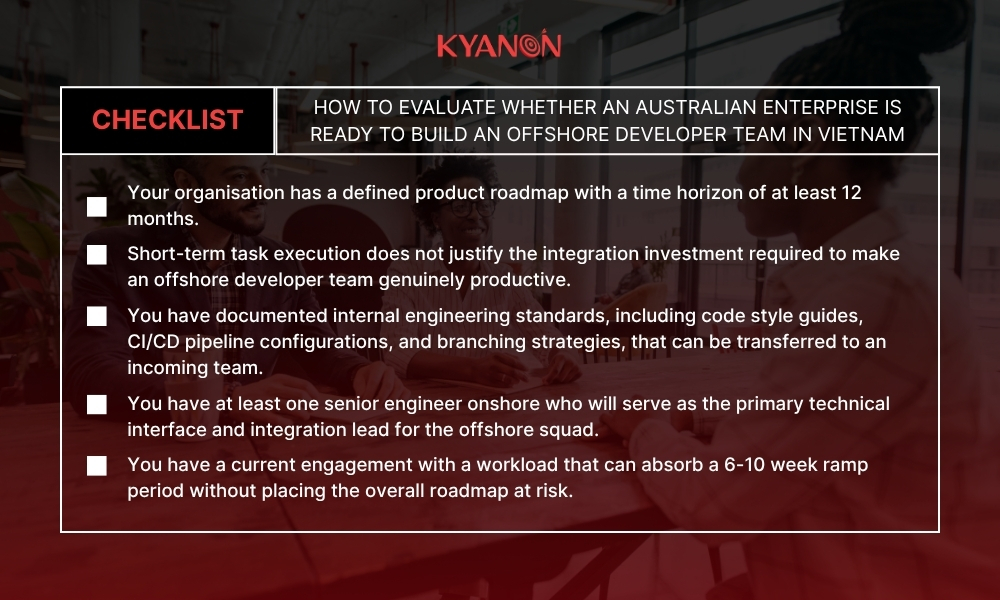
The following criteria represent the baseline conditions for a successful engagement:
- Your organisation has a defined product roadmap with a time horizon of at least 12 months.
- Short-term task execution does not justify the integration investment required to make an offshore developer team genuinely productive.
- You have documented internal engineering standards, including code style guides, CI/CD pipeline configurations, and branching strategies, that can be transferred to an incoming team.
- You have at least one senior engineer onshore who will serve as the primary technical interface and integration lead for the offshore squad.
- You have a current engagement with a workload that can absorb a 6-10 week ramp period without placing the overall roadmap at risk.
What conditions suggest the timing is premature?
If your onshore team is already operating under delivery pressure without documented processes, adding an offshore developer team before resolving internal engineering culture issues will amplify existing problems rather than solve them. The offshore team will reflect the clarity, or lack thereof, of the environment it is integrated into.
Kyanon Digital: Your offshore development partner for Australia
Kyanon Digital is a Vietnam-based enterprise technology firm that specialises in building integrated offshore developer teams for Australian and New Zealand organisations. Unlike general-purpose outsourcing providers, Kyanon Digital’s engagement model is designed specifically around the operational requirements of ANZ clients – including AEST time zone alignment, Australian Privacy Act compliance, and the Agile delivery standards expected by enterprise engineering organisations in Sydney, Melbourne, and beyond.

Why Partner with Kyanon Digital?
We’re a Tech Partner, Not a Recruiter
We build your team strategically, aligning talents with your software vision and roadmap, not just job requirements. With ongoing upskilling and expert support from our Center of Excellence, your talent stays ahead of challenges and delivers results.
Comprehensive Talent Ecosystem
Kyanon Digital talent ecosystem encompasses over 50,000 technology professionals
- Internal Talent Core: 500+ professionals
- K-Fresh Program: Nurturing Future Digital Leaders from 18 Universities in Vietnam
- External Talent Network: 15,000+ premium candidates
- Partner Network: 1,000+ trusted partners
Your One-Stop Talents Impact Solution
We manage from talent acquisition to HR management for your tech workforce, freeing your team to focus on core business and innovation.
Case study: Scaling Accenture’s Digital Capabilities with Kyanon Digital’s Dedicated Software Engineers

Challenges
- Accenture needed to rapidly scale its digital delivery capacity to meet increasing project demand.
- Shortage of qualified engineers for modern tech stacks created pressure on timelines and delivery quality.
- Maintaining consistent engineering standards across distributed teams was critical but difficult at scale.
Solutions
- Partnered with Kyanon Digital to build dedicated developer teams aligned with Accenture’s internal processes.
- Established integrated offshore squads with full alignment on tools, workflows, and Agile practices.
- Implemented structured onboarding, governance models, and continuous collaboration to ensure seamless team extension.
Impact
- Accelerated team scaling without compromising engineering quality or delivery standards.
- Improved project turnaround time through increased development capacity and efficient collaboration.
- Built a reliable, long-term offshore delivery model that functions as an extension of Accenture’s internal teams.
Explore the full case study here: Scaling Accenture’s Digital Capabilities with Kyanon Digital’s Dedicated Software Engineers
Note: Although this case study highlights an offshore development team delivered for a Singapore-based client, Kyanon Digital follows international engineering and delivery standards, making the model fully applicable to enterprises in Australia and New Zealand.
The strategic case for acting now
The movement of developer teams from Australia to Vietnam is not a cost arbitrage exercise in isolation. It is a response to a structural talent constraint that domestic hiring cannot resolve within competitive timelines, combined with the recognition that Vietnam now offers an operationally compatible environment for enterprise-grade software delivery.
The organisations that extract the most value from this model are those that approach it as an engineering culture export, investing in the integration infrastructure, documentation standards, and governance rituals that allow an offshore developer team to function as an extension of the home team rather than a separate execution unit.
Ready to evaluate whether a Vietnam-based developer team is the right next step for your organisation? Kyanon Digital works exclusively with ANZ enterprise clients to design, staff, and integrate offshore development squads built for real-time collaboration, modern stack delivery, and long-term IP ownership. Contact Kyanon Digital to schedule a 30-minute assessment – we will map your current team structure, identify where an offshore squad creates the most leverage, and give you a realistic ramp timeline before you commit to anything.