High-value software projects are accelerating worldwide as the global IT outsourcing market is projected to reach US$588.38 billion in 2025 (according to Statista), growing further to US$806.55 billion by 2030 (CAGR 6.51%). Enterprises are also increasing their outsourcing investment, averaging US$156.92 per employee, as they move from cost-driven outsourcing toward complex, mission-critical builds that demand engineering precision, speed, and predictable outcomes.
This shift is driven by the rise of AI-native architectures, cloud modernization, platform consolidation, and the increasing need for data-intensive systems. Traditional offshore delivery models can no longer keep pace; organizations now require partners with enterprise-grade engineering maturity, stable teams, and deep domain capabilities.
At the same time, Vietnam is emerging as one of the fastest-growing digital economies in Southeast Asia. The country’s digital sector expanded more than 20% in 2024 and now contributes 18.3% of national GDP, signaling a rapidly maturing ecosystem capable of supporting large-scale, high-value software development at global standards (according to Statista).
In this blog, let’s explore with Kyanon Digital why Vietnam is emerging as one of the world’s most competitive destinations for high-value software projects and how your organization can leverage this ecosystem to build scalable, future-proof digital platforms.
Further reading
- Top 15 Leading EdTech Software Development Firms in Vietnam
- Empower Your Tech with a Top Software Outsourcing Company in Vietnam
- Top 10 Software Development Outsourcing Companies in Vietnam
Top 10 reasons why businesses should choose Vietnam for high-value software projects
Below are the top reasons why leading organizations are choosing Vietnam for their next wave of high-value software projects.
Quick comparison table
|
Criteria |
Vietnam | India | Philippines | Eastern Europe |
|
Talent quality |
High | High | Medium |
High |
|
Cost efficiency |
Very high | High | High |
Medium |
|
Attrition rate |
Low | High | Medium |
Medium |
|
Communication |
Strong | Medium | Strong |
Strong |
|
Security maturity |
High | High | Medium |
High |
| Fit for high-value projects |
Excellent |
Good | Fair |
Excellent |
1. Enterprise-grade engineering talent for modern architectures
Vietnam now provides architecture-driven engineers skilled in cloud-native, microservices, DevOps, and data engineering, exactly the talent enterprises need to deliver and modernize high-value software projects.
The real challenge for C-level leaders
Most transformation programs stall not because of a lack of developers, but because companies can’t find engineers who understand distributed systems, cloud-native patterns, automation, and data pipelines, skills critical for AI-era platforms.
Why does Vietnam solve this
Vietnam’s engineering maturity has grown rapidly, fueled by a digital economy contributing 18.3% of GDP and expanding over 20% annually (according to VnEconomy), creating a large pool of cloud and data-skilled engineers.
Vietnam’s tech workforce is overwhelmingly young and fast-maturing, giving enterprises access to a highly scalable engineering talent pool. The market is dominated by developers aged 20–34, with the largest segments at 25–29 (29.3%) and 20–24 (28.8%). Overall, 58.1% of developers are between 20–29 years old, one of the youngest tech demographics in Asia.
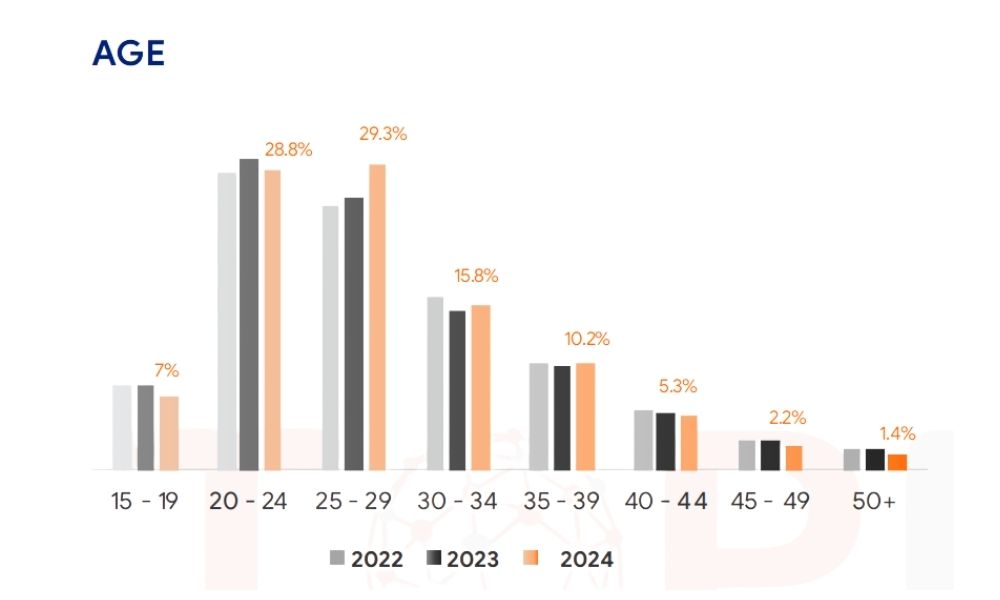
After years of rapid growth, the ratio of developers with over 3 years of experience versus those with under 3 years has reached nearly 1:1, signaling a more balanced and mature labor market.
In terms of seniority distribution, more than 45% of developers are fresher to junior level, 30% are mid-level, nearly 18% are senior, and only 6% are tech leads or above, providing both high-volume junior talent and a stable mid-senior base for high-value software projects (Vietnam IT Market Report 2024-2025).
What Vietnamese engineers reliably deliver

- Cloud-native systems (AWS/GCP/Azure, Kubernetes, Terraform)
- Microservices & event-driven architectures
- CI/CD, GitOps, DevSecOps
- Data pipelines, streaming, analytics foundations
2. Low attrition for stable delivery
Vietnam offers one of Asia’s most stable and competent engineering workforces, critical for multi-year, high-value software projects.
The country ranks #23 worldwide in HackerRank, Top 2 in SkillValue’s Best Developers Survey, and is listed by UNESCO among the Top 10 countries producing the most engineers, giving enterprises both high capability and low turnover in one destination.
Why stability matters
High-value projects often fail due to team churn, causing knowledge loss, onboarding fatigue, and inconsistent velocity. In high-attrition markets, squads may rotate every 12–18 months, disrupting long-term delivery.
Why Vietnam solves this
Vietnam’s attrition rate is significantly lower than India’s or the Philippines’, and its balanced talent base (fresher–junior, mid, senior) enables companies to maintain long-tenured engineering teams.
What this means for C-level leaders
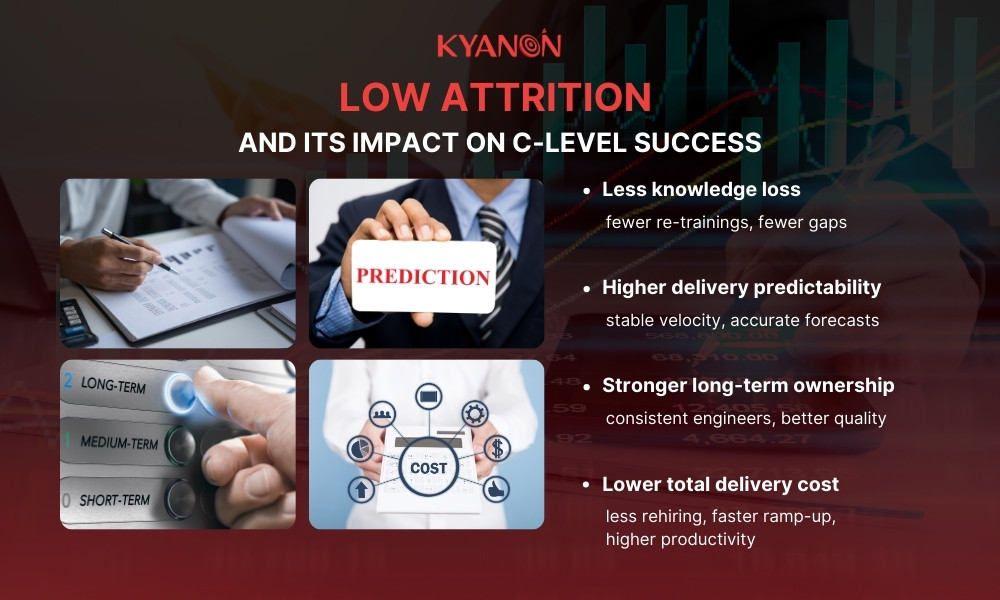
- Less institutional knowledge loss: reduces dependency on re-training and documentation gaps
- Higher delivery predictability: stable velocity, fewer surprises, more accurate forecasting
- Better long-term ownership: the same engineers evolve with the product, improving quality
- Lower total cost of delivery: reduced re-hiring, onboarding, ramp-up, and productivity dips
3. Strong English and communication
Vietnam’s tech hubs – HCMC, Hanoi, and Da Nang – consistently demonstrate improving English proficiency and mature Agile communication habits, enabling smooth, low-friction collaboration with global product and engineering teams.
Why it matters for high-value software projects
High-value projects rely on precise communication across distributed teams. Vietnam’s rising English capability and strong exposure to Western workflows reduce misunderstandings, accelerate decision-making, and create cleaner execution paths for complex initiatives.
Business advantage
- Clearer requirements: fewer misalignments, faster approvals
- Faster iteration cycles: Agile ceremonies that run smoothly
- Fewer collaboration blockers: efficient cross-border standups, demos, and reviews
- Higher productivity: reduced time lost to re-explaining, rewriting, or re-scoping
- Better stakeholder alignment: global teams stay in sync across time zones
4. High cost-to-value efficiency
Vietnam offers enterprise-grade engineering at highly competitive TCO, with developer labor costs 20–30% lower than India (Statista, 2024), enabling high-value projects at stronger cost–quality ratios. According to CIO magazine, software development outsourcing in Vietnam is around 90% less expensive than employing US workers.
Why this is strategically important
High-value software projects often span 12–36 months, involving ongoing architecture work, feature expansion, maintenance, testing, and cross-team collaboration. In such long-term programs, TCO (total cost of ownership) becomes a critical factor, not just hourly rates.
Vietnam’s cost-to-value model allows enterprises to
- Reduce burn-rate without sacrificing engineering depth
- Allocate more budget to AI, automation, or cloud modernization
- Maintain long-term teams with stable velocity
- Scale squads quickly without exponential cost increases
This combination of lower labor cost + higher engineering maturity + low attrition creates one of the strongest TCO profiles in Asia.
Quick comparison table of global engineering cost, for reference only.
|
Region/country |
Avg. hourly rate (USD) | Typical capability level | Cost positioning |
|
Vietnam |
$18–28/hr | Mid-senior strong |
Most cost-efficient |
|
India |
$25–40/hr |
Broad talent pool |
Competitive |
|
Philippines |
$22–35/hr | Strong BPO, mid dev maturity |
Competitive |
|
Eastern Europe (Poland, Romania, Ukraine) |
$45–65/hr | Strong engineering and product maturity |
Mid–high |
|
China |
$35–55/hr | High tech depth, higher overhead |
Mid |
|
Latin America (Mexico, Colombia, Brazil) |
$40–60/hr | Nearshore for US, good senior talent |
Mid-high |
|
Western Europe (Germany, UK, Netherlands) |
$70–110/hr | Senior-heavy, enterprise-grade |
High |
| United States | $90–150/hr | Enterprise & product engineering |
Highest |
Source: Salary Expert.
5. Fast growth in AI and data
AI has moved from experimentation to core infrastructure, powering personalization, automation, decisioning, and predictive intelligence across modern platforms.
According to the Future of Jobs Report 2025, AI and information-processing technologies will create 11 million new jobs while displacing 9 million, making AI capability a strategic differentiator for enterprises worldwide.
Vietnam stands out in this shift. The country has accelerated its AI readiness dramatically, ranking 39th out of 193 countries in the Government AI Readiness Index 2023, up from 62nd in 2021, reflecting one of the fastest improvements globally (Oxford Insights), according to TopDev.
This growth is supported by Vietnam’s National AI Strategy (Decision No. 127/QĐ-TTg), which targets nationwide connectivity of all regional data centers and large-scale computing infrastructure by 2030.
In this environment, Vietnam offers rare access to affordable, production-grade AI and data engineering talent at a time when US/EU markets face severe shortages.
What Vietnam’s AI/data engineers can deliver
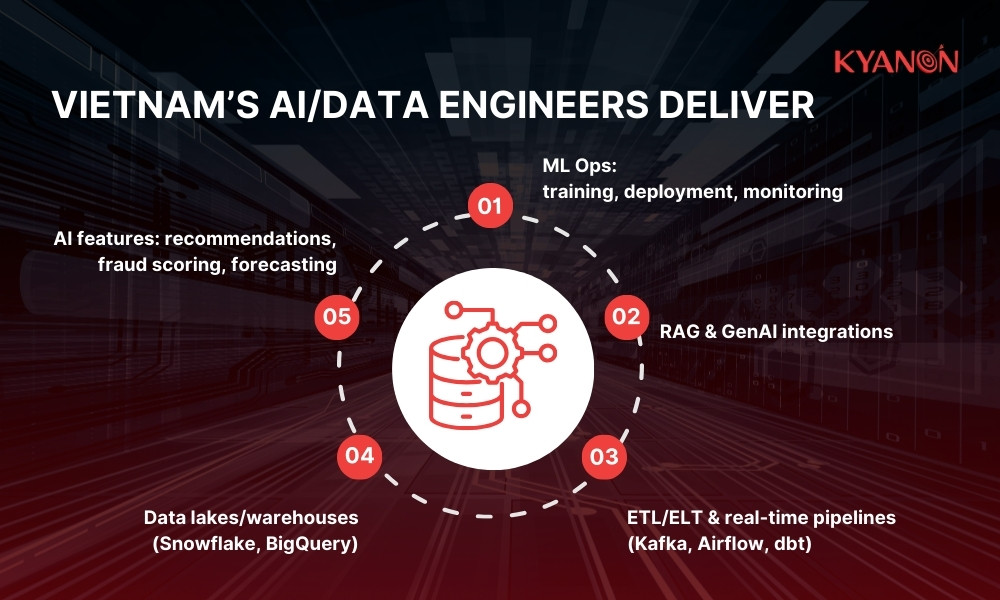
- ML Ops workflows for training, deployment, and model monitoring
- RAG and GenAI integrations for search, automation, and knowledge systems
- ETL/ELT and real-time data pipelines (Kafka, Airflow, dbt, Snowflake, BigQuery)
- AI-driven product features such as recommendation engines, fraud scoring, and demand forecasting
These are not prototype-level skills; Vietnamese teams can build AI systems ready for production, scalable across multi-cloud environments.
6. Government-backed digital innovation
Vietnam’s government is driving one of Asia’s most ambitious digital transformation agendas, investing heavily in AI, cloud infrastructure, and cybersecurity, fueling a digital economy that reached 18.3% of GDP in 2024 and is targeted to expand to 30-35% by 2030 (VnEconomy, 2024), creating a highly supportive environment for high-value software projects.
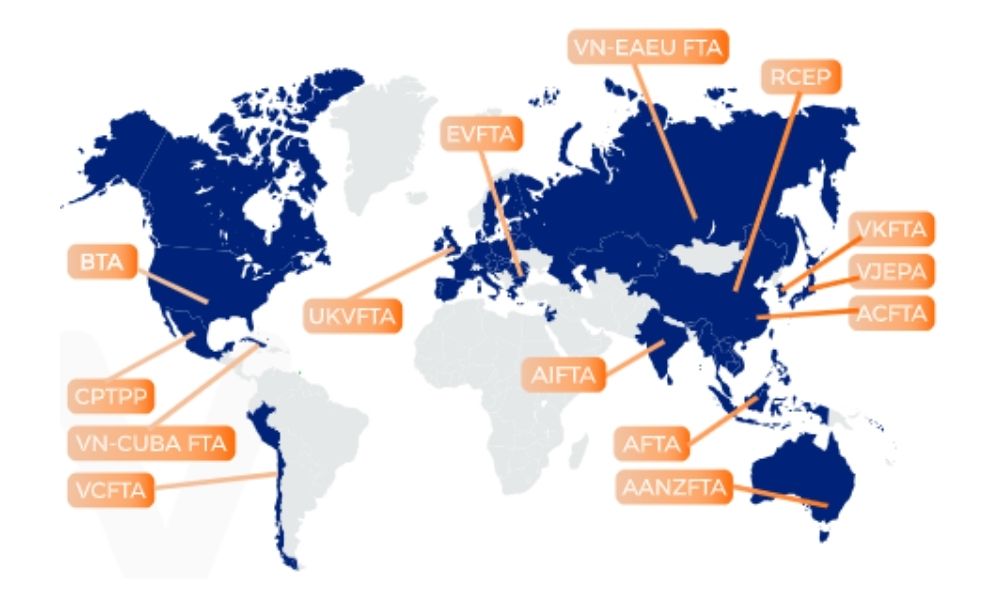
High-value software projects require a predictable, regulation-aligned, and innovation-friendly environment, something Vietnam is actively building at the national level. Beyond its digital and AI strategies, Vietnam has strengthened its global integration through 15 Free Trade Agreements covering 60+ major partners including the US, UK, EU, China, India, and ASEAN, creating a highly open and stable environment for foreign tech investment.
The country is also modernizing its financial and compliance landscape with nationwide IFRS adoption by 2025 (Decision 345/QĐ-BTC), enhancing transparency, global comparability, and investor confidence.
In parallel, Vietnam has elevated its data governance framework through Decree 13/2023/NĐ-CP on Personal Data Protection, introducing stricter cybersecurity and data-handling requirements aligned with global privacy standards.
Together, these initiatives create a uniquely stable, globally connected ecosystem that supports multi-year, high-value software platforms, offering enterprises strong talent pipelines, regulatory predictability, and alignment with international technology and compliance standards, advantages rarely seen in emerging outsourcing markets.
7. Mature security and compliance
Vietnamese engineering companies increasingly operate under ISO 27001, SOC 2, PCI-DSS, and GDPR-aligned frameworks, allowing them to handle regulated, high-stakes workloads.
High-value projects often touch:
- Payment systems
- Healthcare data
- Identity & authentication
- Supply chain & operational systems
Key engineering practices include:
- Secure SDLC
- DevSecOps
- Automated compliance monitoring
- Regular pen-testing
Outcome: Reduced risk exposure and better audit readiness.
8. High cultural and workflow fit
C-level leaders know that outsourcing failures rarely come from technology; they come from misalignment in communication, workflow, and ownership. High-value projects require teams who can collaborate across time zones, manage ambiguity, and maintain momentum without constant oversight.
Vietnam excels here because its engineering culture
- Proactive, not reactive
- Detail-oriented but flexible
- Comfortable with Western expectations for quality, timelines, and autonomy
Core cultural strengths
- Strong ownership mindset
- Engineers take responsibility for outcomes, not just tasks
- Ideal for modernization, multi-squad programs, and product-led models
- High responsiveness & clear communication
- Structured updates
- Proactive risk flagging
- Transparent reporting across time zones
- Solution-driven problem-solving
- Teams propose solutions early
- Effective in complex, AI/data-heavy projects
- Natural fit with Agile & Lean
- Smooth sprint ceremonies
- Concise, practical documentation
- Strong collaboration with Western product owners
Enterprise benefit
- Fewer cross-cultural misalignments: lower rework
- Higher delivery momentum: faster cycle time
- Stronger trust and collaboration: easier scaling
- Better product outcomes: teams who “think with you,” not just “build for you”
9. Proven success in key industries
When choosing an outsourcing destination, C-level leaders prioritize evidence of real-world execution, not theoretical capability.
Vietnam already builds production-grade, multi-year platforms for global clients, proving its ability to handle scale, complexity, compliance, and integration-heavy work.
What Vietnam has already delivered
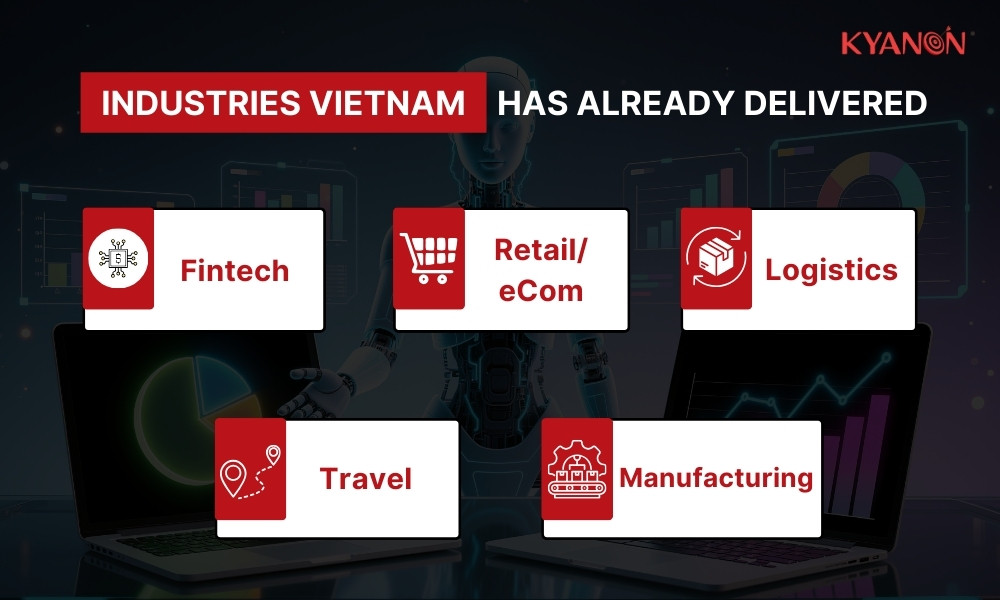
- Fintech: payment gateways, KYC/AML systems, lending platforms
- Retail/eCom: OMS, CRM/CDP, personalization engines
- Logistics: routing engines, fleet tracking, warehouse automation
- Travel: booking engines, dynamic pricing, partner portals
- Manufacturing: MES, IoT integrations, real-time production analytics
10. Rapid, high-quality team scaling
Vietnam enables fast, reliable scaling for high-value software projects, allowing the teams to ramp from 5 to 50+ engineers quickly while maintaining strong engineering maturity and delivery continuity.
Why Vietnam scales better than other markets
Quick comparison table
|
Criteria |
Vietnam | India | Philippines | Eastern Europe |
|
Talent quality |
High | High | Medium |
High |
|
Cost efficiency |
Very high | High | High |
Medium |
|
Attrition rate |
Low | High | Medium |
Medium |
|
Communication |
Strong | Medium | Strong |
Strong |
|
Security maturity |
High | High | Medium |
High |
| Fit for high-value projects | Excellent | Good | Fair |
Excellent |
- Large mid- to senior-level talent pool: Vietnam produces strong mid-level engineers who can be deployed immediately.
- Lower saturation vs. India/Philippines: Less hiring competition = faster access to high-quality talent.
- Mature staffing engines: Top Vietnamese firms maintain vetted benches, internal academies, and rapid onboarding workflows.
- R&D-driven upskilling culture: Continuous cloud, AI, DevOps, and data certifications accelerate capability growth.
C-level advantages
- Scale on demand without compromising engineering quality
- Support new squads for modernization, AI, or platform expansion
- Avoid the budget shocks common in saturated outsourcing markets
- Maintain velocity during peak program phases
Which businesses should choose Vietnam for high-value projects?
Quick table of industry fit for high-value offshore projects
|
Industry |
Complexity | Data sensitivity | ROI impact | Fit for Vietnam |
|
Fintech |
High | Very high | High | Excellent |
|
Retail/eCom |
Medium | Medium | Very high |
Strong |
|
Healthcare |
High | Very high | High |
Good |
|
Travel/Logistics |
Medium | Medium | High |
Excellent |
| Manufacturing |
Medium |
Medium | Medium |
Good |
Why these industries align well with Vietnam
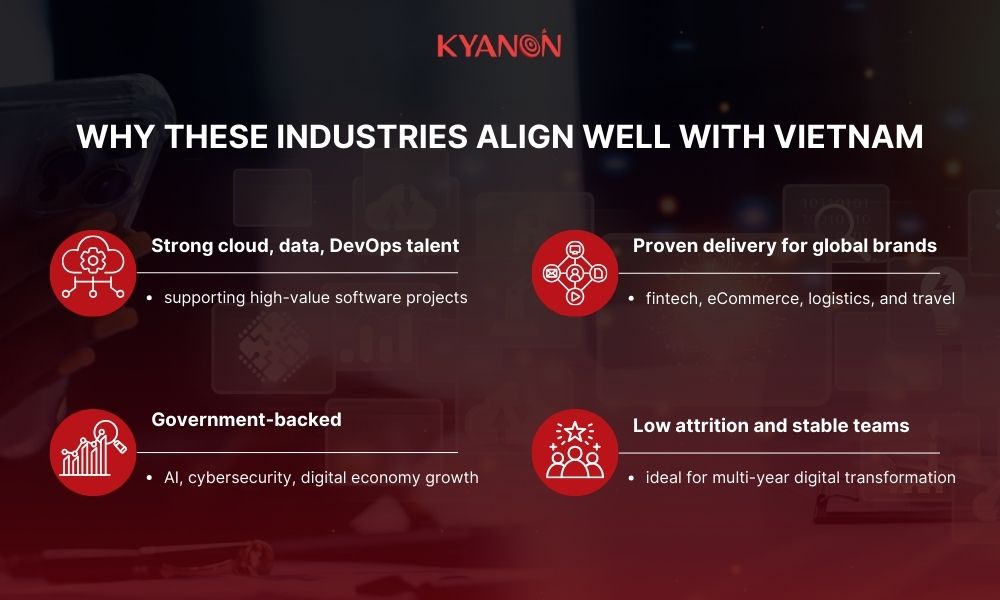
High-value workloads such as AI-driven platforms, cloud modernization, enterprise data engineering, omnichannel experience systems, complex ERP/CRM/payment integrations, and multi-year digital transformation programs are particularly well-suited for Vietnam.
These project types require deep engineering maturity, stable long-term teams, and cross-functional technical capability, areas where Vietnam consistently performs at a global standard. The country’s strong base of cloud, data, and DevOps engineers enables enterprises to execute complex modernization and AI initiatives with confidence, while its proven track record delivering for international brands demonstrates its ability to handle scale and integration complexity.
Combined with government policies that heavily support AI, cybersecurity, and digital economy expansion, and a notably low attrition environment that ensures continuity across multi-year initiatives, Vietnam offers one of the most reliable destinations for executing strategic, high-value software programs.
How to successfully run high-value projects in Vietnam
Delivering high-value software requires more than talented engineers; it demands a governed, scalable, product-led operating model. Below are the best practices used by top global enterprises.

Build a hybrid product + engineering model
A hybrid onsite–offshore model (onsite product leadership + offshore engineering squads) is now the most effective operating model for high-value software projects. According to Deloitte’s Global Outsourcing Survey 2024, hybrid delivery increases decision-making speed by 30–40% and reduces requirement-related rework by up to 25%, making it the preferred structure for complex, multi-squad programs.
Why the hybrid model works
Hybrid teams allow enterprises to maintain strategic control onsite while leveraging Vietnam’s high-quality, scalable engineering capacity offshore.
Key elements of a successful hybrid setup
- On-site product owner + offshore engineering squads to ensure real-time business alignment
- Clear ownership boundaries between product, architecture, and delivery to reduce ambiguity
Enterprise benefits
- Faster decision cycles: Hybrid teams reduce approval bottlenecks and accelerate feature throughput.
- Cleaner requirement handoffs: Clear roles and async workflows decrease requirement errors.
- Higher consistency in scaling: Distributed teams with onsite product leadership show 40% higher long-term delivery stability compared to fully offshore models.
- Better cross-functional alignment: Product and engineering collaboration improves roadmap accuracy and cycle-time predictability.
Use a capability maturity scorecard
Checklist table
|
Capability |
What to evaluate |
Indicators |
|
Technical expertise |
Cloud, Data, AI, Security |
Certifications, case studies |
|
Delivery maturity |
Agile, DevOps |
Velocity, predictability |
|
Quality engineering |
Automated testing, QA processes |
Defect rate, test coverage |
|
Security compliance |
ISO, SOC, PCI |
Audit records |
|
Scalability |
Ability to expand team quickly |
Ramp-up time |
Case study: Kyanon Digital delivers end-to-end platform modernization & integration

A leading F&B conglomerate with hundreds of outlets and multiple business units struggled with fragmented legacy platforms, eCommerce, CRM, POS, loyalty, supply chain, plus added complexity from post-M&A integration.
The lack of unified architecture slowed operations, limited customer experience improvements, and constrained scalability.
Challenges
- Siloed systems blocking cross-brand data flows
- Inconsistent processes across retail, operations, and finance
- High complexity in integrating newly acquired businesses
- Limited ability to scale or support real-time analytics
Our approach
Kyanon Digital conducted a full enterprise audit, designed a modular cloud-ready architecture, unified integration layers, and built a future-state roadmap covering governance, data strategy, customer engagement, and M&A scalability.
Key initiatives
- System & dependency mapping across all brands
- Unified architecture for CRM, loyalty, operations, and data
- Post-M&A integration blueprint & governance framework
- Cloud-ready modernization & future-state platform design
Outcomes
- Unified, scalable enterprise platform replacing fragmented systems
- Real-time and cross-brand data visibility for smarter decision-making
- Improved operational efficiency with standardized workflows
- Faster integration for future acquisitions
- Strong foundation for AI, personalization, and omnichannel expansion
Protect the project with clear governance
Large-scale, high-value projects require strict governance and engineering transparency.
Governance essentials
- Engineering metrics: cycle time, deployment frequency, MTTR
- Technical documentation: architecture maps, API specs, data lineage
- Delivery reporting: burndowns, release plans, risk logs
- Compliance tracking: security scans, vulnerability reports, audit records
Outcome
- Predictable delivery
- Lower project risk
- Stronger alignment between product, engineering, and PMO
In conclusion
Vietnam has rapidly evolved into one of the world’s most capable destinations for high-value software projects, offering a rare combination of enterprise-grade engineering talent, low attrition, strong cost-to-value efficiency, fast-growing AI and data capabilities, and a government-backed digital ecosystem aligned with global technology standards.
From cloud modernization to AI-native platforms, omnichannel systems, and complex enterprise integrations, Vietnam provides the technical depth, delivery stability, and scalability that modern organizations need to accelerate transformation and stay competitive.
For enterprises looking to build mission-critical platforms with predictable outcomes, long-term continuity, and high engineering maturity, Vietnam offers an unmatched advantage. And with a proven track record of delivering complex modernization programs for leading brands, Kyanon Digital stands as one of the country’s premier technology partners.
If you’re ready to explore how Vietnam can support your next high-value software initiative, contact Kyanon Digital today. Our team will help you assess your current systems, define a clear roadmap, and build a world-class delivery model tailored to your business goals.