
As retail grows more complex, technology decisions become strategic decisions. After more than a decade working in retail and digital transformation at Kyanon Digital, one pattern is clear. Retailers do not move toward custom software platforms because they want more features. They move because they need more control.
Key takeaways
- Retailers build custom software platforms when growth exposes the structural limits of off-the-shelf tools.
- The core driver is operational control, not feature customization.
- Custom ecommerce systems increasingly act as the central operating layer of modern retail.
- Unified data, automation, and scalability justify higher upfront investment.
- The trigger to build custom is complexity, not company size.
Further reading:
- Custom Software Development for FMCG Operations in Singapore
- Customer Experience Design for Southeast Asia’s Future
- Future of Digital Commerce with Intelligent Experience Engines in SEA
When retail growth breaks existing software
Retail growth does not just increase revenue. It increases operational complexity across channels, inventory, fulfillment, and data. At a certain point, existing software that once supported the business efficiently begins to slow it down. This is the moment when technology limitations become strategic risks rather than minor inconveniences.
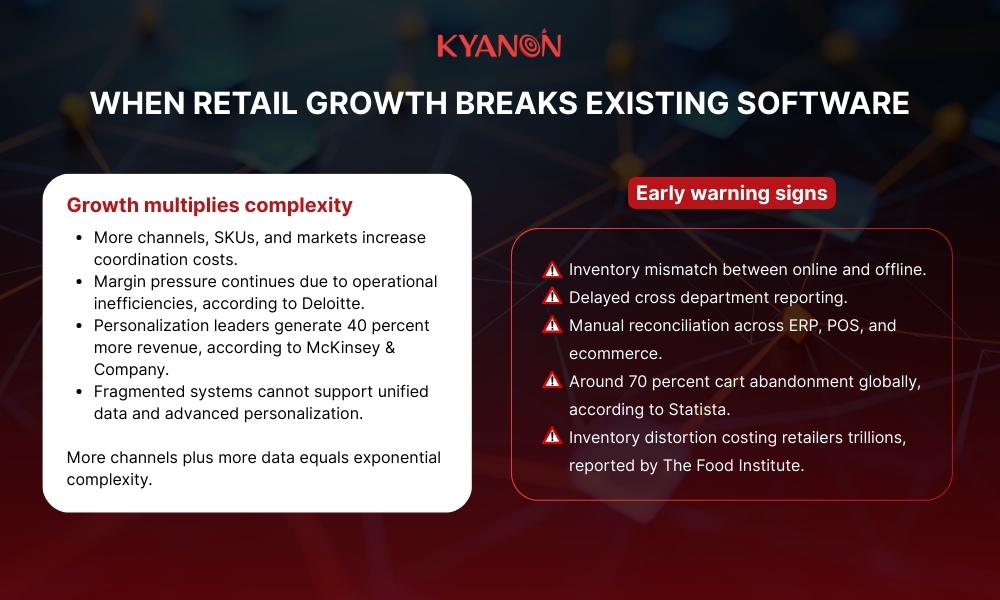
Growth multiplies complexity, not efficiency
Retail expansion rarely scales linearly. Adding channels, SKUs, fulfillment models, or regions increases coordination cost across systems. According to Deloitte, retailers continue to face margin pressure driven by cost volatility, omnichannel expectations, and operational inefficiencies. Growth without structural alignment increases friction rather than profitability.
At the same time, personalization expectations are rising. Research from McKinsey & Company shows that companies that excel at personalization generate 40 percent more revenue from those activities than average players. But personalization requires unified data and flexible infrastructure, something fragmented tools struggle to support.
More channels plus more data plus more fulfillment logic equals exponential operational complexity.
Early warning signs retailers often ignore
Retailers often experience signals long before they consider software custom development:
- Inventory mismatch between online and offline
- Delayed reporting across departments
- Manual reconciliation between ERP, POS, and ecommerce
- High online cart abandonment. The global average is around 70 percent, according to Statista
- Inventory distortion, such as overstocks and out-of-stocks. Industry analysis reported by The Food Institute suggests this problem costs retailers trillions globally
These are not isolated system bugs. They are structural misalignments.
What a custom software platform really means in retail
A custom software platform in retail is not simply a tailored website or a modified ecommerce tool. It is a centralized operating layer designed around how the business actually runs. Instead of forcing workflows to fit predefined software structures, the platform aligns technology with inventory logic, pricing rules, order orchestration, customer data, and reporting processes.
In practice, it becomes the system that connects every moving part of retail operations into one coordinated flow.
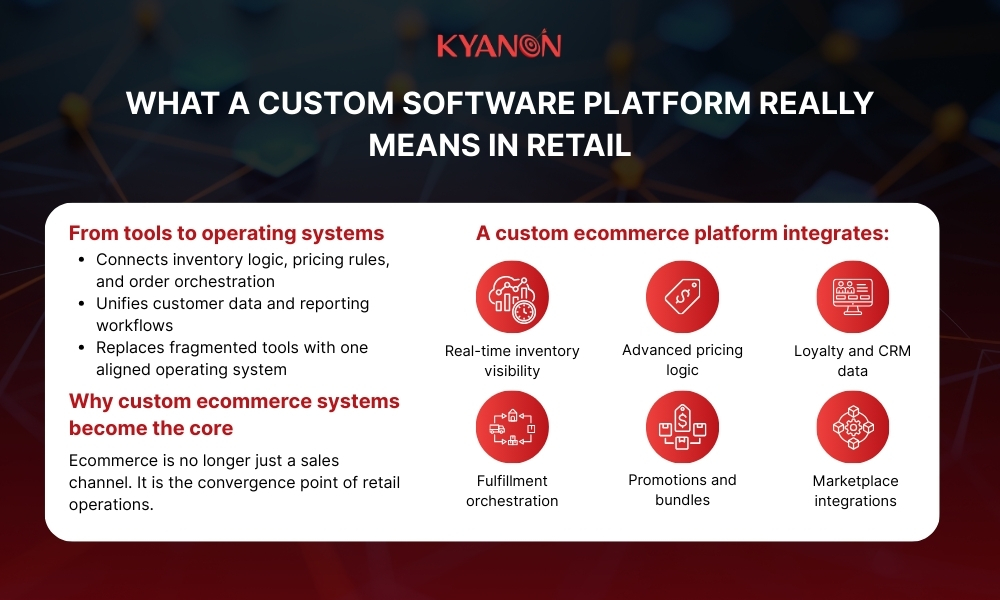
From tools to operating systems
A retail platform is not just a website. It is a coordination engine that connects inventory logic, pricing rules, order orchestration, customer data, and reporting workflows. Custom software platforms replace fragmented tools with a connected operating system aligned to how the business actually runs.
Why custom ecommerce systems become the system core
In modern retail, ecommerce is no longer just a channel. It is the convergence point. A custom ecommerce platform integrates:
- Real-time inventory visibility
- Advanced pricing logic
- Loyalty and CRM data
- Fulfillment orchestration
- Promotions and bundles
- Marketplace integrations
This is why many retailers invest in custom ecommerce software development as the backbone of broader transformation.
Why off-the-shelf software stops working at scale
Off-the-shelf software is designed to serve the average business model. In early stages, it enables speed and lowers upfront investment. However, as retail operations expand across channels, markets, and fulfillment models, standardized workflows begin to create friction. Integration layers multiply, manual workarounds increase, and data becomes fragmented.
At scale, the limitation is no longer missing features. It is the inability of rigid systems to adapt to growing operational complexity and strategic change.
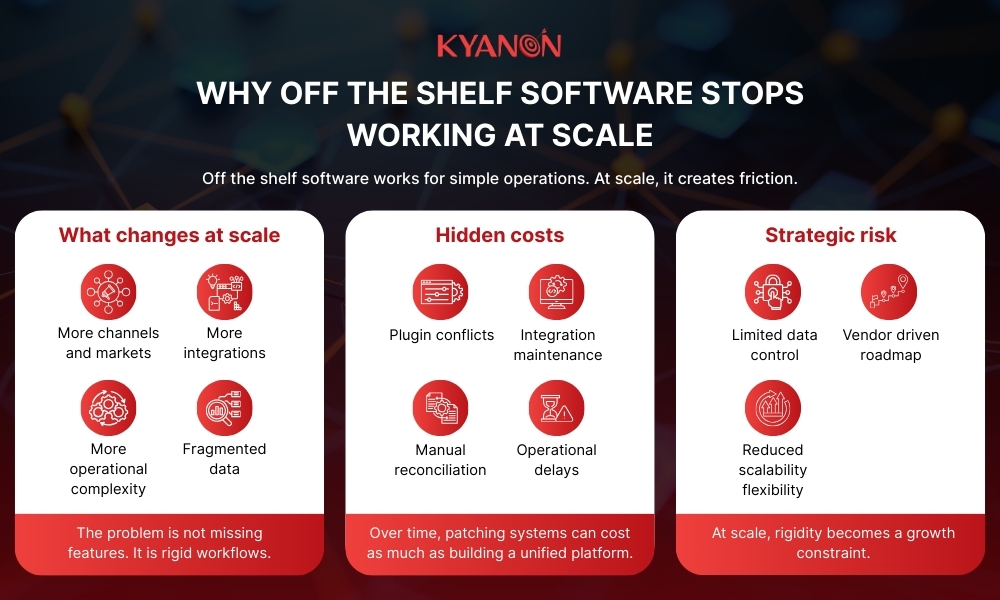
Rigid workflows and forced compromises
SaaS platforms optimize for standardization. Retail complexity does not. As retailers expand into B2B, subscription, cross-border, or marketplace models, they encounter forced compromises such as workarounds, manual processes, and shadow systems.
Standard tools are not bad. They are optimized for the average use case.
Hidden cost of plugins, licenses, and manual work
The visible cost is subscription fees. The hidden cost includes:
- Integration maintenance
- Plugin conflicts
- Custom patches
- Manual reconciliation
- Operational delays
Over time, the total cost of ownership of patched systems can approach the cost of building a coherent platform.
Loss of data ownership and roadmap control
Vendor dependency limits data portability, feature prioritization, and scalability flexibility. Retailers become constrained by someone else’s roadmap instead of their own strategy.
Core reasons why retailers build custom software platforms
Retailers build custom software platforms when operational complexity starts limiting growth, margin, and customer experience. The decision is rarely about adding new features. It is about redesigning the system logic behind inventory, pricing, fulfillment, and data so the business can operate with greater control and efficiency.
As competition intensifies and personalization expectations rise, retailers need platforms that support differentiation, automation, unified data, and long-term scalability. Custom software becomes a strategic investment to align technology with business model evolution rather than forcing the business to adapt to generic tools.
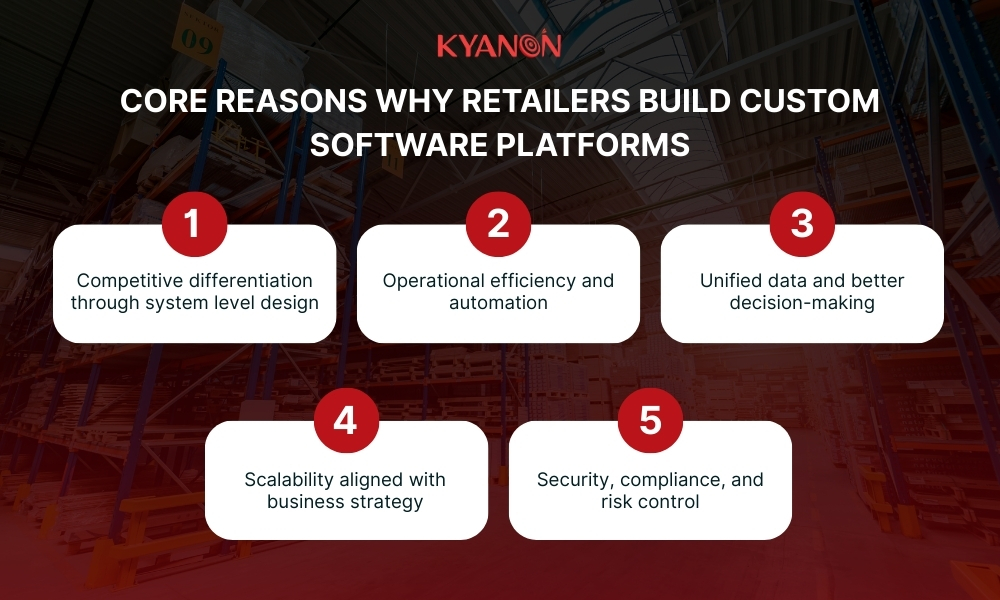
Competitive differentiation through system level design
Differentiation is no longer visual. It is operational. Unique workflows, fulfillment logic, pricing rules, and experience design embedded into custom ecommerce systems create defensible advantages that competitors cannot easily copy.
Operational efficiency and automation
Automation reduces manual stock adjustments, order routing errors, and reporting lag. Inventory distortion alone costs retailers massively each year. Fixing system logic improves working capital efficiency and margin protection.
Unified data and better decision-making
Retail leaders need a single source of truth. A unified platform supports real time dashboards, predictive analytics, personalized campaigns, and margin optimization. Without clean and connected data, AI initiatives fail before they begin.
Scalability aligned with business strategy
A modular custom ecommerce architecture allows retailers to add new markets, introduce subscription or B2B models, expand marketplaces, and launch new brands without replatforming every few years.
Security, compliance, and risk control
Custom platforms enable role-based access control, region-specific compliance logic, and stronger data governance. Tailored safeguards reduce systemic risk compared to generic platform constraints.
Custom ecommerce systems as the backbone of retail platforms
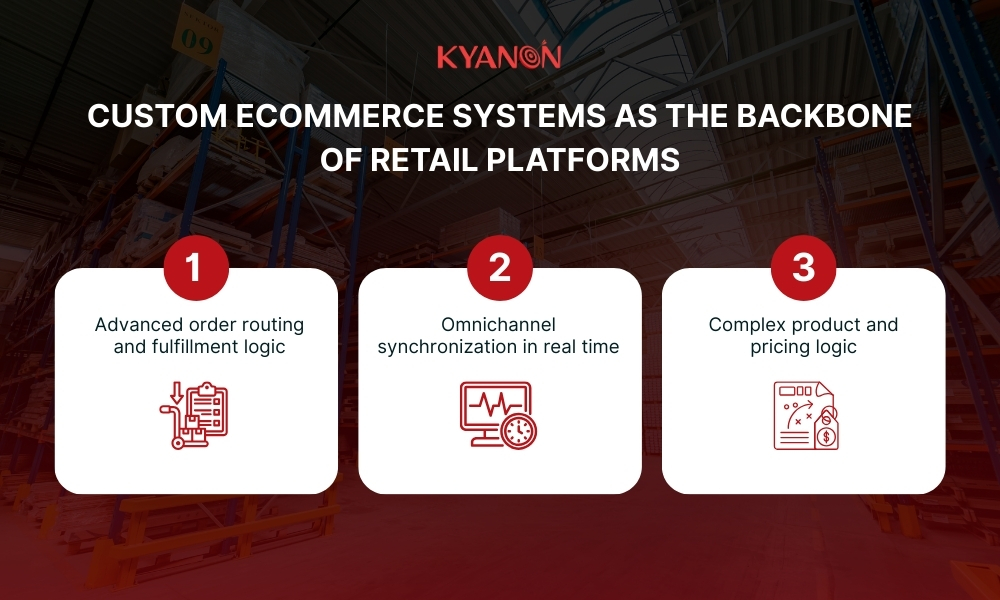
Custom ecommerce systems have evolved far beyond the role of an online storefront. In modern retail, they act as the backbone of the entire platform, connecting inventory, pricing, orders, fulfillment, and customer data into a single operational flow. Because ecommerce sits at the intersection of online and offline channels, it becomes the control layer where business rules are executed in real time.
By designing this layer around specific operational needs, retailers gain tighter coordination across warehouses, stores, marketplaces, and loyalty programs, enabling true omnichannel execution rather than disconnected channel management.
Advanced order routing and fulfillment logic
Retailers increasingly require split order logic, ship from store models, multi warehouse routing, and intelligent fulfillment cost optimization. These workflows are core business rules, not optional plugins.
Omnichannel synchronization in real time
True omnichannel requires unified inventory, consistent pricing, cross-channel returns, and loyalty integration. A custom ecommerce platform ensures real-time synchronization across POS, ERP, and CRM.
Complex product and pricing logic
Retail models now include bundled SKUs, configurable products, tier-based B2B pricing, regional tax rules, and subscription models. These require customized ecommerce solutions, not template-based logic.
Custom software platform in retail real world
Real-world retail leaders rarely rely entirely on standard tools. As complexity increases, many build or heavily customize their core platforms to support unique operational models, scale, and customer experience.
Below are examples of how major retailers use custom software platforms in practice.
Amazon

Amazon’s entire retail engine is built on proprietary, custom software systems. Its platform integrates:
- Real-time inventory visibility across global warehouses
- Dynamic pricing algorithms
- Advanced order routing and fulfillment optimization
- Marketplace seller management
Recommendation engines powered by large-scale data
The differentiation is not just the website. It is the tightly integrated backend systems that coordinate logistics, personalization, and fulfillment at scale.
Walmart

Walmart has invested heavily in building and modernizing its internal retail platform rather than relying purely on third-party e-commerce tools. Its custom systems support:
- Ship from store logic across thousands of locations
- Real-time inventory synchronization between online and offline
- Advanced replenishment and supply chain analytics
- Integrated marketplace operations
This system-level control allows Walmart to compete directly with Amazon on speed and scale.
Zara

Zara’s competitive advantage is operational speed. Its custom retail systems connect:
- In-store sales data
- Production planning
- Distribution logic
- Regional demand forecasting
The result is a tightly integrated platform that reduces lead time from design to shelf, minimizing overproduction and markdown risk.
Nike

Nike has built custom digital platforms to support its direct-to-consumer strategy. Its systems integrate:
- Membership and loyalty data
- Personalized recommendations
- Regional product launches
- Omnichannel order fulfillment
By owning the platform logic, Nike controls both customer data and experience, rather than relying solely on marketplace intermediaries.
Architectural approaches retailers use
As retail platforms grow in complexity, architecture becomes a strategic choice rather than a technical detail. Retailers increasingly adopt approaches that prioritize flexibility, scalability, and integration across systems. Instead of relying on monolithic structures, they move toward modular, integration-first designs that allow different components to evolve independently.
These architectural approaches make it easier to adapt to new business models, add channels, and integrate core systems such as ERP, POS, CRM, and WMS without disrupting the entire platform.
Headless and composable commerce
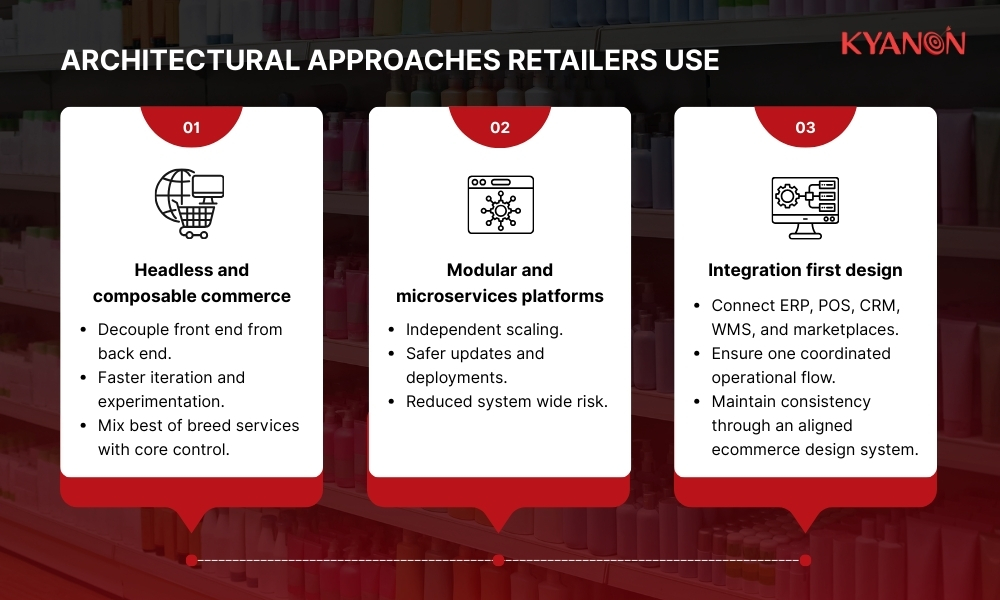
Decoupling front-end experience from back-end logic enables faster iteration and experimentation. Composable strategies allow retailers to mix best-of-breed services while maintaining control over core workflows.
Modular and microservices-based platforms
Modular platforms support independent scaling, safer deployment cycles, and reduced system-wide risk.
Integration-first design
Retail platforms must connect ERP, POS, CRM, WMS, and marketplace APIs into one coordinated flow. An aligned ecommerce design system ensures consistent logic and experience across all touchpoints.
When custom software makes sense and when it does not
Custom software is not always necessary. For simple operations with limited channels, off-the-shelf solutions can be faster and more cost-effective. However, when growth creates operational bottlenecks, data fragmentation, and scaling constraints, custom software becomes a strategic choice.
The decision should be driven by business complexity, not company size.
Scenarios where off-the-shelf still works
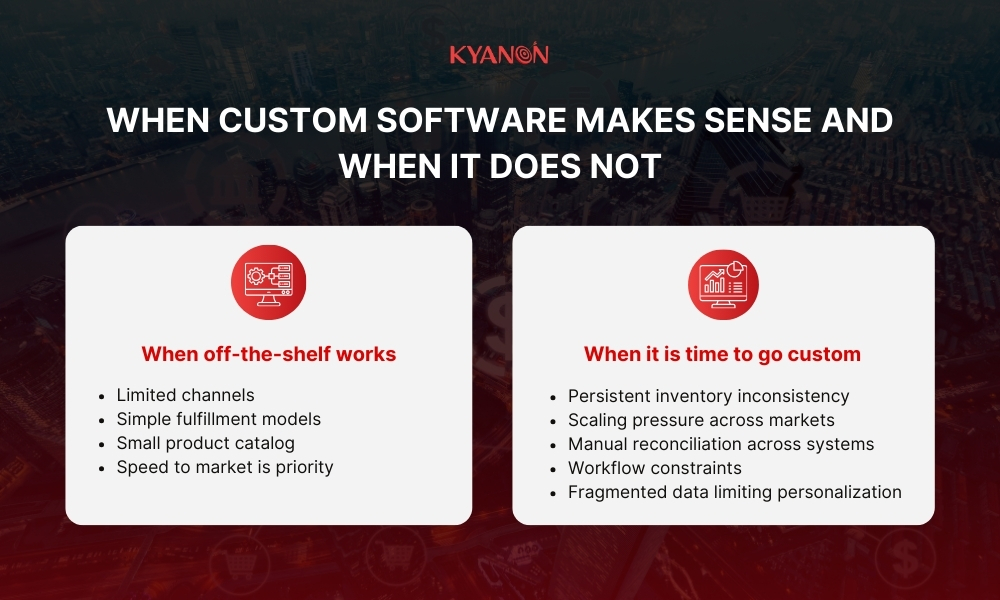
Custom investment may not be justified when operations are simple, sales channels are limited, fulfillment models are straightforward, and speed to market is the main priority.
Clear signals it is time to go custom
- Persistent inventory inconsistency
- Scaling pressure across markets
- Manual reconciliation across systems
- Frequent workflow constraints
- Data fragmentation limiting personalization
The trigger is structural complexity, not company size.
Risks and realities of building custom platforms
Building custom platforms offers long-term control and flexibility, but it comes with trade-offs. Upfront investment is higher, timelines are longer, and internal alignment is critical. Retailers must also commit to ongoing governance, maintenance, and continuous improvement.
Success depends not only on strong technical execution but also on clear ownership, strategic discipline, and the right implementation partner.
Upfront investment and longer timelines
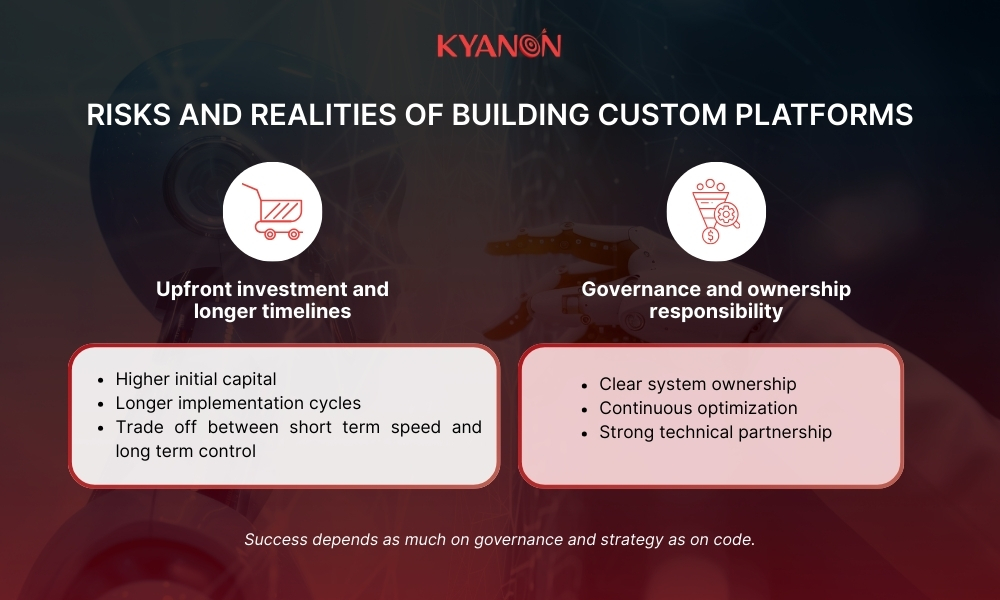
Building requires higher initial capital, longer implementation cycles, and strong internal alignment. It is a trade-off between short-term speed and long-term control.
Governance, maintenance, and ownership responsibility
Custom platforms require clear ownership, continuous optimization, and a strong technical partnership. Success depends as much on governance as on code.
How retail leaders approach the decision strategically
Retail leaders approach the build-versus-buy decision as a strategic evaluation, not a technology upgrade. They begin by mapping core business flows such as inventory, pricing, fulfillment, and customer journeys to identify structural friction.
Instead of focusing on feature lists, they prioritize workflows that impact margin, scalability, and customer experience. The decision is phased, data-driven, and aligned with long-term business strategy rather than short-term convenience.
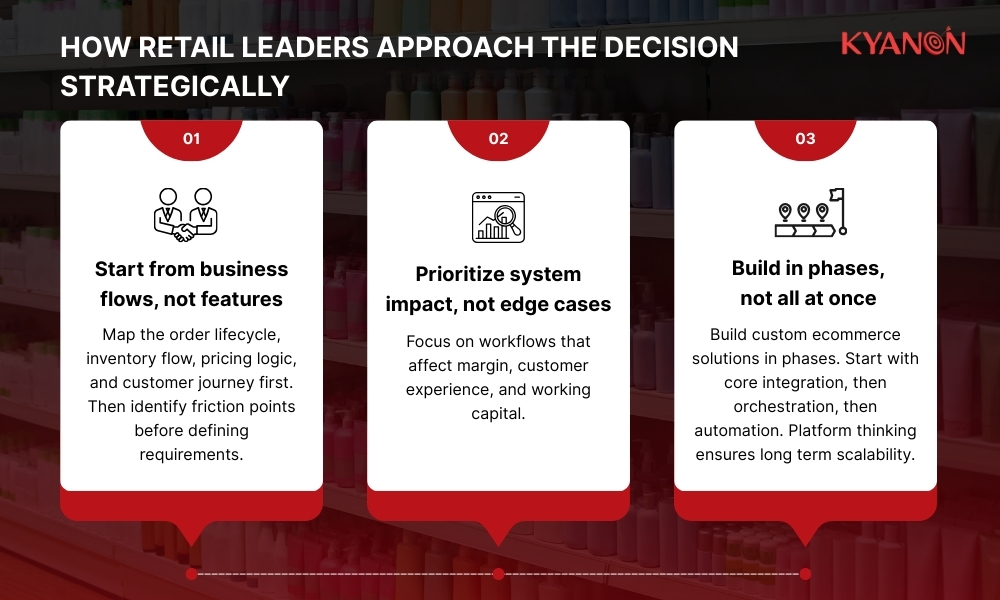
Start from business flows, not features
Map the order lifecycle, inventory flow, pricing logic, and customer journey first. Then identify friction points before defining requirements.
Prioritize system impact, not edge cases
Focus on workflows that affect margin, customer experience, and working capital.
Build in phases, not all at once
Successful custom ecommerce solutions are built iteratively. Start with the core integration layer, then ecommerce orchestration, then automation and optimization. Platform thinking is more sustainable than project thinking.
Building the right platform with Kyanon Digital
Retail transformation is not about building versus buying. It is about alignment.
What Kyanon Digital helps retailers evaluate
- Whether custom software platforms are justified
- Which systems should be custom versus integrated
- How to phase investment safely
- Where operational bottlenecks create hidden costs
Typical engagements at this stage
- Platform and workflow assessment
- Architecture and roadmap definition
- Build versus customize versus integrate recommendations
Case study: Integrated Commerce Platform For Thailand’s Largest Retail Group
Challenges
- Legacy systems lacked scalability and couldn’t support high-volume, omnichannel e-commerce operations.
- Operations were fragmented with no unified backend for inventory, pricing, promotions, and orders.
- Customers expected seamless experiences across mobile, web, and third-party marketplaces.
- Order fulfillment was complex across stores, warehouses, and external platforms.
Solutions
- Built a microservices-based commerce platform with a core operational engine to centralize key functions.
- Launched a mobile ordering app integrated with real-time inventory, pricing, and promotions.
- Integrated commerce systems with multiple channels, including GrabMart, Tiki, Shopee, Lazada, and the brand’s own web and app.
Impact
- Managed 26,000+ SKUs across six sales channels with real-time updates.
- Processed 8,000+ daily orders without downtime.
- 99 % of offline promotions transitioned online.
- Significantly improved operational efficiency and enabled scalable, unified omnichannel commerce.
Explore the full case study here: Integrated Commerce Platform For Thailand’s Largest Retail Group
Building the right foundation for scalable retail growth
Retail transformation is no longer about launching a better website or adding new features. It is about building the right operating foundation to support complexity, scale, and differentiation. As margins tighten and customer expectations rise, system limitations quickly become growth limitations.
Custom software platforms are not a trend. They are a structural response to modern retail demands. When designed around real business workflows, custom ecommerce systems create tighter operational control, cleaner data, and stronger strategic flexibility.
If you are evaluating whether a custom software platform is the right move, contact Kyanon Digital to assess your retail workflows, architecture readiness, and phased roadmap with clarity and confidence.