
What is 3PL Integration?
3PL Integration is the technical connection that links an e-commerce platform (like Shopify or WooCommerce) directly to a Third-Party Logistics provider’s Warehouse Management System (WMS).Instead of a merchant manually exporting CSV files of daily orders and emailing them to a warehouse, this integration automates the entire flow of data in real-time.
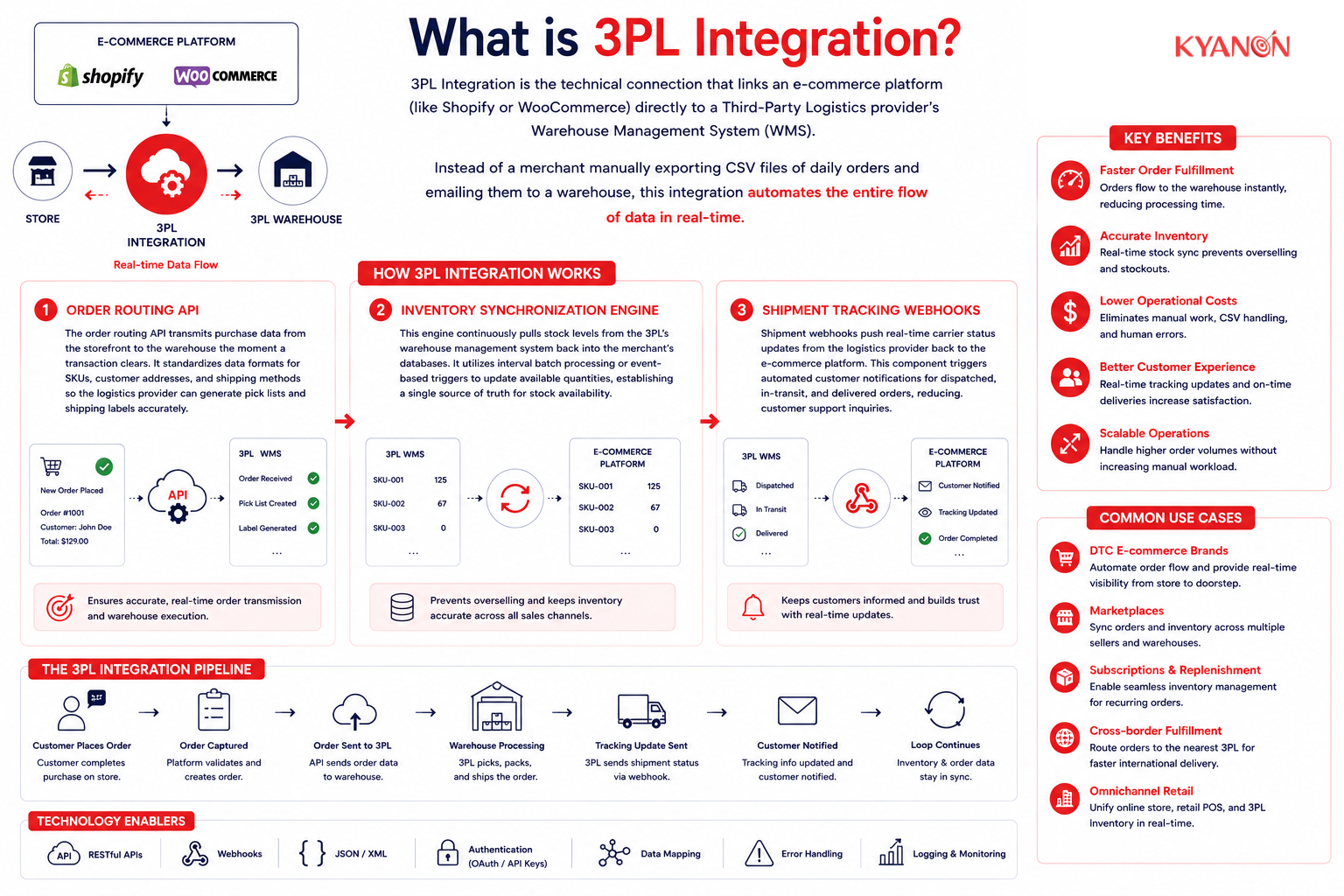
How 3PL integration works
3PL integration functions as a bidirectional middleware layer translating data between merchant sales channels and logistics facilities. The mechanism relies on event-driven webhooks and scheduled API calls to transfer critical supply chain data, ensuring physical warehouse actions strictly align with digital store records.
Order routing API
The order routing API transmits purchase data from the storefront to the warehouse the moment a transaction clears. It standardizes data formats for SKUs, customer addresses, and shipping methods so the logistics provider can generate pick lists and shipping labels accurately.
Inventory synchronization engine
This engine continuously pulls stock levels from the 3PL’s warehouse management system back into the merchant’s databases. It utilizes interval batch processing or event-based triggers to update available quantities, establishing a single source of truth for stock availability.
Shipment tracking webhooks
Shipment webhooks push real-time carrier status updates from the logistics provider back to the e-commerce platform. This component triggers automated customer notifications for dispatched, in-transit, and delivered orders, reducing customer support inquiries.

3PL Integration vs Native Fulfillment
Both approaches manage order delivery, but differ fundamentally in capital allocation and operational control.
Dimension | 3PL Integration | Native Fulfillment |
| Upfront capital expenditure | Low | High |
Geographic scaling speed | Fast | Slow |
| IT infrastructure burden | High (Middleware/API) | Low |
Operational control over physical picking | Low | High |
| Cost model | OpEx | CapEx |
When to consider 3PL Integration
Consider 3PL integration if:
- Your organization processes over 1,000 orders monthly and manual spreadsheet uploads to logistics partners are creating shipping delays.
- You are expanding fulfillment into new Southeast Asian markets and require localized delivery networks without acquiring physical warehouses.
- Discrepancies between storefront inventory and actual warehouse stock cause frequent backorders and high customer service volume.
It may not be the right priority if:
- Your product catalog consists of highly customized, made-to-order items requiring specialized in-house quality assurance before shipping.
Why 3PL integration matters for omnichannel retail
As retailers expand across eCommerce websites, marketplaces, physical stores, and social commerce, disconnected logistics systems create inventory inaccuracies, fulfillment delays, and inconsistent customer experiences. Integrating a 3PL with core commerce platforms, including ERP, OMS, WMS, and eCommerce systems, provides real-time inventory visibility, automates order routing, and enables consistent fulfillment across every channel.
According to Deloitte, this operational capability is increasingly important as omnichannel shoppers spend 1.5x more per month than single-channel shoppers, while leading retailers continue investing in unified commerce to reduce fulfillment costs and improve conversion.
Common misconceptions
Clicking ‘install’ on a standard Shopify 3PL app means we are fully integrated and ready to scale
Reality: Pre-built connectors only execute basic, linear workflows. Handling multi-location inventory routing, custom product bundles, or localized tax variations requires custom API mapping, middleware configuration, and rigorous load testing.
Once the API is connected, it’s a set-it-and-forget-it automated process
Reality: API protocols update, SKU structures evolve, and edge cases like international customs delays require continuous exception management. Maintaining a 3PL integration demands ongoing middleware monitoring to prevent dropped data payloads and connection timeouts.
Integrating our storefront with a 3PL eliminates the need for an ERP or inventory management system
Reality: A 3PL integration only covers the data transfer between active store sales and warehouse fulfillment. It does not handle upstream supply chain management, purchase orders for manufacturers, multi-channel financial accounting, or long-term demand forecasting.
How Kyanon Digital applies 3PL Integration
Kyanon Digital engineers 3PL integrations using custom API middleware and headless commerce architectures for enterprise retail and FMCG clients expanding across Southeast Asia. Our technical approach connects complex omnichannel order management systems directly with regional carriers like DHL, Ninja Van, and J&T, focusing on minimizing API latency, mapping complex custom workflows, and establishing exact inventory parity to accelerate time-to-market.
Explore our services:

 Create project brief with AI