
What is guest checkout?
Guest checkout is an e-commerce transaction mechanism that allows customers to make purchases without logging in or creating a persistent user account. This approach removes mandatory registration barriers from the buying process, prioritizing immediate transaction completion over long-term customer data capture.
How guest checkout works
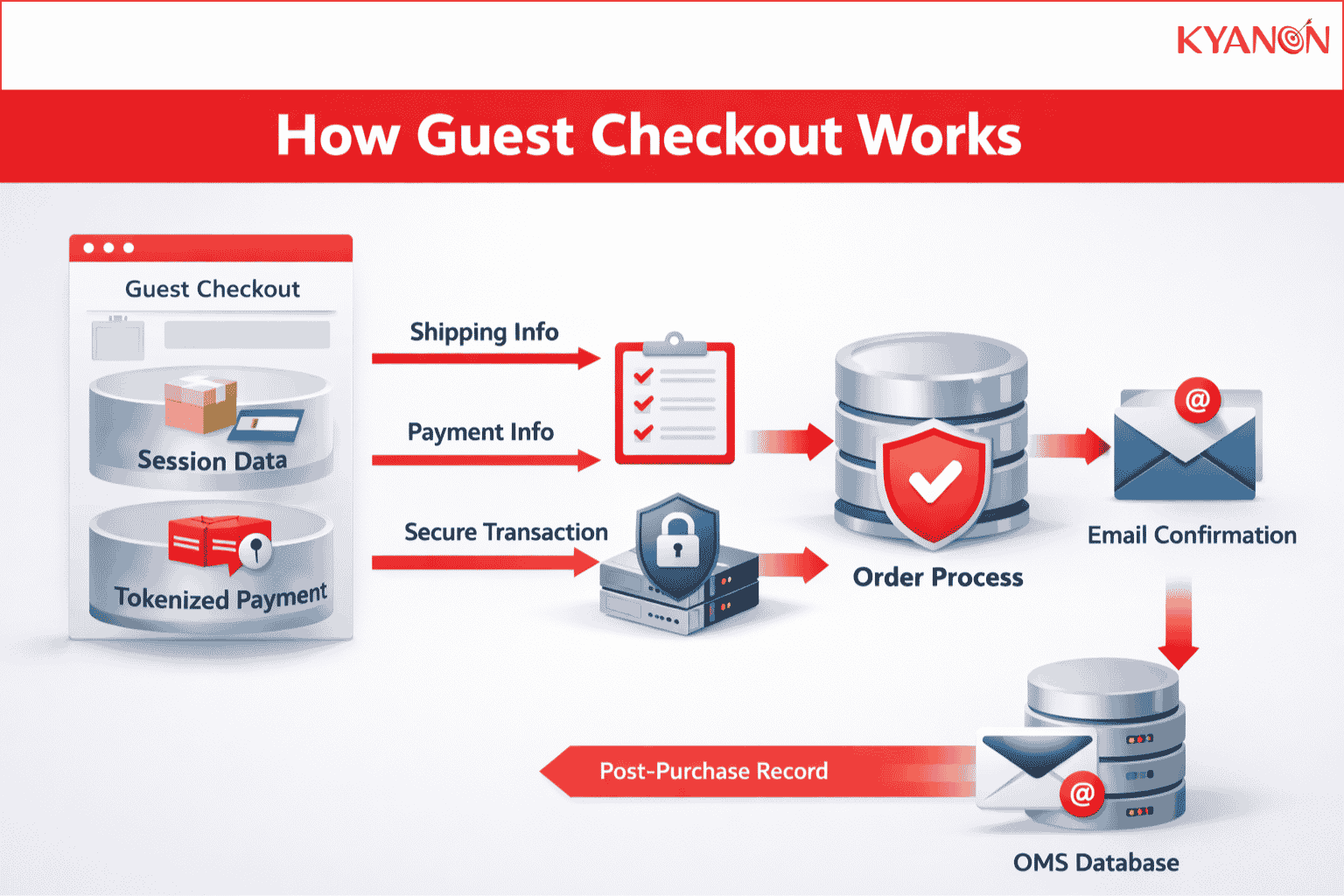
Guest checkout functions by bypassing the relational database mapping required for persistent user profiles, temporarily storing transaction data in a localized session state. By eliminating the cognitive load of password creation and reducing the physical typing required on mobile screens, this architecture accelerates purchase completion while capturing only the essential fulfillment data required to process the order.
Session-based data capture & privacy control
Session-based data capture collects critical shipping and billing details within a transient browser state rather than linking them to a permanent database ID. This minimizes the stored customer data footprint, reducing corporate vulnerability during security breaches, and builds immediate brand trust by assuring shoppers they will not be subjected to forced marketing enrollments.
Tokenized payment processing
Tokenized payment processing securely transmits financial data directly to payment gateways via API endpoints without storing sensitive card numbers on the merchant’s servers. In a guest workflow, this minimizes PCI-DSS compliance scope for the enterprise while ensuring high-speed, secure transactions for unauthenticated users.
Progressive post-purchase identity resolution
Progressive post-purchase identity resolution maps the completed transaction record to an email address within the enterprise Order Management System (OMS) after the payment is finalized. This lowers initial commitment by allowing shoppers to complete their purchase first, while enabling systems to offer one-click account registration on the confirmation page using the data already provided.

Guest checkout vs mandatory account registration
Both approaches process e-commerce transactions but differ fundamentally in their approach to data capture, user privacy, and purchase friction.
| Dimension | Guest checkout | Mandatory account registration |
Deployment speed | Fast | Slow |
| Vendor lock-in | Low | Low |
Upfront complexity | Low | High |
| Best for | Impulse buyers, seasonal gift shoppers, and mobile traffic | Repeat purchases and B2B portal engagement |
Cost model | OpEx | CapEx |
| Data capture depth | Transactional only (Minimal data footprint) | Full behavioral and historical profile |
Mobile conversion speed | Fast (Bypasses lengthy form filling) | Slow (High typing friction on small screens) |
When to consider guest checkout
Consider guest checkout if:
- Your web analytics indicate high drop-off rates on mobile devices, where typing through lengthy registration fields on small screens creates physical friction that drives shoppers away.
- Your enterprise captures high volumes of impulse buyers, seasonal gift shoppers, or one-time purchasers who demand instant gratification without the cognitive load of remembering another password.
- You are expanding into Southeast Asian retail markets where consumers prioritize rapid digital wallet checkouts over traditional email-and-password account creation.
It may not be the right priority if:
- Your e-commerce architecture relies on complex B2B contract pricing, custom credit limits, or tiered organization hierarchies that require authenticated user sessions before revealing catalog pricing.
Why guest checkout matters for e-commerce
Integrating guest checkout within enterprise e-commerce architectures directly mitigates revenue leakage caused by mandatory registration friction and customer privacy concerns. Removing upfront barriers allows organizations to capture high-intent traffic immediately, balancing short-term transaction volume with strategic post-purchase engagement workflows.
Common misconceptions
“Guest checkout solves all cart abandonment issues automatically.”
Reality: Many users still abandon carts due to unexpected shipping costs or slow delivery times. While guest checkout eliminates registration friction and form-filling fatigue, relying on it blindly without addressing pricing clarity or logistics transparency will not fix underlying conversion drop-offs.
“Enabling guest transactions prevents marketing teams from collecting email addresses or building customer loyalty.”
Reality: You can still collect their email address during checkout for order tracking and marketing opt-ins without forcing account creation. Furthermore, modern implementations allow merchants to offer post-purchase account creation on the confirmation page or incentivize registration with discounts before payment, effectively bridging immediate conversion with long-term retention.
“Guest buyers never return to purchase again and do not care about personalization.”
Reality: Many loyal, repeat customers intentionally use guest checkout every time to avoid managing passwords and reduce cognitive load. Shoppers still expect accurate order tracking and relevant product recommendations based on their active session, making session-based personalization critical even for unauthenticated traffic.
“Account creation takes too much time, making guest checkout the only viable option for fast checkouts.”
Reality: Modern tools like Google Pay or Apple Pay make account creation happen in a single click. By integrating digital wallets, enterprise platforms can bypass standard registration forms entirely while still capturing authenticated customer data securely.
How Kyanon Digital applies guest checkout
Kyanon Digital implements guest checkout within composable architecture frameworks using headless platforms like Commercetools and Shopify Plus for enterprise retail clients across Vietnam, Singapore, and Australia. Our approach focuses on balancing rapid mobile conversion speeds with intelligent post-purchase identity resolution, allowing enterprises to capture high-intent impulse transactions while systematically transitioning guest users into authenticated loyalty programs without upfront friction.
→ Explore our: E-commerce service

 Create project brief with AI