
What is Hallucination (AI)?
Hallucination in artificial intelligence refers to a phenomenon where a large language model generates a response that is syntactically correct and highly plausible, but factually inaccurate or entirely fabricated based on its training data limitations. This output occurs because the underlying neural network acts as a probabilistic prediction engine rather than a deterministic database of verified facts.
How Hallucination (AI) Works
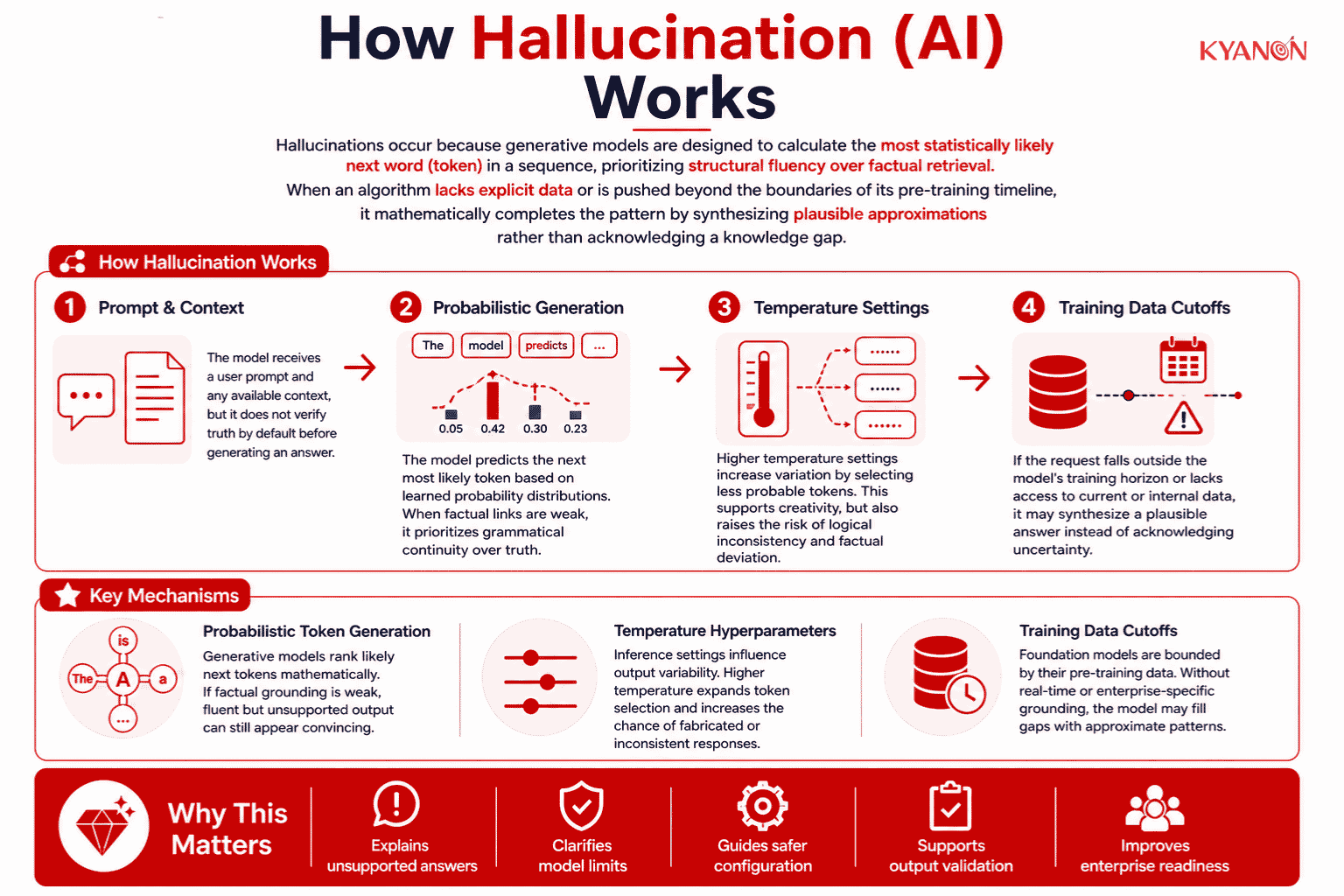
Hallucinations occur because generative models are designed to calculate the most statistically likely next word (token) in a sequence, prioritizing structural fluency over factual retrieval. When an algorithm lacks explicit data or is pushed beyond the boundaries of its pre-training timeline, it mathematically completes the pattern by synthesizing plausible approximations rather than acknowledging a knowledge gap.
Probabilistic Token Generation
The core mechanism of a generative model relies on calculating mathematical probability distributions across its vocabulary. When explicit factual connections are weak within the training weights, the system prioritizes grammatical continuity, mathematically linking tokens that sound correct together regardless of their actual truth value.
Temperature Hyperparameters
System configurations directly influence the likelihood of fabricated outputs during inference. Higher temperature settings instruct the model to select less probable tokens, which increases creative variability for brainstorming tasks but simultaneously elevates the risk of logical inconsistencies and factual deviations.
Training Data Cutoffs
Foundation models operate strictly within the confines of the historical data they ingested during pre-training. When prompted for real-time information or specialized internal corporate data outside that boundary, the lack of grounding context forces the algorithm to invent an answer based on adjacent, generalized concepts.

Why Do AI Hallucinations Happen?
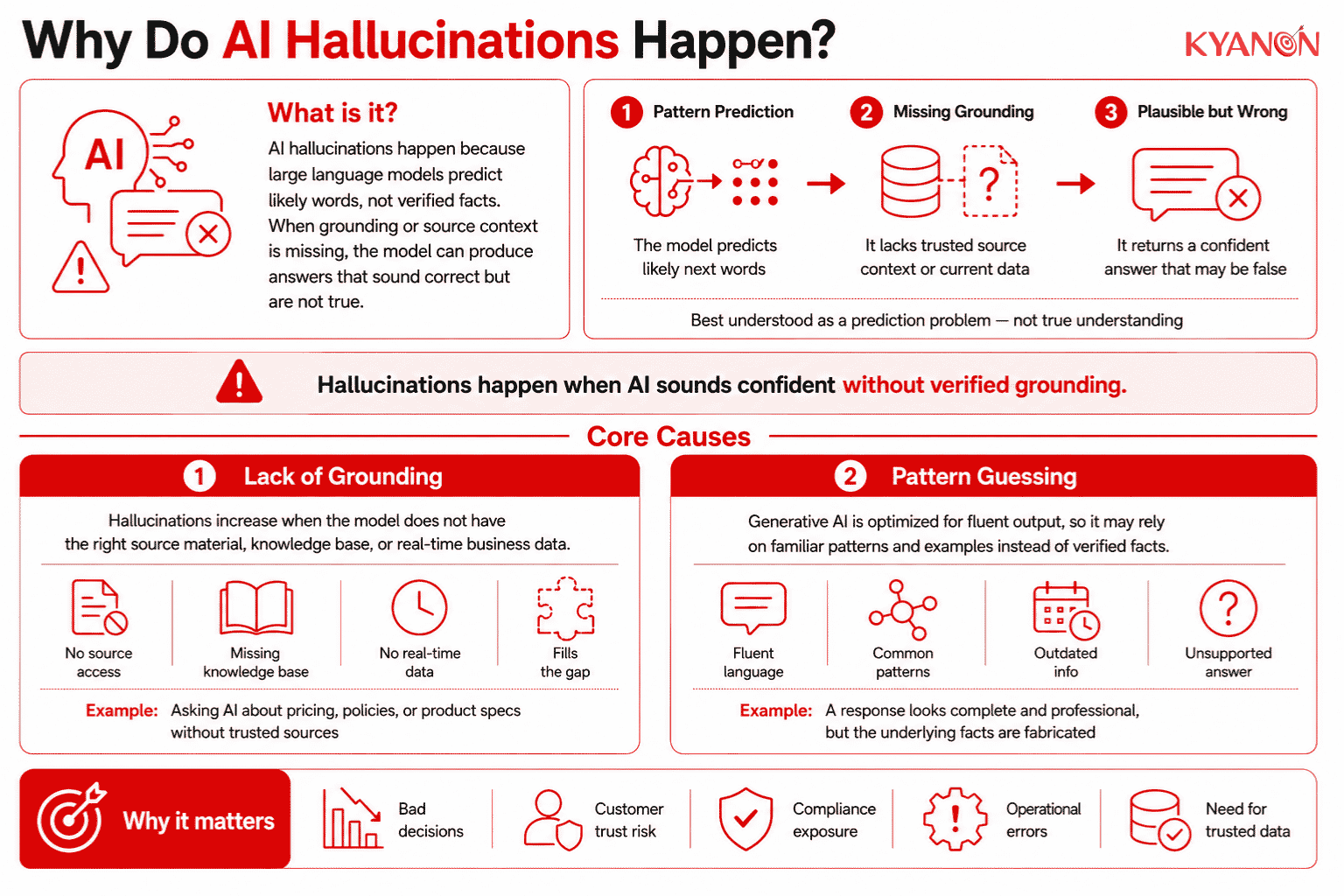
AI hallucinations happen because large language models do not “know” facts in the same way a human expert or a verified database does. Instead, they generate outputs by predicting the most likely next words based on patterns learned from training data.
When the model lacks reliable grounding, source context, or up-to-date information, it may generate a plausible answer that sounds correct but is not factually true.
Lack of Grounding
A hallucination can occur when the AI model does not have access to the right source material, internal knowledge base, or real-time business data. If the prompt asks for information outside the model’s training data or available context, the model may fill the gap with a confident but unsupported answer.
For enterprise AI, this risk increases when teams ask generative AI to answer questions about pricing, policies, product specifications, legal requirements, financial metrics, or customer data without connecting it to trusted sources.
Pattern Guessing
Generative AI systems are optimized to produce fluent and coherent output. This means the model may rely on familiar sentence structures, common examples, or statistical patterns instead of verified facts.
As a result, an AI response can look professional, complete, and authoritative even when the underlying information is fabricated, outdated, or unsupported.
Hallucination (AI) vs Data Poisoning
Both issues compromise the reliability of machine learning outputs, but they originate from entirely different mechanisms within the model lifecycle.
Dimension | Hallucination (AI) | Data Poisoning |
| Origin phase | Inference phase (during generation) | Training phase (data ingestion) |
Core intent | Unintentional statistical artifact | Malicious adversarial attack |
| Trigger condition | Prompting beyond knowledge boundaries | Corrupted training datasets |
Output characteristic | Plausible but fabricated facts | Systematically biased or harmful outputs |
| Primary mitigation | Retrieval-Augmented Generation (RAG) | Strict dataset sanitization and auditing |
Common Examples of AI Hallucination
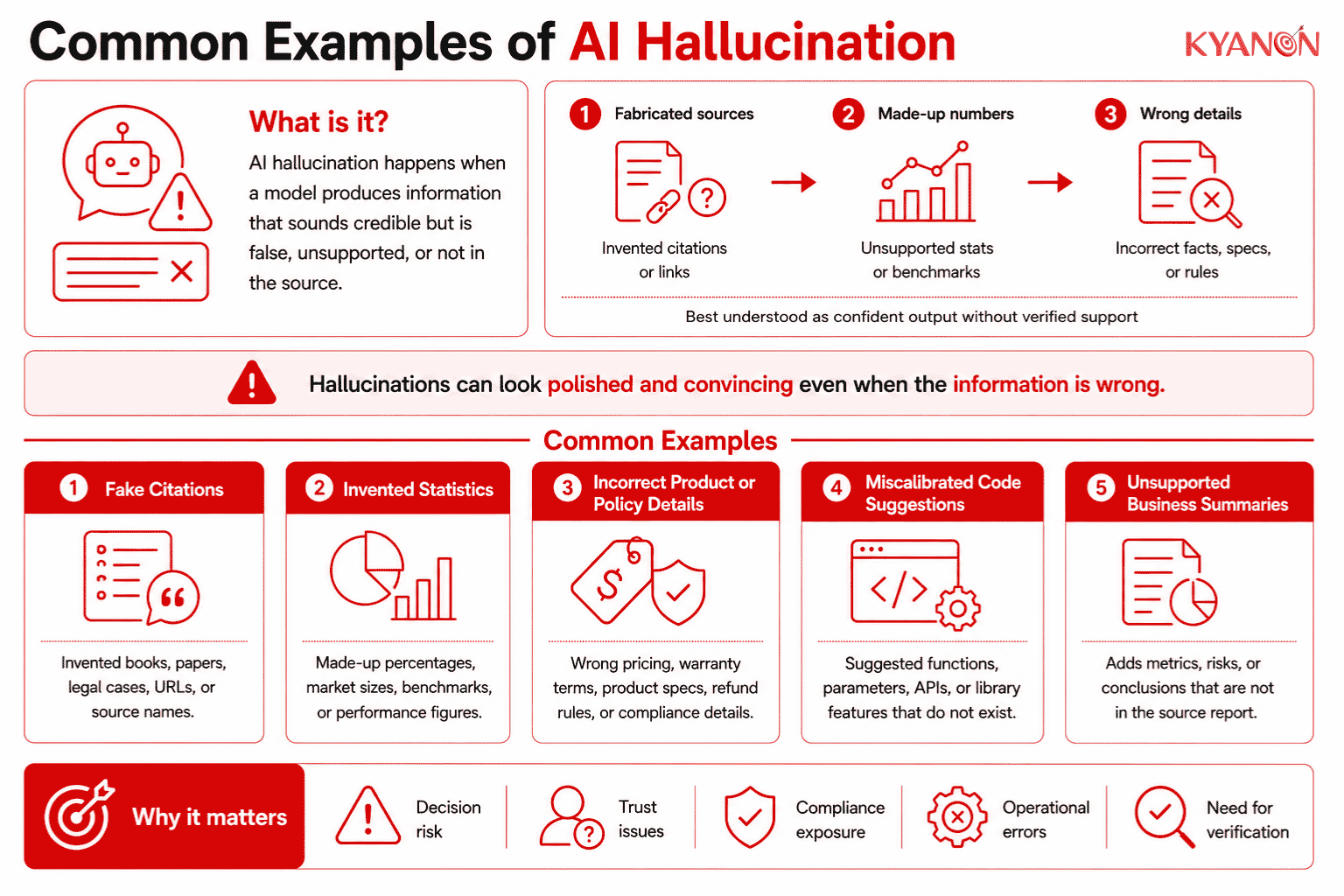
AI hallucination can appear in different formats depending on the use case.
- Fake citations: The model invents books, research papers, legal cases, URLs, or source names that do not exist.
- Invented statistics: The model generates numbers, percentages, market figures, or performance benchmarks without a verified source.
- Incorrect product or policy details: The model provides wrong pricing, warranty terms, product specifications, refund rules, or compliance requirements.
- Miscalibrated code suggestions: The model recommends a function, parameter, API method, or library feature that does not actually exist.
- Unsupported business summaries: The model summarizes a report but adds financial metrics, risk factors, or conclusions that are not present in the source document.
When to Consider Hallucination (AI) Mitigation
Consider aggressive hallucination mitigation architectures if:
- Your engineering team is deploying a customer-facing chatbot where providing incorrect pricing or policy information creates immediate legal and financial liabilities.
- You are integrating generative AI into automated compliance document generation, where regulatory accuracy is strictly mandated by external auditing bodies.
- Your internal teams rely on AI summaries of dense financial reports, and early testing shows the model occasionally inventing financial metrics not present in the source text.
It may not be the right priority if:
- Your product utilizes generative models purely for creative ideation, marketing copy brainstorming, or generating synthetic variations of non-critical design assets where strict factual precision is not the objective.
How to Reduce AI Hallucination Risk
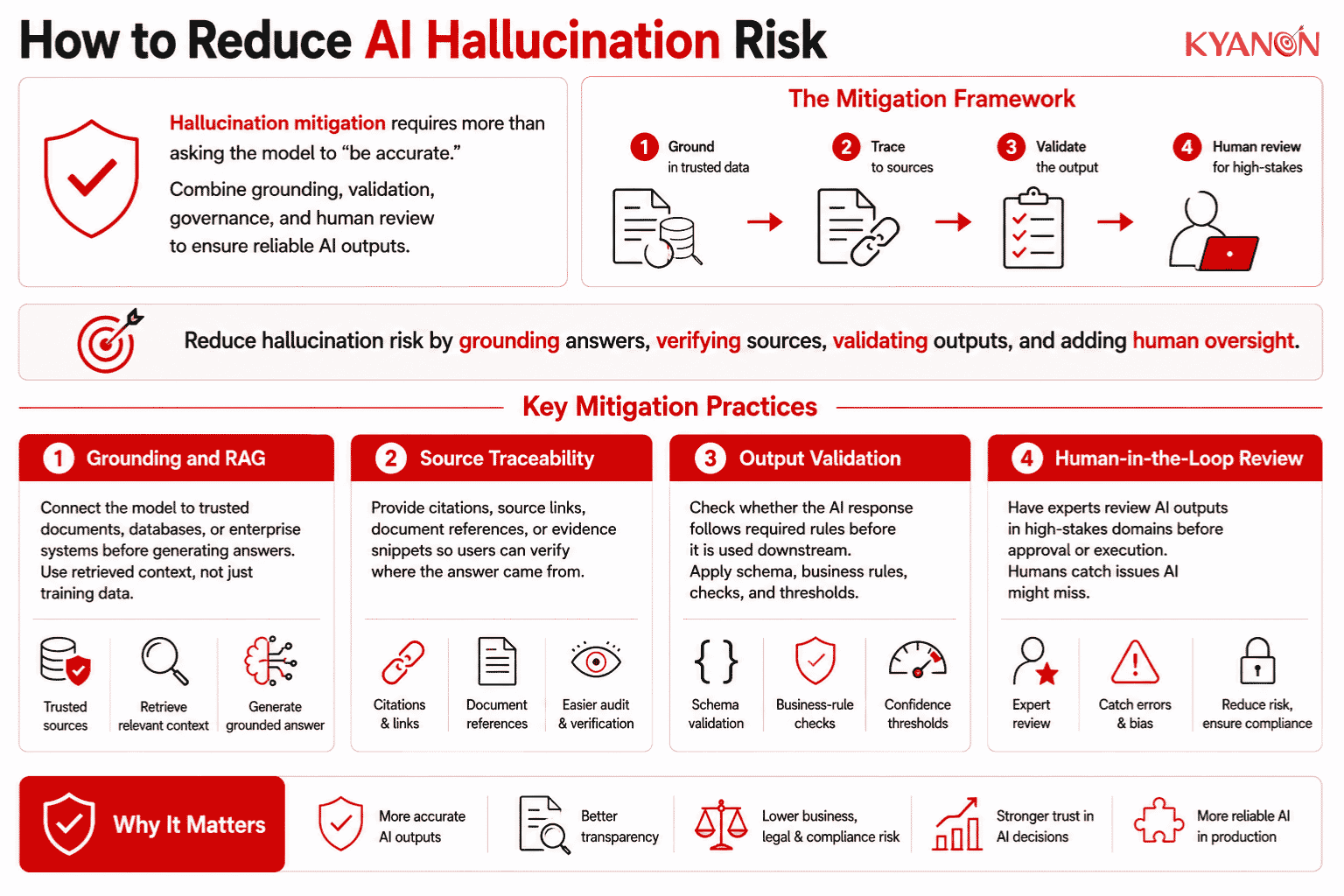
Hallucination mitigation requires more than asking the model to “be accurate.” Enterprise teams should combine grounding, validation, governance, and human review.
Grounding and RAG
Retrieval-Augmented Generation, or RAG, reduces hallucination risk by connecting the AI model to trusted documents, databases, knowledge bases, or enterprise systems before it generates an answer.
Instead of relying only on training data, the model retrieves relevant source content and uses it as context for the response. This is especially useful for customer support, policy search, product information, compliance workflows, and internal knowledge assistants.
Source Traceability
AI systems should provide citations, source links, document references, or evidence snippets when factual accuracy matters. Source traceability helps users verify where an answer came from and makes AI outputs easier to audit.
For enterprise use cases, this is important when AI-generated answers influence customer communication, operational decisions, legal review, financial reporting, or regulated workflows.
Output Validation
Output validation checks whether the AI response follows required rules before it is used downstream. This may include JSON Schema validation, business-rule validation, numerical checks, policy constraints, and confidence thresholds.
For example, an AI-generated financial summary should be checked against the original report before it is used in a dashboard or executive decision.
Human-in-the-Loop Review
For high-stakes domains such as healthcare, finance, legal, insurance, and compliance, human experts should review AI outputs before they are approved or executed.
Human-in-the-loop review helps catch hallucinations, biased conclusions, missing context, and unsupported recommendations before they create business, legal, or customer risk.
Why Hallucination (AI) Matters for Enterprise AI
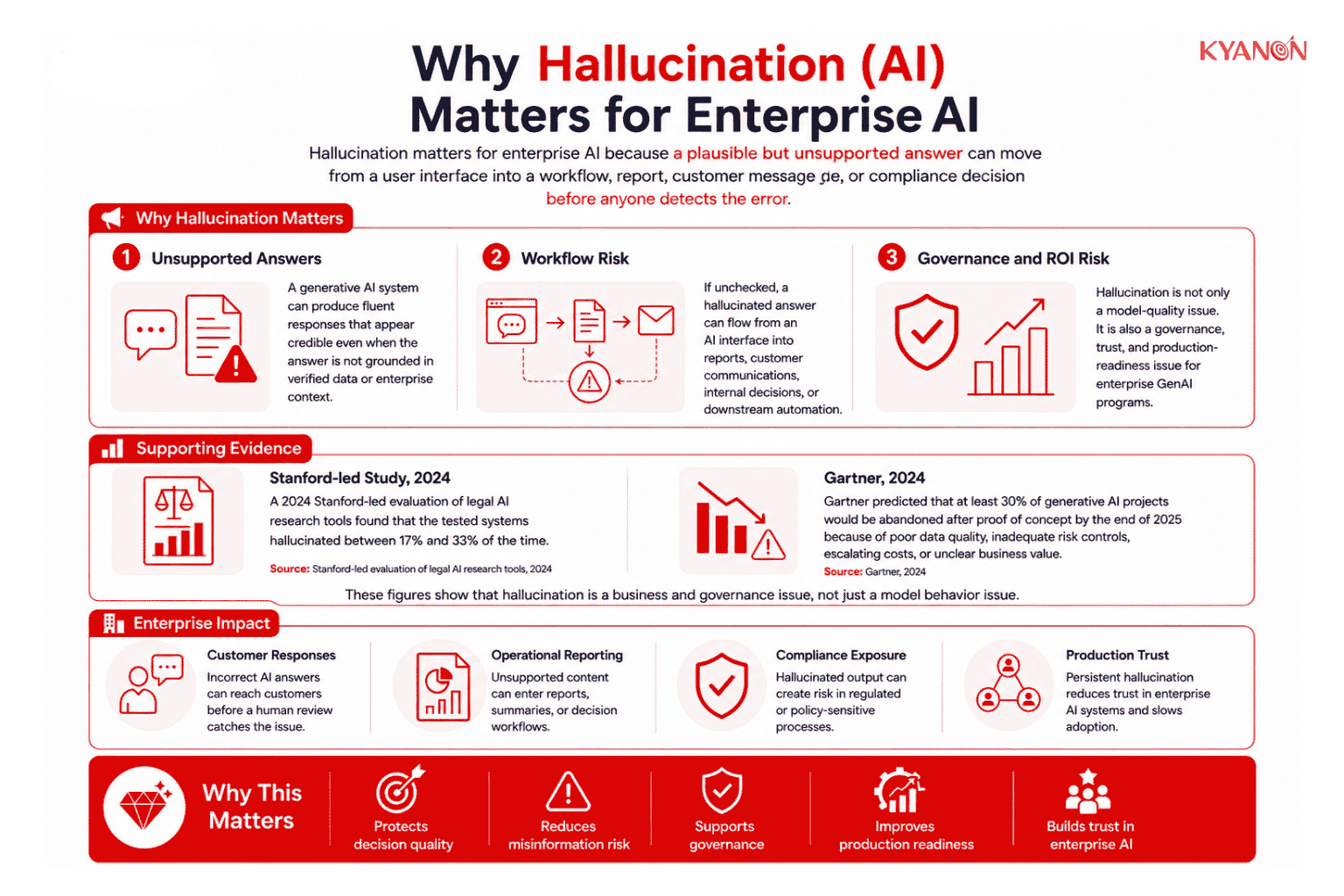
Hallucination matters for enterprise AI because a plausible but unsupported answer can move from a user interface into a workflow, report, customer message, or compliance decision before anyone detects the error.
A 2024 Stanford-led evaluation of legal AI research tools found that the tested systems hallucinated between 17% and 33% of the time, showing that even domain-specific AI systems can produce unsupported answers in high-stakes knowledge work.
Gartner predicted in 2024 that at least 30% of generative AI projects would be abandoned after proof of concept by the end of 2025 because of poor data quality, inadequate risk controls, escalating costs, or unclear business value. For enterprise leaders, hallucination is therefore not only a model-quality issue; it is part of the broader governance and ROI problem that determines whether GenAI moves from pilot to production.
Common Misconceptions
Hallucination is not simply a rare defect that disappears with a better prompt; it is a persistent reliability risk that must be managed through grounding, validation, monitoring, and governance.
“Hallucination is just a bug we can fix later.”
Reality: Hallucination is linked to how large language models generate likely text, so it cannot be treated like a normal software defect with a one-time patch. A CTO should manage hallucination as an operational risk with measurable controls, not as a temporary engineering issue.
“The AI is confused or lying.”
Reality: An AI model is not intentionally lying or experiencing confusion; it is generating statistically likely output based on the input, training patterns, and decoding process. This distinction matters because the solution is not to “ask the model to be honest,” but to design retrieval, validation, fallback, and escalation controls.
“RAG eliminates hallucination.”
Reality: RAG can reduce hallucination by grounding answers in enterprise documents, but it does not guarantee correctness if retrieval is incomplete, documents are outdated, permissions are wrong, or the final answer is not validated. NIST’s 2024 Generative AI Profile treats generative AI as a risk-management problem requiring lifecycle controls, not a single mitigation technique.
How Kyanon Digital Applies Hallucination (AI)
Kyanon Digital applies hallucination risk controls in GenAI and RAG-based solutions by grounding answers in enterprise data, adding source traceability, integrating private or dedicated LLM endpoints, and supporting deployment on client cloud, client domain, or private SaaS environments. Its Generative AI consulting approach describes RAG pipelines that retrieve relevant internal content before generation and produce answers grounded in trusted business data with traceable sources, which is directly relevant to reducing hallucination risk in enterprise AI deployments.
→ Explore our Generative AI consulting services

 Create project brief with AI