
What is RAG (Retrieval-Augmented Generation)?
Retrieval-Augmented Generation (RAG) is an AI architecture that improves the accuracy and relevance of Large Language Models (LLMs) by connecting them to external knowledge sources. Instead of relying only on the data used during training, RAG retrieves up-to-date and domain-specific information from sources such as company databases, research papers, and specialized datasets, then incorporates that information into the response generation process. This enables AI systems to produce more accurate, context-aware, and business-relevant answers without requiring the model to be retrained. (IBM)
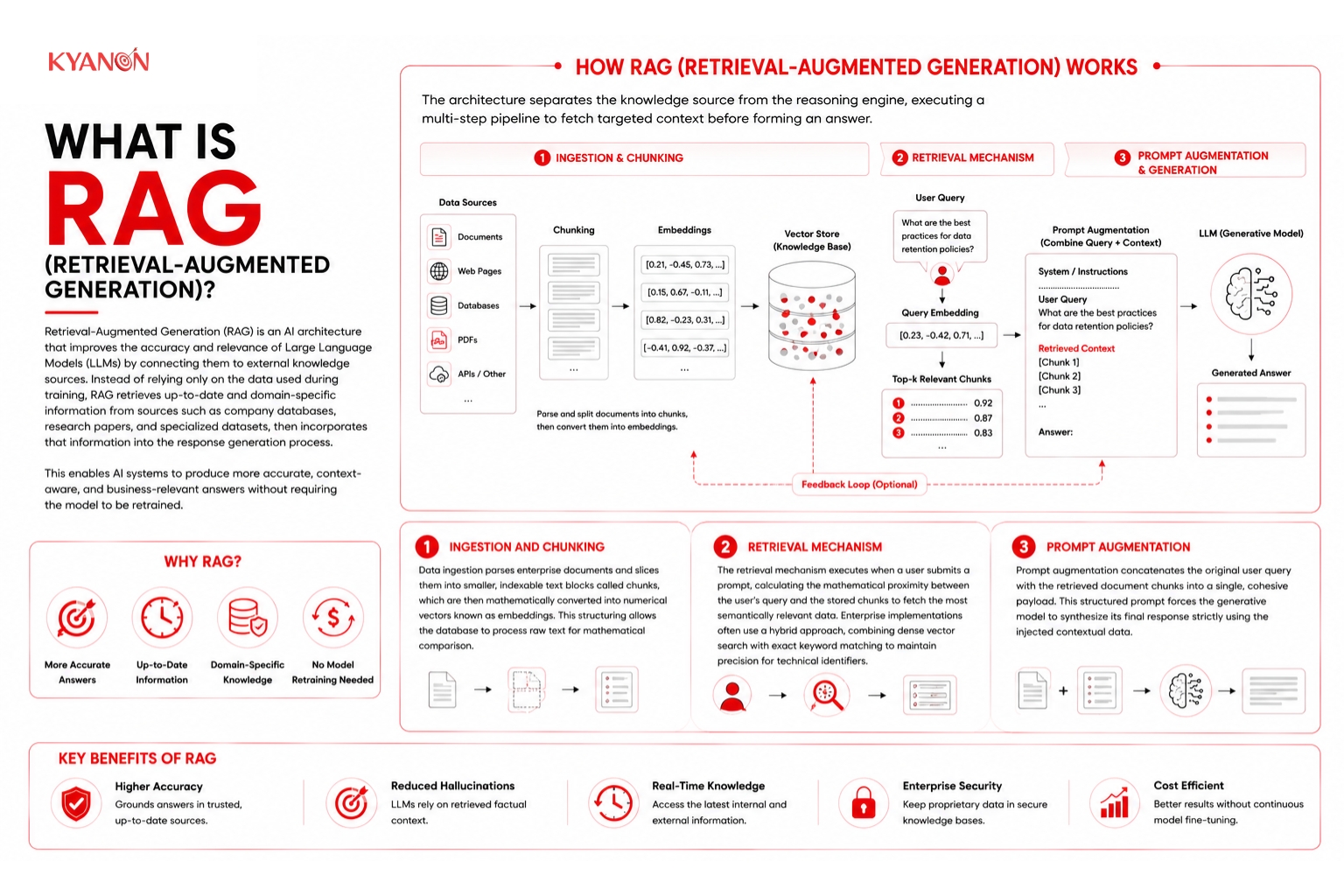
How RAG (Retrieval-Augmented Generation) Works
The architecture separates the knowledge source from the reasoning engine, executing a multi-step pipeline to fetch targeted context before forming an answer.
Ingestion and Chunking
Data ingestion parses enterprise documents and slices them into smaller, indexable text blocks called chunks, which are then mathematically converted into numerical vectors known as embeddings. This structuring allows the database to process raw text for mathematical comparison.
Retrieval Mechanism
The retrieval mechanism executes when a user submits a prompt, calculating the mathematical proximity between the user’s query and the stored chunks to fetch the most semantically relevant data. Enterprise implementations often use a hybrid approach, combining dense vector search with exact keyword matching to maintain precision for technical identifiers.
Prompt Augmentation
Prompt augmentation concatenates the original user query with the retrieved document chunks into a single, cohesive payload. This structured prompt forces the generative model to synthesize its final response strictly using the injected contextual data.

The benefits of RAG
RAG empowers organizations to avoid high retraining costs when adapting generative AI models to domain-specific use cases. Enterprises can use RAG to complete gaps in a machine learning model’s knowledge base so it can provide better answers.
The primary benefits of RAG include:
- Cost-efficient AI implementation and AI scaling
- Access to current domain-specific data
- Lower risk of AI hallucinations
- Increased user trust
- Expanded use cases
- Enhanced developer control and model maintenance
- Greater data security
RAG use cases
RAG systems essentially enable users to query databases with conversational language. The data-powered question-answering abilities of RAG systems have been applied across a range of use cases, including:
- Specialized chatbots and virtual assistants
- Research
- Content generation
- Market analysis and product development
- Knowledge engines
- Recommendation services
RAG (Retrieval-Augmented Generation) vs Fine-Tuning
Both approaches customize language models for specific domains, but they differ fundamentally in data mutability and infrastructure costs.
Dimension | RAG (Retrieval-Augmented Generation) | Fine-Tuning |
| Primary objective | Injecting dynamic, factual knowledge | Teaching new skills, syntax, or tone |
Data update mechanism | Real-time database index updates | Requires complete model retraining runs |
| Hallucination mitigation | High (grounds answers in retrieved data) | Low (models can still hallucinate internal weights) |
Upfront infrastructure cost | Moderate | High |
| Best for | Document Q&A, enterprise knowledge bases | Syntax formatting, specific output styling |
When to Consider RAG (Retrieval-Augmented Generation)
Consider RAG (Retrieval-Augmented Generation) if:
- Your legal or compliance teams require strict traceability, demanding that every AI-generated response cites a specific, verifiable source document.
- Your enterprise knowledge base updates daily, rendering static language models instantly obsolete without a real-time data connection.
- Your organization operates with proprietary financial data that cannot be uploaded into public model training sets due to strict security constraints.
It may not be the right priority if:
- Your primary objective is to train an AI agent to write code in a highly specific, proprietary programming language where strict syntax rules dictate success rather than factual information retrieval.
Why RAG (Retrieval-Augmented Generation) Matters for Enterprise Operations
Operating generative AI without a dedicated retrieval layer introduces unacceptable risk in highly regulated B2B environments where factual accuracy determines operational safety.
With RAG, enterprises can use internal, authoritative data sources and gain similar model performance increases without retraining. Enterprises can scale their implementation of AI applications as needed while mitigating cost and resource requirement increases.
Common Misconceptions
Implementing this architecture completely eliminates all hallucinations from our AI system
Reality: RAG (Retrieval-Augmented Generation) shifts hallucinations from parametric memory to contextual processing. If the initial retrieval step fetches irrelevant or conflicting documents due to poor indexing, the language model will dutifully synthesize that flawed information into a highly confident, incorrect answer.
We should retrieve as many documents as possible (Top-K=30) to guarantee the AI has the right context
Reality: Flooding the context window triggers the “lost in the middle” phenomenon. Language models struggle to extract specific information buried inside excessively long prompts. Sending too many documents dilutes the correct answer, spikes system latency, and massively inflates API token costs.
Once deployed, it is a zero-maintenance architecture
Reality: Production setups require constant telemetry, evaluations, and data curation. As corporate wikis grow, outdated data begins to conflict with new data. Without strict metadata filtering and continuous evaluation frameworks, the system’s accuracy steadily degrades over time as old documents pollute the search index.
How Kyanon Digital applies RAG (Retrieval-Augmented Generation)
Kyanon Digital builds RAG (Retrieval-Augmented Generation) pipelines for enterprise clients across the US, ANZ, and Southeast Asia, combining hybrid search mechanisms with strict metadata filtering to prevent document fragmentation. Our implementation strategy focuses on optimizing chunking algorithms for complex data, such as financial tables and nested code blocks, ensuring the generative model receives intact, structured context to deliver accurate insights while keeping Total Cost of Ownership (TCO) under control.
Explore our Generative AI Development services.

 Create project brief with AI