
What is Human-in-the-Loop (HITL)?
Human-in-the-loop (HITL) is an artificial intelligence design pattern that requires explicit human review, intervention, or approval at critical decision points within an algorithmic workflow. This framework balances the computational efficiency of machine learning models with the contextual judgment and risk mitigation capabilities of human domain experts.
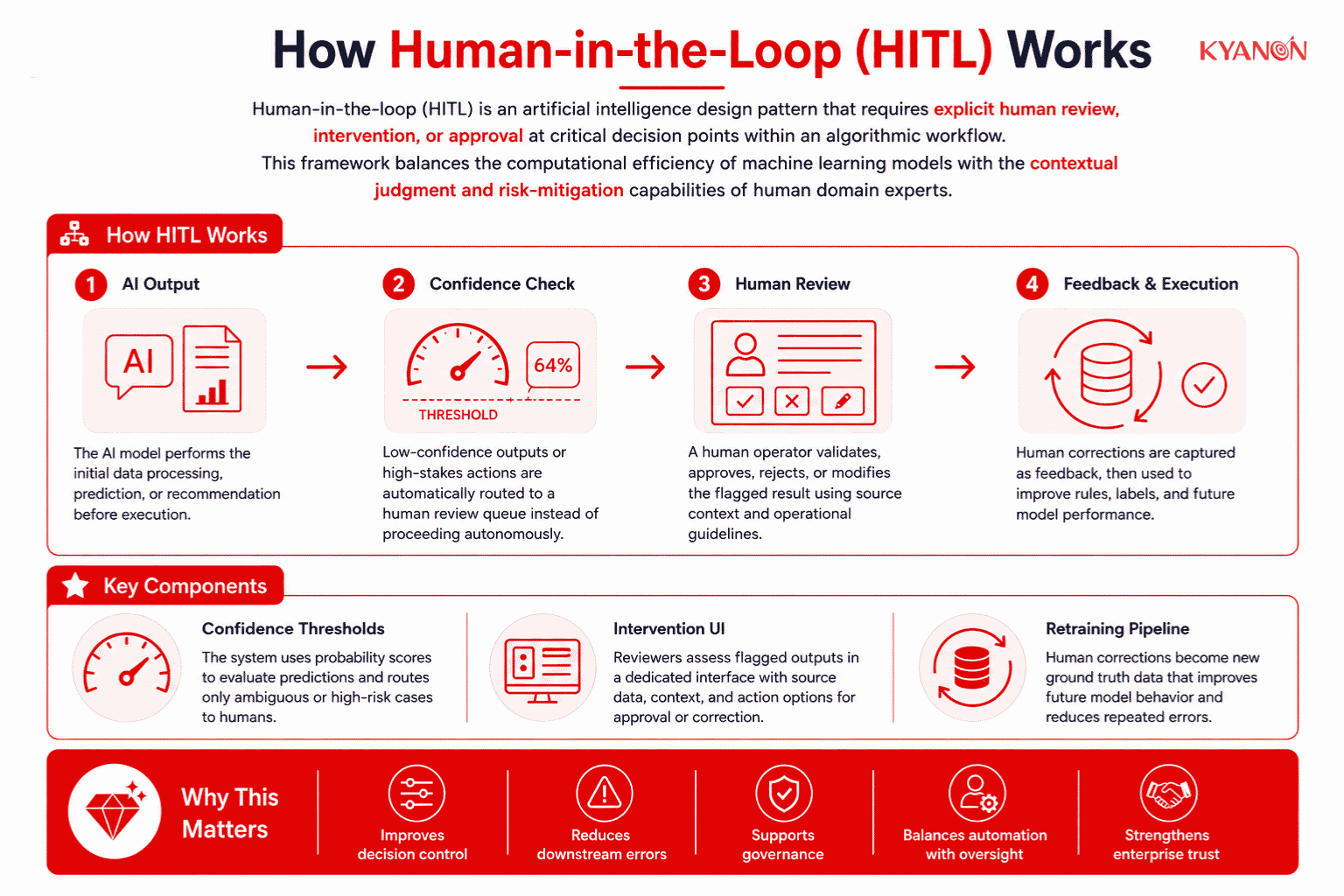
How Human-in-the-Loop (HITL) Works
A HITL architecture establishes a continuous feedback cycle where an AI model executes initial data processing or predictions, but routes low-confidence outputs or high-stakes actions to a human operator for final validation before execution. The human’s corrective actions are then fed back into the system’s database to continuously retrain the algorithm and improve its future accuracy parameters.
Confidence Thresholds
The system utilizes mathematical probability scores to evaluate its own predictions, automatically routing any output that falls below a predefined certainty metric to a human queue for manual review. This ensures human effort is only expended on ambiguous edge cases.
Intervention UI
This is the specialized interface where human reviewers assess the flagged AI outputs. It provides the operator with the necessary context, source data, and operational guidelines to make an informed approval, rejection, or modification decision.
Retraining Pipeline
The pipeline captures the human corrections and integrates them as new ground truth data, ensuring the model dynamically adjusts its underlying weights to prevent repeating the same classification errors in future iterations.

How HITL Works in the AI Lifecycle
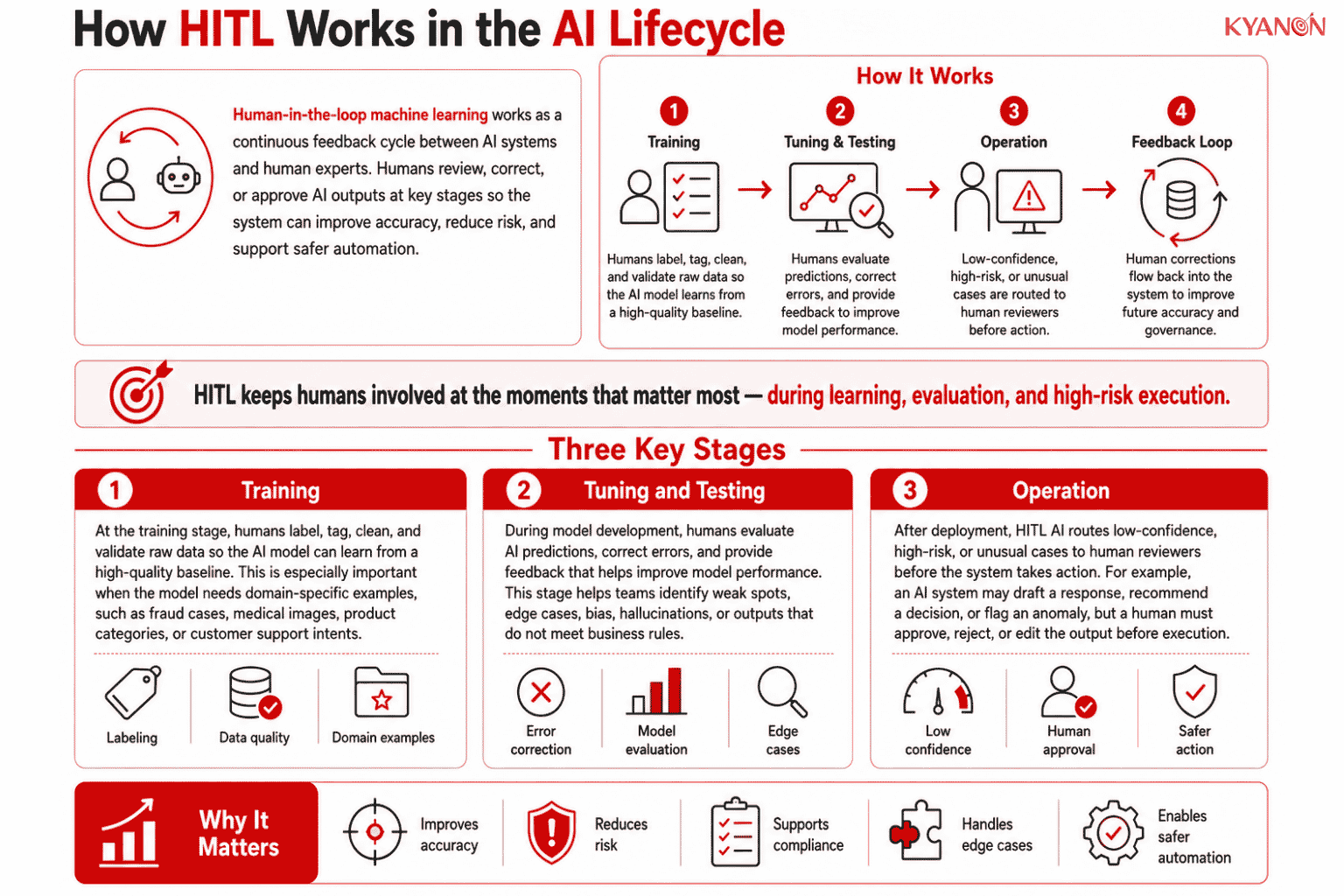
Human-in-the-loop machine learning works as a continuous feedback cycle between AI systems and human experts. Humans review, correct, or approve AI outputs at key stages so the system can improve accuracy, reduce risk, and support safer automation.
Training
At the training stage, humans label, tag, clean, and validate raw data so the AI model can learn from a high-quality baseline. This is especially important when the model needs domain-specific examples, such as fraud cases, medical images, product categories, or customer support intents.
Tuning and Testing
During model development, humans evaluate AI predictions, correct errors, and provide feedback that helps improve model performance. This stage helps teams identify weak spots, edge cases, bias, hallucinations, or outputs that do not meet business rules.
Operation
After deployment, HITL AI routes low-confidence, high-risk, or unusual cases to human reviewers before the system takes action. For example, an AI system may draft a response, recommend a decision, or flag an anomaly, but a human must approve, reject, or edit the output before execution.
Human-in-the-Loop (HITL) vs Human-on-the-Loop (HOTL)
Both approaches integrate human oversight, but they differ fundamentally in the level of operational autonomy granted to the AI system and the timing of human intervention.
Dimension | Human-in-the-Loop (HITL) | Human-on-the-Loop (HOTL) |
AI Autonomy Level | Low (requires explicit approval) | High (acts autonomously unless stopped) |
| Intervention Timing | Pre-execution (before action occurs) | Post-execution or during execution |
Decision Authority | Human holds final veto power | Machine executes by default |
| Best For | High-risk, heavily regulated workflows | Low-risk, high-volume automated tasks |
Latency Impact | High (creates operational bottlenecks) | Low (maintains processing speed) |
Spectrum of Human Oversight
Human oversight in AI can be designed at different levels depending on risk, speed, and compliance requirements.
| Oversight Model | How It Works | Best For |
|---|---|---|
| Human-in-the-Loop (HITL) | AI stops and waits for human approval before action. | High-risk or regulated decisions |
| Human-on-the-Loop | AI acts autonomously, while humans monitor and intervene when needed. | Medium-risk, high-volume workflows |
| Human-out-of-the-Loop | AI analyzes, decides, and executes without human review. | Low-risk, routine automation |
Core Benefits of Human-in-the-Loop (HITL)
- Handles edge cases: HITL helps AI systems manage rare, ambiguous, or unfamiliar scenarios that may fall outside the model’s training data.
- Improves safety and compliance: Human review acts as a control layer for high-stakes workflows such as lending, healthcare, insurance, legal review, and enterprise approvals.
- Creates continuous improvement: Every human correction becomes valuable feedback that can be used to retrain, tune, or improve the AI model over time.
When to Consider Human-in-the-Loop (HITL)
Consider Human-in-the-loop (HITL) if:
- Your organization is deploying an automated underwriting system where algorithmic loan denials carry significant compliance and regulatory risks.
- Your e-commerce platform utilizes generative AI for product descriptions, and early testing shows the model occasionally fabricating specifications for high-value SKUs.
- Your customer support triage model frequently encounters highly nuanced, escalated complaints that fall outside the mathematical parameters of its initial training data.
It may not be the right priority if:
- Your machine learning pipeline handles low-stakes, high-velocity tasks, such as standard website product recommendations, where the cost of a delayed decision far outweighs the cost of an inaccurate prediction.
Why Human-in-the-Loop (HITL) Matters for Enterprise Compliance
Embedding human oversight into automated systems ensures organizations maintain auditable accountability for algorithmic outputs, which directly mitigates legal and financial liabilities in regulated industries.
Gartner predicted in 2024 that by 2028, one-third of interactions with generative AI services will use action models and autonomous agents for task completion, meaning AI systems are expected to move beyond response generation into workflow execution. For compliance leaders, this makes HITL important because autonomous AI actions need approval checkpoints, escalation rules, monitoring, and audit trails before they can be trusted in policy-sensitive environments.
ISO/IEC 42001:2023 specifies requirements for establishing, implementing, maintaining, and continually improving an AI management system within organizations. This reinforces why human oversight should be designed as part of AI governance: regulated enterprises need evidence of who reviewed AI decisions, what was approved or rejected, and how corrective feedback is used to improve the system over time.
Real-World Examples of HITL AI
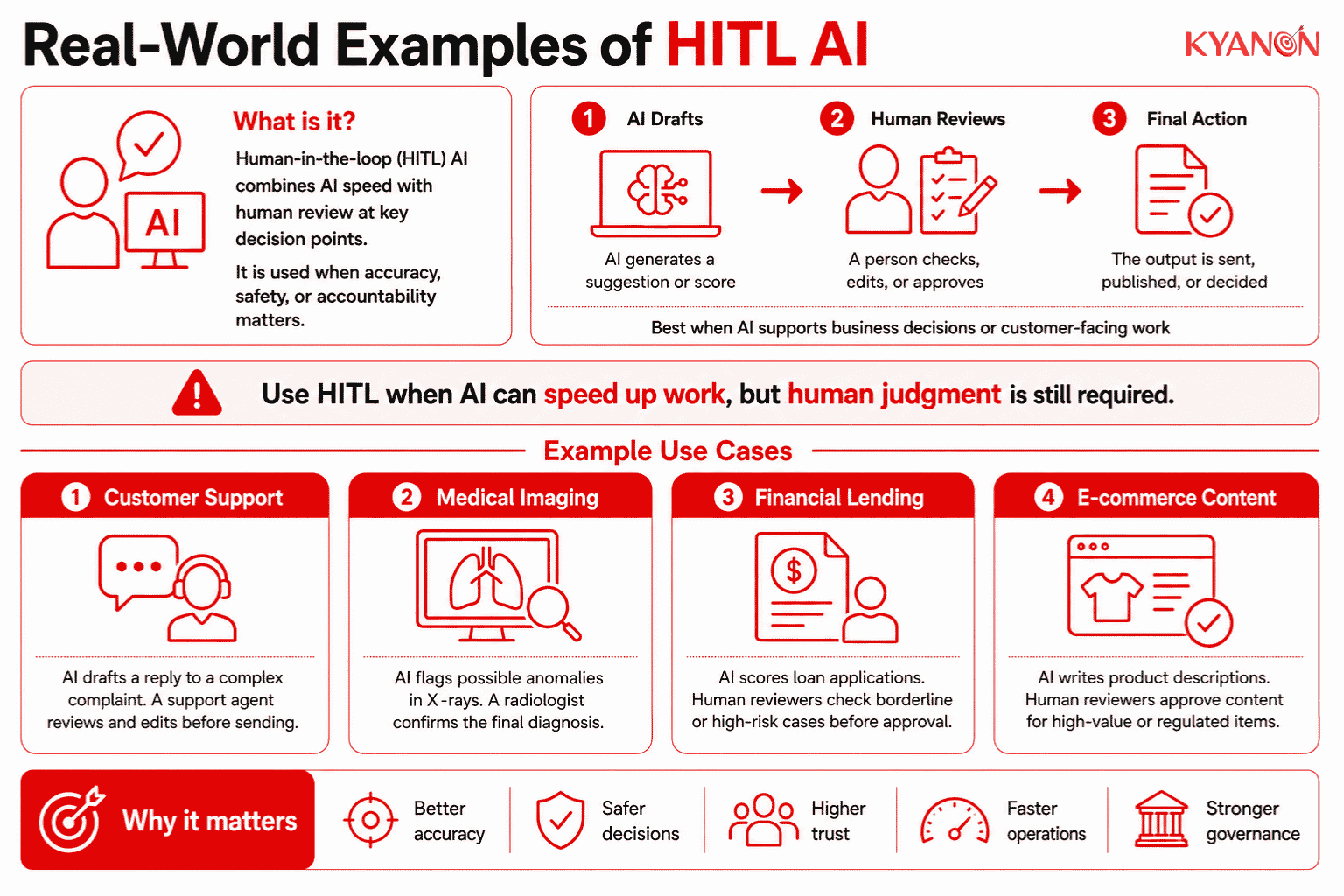
- Customer support: An AI assistant drafts a reply to a complex complaint, but a support agent reviews and edits it before sending.
- Medical imaging: An AI system scans X-rays and highlights possible anomalies, while radiologists confirm the final diagnosis.
- Financial lending: An AI model scores loan applications, but human reviewers check borderline or high-risk cases before approval or rejection.
- E-commerce content: Generative AI creates product descriptions, but human reviewers approve high-value or regulated product content before publication.
Common Misconceptions
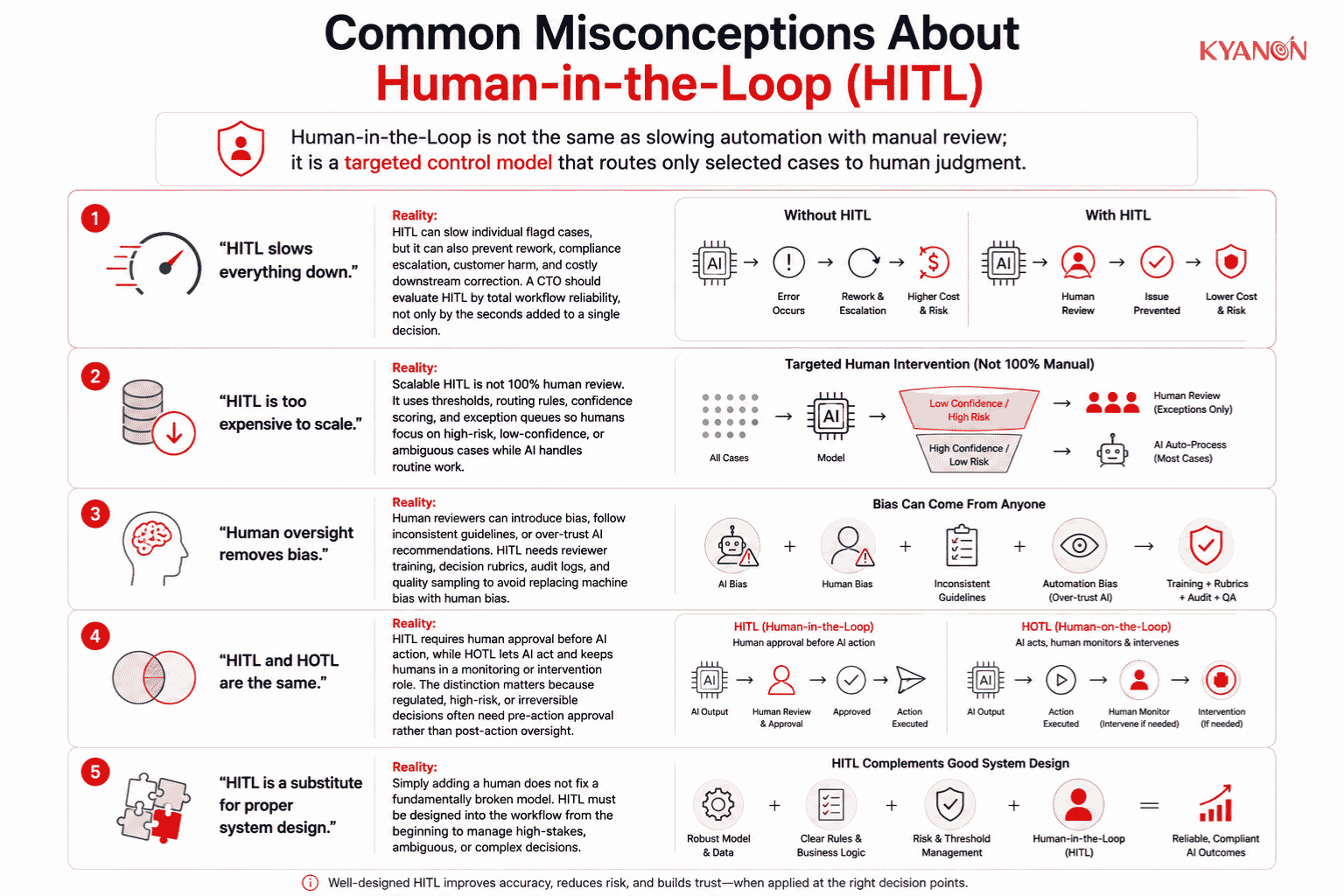
Human-in-the-Loop is not the same as slowing automation with manual review; it is a targeted control model that routes only selected cases to human judgment.
“HITL slows everything down.”
Reality: HITL can slow individual flagged cases, but it can also prevent rework, compliance escalation, customer harm, and costly downstream correction. A CTO should evaluate HITL by total workflow reliability, not only by the seconds added to a single decision.
“HITL is too expensive to scale.”
Reality: Scalable HITL is not 100% human review. It uses thresholds, routing rules, confidence scoring, and exception queues so humans focus on high-risk, low-confidence, or ambiguous cases while AI handles routine work.
“Human oversight removes bias.”
Reality: Human reviewers can introduce bias, follow inconsistent guidelines, or over-trust AI recommendations. HITL needs reviewer training, decision rubrics, audit logs, and quality sampling to avoid replacing machine bias with human bias.
“HITL and HOTL are the same.”
Reality: HITL requires human approval before AI action, while HOTL lets AI act and keeps humans in a monitoring or intervention role. The distinction matters because regulated, high-risk, or irreversible decisions often need pre-action approval rather than post-action oversight.
How Kyanon Digital Applies Human-in-the-Loop (HITL)
Kyanon Digital applies HITL concepts in AI and machine learning initiatives by designing review checkpoints, validation rules, escalation workflows, feedback loops, and monitoring processes for enterprise AI systems. Its machine learning software development offerings include custom ML solutions, LLM and generative AI applications, predictive analytics, AI-powered automation, model deployment, optimization, and continuous monitoring, which are relevant capabilities for building HITL into production AI workflows across enterprise environments.
→ Explore our machine learning software development services.

 Create project brief with AI