
What is Intelligent Automation?
Intelligent automation is a software architecture that integrates robotic process automation (RPA) with artificial intelligence technologies, such as machine learning and natural language processing, to execute end-to-end business processes that require cognitive decision-making. By combining deterministic task execution with probabilistic AI models, systems transition from merely following programmed rules to interpreting unstructured data and adapting to process variations.
Where traditional automation follows fixed rules on structured data, intelligent automation can interpret unstructured inputs, learn from outcomes, and handle exceptions that rule-based systems cannot process.
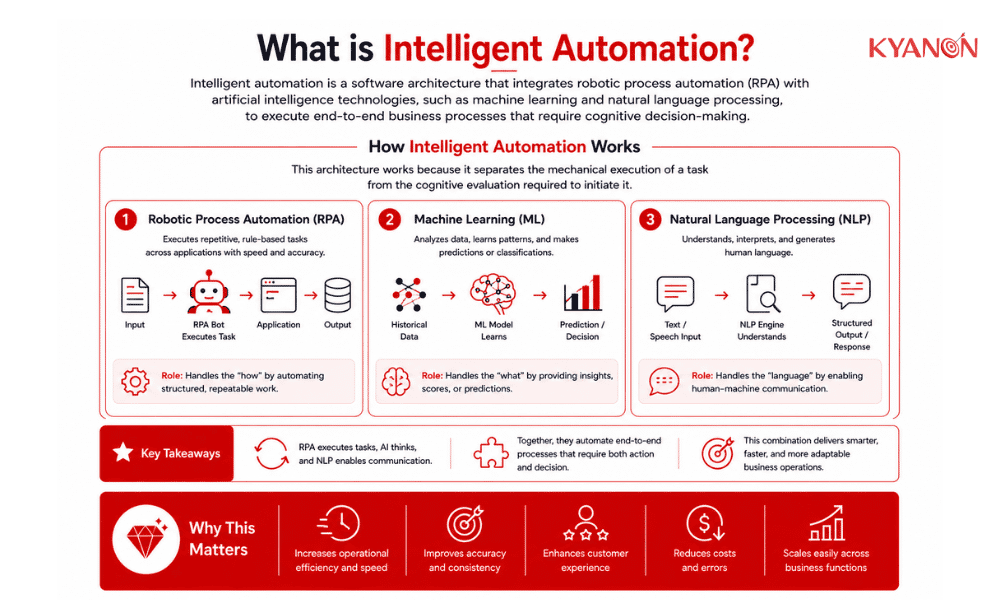
How Intelligent Automation Works
Intelligent automation functions by layering cognitive AI capabilities over rule-based RPA scripts, allowing the system to process unstructured data, recognize patterns, and handle exceptions without manual intervention. This architecture works because it separates the mechanical execution of a task from the cognitive evaluation required to initiate it.
Robotic Process Automation (RPA)
RPA executes deterministic, rule-based tasks across existing applications through user interface interactions or APIs. It functions as the execution engine, handling high-volume repetitive actions such as data entry and system navigation.
Machine Learning (ML)
Machine learning models analyze historical transaction data to identify patterns and predict outcomes. These algorithms provide the cognitive layer, enabling the system to route exceptions, score confidence levels, and adapt to data variations over time.
Natural Language Processing (NLP)
NLP extracts, categorizes, and interprets meaning from unstructured text and speech inputs. This component translates emails, PDFs, and customer communications into structured data formats that the RPA engine can process.

How AI-Driven Workflows Eliminate Core Bottlenecks
Intelligent automation systematically resolves operational latency by substituting manual data triaging and exception routing with algorithmic execution.
- Processing unstructured data: AI tools extract, classify, and interpret unstructured text, emails, and images to halt the backlog caused by manual data entry or initial triage.
- Context-aware decisioning: Machine learning models evaluate processing exceptions and execute real-time operational choices without requiring human approval for minor anomalies.
- Predictive latency prevention: Workflows continuously monitor operations to forecast material stockouts, technical failures, or capacity overloads, triggering automated rerouting rules before systemic backups occur.
- Cross-system orchestration: AI connects legacy enterprise software, third-party databases, and modern applications, dismantling information silos that force staff into duplicated effort.
Intelligent Automation vs Traditional Automation
While traditional RPA accelerates rule-based tasks, intelligent automation introduces cognitive capabilities to handle unstructured inputs and variable conditions.
Dimension | Intelligent Automation (IA) | Traditional / Rule-Based Automation (RPA) |
| Data requirement | Structured and unstructured, documents, emails, images, voice | Structured data only, fixed formats and defined fields |
Decision handling | Probabilistic, evaluates context, handles exceptions, escalates by confidence | Deterministic, executes predefined rules, fails on exceptions |
| Adaptability | Learns from outcomes and improves over time | Static, requires manual reprogramming when rules change |
Process fit | Complex, variable workflows with judgment requirements | Repetitive, high-volume workflows with stable inputs |
| Failure mode | Degrades gradually as data drifts, requires monitoring | Breaks immediately when inputs fall outside defined parameters |
Implementation complexity | Higher, requires data governance, model training, and orchestration design | Lower, rules are coded directly with no model dependency |
| Best for | Document processing, customer service, fraud detection, compliance workflows | Data entry, system transfers, scheduled reporting, form filling |
When to Consider Intelligent Automation
Consider intelligent automation if:
- Manual document processing (such as invoices or claims) creates a bottleneck that prevents horizontal scaling across your operations.
- Your customer service teams spend more than 40% of their time categorizing requests and locating data across disparate legacy systems.
- You experience high error rates in data transfer processes that involve unstructured inputs from external vendors or clients.
It may not be the right priority if:
- Your processes are highly unstable, frequently changing, or lack clear baseline metrics for current manual performance.
Why Intelligent Automation Matters for Enterprise Operations
Deploying cognitive workflows shifts enterprise operations from labor-intensive execution to strategic oversight. Gartner surveyed 350 global business executives in Q3 2025 and found that approximately 80% of organizations report workforce reductions following automation deployment, yet those reductions do not appear to translate into ROI. The organizations generating measurable returns are those applying intelligent automation to increase throughput and decision quality, not those reducing headcount and expecting the savings to compound.
The scale of deployment is accelerating alongside the market. Gartner predicts 40% of enterprise applications will be integrated with task-specific AI agents by the end of 2026, up from less than 5% in 2025, a trajectory that places intelligent automation at the center of how enterprises connect AI capabilities to operational workflows.
For CTOs and operations leaders, this means the question is no longer whether to deploy intelligent automation but which processes to prioritize, how to govern outputs, and what human oversight model to maintain as automation coverage expands.
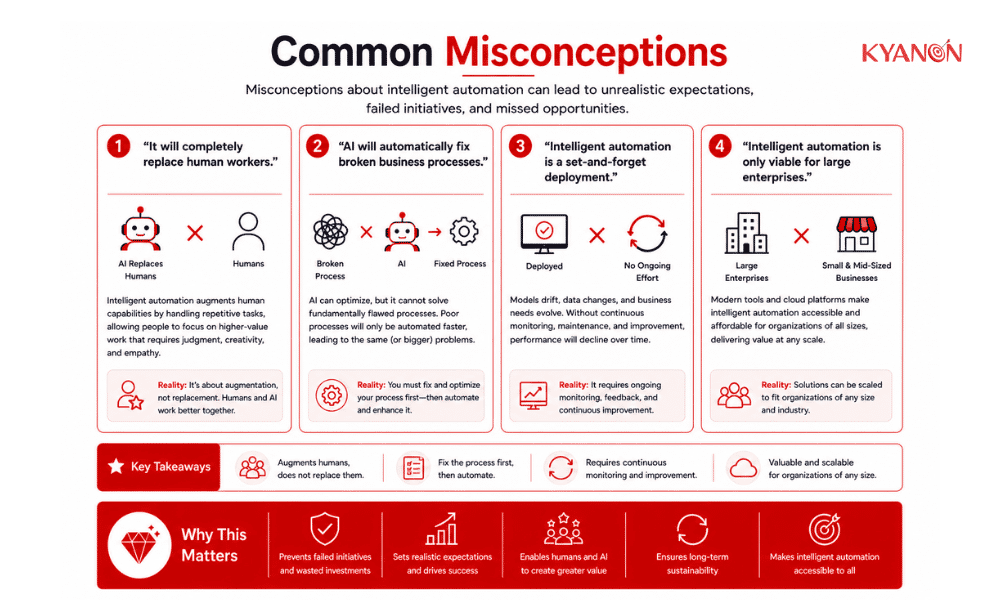
Common Misconceptions
“It will completely replace human workers.”
Reality: Intelligent automation is engineered to augment human capabilities by taking over data-heavy tasks. This reallocation frees human workers to focus on exception handling, strategic planning, and relationship building.
“AI will automatically fix broken business processes.”
Reality: Automating a poorly designed workflow strictly accelerates the generation of errors and bad data. Organizations must audit, optimize, and streamline their process logic before applying any cognitive automation layer.
“Intelligent automation is a set-and-forget deployment.”
Reality: Automated processes and AI models degrade as business rules change, data distributions shift, and the systems they connect to are updated. A workflow that runs at 95% accuracy at launch can drop to 70% within 12 months without active monitoring and maintenance.
“Intelligent automation is only viable for large enterprises.”
Reality: The barrier to entry has dropped materially. Cloud-native deployment, subscription-based pricing, and low-code orchestration platforms mean that mid-market organizations can implement targeted intelligent automation projects, document processing, customer service routing, and compliance reporting without the infrastructure investment that full enterprise deployments required five years ago.
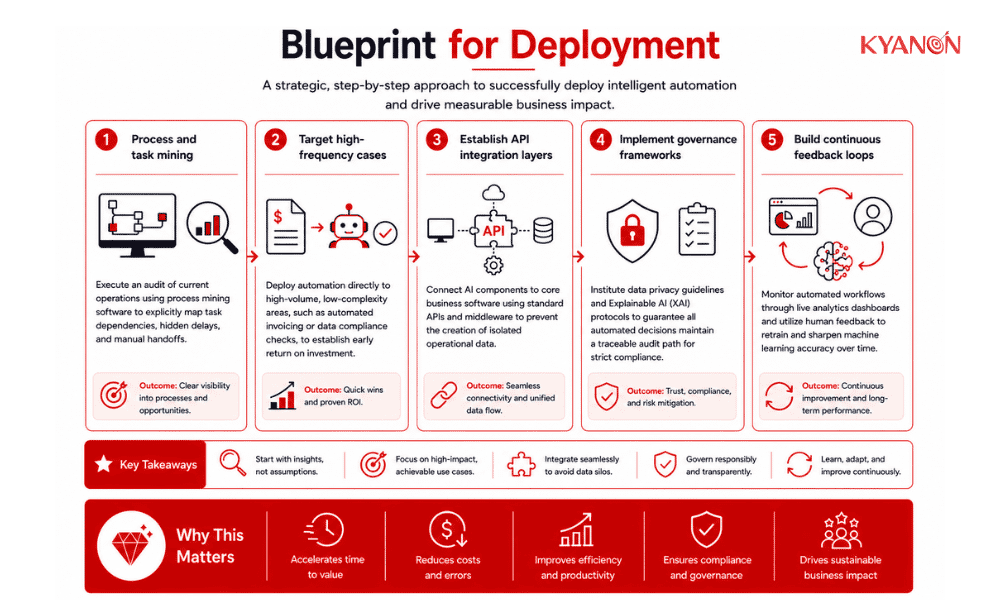
Blueprint for Deployment
Transitioning to intelligent automation requires a structured execution framework that prioritizes process mining and data governance to generate measurable business outcomes.
- Process and task mining: Execute an audit of current operations using process mining software to explicitly map task dependencies, hidden delays, and manual handoffs.
- Target high-frequency cases: Deploy automation directly to high-volume, low-complexity areas, such as automated invoicing or data compliance checks, to establish early return on investment.
- Establish API integration layers: Connect AI components to core business software using standard APIs and middleware to prevent the creation of isolated operational data.
- Implement governance frameworks: Institute data privacy guidelines and Explainable AI (XAI) protocols to guarantee all automated decisions maintain a traceable audit path for strict compliance.
- Build continuous feedback loops: Monitor automated workflows through live analytics dashboards and utilize human feedback to retrain and sharpen machine learning accuracy over time.
How Kyanon Digital Applies Intelligent Automation
Kyanon Digital deploys intelligent automation for enterprise clients across Vietnam, Singapore, Malaysia, Thailand, ANZ, the US, and Nordic Europe, with implementation focused on three operational areas where the gap between rule-based automation and AI-enabled automation is widest: document processing, customer service workflows, and back-office operations in finance, logistics, and compliance.
Within the integrate & automate and analyse & augment service lines, Kyanon Digital’s approach starts with process assessment before any tooling decision is made, identifying which workflows have the volume, variability, and data availability to support intelligent automation and which are better served by simpler rule-based tools or process redesign.
For clients in retail, banking, and logistics across APAC, this typically means combining RPA for execution tasks with NLP-based document understanding, ML-based classification, and a human escalation path for low-confidence outputs. Orchestration is built to connect across existing enterprise systems, ERP, CRM, CDP, and legacy platforms, rather than requiring clients to replace infrastructure as a prerequisite for automation.
→ Explore our Artificial Intelligence services.

 Create project brief with AI