
What is the joint promotions engine?
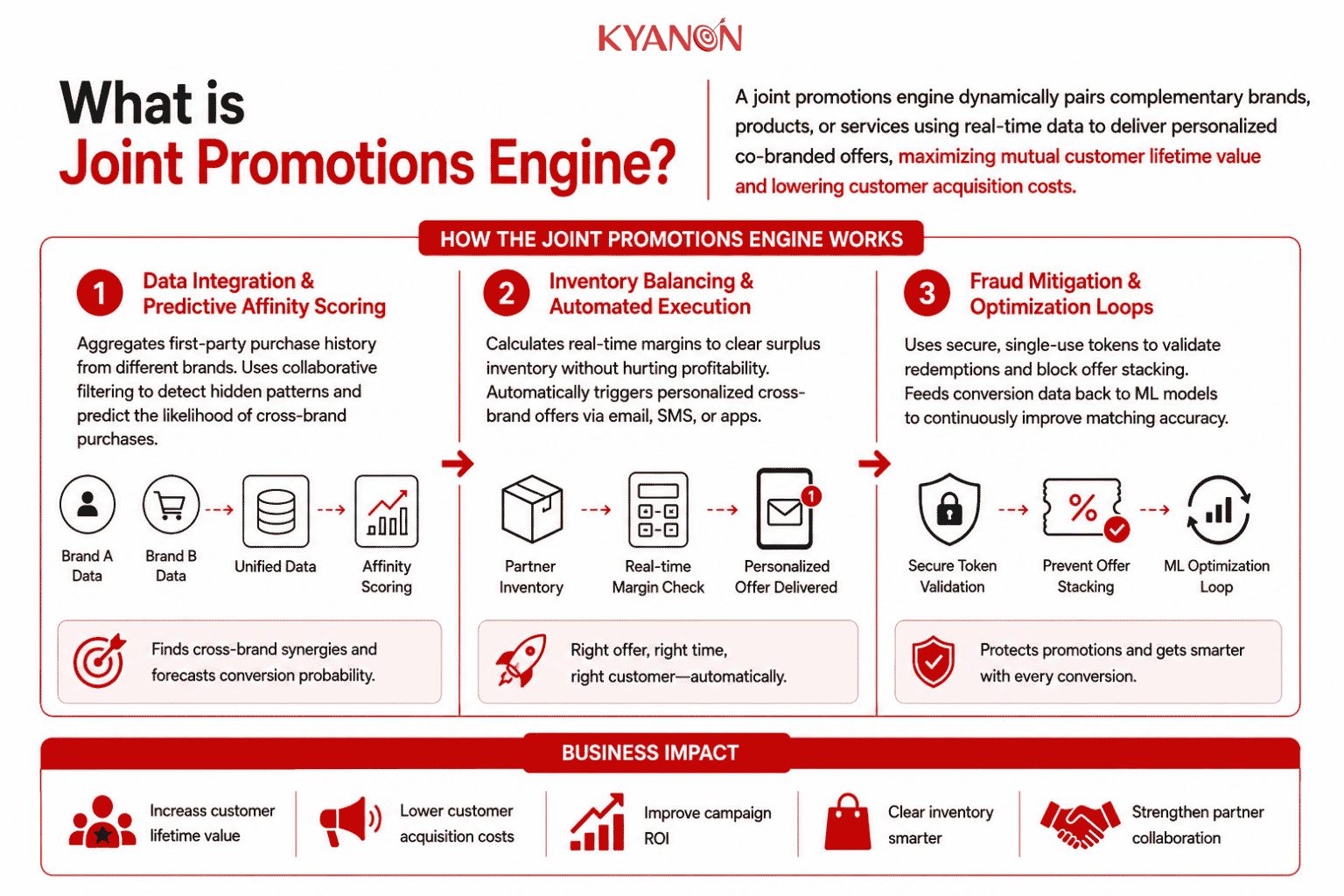
A joint promotions engine is an algorithmic framework that dynamically pairs complementary brands, products, or services using real-time transactional data to deliver personalized co-branded offers. It blends first-party consumer data with partner inventory to maximize mutual customer lifetime value and lower customer acquisition costs.
How the joint promotions engine works
This engine operates by integrating Customer Data Platforms (CDPs) or CRMs via secure APIs to identify cross-brand synergies deterministically. It continuously analyzes consumer purchase history, runs predictive scoring models, and automates cross-campaign execution across digital touchpoints to trigger rewards exactly when conversion probability peaks.
Data integration & predictive affinity scoring
This layer aggregates first-party purchase history across distinct brand ecosystems. It relies on collaborative filtering algorithms to detect hidden purchasing patterns and forecast the statistical likelihood of Brand A customers buying from Brand B.
Inventory balancing & automated execution
The engine calculates real-time margins to ensure discounts clear surplus inventory without eroding profitability. It then automatically triggers personalized cross-brand offers directly via email, SMS, or checkout apps without requiring manual campaign setup.
Fraud mitigation & optimization loops
Security protocols use synchronized, single-use token generation to validate cross-merchant redemptions and prevent offer stacking. Simultaneously, the engine feeds ongoing conversion data back into the machine learning models to refine future matching accuracy continuously.

Joint promotions engine vs. digital coupon engine
Both systems distribute consumer incentives, but a joint promotions engine evaluates multi-merchant data while a digital coupon engine relies on single-brand rules.
Dimension | Joint promotions engine | Digital coupon engine |
Data scope | Multi-merchant CDP/CRM data | Single-merchant transactional data |
| Primary objective | Cross-brand customer acquisition | Single-brand conversion rate optimization |
Offer logic | Collaborative filtering and predictive scoring | Static rules and fixed discount thresholds |
| Fraud prevention | Synchronized single-use cross-platform tokens | Platform-specific code validation |
Partnership management | Automated algorithmic matchmaking | Manual campaign-by-campaign negotiation |
When to consider a joint promotions engine
Evaluating a joint promotions engine requires analyzing customer acquisition costs against external partnership potential.
Consider a joint promotions engine if:
- Your customer acquisition costs (CAC) across standard digital channels are exceeding individual customer lifetime value, necessitating access to qualified external audiences.
- Your enterprise operates a multi-brand ecosystem where cross-pollination of user bases is required to clear excess inventory while preserving premium brand positioning.
- Your engineering and operations teams spend excessive hours manually reconciling co-funded marketing budgets and negotiating API integrations for individual brand partnerships.
It may not be the right priority if:
- Your brand operates in an isolated niche with strict data-sharing compliance restrictions, no unified CDP infrastructure, and no complementary secondary markets to leverage.
Why a joint promotions engine matters for retail and FMCG
In the retail and FMCG sectors, acquiring net-new customers requires leveraging adjacent audience ecosystems to lower acquisition costs.
According to Forrester Research (2021), mature partnership ecosystems and cross-promotional programs drive 28% of overall corporate revenue for high-growth enterprises. A multi-brand retail conglomerate in Southeast Asia applied a joint promotions engine to synchronize loyalty data between its FMCG division and an airline partner, resulting in a 40% reduction in customer acquisition cost for high-tier buyers. This demonstrates how algorithmic matchmaking translates from a technical architecture to a measurable reduction in marketing expenditure.
Common misconceptions
The biggest misconception about a joint promotions engine is that it acts merely as a billing tool for co-marketing campaigns.
“It only splits marketing costs and requires manual partnership negotiation for every campaign.”
Reality: It acts as a revenue multiplier by unlocking entirely new, highly qualified customer bases. Advanced engines automate matchmaking by analyzing cross-brand transaction data and predictive affinity scores.
“It only works for giant enterprise brands and dilutes core brand identity.”
Reality: Small-to-medium businesses frequently use cloud-based engines to scale via micro-partnerships. Precision targeting ensures promotions only display to users with a proven affinity for both niches, protecting brand perception.
“It is a static coupon-dispensing tool.”
Reality: The engine utilizes machine learning to adjust reward values dynamically based on collaborative filtering, cart abandonment risk, and real-time margin requirements.
How Kyanon Digital applies joint promotions engine
Kyanon Digital implements joint promotion engines using API-first architectures and MACH principles for multi-brand eCommerce clients and marketplaces across Vietnam, Singapore, and ANZ. Our approach focuses on connecting existing CDPs with real-time margin-checking algorithms and secure tokenization to accelerate time-to-market, lower total cost of ownership, and drive measurable CLTV expansion.
→ Explore our: Customer Loyalty Consulting & Loyalty Software in Singapore Service

 Create project brief with AI