
What is Just-in-Time Training?
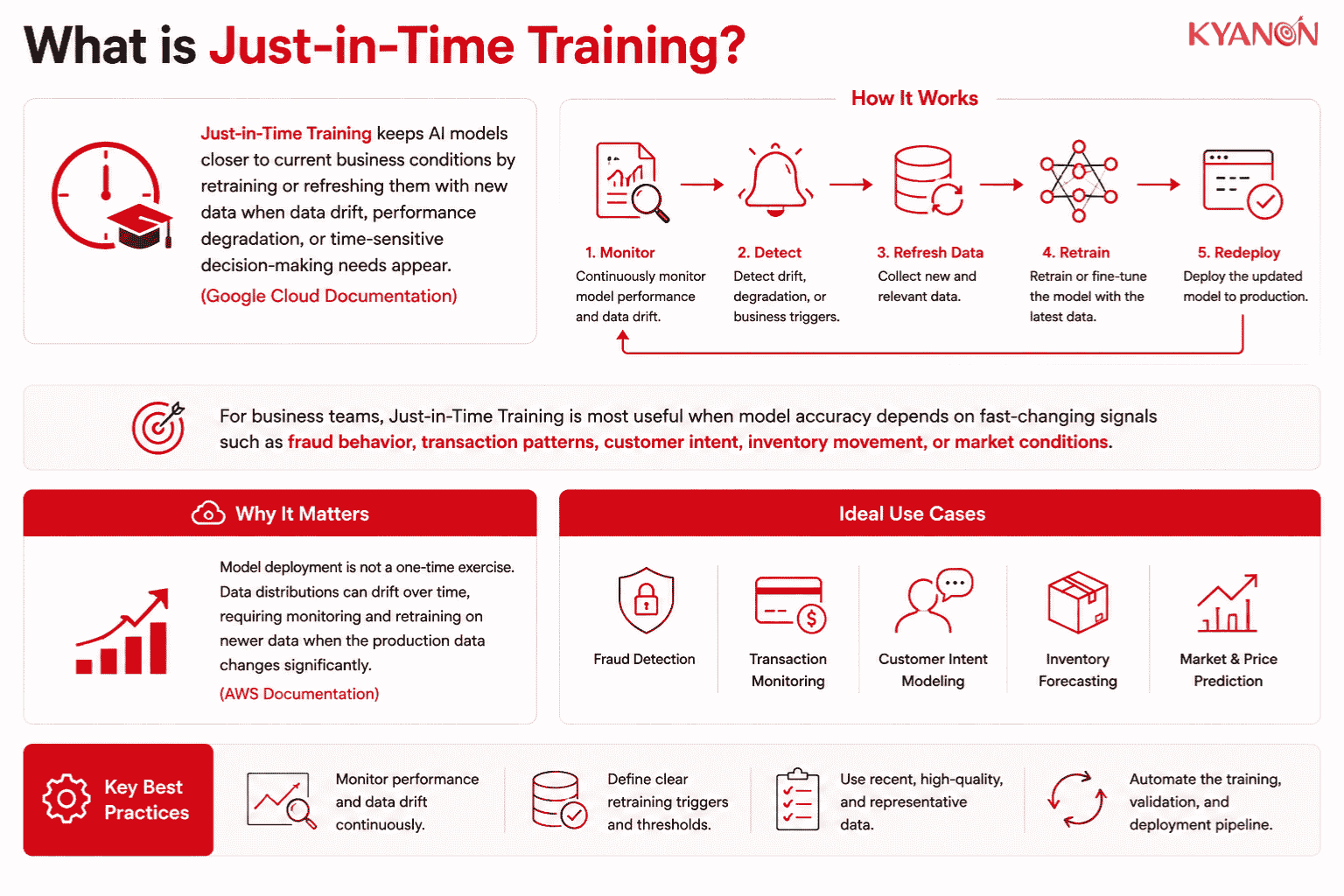
Just-in-time training keeps AI models closer to current business conditions by retraining or refreshing them with new data when data drift, performance degradation, or time-sensitive decision-making needs appear (Google Cloud Documentation).
For business teams, just-in-time training is most useful when model accuracy depends on fast-changing signals such as fraud behavior, transaction patterns, customer intent, inventory movement, or market conditions. AWS notes that model deployment is not a one-time exercise because data distributions can drift over time, requiring monitoring and retraining on newer data when the production data changes significantly.
Core Characteristics of JIT Training
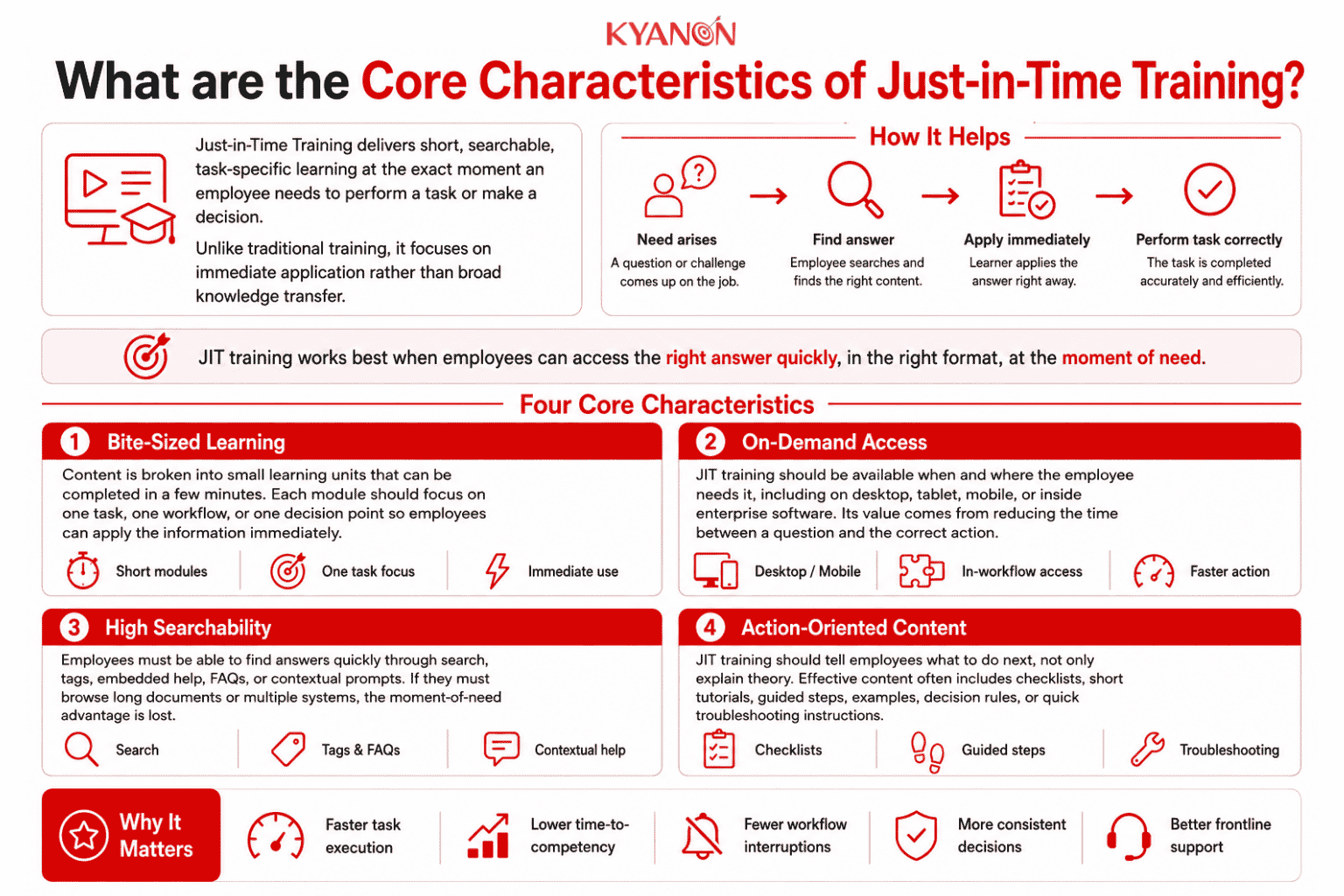
Just-in-time training delivers short, searchable, task-specific learning at the exact moment an employee needs to perform a task or make a decision. Unlike traditional training programs, it focuses on immediate application rather than broad knowledge transfer.
Bite-Sized Learning
Just-in-time training usually breaks content into small learning units that can be completed in a few minutes. Each module should focus on one task, one workflow, or one decision point so employees can apply the information immediately.
On-Demand Access
Just-in-time training should be available when and where the employee needs it, including on desktop, tablet, or mobile or directly inside enterprise software. This matters because the value of JIT training depends on reducing the time between a question and the correct action.
High Searchability
A just-in-time training system must make answers easy to find through search, tags, embedded help, FAQs, or contextual prompts. If employees need to browse through long documents or multiple systems, the training loses its “moment of need” advantage.
Action-Oriented Content
Just-in-time training should show employees what to do next, not only explain the theory behind a process. Effective JIT content often includes checklists, short tutorials, guided steps, examples, decision rules, or quick troubleshooting instructions.

Common Formats and Workplace Examples of Just-in-Time Training
Just-in-time training can appear as videos, checklists, nudges, FAQs, knowledge-base articles, or embedded guidance inside business applications. The right format depends on the task complexity, employee role, and urgency of the decision.
Format | Workplace Scenario | Best Used For |
| 90-second video tutorials | A sales representative watches a short CRM guide before logging a complex multi-currency deal. | Software workflows and feature adoption |
Interactive checklists | A field engineer follows a 10-point safety checklist before repairing heavy machinery. | Compliance, safety, and operational procedures |
| Just-in-Time nudges | A manager receives a 5-minute conversation framework before an annual performance review. | Manager enablement and decision support |
Searchable FAQs | A customer service agent finds a troubleshooting guide while speaking with a customer. | Support issues and exception handling |
| Embedded tooltips | An employee sees field-level guidance while submitting an expense claim. | Reducing process errors inside enterprise systems |
For enterprise teams, the strongest just-in-time training formats are those embedded directly into the tools employees already use. This reduces context switching and improves the chance that employees follow the correct workflow at the moment of action.
How Just-in-Time Training Works
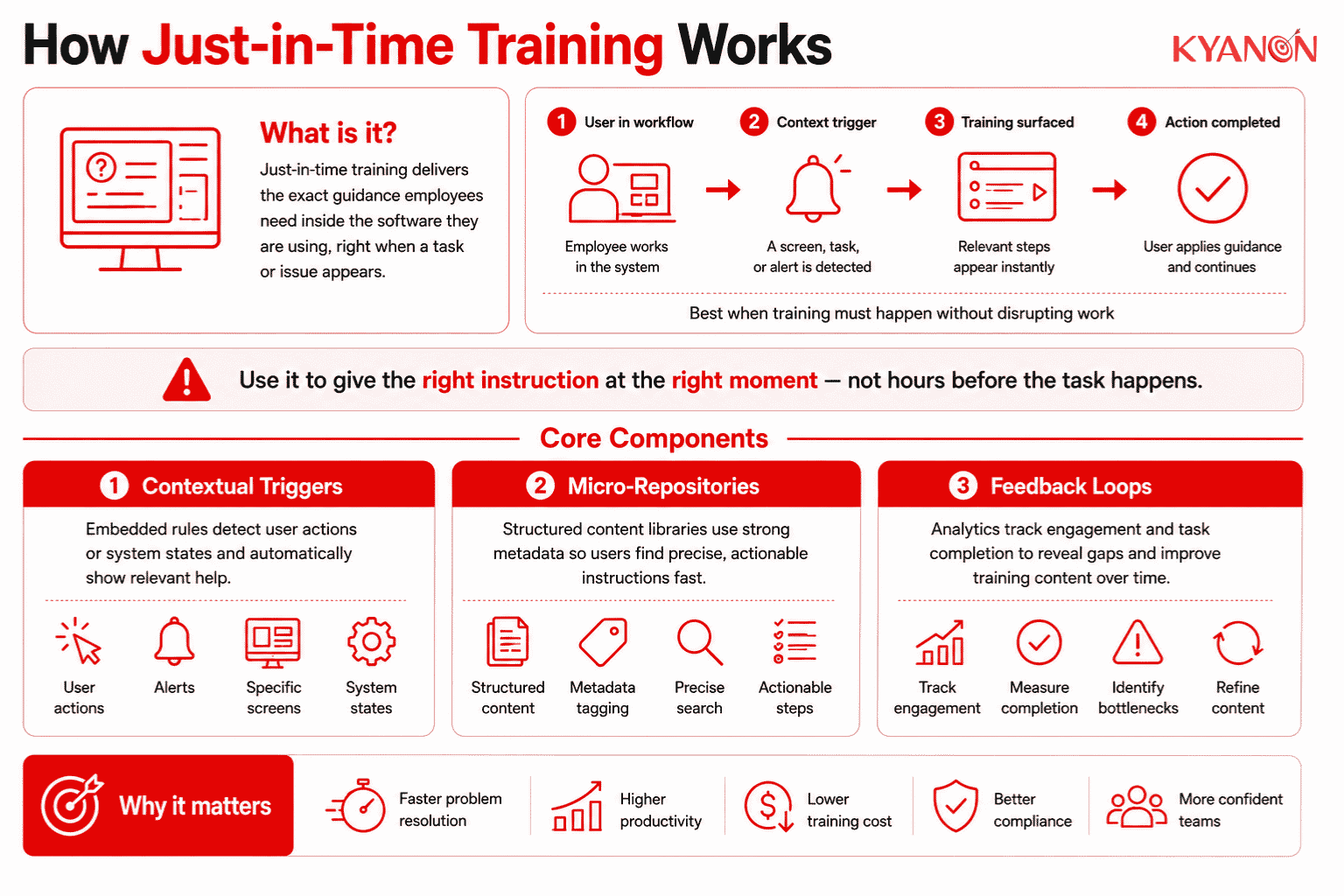
Just-in-time training functions by integrating searchable, granular learning materials directly into the operational software environments of enterprise employees. Instead of requiring users to recall comprehensive information from prior structured sessions, the system uses contextual triggers, such as navigating to a specific software screen or receiving an operational alert, to surface exact procedural instructions immediately.
Contextual Triggers
Contextual triggers are mechanisms embedded within digital interfaces that detect user actions or system states. They automatically push relevant support documentation or prompts to the user based on immediate operational conditions, preventing workflow disruption.
Micro-Repositories
Micro-repositories act as highly structured databases hosting the instructional content. They organize data through meticulous metadata tagging, ensuring that search queries return precise, actionable steps rather than overarching conceptual manuals.
Feedback Loops
Feedback loops are integrated analytics systems that track employee interaction with the training modules. They measure engagement duration and task completion rates to identify bottlenecks in the documentation and determine where subject matter experts need to refine the material.
Just-in-Time Training vs Formal Training
Both approaches update AI models, but just-in-time training reacts to fresh business signals while scheduled model retraining follows a fixed calendar or batch cycle.
Just-in-time training is better suited to fast-changing decision environments, while scheduled model retraining is better suited to stable use cases with predictable data patterns.
Dimension | Just-in-Time Training | Formal Training |
| Delivery timing | Immediate, point-of-need | Scheduled, asynchronous or synchronous |
Content granularity | Bite-sized, task-specific | Comprehensive, overarching concepts |
| Primary objective | Unblock tasks, ensure compliance | Build foundational skills, behavioral shifts |
Format structure | Searchable wikis, pop-ups, short guides | Instructor-led, multi-hour courses, cohorts |
| Upfront complexity | High (infrastructure & metadata planning) | Moderate (instructional design focus) |
When to Consider Just-in-Time Training
Enterprise organizations should implement just-in-time training when operational workflows undergo frequent updates requiring continuous employee realignment without disrupting productivity.
Consider just-in-time training if:
- Your engineering or operations teams face recurring critical alerts, such as fraud detection anomalies, that require standardized, immediate response protocols based on real-time data freshness.
- Support and technical staff spend excessive working hours searching internal repositories or waiting on subject matter experts to clarify standard operating procedures.
- You are deploying new enterprise software features rapidly and need users to adopt specific UI changes without scheduling ongoing organizational retraining sessions.
It may not be the right priority if:
- The organizational objective involves deep cognitive restructuring, critical thinking development, or strategic leadership planning, which demands structured, continuous learning and conceptual immersion.
Why Just-in-Time Training Matters for Enterprise AI
Just-in-time training matters for enterprise AI because model accuracy often depends on whether the model reflects current business reality, not only on whether the original training dataset was large.
According to the Association for Talent Development’s 2025 State of the Industry Report, formal learning hours used per employee declined to 13.7 hours in 2024 from 17.4 hours in 2023, showing that organizations are under pressure to make training time more targeted and outcome-driven. Although this statistic refers to workforce learning, the same executive logic applies to AI operations: training effort should be focused where freshness changes performance, risk, or cost.
For a real-time fraud detection platform, just-in-time training can help the model adapt to new fraud signals such as unusual purchase velocity, new device patterns, abnormal payment routes, or sudden changes in chargeback behavior. This does not remove the need for human risk rules, but it can reduce the time between a new fraud pattern appearing and the model learning from it.
A regional e-commerce enterprise in Southeast Asia may apply just-in-time training to update risk models during peak campaigns, flash sales, or cross-border payment spikes. In this context, the business value is not “more AI”; it is fewer stale decisions during high-volume operating windows.
Common Misconceptions
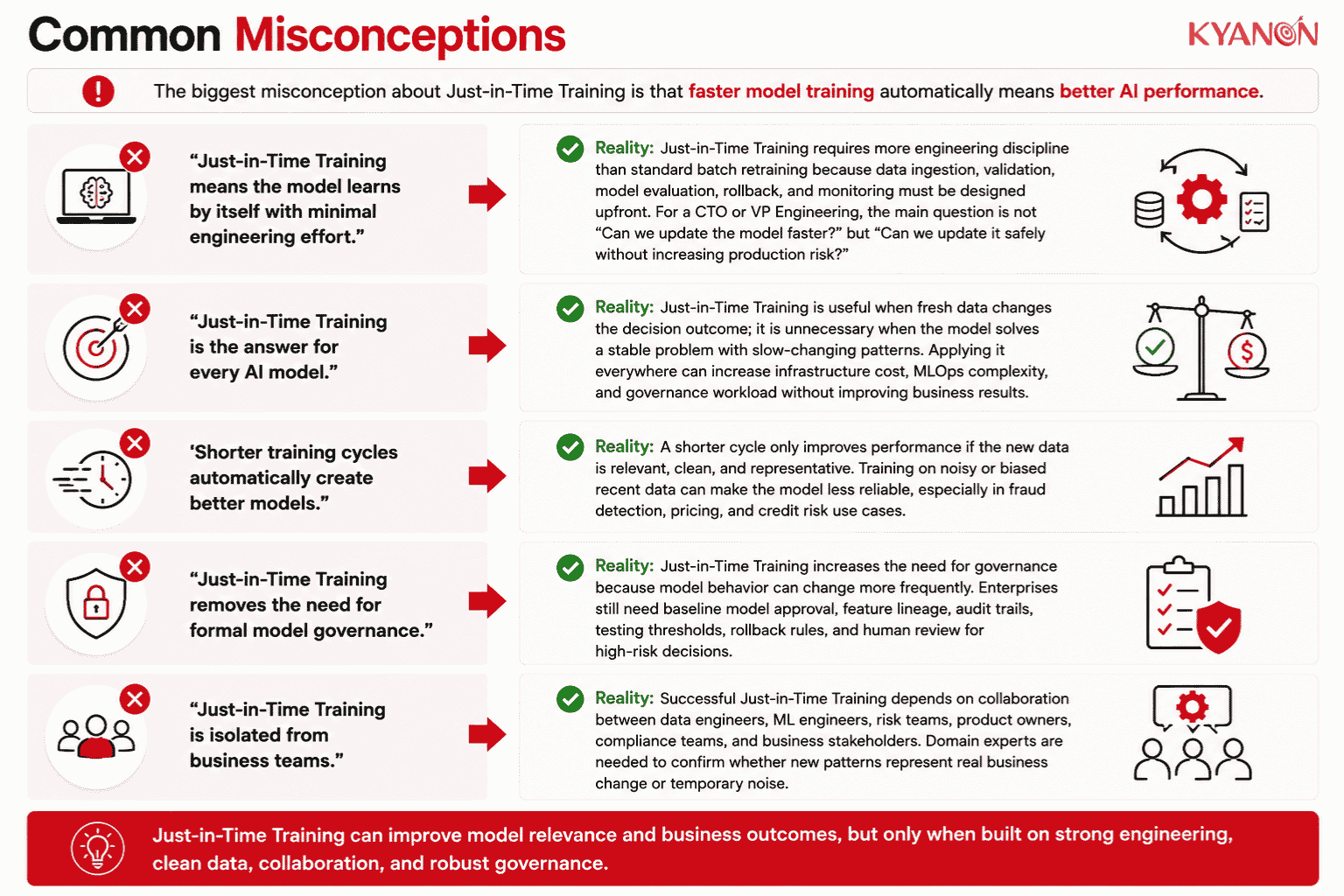
The biggest misconception about Just-in-Time Training is that faster model training automatically means better AI performance.
“Just-in-Time Training means the model learns by itself with minimal engineering effort.”
Reality: Just-in-Time Training requires more engineering discipline than standard batch retraining because data ingestion, validation, model evaluation, rollback, and monitoring must be designed upfront. For a CTO or VP Engineering, the main question is not “Can we update the model faster?” but “Can we update it safely without increasing production risk?”
“Just-in-Time Training is the answer for every AI model.”
Reality: Just-in-Time Training is useful when fresh data changes the decision outcome; it is unnecessary when the model solves a stable problem with slow-changing patterns. Applying it everywhere can increase infrastructure cost, MLOps complexity, and governance workload without improving business results.
“Shorter training cycles automatically create better models.”
Reality: A shorter cycle only improves performance if the new data is relevant, clean, and representative. Training on noisy or biased recent data can make the model less reliable, especially in fraud detection, pricing, and credit risk use cases.
“Just-in-Time Training removes the need for formal model governance.”
Reality: Just-in-Time Training increases the need for governance because model behavior can change more frequently. Enterprises still need baseline model approval, feature lineage, audit trails, testing thresholds, rollback rules, and human review for high-risk decisions.
“Just-in-Time Training is isolated from business teams.”
Reality: Successful Just-in-Time Training depends on collaboration between data engineers, ML engineers, risk teams, product owners, compliance teams, and business stakeholders. Domain experts are needed to confirm whether new patterns represent real business change or temporary noise.
How Kyanon Digital Applies Just-in-Time Training
Kyanon Digital applies just-in-time training by designing data pipelines, feature workflows, model monitoring, and deployment controls for enterprise AI systems where data freshness affects business outcomes.
Kyanon Digital implements just-in-time training pipelines for enterprise clients in sectors such as e-commerce, financial services, retail, logistics, and digital platforms across Vietnam, Singapore, Malaysia, Thailand, ANZ, the US, and Nordic Europe. The approach focuses on practical implementation: connecting enterprise data sources, validating data quality, automating retraining triggers, monitoring model drift, and measuring outcomes such as fraud detection accuracy, false positive reduction, time-to-market, conversion, and TCO.
For real-time fraud detection, Kyanon Digital can help enterprises connect transaction streams, customer behavior data, risk signals, and rule-based controls into a governed AI pipeline. This allows fraud models to respond to changing attack patterns while keeping human oversight, auditability, and rollback controls in place.
→ Explore our Data & AI services for enterprise AI implementation.

 Create project brief with AI