
What is Online Learning?
Online learning is a machine learning methodology where predictive models are continuously updated in sequential order as new data streams arrive, eliminating the requirement to retrain the algorithm on an entire historical dataset. This approach ingests incoming data instances incrementally, allowing enterprise systems to adapt their logic to shifting user behaviors and market variables immediately.
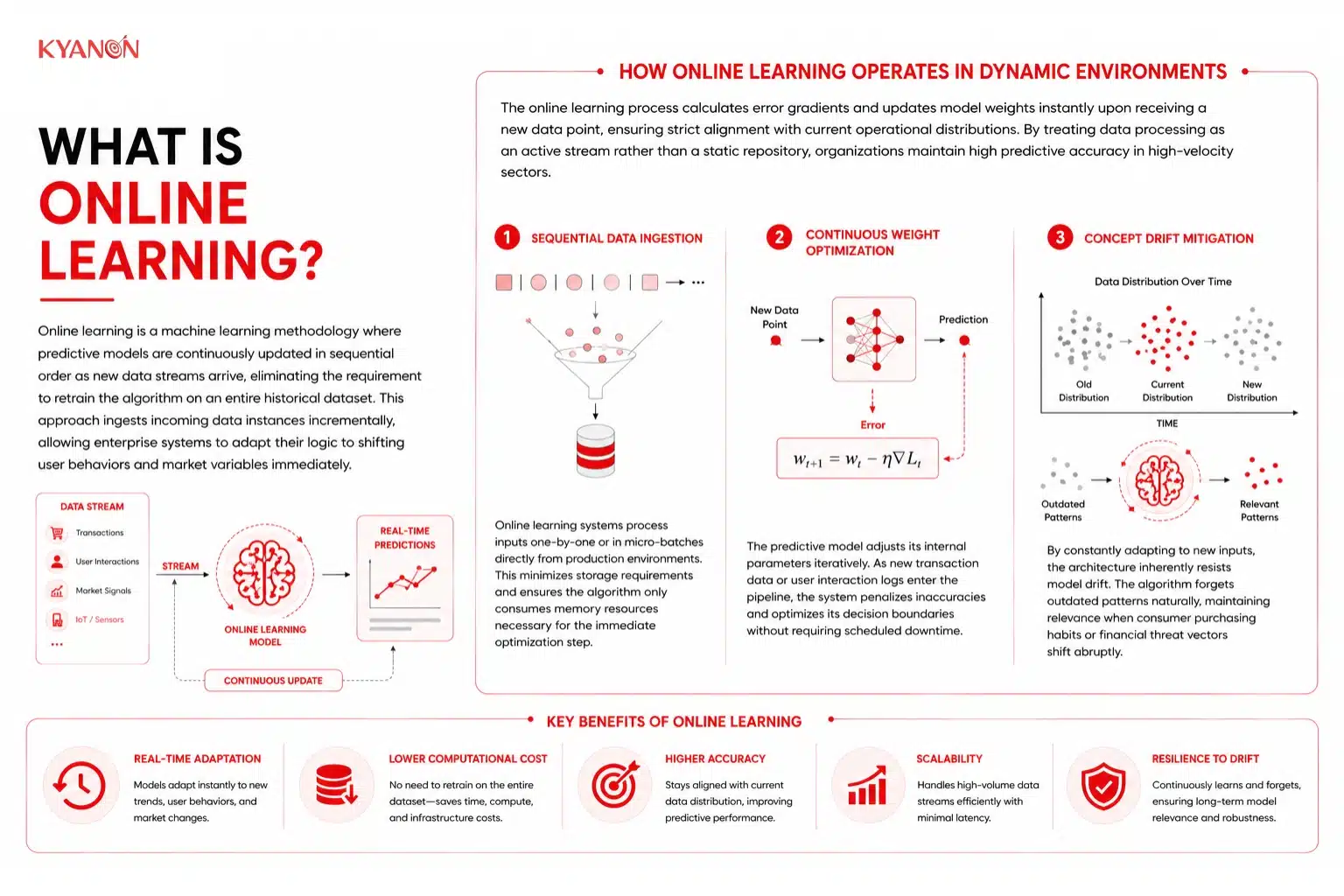
How Online Learning operates in dynamic environments
The online learning process calculates error gradients and updates model weights instantly upon receiving a new data point, ensuring strict alignment with current operational distributions. By treating data processing as an active stream rather than a static repository, organizations maintain high predictive accuracy in high-velocity sectors.
Sequential Data Ingestion
Online learning systems process inputs one-by-one or in micro-batches directly from production environments. This minimizes storage requirements and ensures the algorithm only consumes memory resources necessary for the immediate optimization step.
Continuous Weight Optimization
The predictive model adjusts its internal parameters iteratively. As new transaction data or user interaction logs enter the pipeline, the system penalizes inaccuracies and optimizes its decision boundaries without requiring scheduled downtime.
Concept Drift Mitigation
By constantly adapting to new inputs, the architecture inherently resists model drift. The algorithm forgets outdated patterns naturally, maintaining relevance when consumer purchasing habits or financial threat vectors shift abruptly.

Online Learning vs Batch Learning Architecture
While batch learning processes massive historical datasets offline, online learning modifies algorithmic parameters incrementally during active production execution.
Dimension | Online Learning | Batch Learning (Offline) |
| Data Processing Strategy | Sequential (instance-by-instance) | Entire dataset accumulated at once |
Model Freshness | Immediate adjustment to new inputs | Delayed until the next retraining cycle |
| Resource Consumption | Low memory footprint per update | High memory and intensive compute loads |
Adaptability to Drift | Rapid recalibration to concept drift | Vulnerable to shifting data patterns |
| Enterprise Use Case | Real-time recommendations, fraud detection | Image recognition, historical trend analysis |
Why Online Learning drives revenue in E-commerce and Fintech
Online learning drives revenue in E-commerce and Fintech by acting as a high-conversion marketing channel that educates customers, accelerates product adoption, and builds long-term brand authority. Instead of relying solely on traditional ads, companies use educational content to systematically lower customer acquisition costs (CAC) and increase customer lifetime value (LTV).
Online learning acts as a revenue-driving engine for e-commerce and fintech by accelerating product adoption, fostering customer retention, and unlocking new monetization streams. In e-commerce, it removes purchase hesitation and drives upselling, while in fintech, it lowers customer acquisition costs (CAC) and boosts trading volume through financial literacy.
Common misconceptions
IT Directors and Engineering VPs often hesitate to adopt continuous model updates due to perceived complexities regarding deployment and maintenance.
Online learning is just “retraining the model very fast”
The Reality: It uses completely different mathematical optimization strategies.
Continuous updates mean the model constantly gets smarter
The Reality: Without strict guardrails, online learning models suffer from Catastrophic Forgetting.
Online learning naturally immunizes a model against bad data
The Reality: Online learning makes a model highly fragile to poisoned or anomalous data streams.
It is always the best solution for handling data drift
The Reality: It is rarely used in enterprise production due to the extreme testing and validation overhead.
How Kyanon Digital Implements Online Learning
Kyanon Digital integrates online learning systems into corporate infrastructure for enterprise clients in e-commerce and fintech across Southeast Asia. Our deployment methodology focuses on establishing reliable MLOps pipelines that automate sequential data ingestion, ensuring that rapid shifts in user behavior translate immediately into optimized model freshness. We align continuous training loops with measurable outcomes, decreasing time-to-market and lowering the Total Cost of Ownership (TCO) for data-driven applications.
Explore our Data & AI services:

 Create project brief with AI