
What is a loyalty platform?
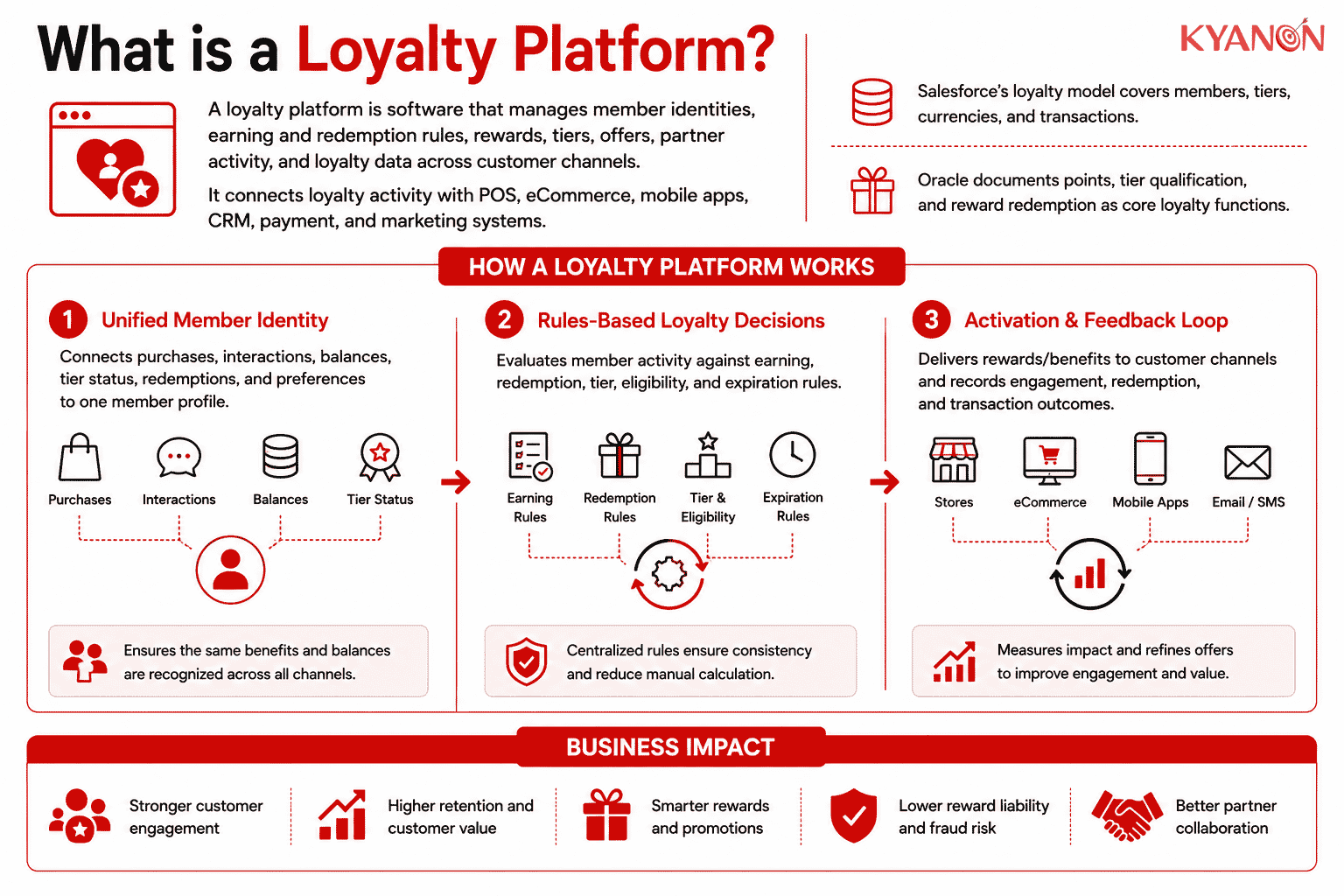
A loyalty platform is software that manages member identities, earning and redemption rules, rewards, tiers, offers, partner activity, and loyalty data across customer channels.
It can connect loyalty activity with POS, eCommerce, mobile apps, CRM, payment, and marketing systems. Salesforce’s loyalty model covers members, tiers, currencies, and transactions, while Oracle documents points, tier qualification, and reward redemption as core loyalty functions.
How a loyalty platform works
A loyalty platform is effective because it connects member identity, reward decisions, and customer activity within one governed system.
This allows the business to recognize the same customer across channels, apply consistent program rules, and use engagement data to refine future offers and benefits.
Unified member identity
The platform connects purchases, interactions, balances, tier status, redemptions, and preferences to one member profile.
A consistent identity prevents fragmented balances and allows the same benefits to be recognized across stores, websites, mobile apps, and partner channels.
Rules-based loyalty decisions
The platform evaluates member activity against earning, redemption, tier, eligibility, and expiration rules.
Centralized rules reduce manual calculation and ensure that rewards are applied consistently across campaigns and customer touchpoints.
Activation and feedback loop
The platform distributes rewards and member benefits to customer-facing channels, then records engagement, redemption, and transaction outcomes.
This feedback loop allows loyalty teams to measure which benefits influence participation, retention, customer value, and reward liability.

What are the core features of a loyalty platform?
A loyalty platform typically combines program management, channel connectivity, customer data, engagement tools, and performance measurement.
Core feature | Primary capability |
Rules engine | Configures earning, redemption, tier, eligibility, bonus, and point-expiration rules |
| Omnichannel connectivity | Makes member balances and benefits available across POS, eCommerce, apps, websites, and partner channels |
CRM and marketing connectivity | Exchanges member, segment, transaction, and offer data with CRM, email, SMS, and campaign systems |
| Member analytics | Tracks enrollment, activity, redemption, customer value, reward liability, and campaign performance |
Engagement management | Supports points, tiers, referrals, challenges, vouchers, subscriptions, and experiential rewards |
| Program administration | Controls reward catalogs, campaigns, partners, permissions, approvals, and operational exceptions |
Not every loyalty platform provides the same capability depth. Decision-makers should compare rule flexibility, channel coverage, integration effort, data ownership, security, reporting, and the time required to launch or modify a program.
Loyalty platform vs. loyalty points engine
A loyalty points engine calculates point transactions, while a loyalty platform manages the wider member, reward, campaign, channel, data, and operating ecosystem.
Dimension | Loyalty platform | Loyalty points engine |
| Primary purpose | Manage the complete loyalty program | Calculate point earning, balances, expiry, and redemption |
Member profiles | Maintains identity, status, preferences, and activity | Usually references a member identifier |
Reward models | Supports points, tiers, cashback, referrals, vouchers, subscriptions, and experiences | Primarily supports point-based mechanics |
| Campaign management | Manages promotions, eligibility, limits, and targeting | Executes point rules defined by another system |
Channel scope | Connects stores, apps, websites, partners, and service channels | Provides point transactions through APIs or internal services |
| Personalization | Can use segments, behaviour, and predictive signals | Usually applies predefined calculation rules |
Analytics | Measures enrollment, engagement, redemption, liability, and campaign outcomes | Reports balances and point transactions |
| Partner management | Can manage earn-and-burn rules across participating partners | Processes partner point transactions when instructed |
Best fit | End-to-end loyalty operations across multiple channels | A program that only needs a controlled points ledger |
A points engine can operate as one component inside a broader loyalty platform.
When to consider a loyalty platform
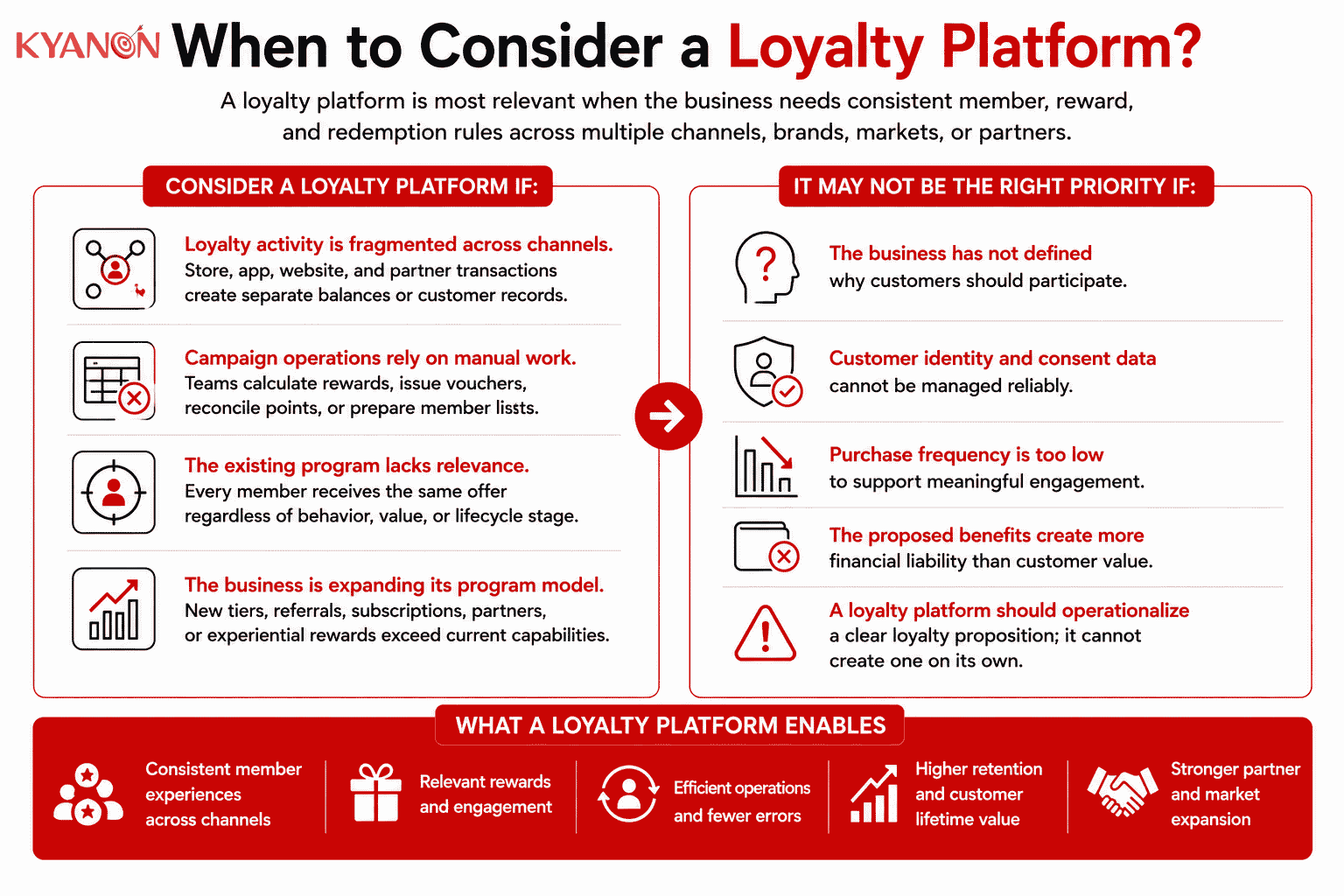
A loyalty platform is most relevant when the business needs consistent member, reward, and redemption rules across multiple channels, brands, markets, or partners.
Consider a loyalty platform if:
- Loyalty activity is fragmented across channels. Store, app, website, and partner transactions create separate balances or customer records.
- Campaign operations rely on manual work. Teams calculate rewards, issue vouchers, reconcile points, or prepare member lists through spreadsheets.
- The existing program lacks relevance. Every member receives the same offer regardless of behavior, value, or lifecycle stage.
- The business is expanding its program model. New tiers, referrals, subscriptions, partners, or experiential rewards exceed the current system’s capabilities.
It may not be the right priority if:
- The business has not defined why customers should participate.
- Customer identity and consent data cannot be managed reliably.
- Purchase frequency is too low to support meaningful engagement.
- The proposed benefits create more financial liability than customer value.
A loyalty platform should operationalize a clear loyalty proposition; it cannot create one on its own.
Why loyalty platforms matter for retail, banking, and services
A loyalty platform matters because enrollment creates limited value unless the business can turn member data into relevant benefits, easy redemption, and consistent experiences.
The platform provides the operating foundation for connecting rewards with transactions, customer behavior, payments, communications, and partner ecosystems.
Deloitte reported in 2026 that 72% of surveyed loyalty members were more likely to spend with their preferred brand, while 56% said the program increased their spending. The survey covered 5,564 US adults who belonged to loyalty programs and was conducted from September to October 2025.
The same research found that consumers were enrolled in eight programs on average but actively participated in only five. This gap shows that platform enrollment and program engagement are separate performance measures.
Reuters reported in February 2026 that Yum China’s KFC and Pizza Hut loyalty programs had surpassed 590 million unique members, with 55% of company sales occurring through those programs. The figures demonstrate the operating scale loyalty platforms can reach, but they do not establish that membership alone caused the sales outcome.
Common misconceptions about loyalty platforms
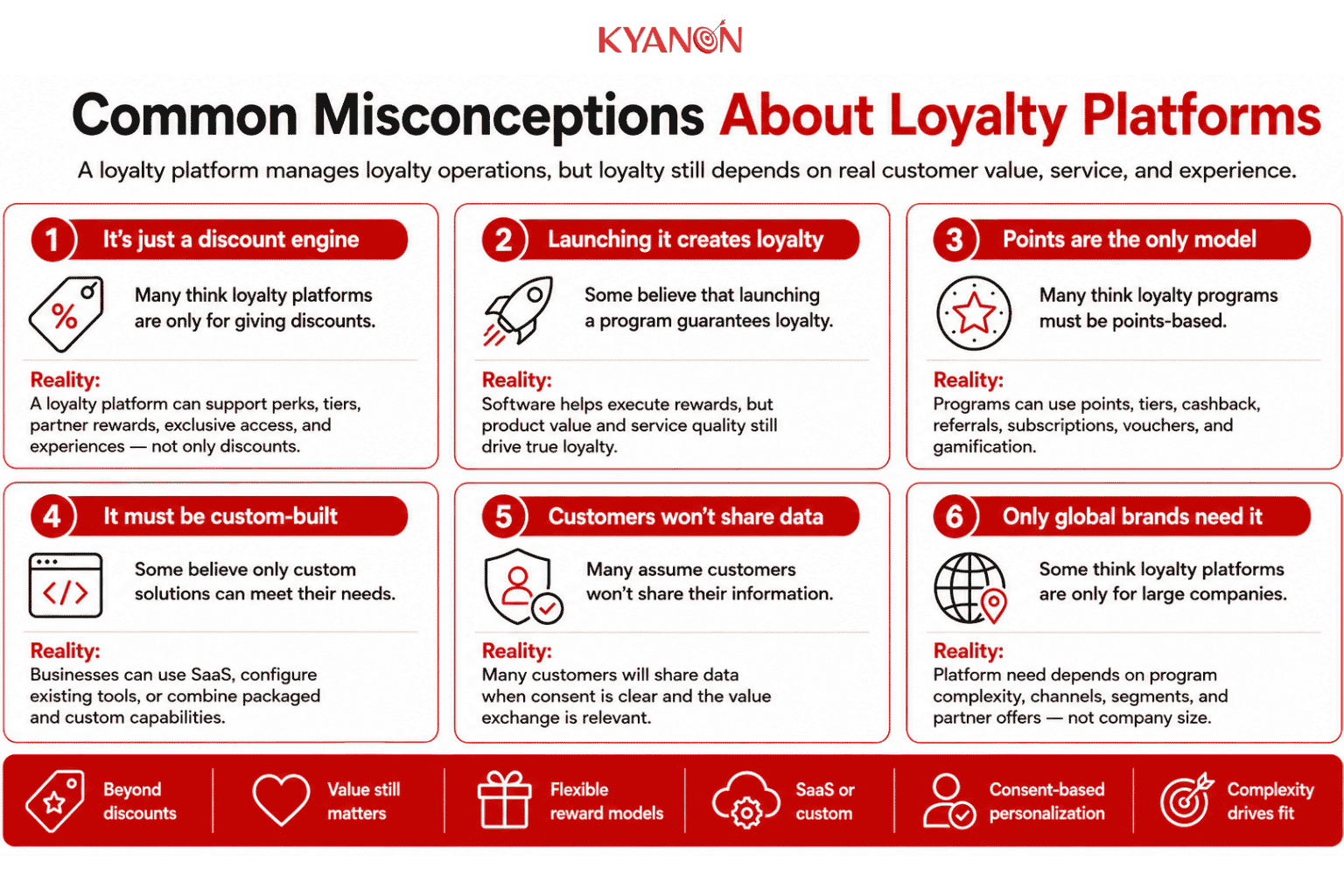
A loyalty platform manages loyalty operations, but customer loyalty still depends on the value, service, and experiences delivered through the program.
“A loyalty platform is just a discount engine.”
Reality: Discounts are one reward type, not the complete value proposition.
Platforms can support early access, exclusive events, priority services, personalized benefits, partner rewards, status recognition, and experiences. Deloitte found that younger members also value community participation, digital experiences, and customized rewards.
“Launching the platform will make customers loyal.”
Reality: Software can track behavior and deliver benefits, but it cannot compensate for poor products, service failures, or an irrelevant program proposition.
The platform supports loyalty execution; it does not guarantee emotional commitment or repeat purchasing.
“Points are the only viable loyalty model.”
Reality: Programs can use tiers, cashback, referrals, subscriptions, vouchers, partner ecosystems, gamification, and non-financial benefits.
The right model depends on customer behavior, purchase frequency, unit economics, and the value members expect.
“A custom loyalty platform must be built from zero.”
Reality: Businesses can configure a SaaS product, extend an existing platform, combine packaged components, or build selected capabilities around a loyalty engine.
The decision should compare workflow fit, integration requirements, data ownership, implementation time, and total cost of ownership rather than treating build and buy as absolute choices.
“Customers will not share data for personalization.”
Reality: Willingness to share data varies by age, trust, transparency, and the value received.
Deloitte found that 89% of surveyed Gen Z members and 87% of millennials were willing to share personal information for more tailored offers or experiences, compared with 64% of baby boomers. Consent and responsible data use remain necessary regardless of willingness.
“Loyalty platforms only make sense for global brands.”
Reality: Platform relevance depends on program complexity rather than company size.
A smaller retailer or D2C brand may require a loyalty platform when it manages several channels, customer segments, reward models, or partner offers that basic store plugins cannot support.
How Kyanon Digital applies loyalty platforms
Kyanon Digital designs and integrates loyalty platforms around the client’s program model, customer journeys, data environment, and regional operating requirements.
Implementations can connect the loyalty layer with POS, eCommerce, mobile apps, CRM, ERP, payments, marketing systems, and partner ecosystems. Depending on the business case, the architecture may use configurable platform capabilities, custom services, or API-first components.
Projects focus on practical outcomes such as accurate member balances, faster campaign delivery, easier redemption, consistent omnichannel recognition, controlled reward liability, and measurable customer engagement.
→ Explore Kyanon Digital’s Loyalty and Rewards Solution Services.

 Create project brief with AI