
What is LangChain?
LangChain is an open source orchestration framework for application development using large language models (LLMs). Available in both Python- and Javascript-based libraries, LangChain’s tools and APIs simplify the process of building LLM-driven applications like chatbots and AI agents. (IBM)
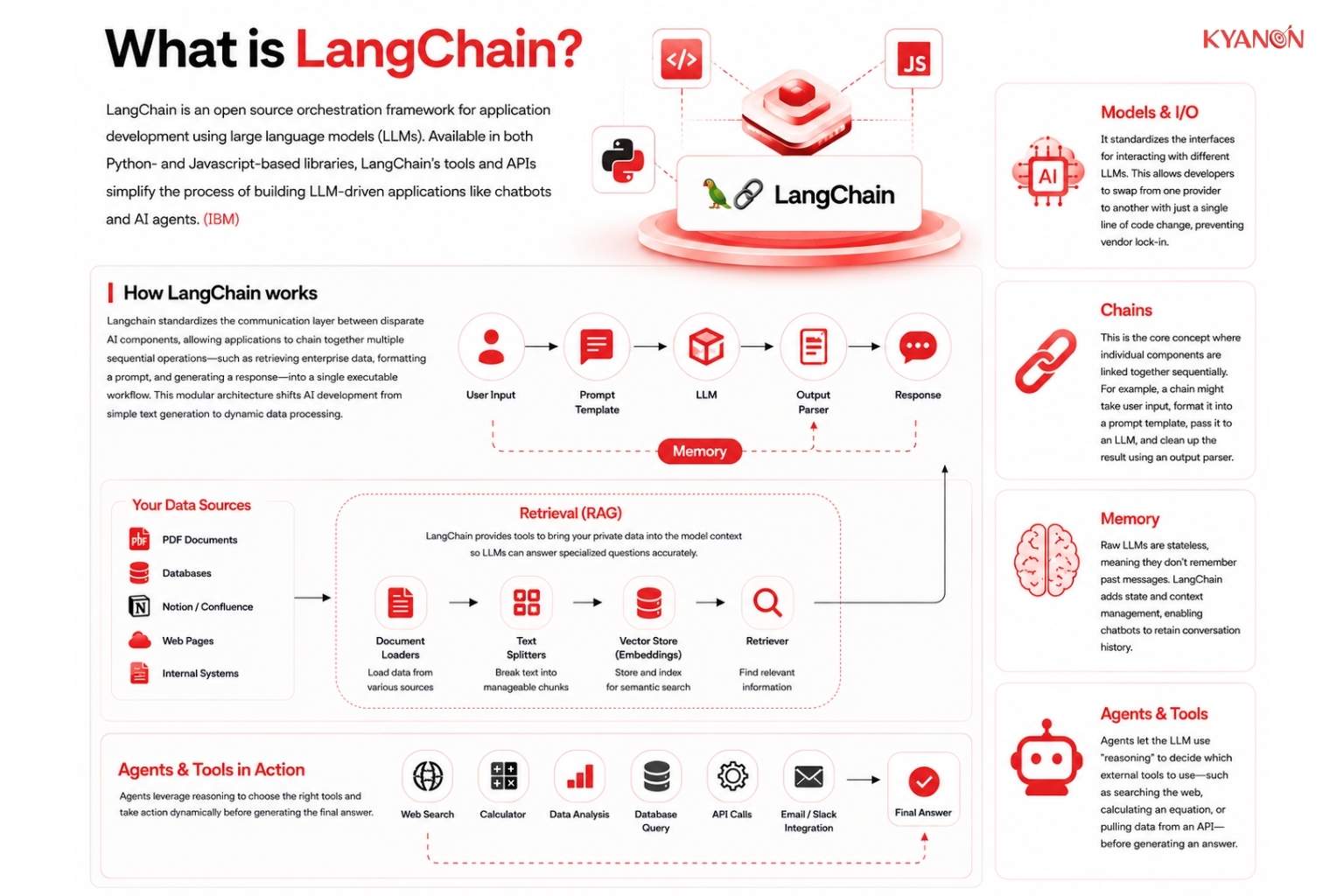
How LangChain works
Langchain standardizes the communication layer between disparate AI components, allowing applications to chain together multiple sequential operations, such as retrieving enterprise data, formatting a prompt, and generating a response, into a single executable workflow. This modular architecture shifts AI development from simple text generation to dynamic data processing.
Models & I/O
It standardizes the interfaces for interacting with different LLMs. This allows developers to swap from one provider to another with just a single line of code change, preventing vendor lock-in.
Chains: This is the core concept where individual components are linked together sequentially. For example, a chain might take user input, format it into a prompt template, pass it to an LLM, and clean up the result using an output parser.
Memory
Raw LLMs are stateless, meaning they don’t remember past messages. LangChain adds state and context management, enabling chatbots to retain conversation history.
Retrieval (RAG)
It provides tools like text splitters and document loaders to inject private data (PDFs, internal databases, Notion pages) directly into the prompt context. This allows the LLM to answer specialized questions accurately without needing to be retrained.
Agents & Tools
Agents let the LLM use “reasoning” to decide which external tools to use, such as searching the web, calculating an equation, or pulling data from an API, before generating an answer.
LangChain vs Native LLM SDKs
While native LLM SDKs provide direct, low-latency API access to specific models, langchain offers a provider-agnostic abstraction layer designed for complex, multi-step AI workflows.
|
Dimension |
LangChain | Native LLM SDKs (e.g., OpenAI API) |
| Vendor lock-in | Low (Model agnostic) |
High (Tied to a single provider) |
|
Upfront complexity |
High | Low |
| Multi-step orchestration | Built-in (Chains, Agents) |
Manual implementation required |
|
Debugging & Tracing |
Complex (Nested wrappers) | Straightforward (Direct API errors) |
| Best for | Multi-model RAG systems |
Single-turn text generation |
When to consider LangChain
Evaluating the necessity of an orchestration layer depends on the complexity of the enterprise data pipeline and the degree of cross-model flexibility required.
Consider LangChain if:
- Your engineering team needs to build complex Retrieval-Augmented Generation (RAG) pipelines that query multiple internal databases before generating an answer.
- You require a provider-agnostic architecture to mitigate vendor lock-in and switch between different LLMs based on token cost or processing performance.
- Your application relies on autonomous workflows that must dynamically select and use external tools like web search or internal business APIs to complete user requests.
It may not be the right priority if:
- Your product requires only basic, single-turn text generation features where a direct API call via a native SDK minimizes latency and dependency maintenance overhead.
Why LangChain matters for enterprise AI
LangChain matters for enterprise AI because it transforms raw, unpredictable AI models into structured, secure, and production-ready corporate software.
While individual developers can easily call an API for simple tasks, enterprises require strict data governance, predictability, multi-vendor flexibility, and the ability to integrate AI with decades of legacy data. LangChain bridges this gap by acting as the connective tissue between advanced reasoning models and enterprise infrastructure. By relying on open-source ecosystems and advanced tools, frameworks like LangChain provide the exact pre-configured components and data-pipeline tools Accenture advocates for to automate B2B marketing, supply chain data extraction, and CRM integrations. (Accenture)
LangChain use cases
AI applications built with LangChain support a wide range of use cases, from basic tasks such as question answering and content generation to advanced solutions where large language models (LLMs) act as intelligent reasoning engines. (IBM)
Chatbots
One of the most common applications of LLMs is conversational AI. LangChain helps chatbots maintain relevant context, improve response quality, and seamlessly integrate with existing communication platforms, business systems, and APIs.
Text Summarization
LLMs can efficiently condense large volumes of information into concise summaries. This includes summarizing research papers, meeting transcripts, reports, articles, and email communications, making information easier to consume and act upon.
Question Answering
By connecting to specialized knowledge repositories or document sources such as Wolfram, arXiv, or PubMed, LLMs can retrieve relevant information and generate accurate, context-aware responses. With effective prompting or fine-tuning, some models can also answer questions based on their pre-trained knowledge without relying on external data sources.
Data Augmentation
LLMs can generate synthetic datasets that mimic real-world data patterns, helping organizations expand training datasets and improve the performance of machine learning models, especially when original data is limited.
Virtual Agents
When combined with business workflows, LangChain’s agent framework enables LLMs to independently evaluate tasks, determine appropriate next actions, and execute processes through integrations with robotic process automation (RPA) tools and external systems.
Common misconceptions
We need an orchestration framework to utilize basic LLM capabilities and API features.
Reality: Native SDKs provided directly by model creators are highly intuitive for baseline tasks. Direct API integration often results in simpler, faster Python code for standard text generation without the operational overhead of importing multi-layered framework classes.
High-level, pre-built framework templates are immediately ready for enterprise scaling
Reality: Out-of-the-box templates are effective for 10-minute prototypes but operate as opaque systems that are difficult to debug at scale. For production environments, engineers frequently require explicit control over hidden prompts and internal logic to ensure application predictability and security.
Abstracting the code automatically simplifies system debugging and error tracking
Reality: Encapsulating prompts, memory, and formatting within dense wrapper layers makes tracking root causes inherently complex. When a standard API token call fails within a deeply nested framework pipeline, it often triggers a multi-page stack trace that obscures the actual source of the failure.
How Kyanon Digital applies LangChain
Kyanon Digital utilizes LangChain as a primary framework for building enterprise RAG systems, structured AI agents, and multi-step LLM pipelines for clients across Southeast Asia and the US. Our engineering teams prioritize modular system design over black-box templates, ensuring organizations maintain explicit control over their AI orchestration layers while driving measurable improvements in time-to-market and total cost of ownership (TCO).
Explore our LLM and Database services:











 Create project brief with AI