
What is Knowledge Base (AI)?
An AI knowledge base is a governed enterprise knowledge layer that connects AI systems to approved business information, such as documents, policies, product data, and SOPs, so they can retrieve relevant context before generating answers. AWS describes knowledge bases as systems that let applications answer user queries by retrieving relevant information from connected data sources.
Commonly used in Retrieval-Augmented Generation (RAG), it helps AI copilots, service bots, and document intelligence systems produce more grounded responses from trusted enterprise sources rather than relying only on pre-trained model knowledge. IBM defines RAG as an AI architecture that connects models with external knowledge bases to improve response relevance and quality.
How Knowledge Base (AI) Works
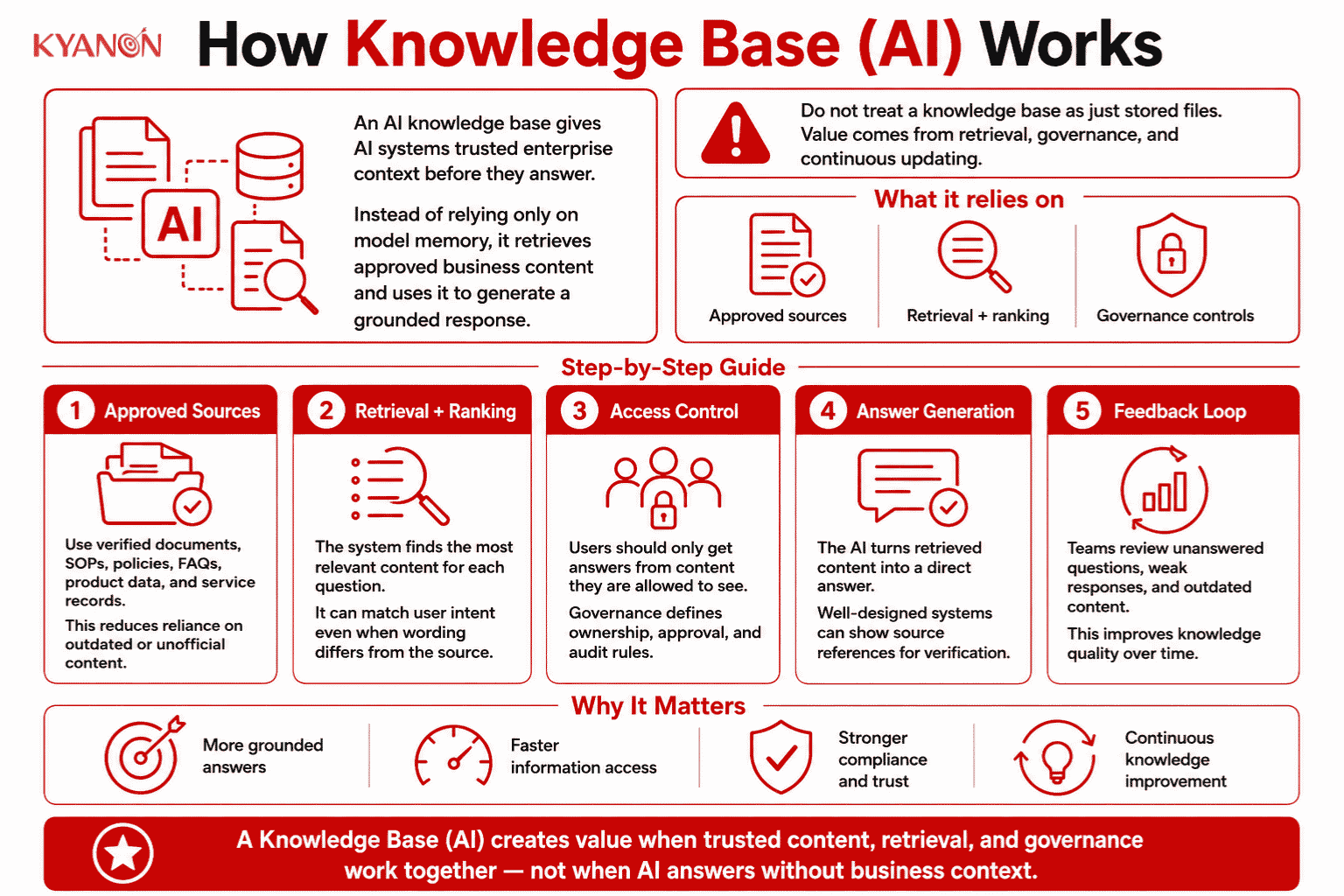
A knowledge base (AI) works by giving AI systems trusted enterprise context before they generate an answer. Instead of relying only on pre-trained model knowledge, the system retrieves relevant information from approved sources and uses it to produce a more grounded response.
This is effective because enterprise knowledge is indexed, ranked, permission-controlled, and updated as business information changes. The AI can match user intent with the right source material, even when the question uses different wording from the original document.
Approved Knowledge Sources
Approved knowledge sources are the verified documents, policies, FAQs, SOPs, product data, and service records that the AI is allowed to use. This reduces the risk of answers based on outdated, duplicated, or unofficial content.
Retrieval and Ranking
Retrieval and ranking help the system find the most relevant information for each user question. This matters because business users often ask in natural language, not in the exact keywords used inside documents.
Access Control and Governance
Access control ensures users only receive answers from information they are allowed to see. Governance defines who owns, updates, approves, and audits the knowledge base over time.
Answer Generation
Answer generation turns retrieved source material into a direct response for the user. In well-designed systems, the answer can include source references so teams can verify where the information came from.
Feedback and Improvement
Feedback loops capture unanswered questions, incorrect responses, and outdated content. This helps teams improve knowledge quality and close documentation gaps over time.

Knowledge Base (AI) vs Traditional Knowledge Base
Both systems organize business knowledge, but a traditional knowledge base is built for human keyword search, while a Knowledge Base (AI) is built for conversational retrieval, summarized answers, and AI application grounding.
An AI knowledge base differs from a traditional knowledge base because it can retrieve information by intent, process structured and unstructured content, and generate direct answers from approved enterprise sources.
Dimension | Traditional Knowledge Base | Knowledge Base (AI) |
Search mechanism | Keyword matching and manual filters | Conversational intent understanding and semantic search |
| Content types | Mostly structured articles, FAQs, and help pages | Structured and unstructured content, including PDFs, chats, files, SOPs, and emails |
Output type | Links to general documents or articles | Direct, summarized answers with source context |
| Maintenance | Manual audits, tagging, and article updates | Automated tagging, gap detection, freshness checks, and human review |
Primary users | Customers, support agents, employees | Customers, employees, AI copilots, service bots, and AI agents |
| Best use case | Self-service documentation and help centers | Customer support automation, employee enablement, onboarding, and RAG grounding |
Main risk | Outdated or hard-to-find articles | Hallucinated, stale, or permission-inappropriate answers if governance is weak |
When to Consider Knowledge Base (AI)
Consider Knowledge Base (AI) if:
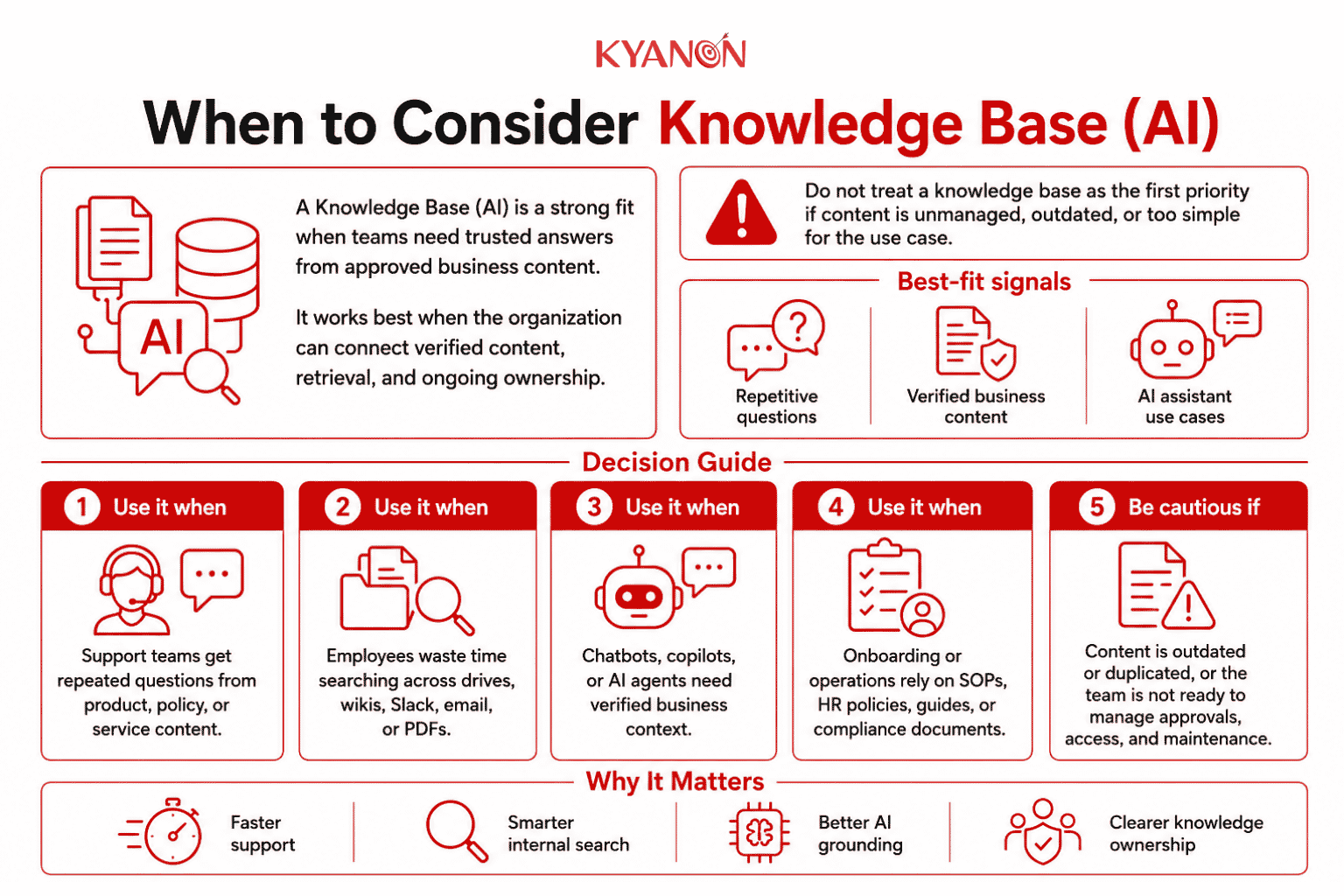
- Your customer support team receives repetitive questions that could be answered from approved product, policy, or service documents.
- Your employees spend too much time searching across shared drives, wikis, Slack, email, PDFs, or internal portals.
- Your company is deploying AI agents, internal copilots, or customer-facing chatbots that need verified business context.
- Your onboarding process depends on complex SOPs, HR policies, technical guides, or compliance documents.
- Your support, product, HR, or operations teams need visibility into knowledge gaps based on repeated user questions.
It may not be the right priority if:
- Your documents are outdated, duplicated, or not owned by a clear business team.
- Your use case only needs a simple FAQ page or static help center.
- Your organization is not ready to define approval, access control, and content maintenance responsibilities.
Common Use Cases of Knowledge Base (AI)
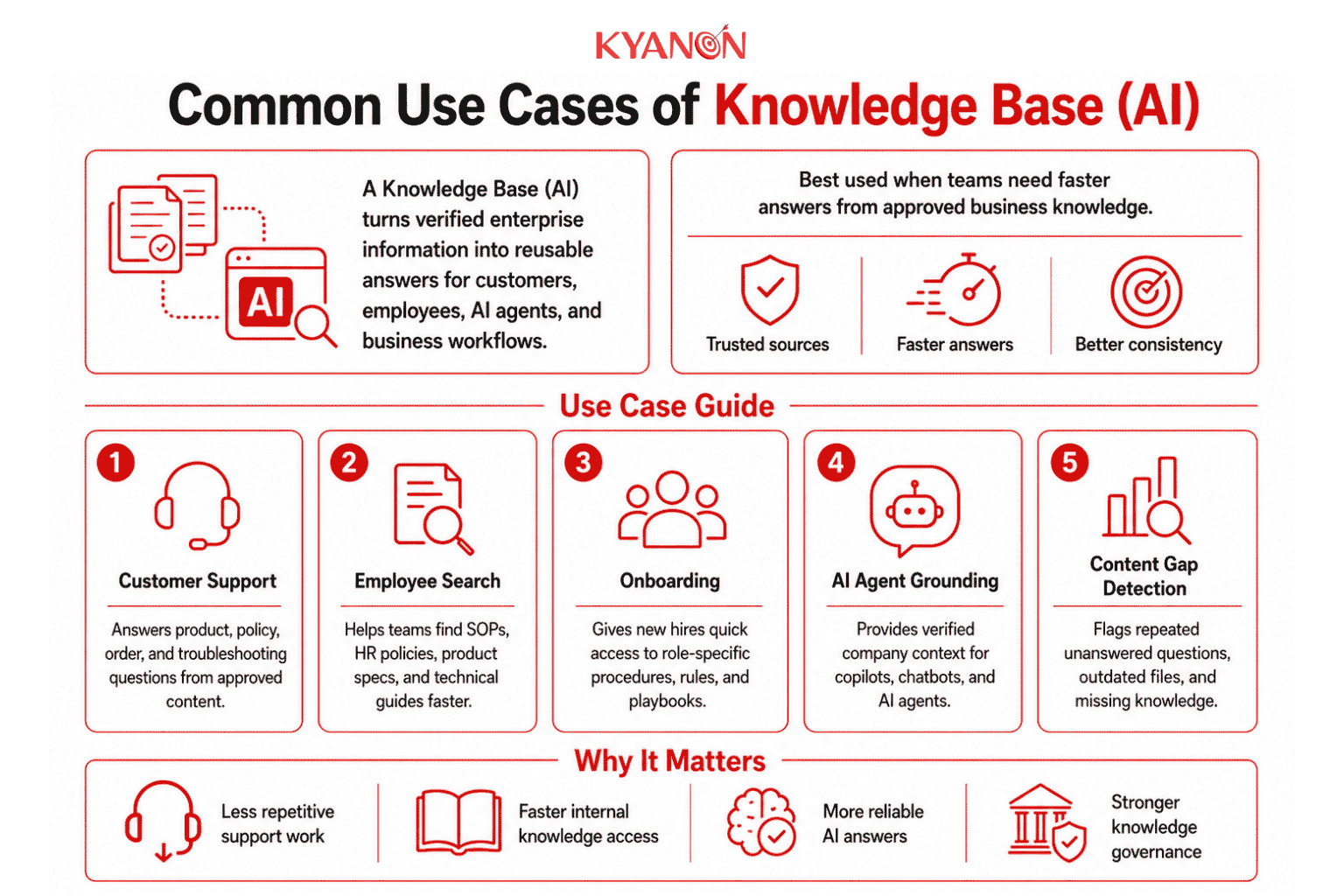
A knowledge base (AI) turns verified enterprise information into reusable answers for customers, employees, AI agents, and business workflows.
- Customer service AI knowledge base: Helps chatbots, voice agents, and support teams answer product, policy, order, and troubleshooting questions from approved content.
- Internal knowledge base for employees: Helps teams search SOPs, HR policies, product specs, technical guides, and process documents from one conversational interface.
- Employee onboarding and training: Gives new hires quick access to role-specific procedures, company policies, compliance rules, and operational playbooks.
- RAG knowledge base for AI agents: Provides verified company context for AI copilots, enterprise chatbots, and AI agents to reduce unsupported or hallucinated answers.
- Content management and knowledge gaps: Identifies repeated unanswered questions, outdated documents, duplicate content, and missing knowledge topics.
Examples of AI Knowledge Base Software
AI knowledge base software usually appears in customer service platforms, collaboration tools, enterprise search systems, and knowledge management platforms.
Enterprise AI knowledge base software should be selected based on use case, content complexity, integration needs, governance requirements, and whether the business needs an off-the-shelf tool or a custom AI knowledge layer.
| Platform Type | Example | Common Enterprise Use |
| Customer service platform | Zendesk AI Knowledge Base | Customer support automation and help center answers |
Collaboration platform | Slack enterprise search | Surfacing internal knowledge inside team communication workflows |
| Knowledge management platform | Guru | Verified employee knowledge and browser-based workflow support |
Enterprise AI stack | RAG + vector database + LLM | Custom copilots, AI agents, and document intelligence systems |
Software choice should depend on the use case, content complexity, governance needs, integration requirements, and whether the organization needs an off-the-shelf tool or a custom enterprise AI knowledge base.
Why Knowledge Base (AI) Matters for Enterprise AI
Knowledge Base (AI) matters because enterprise AI systems need a trusted business context before they can produce useful answers. Without a governed knowledge base, copilots and chatbots may answer from outdated policies, incomplete documents, conflicting sources, or unsupported model assumptions.
For customer service, internal operations, and e-commerce teams, an AI knowledge base can reduce repeated manual lookup, improve answer consistency, and make enterprise knowledge reusable across channels.
McKinsey (2025) notes that AI-driven voice and chat assistants can already resolve simple transactional customer issues by using internal and external knowledge sources.
For enterprises, this makes Knowledge Base (AI) a practical foundation for customer service bots, internal copilots, and document intelligence systems that need trusted business context before generating answers.
Common Misconceptions
“The AI knowledge base understands our business like a human expert.”
Reality: An AI knowledge base does not think, reason, or verify truth like a human expert. It retrieves patterns and source passages, and then an AI model generates a likely answer based on that context.
For enterprise leaders, the practical implication is clear: answer quality depends on source quality, retrieval design, approval workflows, and human review for high-risk outputs.
“We can upload all company documents, and the AI will organize everything.”
Reality: A document dump is not a knowledge base. Messy files, duplicated policies, outdated PDFs, inconsistent naming, and conflicting rules will produce unreliable AI answers.
The right approach is to curate, classify, de-duplicate, approve, and maintain the knowledge layer before exposing it to employees or customers.
“The knowledge base will automatically stay updated.”
Reality: Most AI systems do not automatically learn new company policies, product changes, pricing updates, or process changes unless those sources are refreshed and re-indexed. A Knowledge Base (AI) needs ownership, content lifecycle management, and update workflows.
For business-critical use cases, stale knowledge can create operational risk, customer misinformation, compliance exposure, and poor user trust.
“AI answers are objective because they come from a machine.”
Reality: AI answers can reflect bias, gaps, outdated assumptions, or uneven coverage in the underlying knowledge sources. Governance should include content audits, source traceability, role-based access control, and escalation paths for uncertain answers.
A knowledge base (AI) should be evaluated by accuracy, source grounding, business usefulness, and risk controls, not by how confident the answer sounds.
“An AI knowledge base is just a smarter FAQ.”
Reality: A FAQ answers predefined questions, while an AI knowledge base retrieves, ranks, and summarizes information from many enterprise sources. For CTOs and IT leaders, the difference is that an AI knowledge base can support broader workflows such as service automation, internal search, onboarding, and AI agent grounding.
“AI will maintain the knowledge base automatically.”
Reality: AI can suggest tags, detect gaps, and flag stale content, but humans still need to approve source quality, resolve conflicting information, and define ownership. Without governance, the system may scale outdated or incorrect knowledge faster.
How Kyanon Digital Applies Knowledge Base (AI)
Kyanon Digital builds enterprise AI knowledge bases for internal copilots, customer service bots, document intelligence systems, and AI agent workflows. The work typically includes source assessment, content cleanup, document structuring, metadata design, RAG architecture, vector database setup, access control, answer evaluation, and feedback loops.
For enterprise clients, Kyanon Digital focuses on implementation readiness: connecting approved knowledge sources to real workflows, measuring answer quality, and maintaining the system after launch.
This approach supports clients across Vietnam, Singapore, Malaysia, Thailand, ANZ, the US, and Europe, where enterprise knowledge is often spread across departments, languages, systems, and document formats.
→ Explore our Gen AI development services for enterprise knowledge bases.

 Create project brief with AI