
What is headless commerce?
Headless commerce is an e-commerce architecture that decouples the backend commerce engine from the frontend presentation layer, replacing a rigid, all-in-one system with flexible APIs to deliver content and transactional functionality to any digital touchpoint. This architectural separation allows engineering teams to deploy unique customer interfaces independently without altering underlying backend business logic, payment workflows, or core database structures.
How headless commerce works
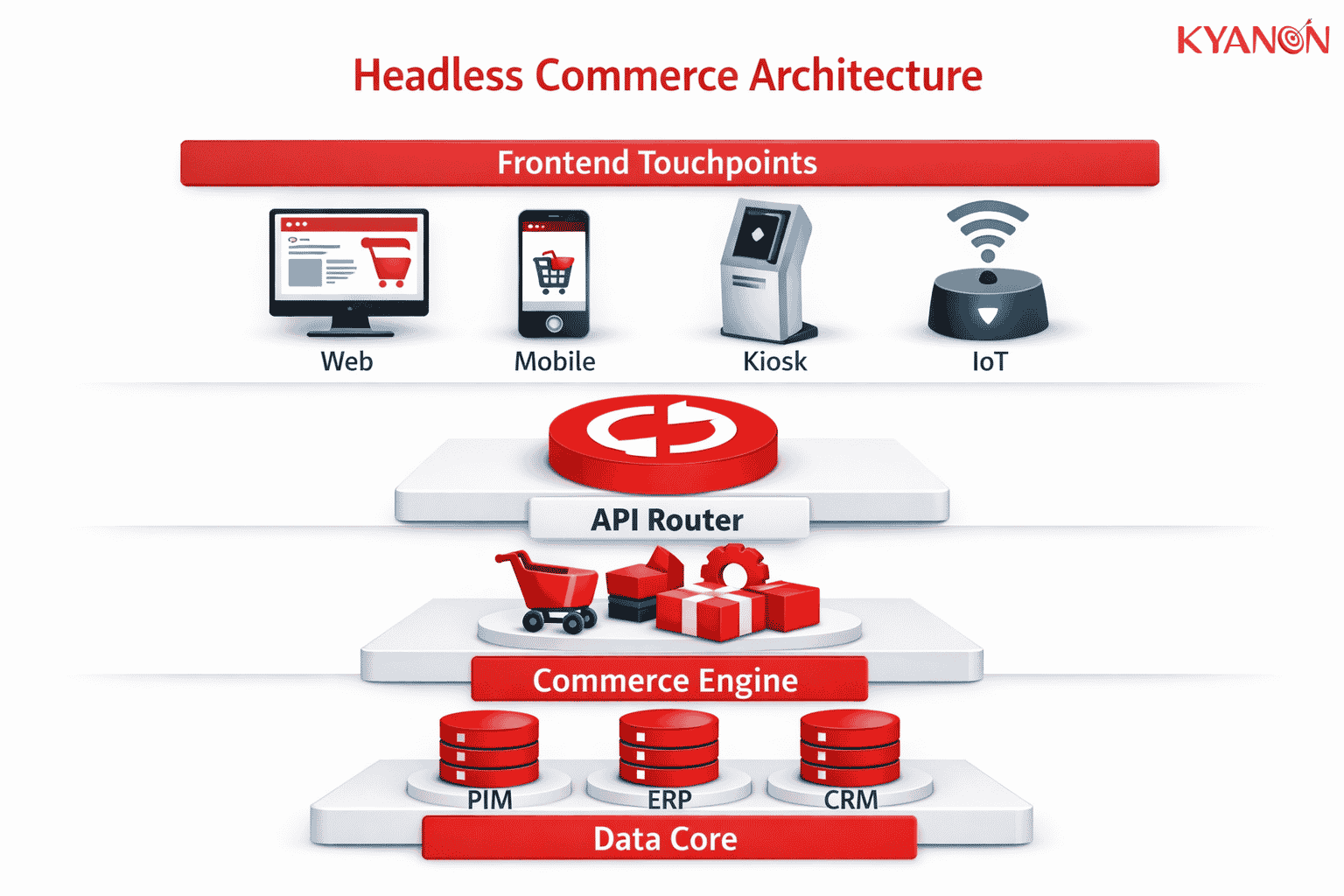
Headless commerce functions by replacing direct, hard-coded database connections with an API (Application Programming Interface) abstraction layer that routes unified backend data to an unlimited array of unique frontend interfaces. In a traditional setup, rendering a product page requires the frontend template to query the backend database directly within a single, unified codebase. By decoupling these layers, the backend operates strictly as a centralized transaction and logic engine, while frontends consume REST or GraphQL APIs to render web stores, mobile apps, IoT devices, or social commerce flows. This architectural model prevents high-frequency frontend interface updates or traffic spikes from compromising core backend transactional stability.
The presentation layer (touchpoints)
The presentation layer encompasses every independent user interface where customers interact with a brand, including progressive web apps (PWAs), native mobile applications, in-store digital kiosks, and social commerce checkout flows. Because this layer operates independently from the database, engineering teams utilize modern frontend JavaScript frameworks like React, Next.js, or Vue.js to optimize page loading speeds and user experience design without backend developer intervention.
The API bridge (REST / GraphQL)
The API bridge serves as the high-performing data routing gateway between client-facing touchpoints and centralized backend systems. It translates requests from user interfaces, such as fetching localized pricing rules or checking real-time stock counts, into lightweight JSON data structures transferred over RESTful or GraphQL endpoints. This standardized communication allows independent development teams to build and scale frontends across different programming languages while referencing a unified set of business rules.
The backend commerce engine
The backend commerce engine manages core transactional mechanics, executing checkout processing, pricing logic, payment gateway integrations, and order fulfillment workflows. Operating entirely without pre-rendered visual templates, this centralized component processes commercial transactions across all connected sales channels simultaneously. It functions as the transactional core that prevents logic duplication when businesses expand into emerging digital touchpoints.
The data core (PIM, ERP, & CRM systems of record)
The data core represents the synchronized systems of record that store critical enterprise data, integrating Product Information Management (PIM), Enterprise Resource Planning (ERP), and Customer Relationship Management (CRM) databases. Headless architecture funnels these distinct data pools through the central commerce engine, establishing a single source of truth for inventory, customer profiles, and product catalogs across every channel. This synchronization prevents operational errors such as overselling inventory on an Instagram flow while a physical retail store holds zero stock.
Headless commerce vs. traditional commerce
Both architectures process online transactions, but differ fundamentally in system dependency, infrastructure scaling mechanics, and omnichannel adaptability.
| Dimension | Traditional commerce |
Headless commerce |
|
Architecture |
Coupled (Frontend and backend tied in a single codebase) | Decoupled (Independent layers connected via APIs) |
| Infrastructure scaling | The entire monolithic server scales during traffic spikes |
Frontend server nodes scale independently from backend databases |
|
Omnichannel expansion |
Requires duplicating code and logic for new touchpoints | Connects new touchpoints directly to existing backend APIs |
| Tech stack flexibility | Vendor lock-in: restricted to platform-specific plugins |
Best-of-breed allows swapping payment or shipping modules freely |
|
Upfront cost & complexity |
Low initial cost; standardized, template-based setup |
Higher initial engineering investment; requires custom API integration |
When to consider headless commerce
Consider headless commerce if your organization needs to deploy independent user experiences across multiple digital touchpoints while maintaining a synchronized, centralized inventory and order management backend.
Consider headless commerce if:
- You experience severe infrastructure scaling costs during traffic surges: When seasonal events like Black Friday overload your customer storefront, decoupled architecture allows IT infrastructure teams to allocate cloud server resources exclusively to frontend nodes without paying to scale complex backend database clusters.
- You are expanding into non-traditional digital touchpoints: Your business roadmap requires launching in-store digital kiosks, smartwatch purchasing, or social media “Shop Now” integrations, and building a standalone backend engine for each new channel is operationally unfeasible.
- Your engineering teams require best-of-breed Modularity: You need the architectural freedom to swap out specific third-party payment processors, search engines, or shipping calculation providers without modifying customer-facing interface code or risking full-system regression bugs.
It may not be the right priority if:
- Your operational model relies on standardized web storefronts and pre-built plugin ecosystems. If your business operates a single e-commerce website and depends on native marketplace add-ons for promotional rules and layout design, a traditional monolithic platform delivers faster implementation and lower maintenance costs.
Why headless commerce matters for enterprise e-commerce
For B2B enterprises and multi-brand retailers, platform architecture dictates operational agility, conversion performance, and long-term infrastructure expenditure. Traditional monolithic systems force engineering teams to share a single code repository across all channels, meaning a minor design update on a mobile web interface can inadvertently introduce bugs into core database routing. Decoupling the presentation layer eliminates these systemic constraints, allowing enterprises to scale frontend customer experiences independently while protecting core enterprise resource planning (ERP) data integrity.
According to the AWS eBook Navigating the New World of Digital Commerce in Retail, which cites Gartner research, organizations that adopt a composable architecture outpace competitors by 80% in the speed of new feature implementation across digital touchpoints. The report attributes this advantage to modular, API-first architectures that enable frontend experiences and backend commerce capabilities to evolve independently, reducing deployment bottlenecks and accelerating innovation.
Industry adoption data from the State of Composable Commerce 2023 report by Elastic Path and Retail Dive shows that 92% of surveyed retail executives have already implemented a composable commerce approach, while 96% report being extremely familiar with composable commerce, indicating that modular commerce architecture has become a mainstream strategy among mid-market and enterprise retailers.
Common misconceptions
“Headless means there is no frontend.”
Reality: You still require a frontend presentation layer for customers to interact with your catalog and execute purchases. Headless simply means the visual interface and the backend database operate as independent systems, allowing engineering teams to attach multiple specialized frontends (web, mobile, IoT kiosks) to a single transactional backend.
“Marketers lose control over content management.”
Reality: While early headless configurations required developer intervention for basic layout edits, modern decoupled architectures integrate directly with headless Content Management Systems (CMS) such as Contentful or Sanity. This integration provides marketing teams with visual drag-and-drop interfaces to publish content and promotional campaigns instantly without touching application code.
“It is only for massive enterprise companies.”
Reality: While enterprise brands pioneered decoupled software patterns to solve complex scaling bottlenecks, modern modular commerce platforms like Shopify Plus and BigCommerce now provide native API-first infrastructure that makes headless deployments technically and financially accessible for mid-market organizations.
“Headless always improves website performance automatically.”
Reality: Decoupling reduces backend server processing load, but page rendering speed depends entirely on how effectively engineering teams architect the frontend codebase. An unoptimized React or Vue.js presentation layer loaded with heavy scripts will still result in high latency and poor Core Web Vitals scores.
“It dramatically reduces overall development costs.”
Reality: Headless architecture typically increases initial build expenditures and ongoing maintenance complexity because your engineering team must manage multiple specialized applications and an API routing layer instead of a single monolith. The financial return on investment is generated through higher conversion rates from faster page loads, independent cloud resource scaling during traffic peaks, and rapid multi-channel expansion.
How Kyanon Digital applies headless commerce
Kyanon Digital implements headless commerce architectures using API-first engines and modern frontend frameworks for enterprise retail and B2B clients across Vietnam, Singapore, Malaysia, Thailand, Australia, New Zealand, the US, and Nordic Europe. Our engineering teams decouple legacy monolithic platforms by introducing Back-End for Front-End (BFF) aggregation layers and React/Next.js presentation layers connected to centralized PIM and ERP data cores. This implementation methodology focuses on measurable commercial and operational outcomes: accelerating mobile and web page load speeds, eliminating vendor lock-in through best-of-breed module integration, and reducing infrastructure scaling costs during high-traffic commercial events.
→ Explore our E-commerce service











 Create project brief with AI