
What is composable commerce?
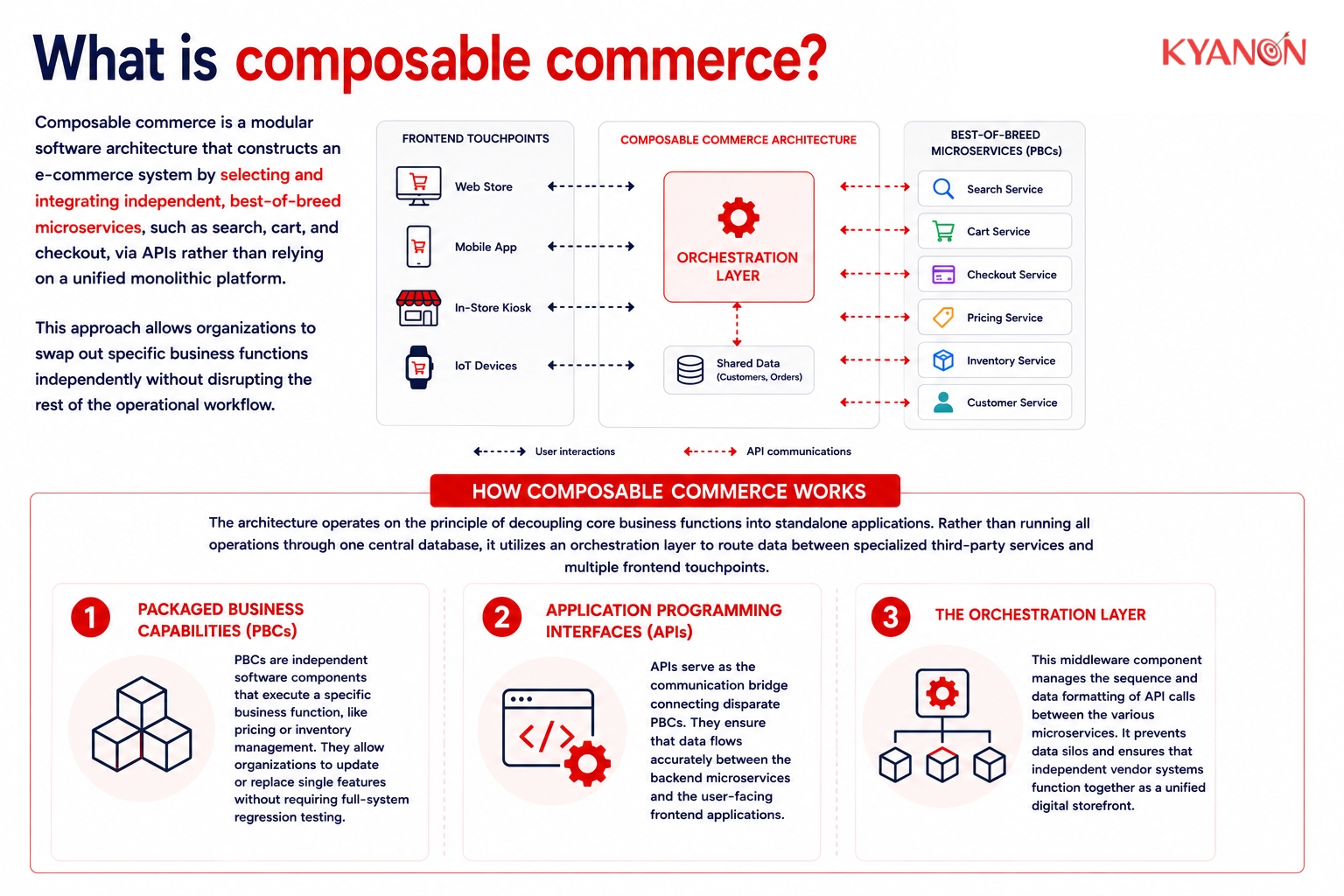
Composable commerce is a modular software architecture that constructs an e-commerce system by selecting and integrating independent, best-of-breed microservices, such as search, cart, and checkout, via APIs rather than relying on a unified monolithic platform. This approach allows organizations to swap out specific business functions independently without disrupting the rest of the operational workflow.
How composable commerce works
The architecture operates on the principle of decoupling core business functions into standalone applications. Rather than running all operations through one central database, it utilizes an orchestration layer to route data between specialized third-party services and multiple frontend touchpoints.
Packaged Business Capabilities (PBCs)
PBCs are independent software components that execute a specific business function, like pricing or inventory management. They allow organizations to update or replace single features without requiring full-system regression testing.
Application Programming Interfaces (APIs)
APIs serve as the communication bridge connecting disparate PBCs. They ensure that data flows accurately between the backend microservices and the user-facing frontend applications.
The orchestration layer
This middleware component manages the sequence and data formatting of API calls between the various microservices. It prevents data silos and ensures that independent vendor systems function together as a unified digital storefront.

Composable Commerce vs Monolithic Commerce
Both approaches facilitate online transactions, but differ fundamentally in system flexibility and upgrade cycles.
Dimension | Composable Commerce | Monolithic Commerce |
| Deployment speed | Fast (Independent component updates) | Slow (Requires system-wide testing) |
Vendor lock-in | Low (Swappable microservices) | High (Tied to one vendor’s ecosystem) |
| Upfront complexity | High (Requires API orchestration) | Low (All-in-one out-of-the-box) |
Best for | Scaling enterprises with multi-brand or omnichannel needs | Early-stage MVP or single-channel retailers |
| Cost model | OpEx (Pay for specific services used) | CapEx / Flat licensing fees |
When to consider composable commerce
Consider composable commerce if:
- Your current platform’s upgrade cycle forces your business offline or requires extensive code freezes that delay product launches.
- You are expanding into multiple geographic regions and require localized payment and shipping vendors that your existing platform cannot support natively.
- Your site performance and time-to-market for new features are severely bottlenecked by legacy backend constraints.
It may not be the right priority if:
- Your gross merchandise value (GMV) is low, your operations fit neatly into standard platform templates, and you lack an in-house engineering team to manage API vendor relationships.
Why composable commerce matters for enterprise retail
For enterprise retailers, composable commerce is a strategic imperative rather than just a technical upgrade. Monolithic e-commerce systems often buckle under the weight of multi-brand portfolios, international expansion, and complex legacy databases, resulting in massive operational bottlenecks. By transitioning to a composable framework, enterprise organizations can decouple risk, unlock localized scalability, and future-proof their business model.
Best-of-breed functionality
Traditional platforms usually do one thing great (like checkout) but do other things poorly (like site search or blog content management). Composable commerce allows you to use the absolute best checkout provider, the fastest search engine, and the most flexible content management system simultaneously.
Ultimate design freedom
Because the frontend layout is completely disconnected from the backend logic, your design and marketing teams can build highly unique, lightning-fast user experiences on the web, mobile apps, or smart screens without any platform restrictions.
No vendor lock-in
If your business outgrows your payment gateway or your product recommendations engine, you do not have to migrate your entire website to a new e-commerce platform. You simply disconnect the old API and plug in a new vendor.
Faster page speeds
By pulling data dynamically via optimized APIs and modern frontend frameworks, web pages load much faster than traditional, heavy e-commerce platforms, directly leading to better conversion rates.
Common misconceptions
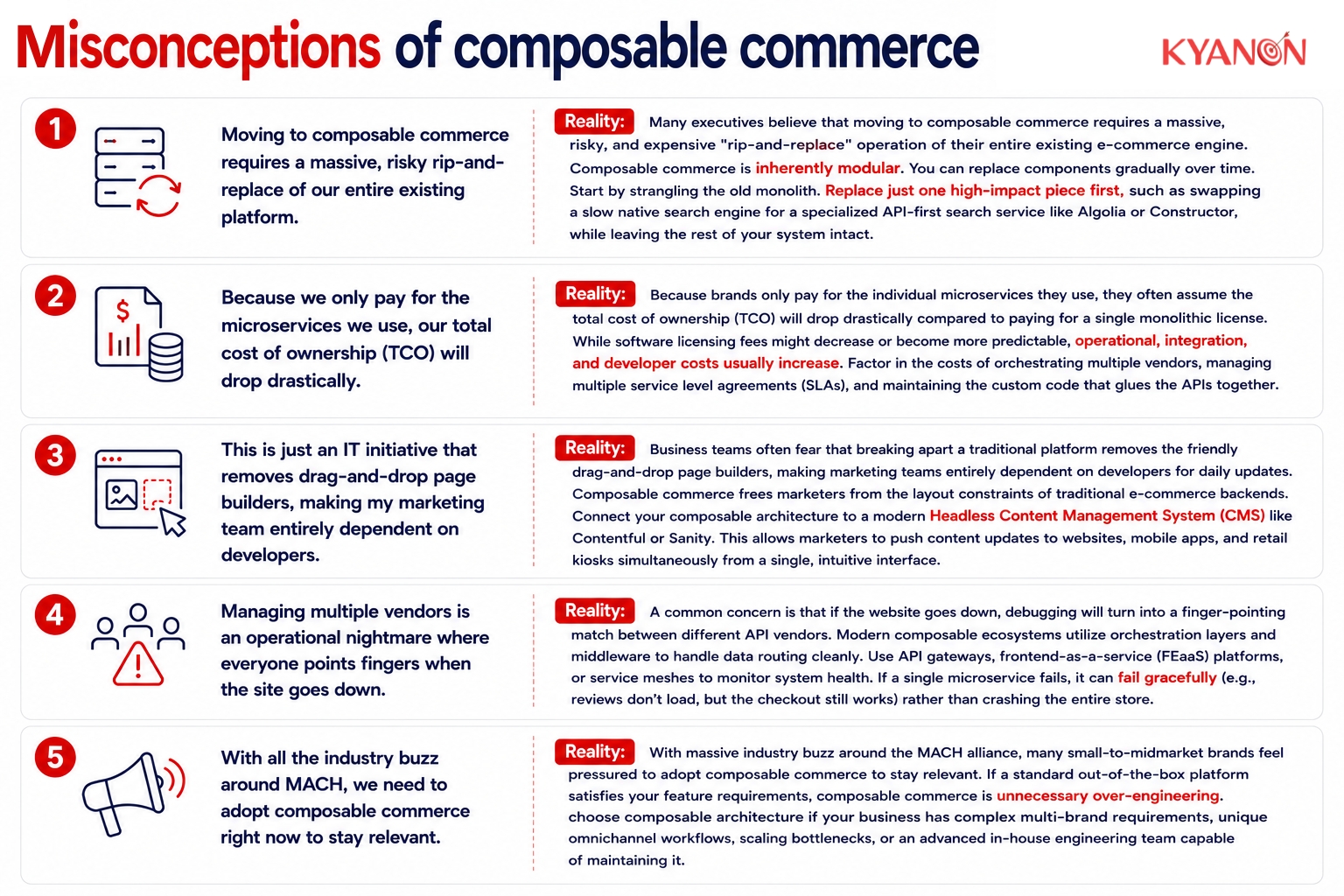
Moving to composable commerce requires a massive, risky rip-and-replace of our entire existing platform.
Reality: Many executives believe that moving to composable commerce requires a massive, risky, and expensive “rip-and-replace” operation of their entire existing e-commerce engine. Composable commerce is inherently modular. You can replace components gradually over time. Start by strangling the old monolith. Replace just one high-impact piece first, such as swapping a slow native search engine for a specialized API-first search service like Algolia or Constructor, while leaving the rest of your system intact.
Because we only pay for the microservices we use, our total cost of ownership (TCO) will drop drastically.
Reality: Because brands only pay for the individual microservices they use, they often assume the total cost of ownership (TCO) will drop drastically compared to paying for a single monolithic license. While software licensing fees might decrease or become more predictable, operational, integration, and developer costs usually increase. Factor in the costs of orchestrating multiple vendors, managing multiple service level agreements (SLAs), and maintaining the custom code that glues the APIs together.
This is just an IT initiative that removes drag-and-drop page builders, making my marketing team entirely dependent on developers.
Reality: Business teams often fear that breaking apart a traditional platform removes the friendly drag-and-drop page builders, making marketing teams entirely dependent on developers for daily updates. Composable commerce frees marketers from the layout constraints of traditional e-commerce backends. Connect your composable architecture to a modern Headless Content Management System (CMS) like Contentful or Sanity. This allows marketers to push content updates to websites, mobile apps, and retail kiosks simultaneously from a single, intuitive interface.
Managing multiple vendors is an operational nightmare where everyone points fingers when the site goes down.
Reality: A common concern is that if the website goes down, debugging will turn into a finger-pointing match between different API vendors. Modern composable ecosystems utilize orchestration layers and middleware to handle data routing cleanly. Use API gateways, frontend-as-a-service (FEaaS) platforms, or service meshes to monitor system health. If a single microservice fails, it can fail gracefully (e.g., reviews don’t load, but the checkout still works) rather than crashing the entire store.
With all the industry buzz around MACH, we need to adopt composable commerce right now to stay relevant.
Reality: With massive industry buzz around the MACH alliance, many small-to-midmarket brands feel pressured to adopt composable commerce to stay relevant. If a standard out-of-the-box platform satisfies your feature requirements, composable commerce is unnecessary over-engineering. Only choose composable architecture if your business has complex multi-brand requirements, unique omnichannel workflows, scaling bottlenecks, or an advanced in-house engineering team capable of maintaining it.
How Kyanon Digital applies composable commerce
Kyanon Digital implements composable commerce using MACH-aligned frameworks for enterprise clients across Vietnam, Singapore, Malaysia, Thailand, ANZ, the US, and Nordic Europe. Our approach relies on deep implementation expertise to dismantle monolithic architectures systematically, focusing strictly on measurable outcomes such as accelerating time-to-market, increasing conversion, and optimizing TCO without unnecessary operational disruption.
Explore our services:

 Create project brief with AI