
What is Native App commerce?
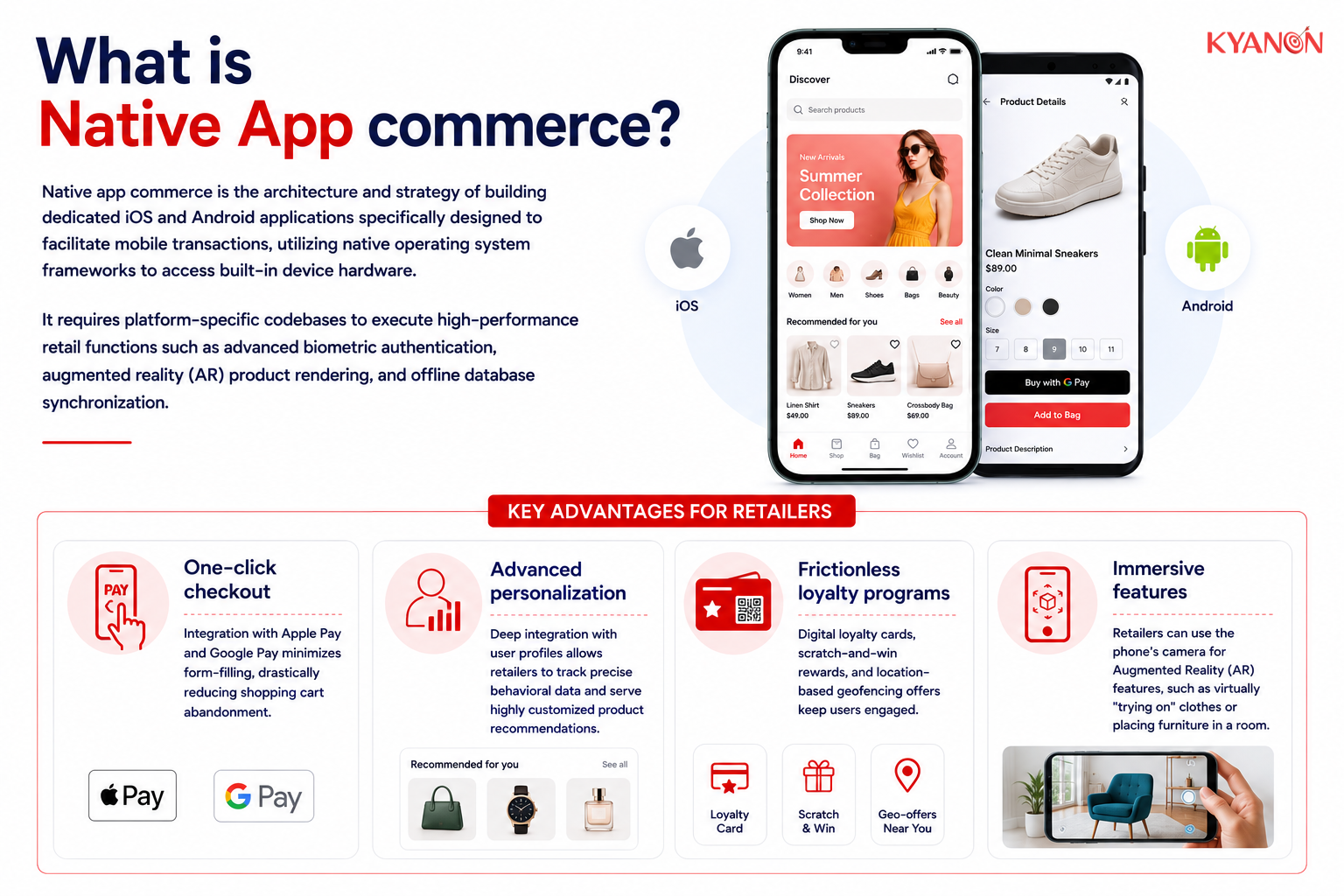
Native app commerce is the architecture and strategy of building dedicated iOS and Android applications specifically designed to facilitate mobile transactions, utilizing native operating system frameworks to access built-in device hardware. It requires platform-specific codebases to execute high-performance retail functions such as advanced biometric authentication, augmented reality (AR) product rendering, and offline database synchronization.
Key advantages for retailers
- One-click checkout: Integration with Apple Pay and Google Pay minimizes form-filling, drastically reducing shopping cart abandonment.
- Advanced personalization: Deep integration with user profiles allows retailers to track precise behavioral data and serve highly customized product recommendations.
- Frictionless loyalty programs: Digital loyalty cards, scratch-and-win rewards, and location-based geofencing offers keep users engaged.
- Immersive features: Retailers can use the phone’s camera for Augmented Reality (AR) features, such as virtually “trying on” clothes or placing furniture in a room.
How Native App commerce works
Operating at the OS level, native mobile commerce applications bypass standard web browser engines to communicate directly with mobile hardware interfaces. This direct integration processes complex local data streams and rendering tasks on the device itself, strictly minimizing server-side latency for computationally intensive retail features.
OS-level SDK integration
Codebases constructed in Swift (iOS) or Kotlin (Android) connect directly with native Software Development Kits (SDKs). This architecture grants unrestricted access to device features like NFC, GPS, and Bluetooth Low Energy (BLE) for precise location-based marketing and contactless interactions in physical store environments.
Localized data storage
Native commerce structures utilize local device storage systems, such as SQLite or Core Data, to maintain state. This mechanism caches complex product catalogs and user preferences locally, ensuring uninterrupted browsing and cart management capabilities even during intermittent network disconnection.
Hardware-accelerated rendering
By utilizing the dedicated graphics processing unit (GPU) of the mobile device, native applications render complex user interfaces and 3D product models. This hardware acceleration prevents the frame-rate drops frequently experienced in heavily scripted browser-based commerce environments during virtual try-on sessions.
Native App Commerce vs Progressive Web Apps (PWA)
Both approaches facilitate mobile transactions, but they differ fundamentally in device integration depth, upfront development complexity, and long-term maintenance costs.
|
Dimension |
Native App Commerce | Progressive Web Apps (PWA) |
| Deployment speed | Slow (Requires App/Play Store approvals) |
Fast (Instant web deployment) |
|
Device hardware access |
Full (NFC, ARKit, advanced BLE) | Limited (Varies by OS and browser engine) |
| Upfront complexity | High (Separate iOS and Android codebases) |
Low (Single web-based codebase) |
|
Best for |
High-frequency loyalty customers | Broad top-of-funnel acquisition |
| Cost model | High CapEx (Dual platform development) |
Moderate CapEx (Unified web architecture) |
When to consider Native App Commerce
Evaluating native app commerce requires assessing your reliance on local device hardware versus the need for rapid web-based customer acquisition.
Consider Native App Commerce if:
- Your retail operation relies strictly on in-store hardware interactions, such as scanning secure QR codes, tracking Bluetooth beacons, or executing NFC-based self-checkout sequences.
- Your customer base exhibits high purchase frequency, demanding persistent biometric login states and complex loyalty platform integrations that exceed standard browser session limits.
- Your product catalog requires advanced augmented reality (AR) or 3D rendering functionality that demands unrestricted access to the mobile device’s GPU framework.
It may not be the right priority if:
- Your primary business objective is rapid new customer acquisition across diverse markets, as acquiring new app downloads requires significantly higher marketing spend than capturing direct search engine web traffic.
Why Native App Commerce matters for Retail & F&B
Native App Commerce helps retailers and restaurant brands turn mobile engagement into measurable business growth. Forrester’s 2025 Digital Experience Review found that 37% of U.S. online adults regularly purchase through retailer mobile apps, highlighting apps as a critical revenue channel for repeat customers.
Meanwhile, McKinsey notes that younger consumers increasingly expect frictionless omnichannel journeys, personalized experiences, and seamless digital-to-store interactions, making native apps essential for driving loyalty and lifetime value.
Common misconceptions
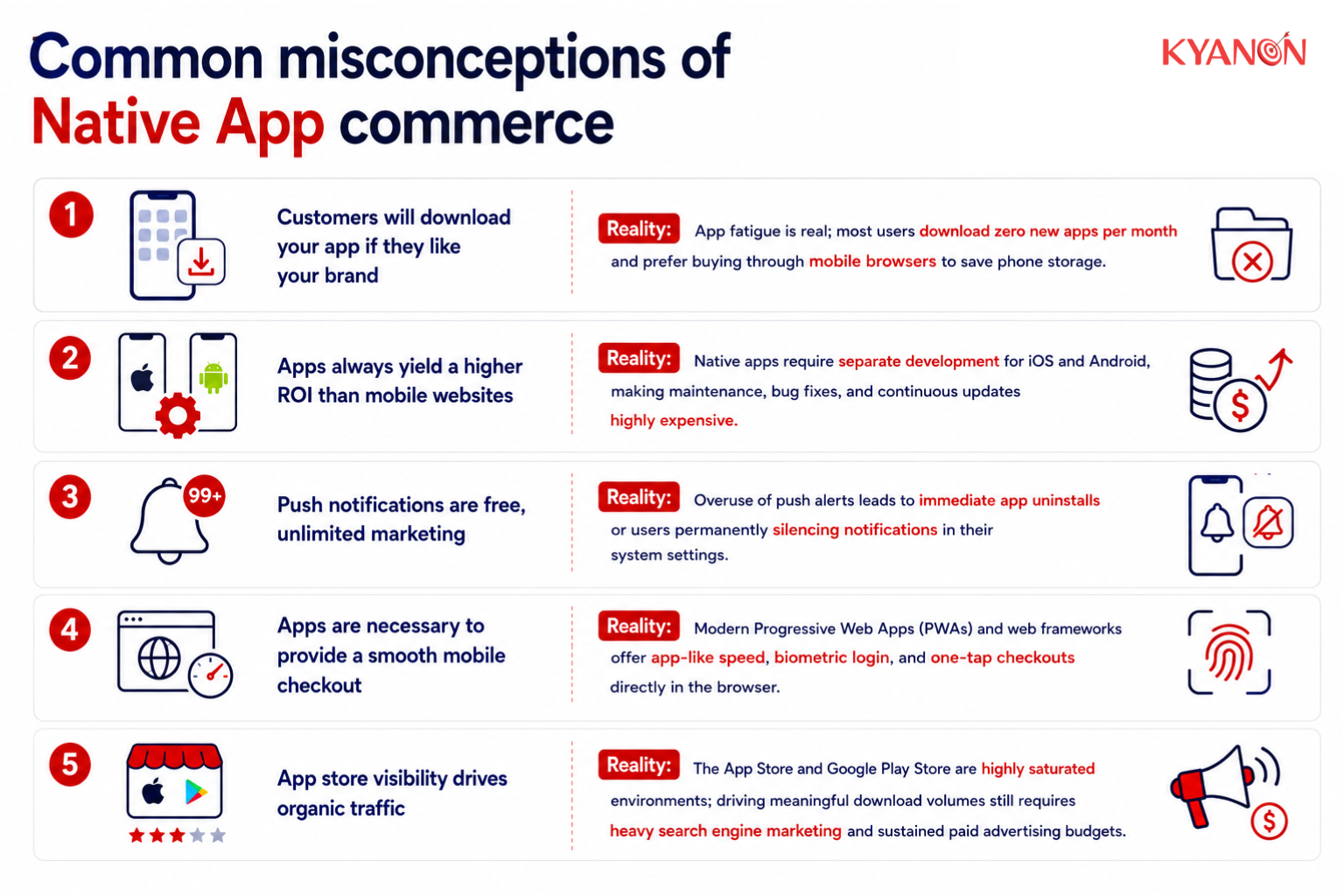
Customers will download your app if they like your brand
Reality: App fatigue is real; most users download zero new apps per month and prefer buying through mobile browsers to save phone storage.
Apps always yield a higher ROI than mobile websites
Reality: Native apps require separate development for iOS and Android, making maintenance, bug fixes, and continuous updates highly expensive.
Push notifications are free, unlimited marketing
Reality: Overuse of push alerts leads to immediate app uninstalls or users permanently silencing notifications in their system settings.
Apps are necessary to provide a smooth mobile checkout
Reality: Modern Progressive Web Apps (PWAs) and web frameworks offer app-like speed, biometric login, and one-tap checkouts directly in the browser.
App store visibility drives organic traffic
Reality: The App Store and Google Play Store are highly saturated environments; driving meaningful download volumes still requires heavy search engine marketing and sustained paid advertising budgets.
How Kyanon Digital applies Native App Commerce
Kyanon Digital develops native mobile commerce applications utilizing Swift and Kotlin for retail and F&B clients requiring deep device integration beyond PWA capability. Our architecture connects directly with existing composable backend frameworks and notification engines, ensuring high-frequency shoppers across Southeast Asia, ANZ, and the US experience reliable offline catalogs and precise location-based loyalty services.
Explore our services:











 Create project brief with AI